Miao! We are so pleased and honored to welcome award winning Vermont author, illustrator and teacher Ashley Wolff to Alphabet Soup today.
We’re big fans of her adorable Baby Bear books, classics such as Compost Stew: An A to Z Recipe for Earth (Mary McKenna Siddals), Baby Beluga (Raffi), and of course, the wildly popular Miss Bindergarten series, written by Joseph Slate.
In all, she’s published close to 70 titles (as either author/illustrator or illustrator), showcasing her lifelong love of nature and animals, and her mastery of a variety of styles and mediums, including acrylic gouache, linoleum block print + watercolor, and collage.
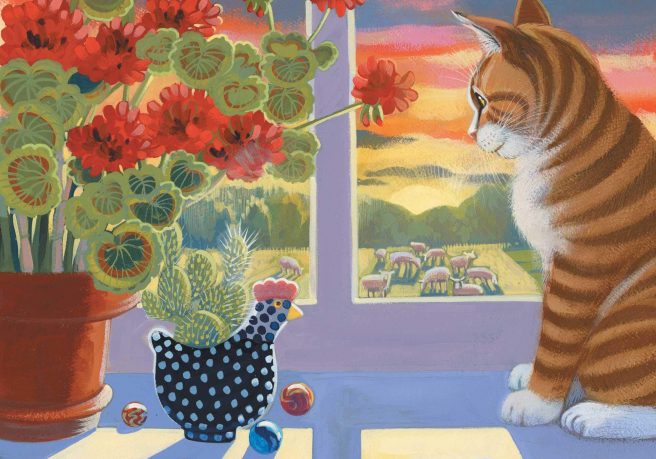
Her most recent self-illustrated picture book, Only the Cat Saw (Beach Lane Books, 2020), is a refreshed edition of a perennial favorite (first published by Dodd, Mead back in 1985) with all new art for a new generation. In this gentle, calming story, a multiracial family of four go about their daily routine from sunset to sunrise, while their marmalade tabby observes the wonders and beauty of the natural world.
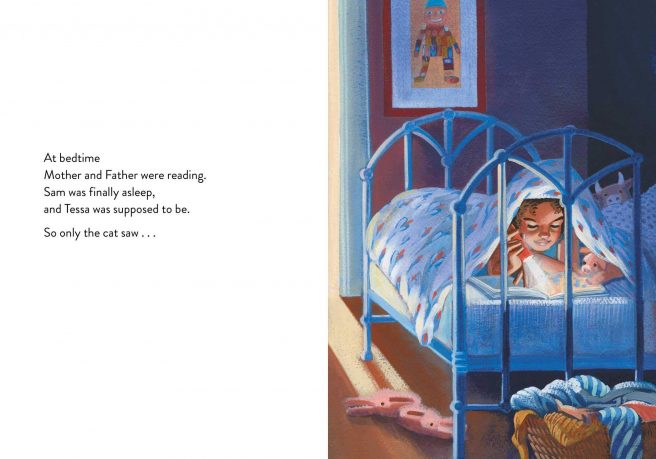
As they’re busy with supper, only the cat notices the colorful sunset outside the window. During bath time, the cat has wandered out by the barn to play with fireflies, and while the older child, Tessa, reads with her flashlight under the covers, the cat witnesses the drama of an owl hunting a mouse. Oh, the wonderful things people miss when they’re preoccupied!
Spare text + single page spreads tracking the family’s indoor activities alternate with double page wordless spreads showing what the cat is up to. With each block of text, the repetitive tag line, “So only the cat saw . . . ” signals a suspenseful page turn that rewards the reader with beautiful scenes rendered in rich colors and lush textures, immersing him/her in the cat’s world of tall grasses, sleepy farm animals, lightning and rain, even a shooting star.
I love what Ashley has done with scale, perspective, and composition to play up the cat’s point of view, and her lighting effects, from gorgeous sunset and sunrise, to lamplight, flashlight, fireflies, moon and stars underscore the simple joys of life indoors and out. Such a lovely reminder to take time to appreciate what we too often take for granted.
In addition to being cozy and heartwarming, this story is reassuringly relatable with its depiction of breast feeding, sitting on the potty, and having both parents share equally in household tasks. Kudos to Ashley for initially including these somewhat unusual details in the earlier book from 35 years ago, clear evidence of her feminist, forward thinking! 🙂
We thank Ashley for dropping by to tell us what it was like to re-illustrate one of her earliest picture books, and for sharing a favorite recipe and so many cool photos. Enjoy!
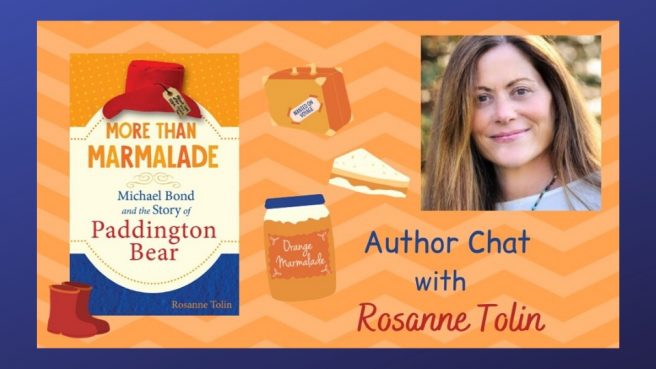
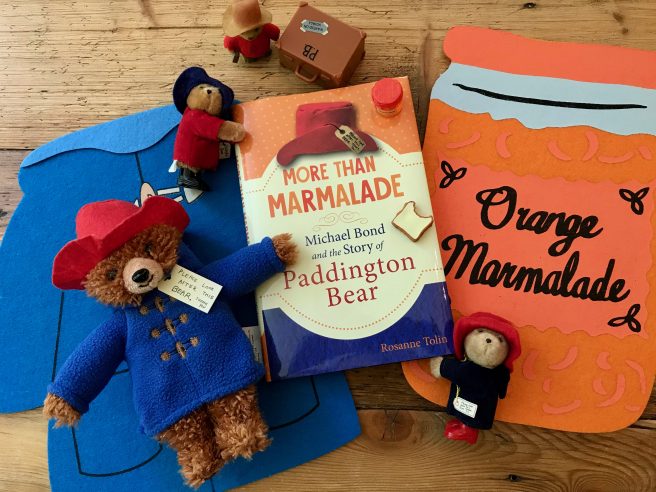
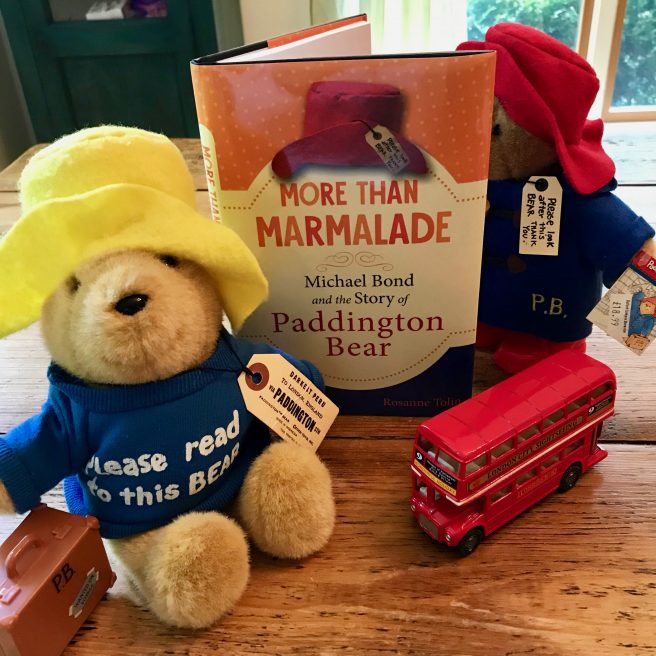
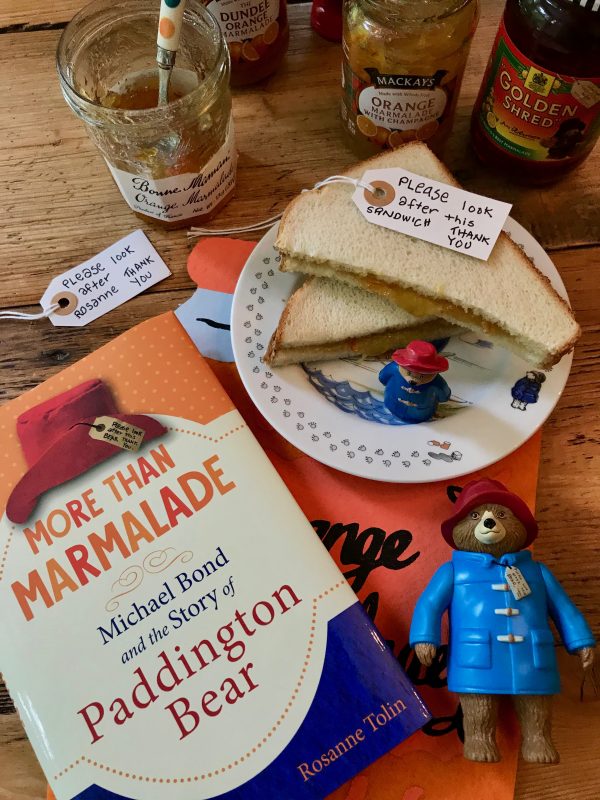
Today we’re more than excited and pawsitively delighted to welcome More Than Marmalade author Rosanne Tolinto Alphabet Soup!
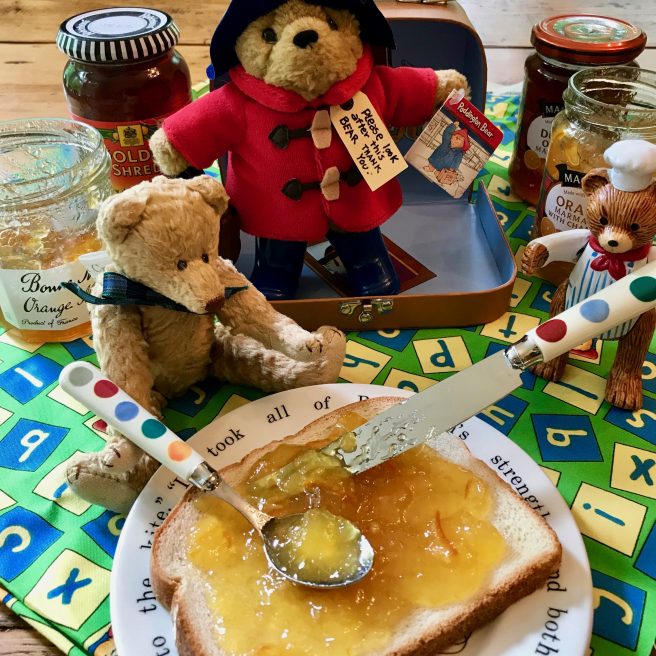
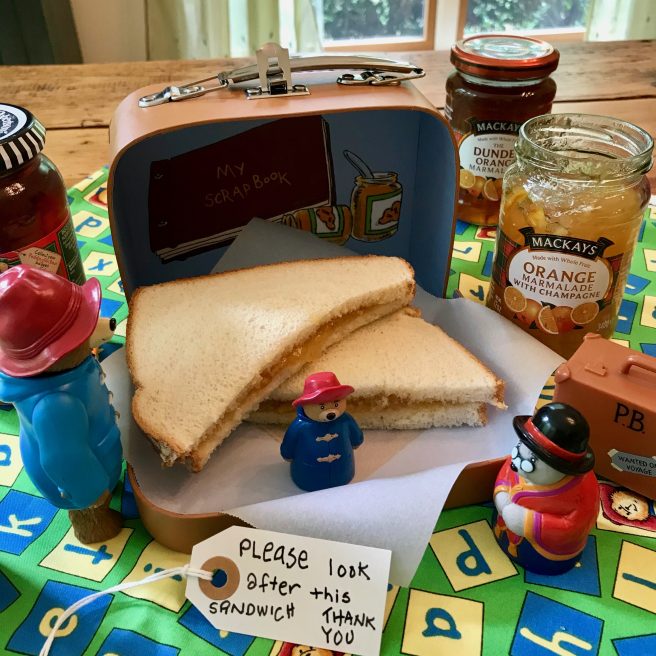
The 60-something resident Paddingtons are simply beside themselves. They’ve brushed their fur, cleaned their whiskers, and polished off at least 126 marmalade sandwiches in anticipation.
FINALLY, they keep saying — finally someone wrote a book about Michael Bond, their favorite person in the entire universe. Indeed, it is hard to believe that this is the first published biography of the iconic British author, whose first Paddington chapter book came out back in 1958.
Though More Than Marmalade: Michael Bond and the Story of Paddington Bear (Chicago Review Press, 2020),is geared for middle grade readers, it’s a beary interesting read for Paddington fans of all ages. A work of well researched creative nonfiction, the narrative is an engaging blend of facts and fictionalized scenes that highlight Bond’s life from his childhood in Reading, England, to his death at age 91 in 2017.
Bond always felt Paddington was “real,” and in this book we learn about the real historical events and personal experiences that inspired this inimitable bear character. We see how circumstance, a vivid imagination, and perseverance all came to bear at a time when Bond hadn’t actually planned to write a children’s book.
His love of trains, lifelong empathy for immigrants, script and story writing background, BBC cameraman experiences, and a fateful decision to rescue a lone bear from a department store shelf one Christmas Eve spawned a classic children’s book series that would evolve into several TV series and two feature length films, along with a slew of children’s merchandising. In 2018, the Great Western Railway named a new Intercity Express Train after Michael Bond and Paddington Bear.
Though he grew up in a nurturing, book-loving family, Bond was deeply affected by the hardships and devastation of WWII. In newsreels and at the train station, he witnessed the traumatic displacement of child evacuees from London (his parents also hosted two Jewish refugees in their home), and at age 17, he survived an air raid in his village before enlisting in the Royal Air Force and later, the British army.
More Than Marmalade not only chronicles Bond’s path to becoming a published author, it shows how he sustained a successful, demanding career — a journey that was fraught with rejection, a broken marriage, even a bout with depression. His grandfather’s advice about never giving up, and his enduring belief in a little stowaway bear from darkest Peru got him through thick and thin.
Why is Paddington so beloved by people of all ages all over the world? How are Bond’s messages of tolerance, kindness, and acceptance — especially of foreigners — more than timely? How does this book prove than when it comes to Michael Bond and Paddington Bear, there is so much more than meets the eye?
We know you’ll enjoy hearing what Rosanne has to say. More marmalade, please!
*
Rosanne with the marmalade loving bear and her dog Dexter.
So pleased to welcome NYC author Erin Yun to the blog today. Her debut middle grade novel, Pippa Park Raises Her Game (Fabled Films Press, 2020),is a contemporary reimagining of the Dickens’s classic Great Expectations.
Life is full of great expectations for Korean American Pippa Park. It seems like everyone, from her family to the other kids at school, has a plan for how her life should look. So when Pippa gets a mysterious basketball scholarship to Lakeview Private, she jumps at the chance to reinvent herself by following the “Rules of Cool.”
At Lakeview, Pippa juggles old and new friends, an unrequited crush, and the pressure to perform academically and athletically while keeping her past and her family’s laundromat a secret from her elite new classmates. But when Pippa begins to receive a string of hateful, anonymous messages via social media, her carefully built persona is threatened.
As things begin to spiral out of control, Pippa discovers the real reason she was admitted to Lakeview and wonders if she can keep her old and new lives separate, or if she should even try.
There are so many things I love about this book: timely themes (ethnic identity, social class, assimilation, friendship, family dynamics), an engaging fast-paced plot, believable characters, just-right humor and tween drama, and lots of mouthwatering food descriptions that make me long for my mom’s Korean cooking. Who could resist a delicious Chuseok feast of homemade galbi, gimbap, japchae, and sweet rice cakes?
Like her plucky heroine Pippa, Erin loves walnut cakes with red bean filling as well as kimchi-jjigae. Wish I had a bowl right now! 🙂
In writing Come to the X (forthcoming, Galileo Press, 2020), I was struck by the way what I eat over the last decade has changed, and how my patterns of eating and relationship to food reflected the events in my life.
In Finding My Distance(Galileo Press, 2009), elaborate dinners and their preparation were like a reward. From lamb to shrimp, exotic pastas to salads, mountains of crabs and all the fixin’s — caesar potato salad and Asian cole slaw — to rich desserts like ice cream and homemade chocolate sauce, crisps and mousses and souffles. The long work days always ended with focus on cocktail hour and dinner, prepared and eaten with relish by this family of four, including two kids who were introduced as toddlers to an adult palate — whatever we ate got whizzed in a blender — a husband who is a stress eater, as well as myself, who has a history of anorexia. Whatever the complex motivations, and whatever stressful life events vying for our attention, sharing dinner and sitting down together as a family were key.
We head to Annapolis to meet my Aunt Kay for dinner at Cantler’s Riverside Inn, where we introduce her to a slice of Maryland she’s not partaken of before: platters of crabs brought steaming to our table. Barrett shows her how to crack open and hammer and peel, and before we know it, several mountains of spent legs and shells litter our brown-papered table, along with empty plastic containers of cole slaw and straggler fries and rings. Crab parts go flying, Aunt Kay busily wipes her white shirt, the clientele whoop it up at the tables and bar behind us, dusk starts to fall, and the Magothy River starts to sparkle behind us. We order another round of beers, another half-dozen crabs, and more slaw. After we’ve consumed our very last crab, we still have room for more and order key lime pies all around. Our server doesn’t even bother to clear away the mess before bringing out dessert, and now we’ve got a Vesuvius on our table.
“I’ve never seen you eat with such gusto, Julia,” Aunt Kay says.
“You’ve never seen me eat crabs before,” I reply. She’s amazed by the mess.
Finding My Distance, in contrast to Come to the X, is a book filled with hope and purpose; it is largely about my determination as a middle-aged equestrian athlete to climb the levels in three-day eventing. It is also about the challenges of being the mother of two young adults. Food, and specifically dinner preparation and its sharing with family, complement the inner weather of the book. After attending the Preakness Race:
My day ends well with Barrett’s shrimp pad thai and lots of Anapamu, and reruns of our eventing and racing videos. There goes Foolish Groom from the back of a twelve-horse pack, picking off his contenders in the last quarter mile, winning again by a good 10 lengths.
As a New Orleans native, I enjoy sharing my culture with others, especially our food and traditions. When I wrote THE KING CAKE BABY, a story about eating King Cake throughout the Carnival season, I wanted to share a taste of Louisiana with kids. That tradition has a sweet spot in my heart.
Carnival has been celebrated for hundreds of years in Louisiana and historians have traced the custom that became the modern King Cake to the pre-Christian ancient Roman rituals. During the winter solstice Saturnalia festival ordinary citizens joined in the celebration to give thanks to Saturnus, the god of sowing or seed. Partying, feasting, merrymaking, role-reversals, and making mischief were all part of the festivities. And yes, there was cake!
A fava bean was hidden in that cake and the person who found it in their piece became ruler of the day or the “Lord of Misrule.” It’s believed the festival allowed those among the lowest levels of society temporary relief from societal pressures imposed by the ruling class.
“The Bean King” by Jacob Jordaens (ca. 1638)
During the Middle Ages Europeans continued to celebrate the return of the sun during the winter solstice and worshipped numerous non-Christian gods. Although the church prohibited the pagan festival, the fun and festivities remained popular. Evidence suggests the church replaced the winter solstice celebration with the feast of the Epiphany on January 6, twelve days after Christmas. This date coincided with the winter solstice and the church intended to secure the worship of only one god –Jesus Christ. Also known as Kings’ Day, this feast honors the three wise men bearing gifts and recognizing the divinity of the baby Jesus. And yes, there was cake!
If you’re wondering how the good times had by all centuries ago translated into Let the good times roll and eating King Cake in Louisiana today, it’s because La Louisiane territory was once ruled by the French and the Spanish. And many customs, even laws, from Latin Louisiana are still practiced today.
Over centuries, serving kings’ cake on the Epiphany remained popular in France. Bakers in boulangeries (a bakery specializing in bread) and pastry chefs in patisseries (a bakery specializing in pastries) each wanted the sole right to sell the cake. When the king granted pastry chefs the monopoly, they made the gâteau des rois shaped into a ring. The gâteau is made of a brioche, a dough using yeast, and topped with jewel-colored candied fruit. This variety is also eaten in Spain but is known as a Tortell De Reis.
Gâteau des rois
Not to be outdone, the bakers made galette des rois with a puff pastry in the shape of a pie. The names translate into “cake of kings.” Eventually small porcelain figures replaced the fève (bean) hidden in the cake. The name and the tradition of becoming king or queen when found, continued. My son is a baker and as you can see, this cake has multiple thin layers and filled with frangipane. A friend who trained as a pastry chef in Paris made the other pictured below. And I got the porcelain fève she hid inside it!
Galette des rois made by Connor Frenck, Baker, Brown Bear Bakery
Galette des rois made by Nori Thompson, Pastry Cook, NoriNoir Bakery and Porcelain fève
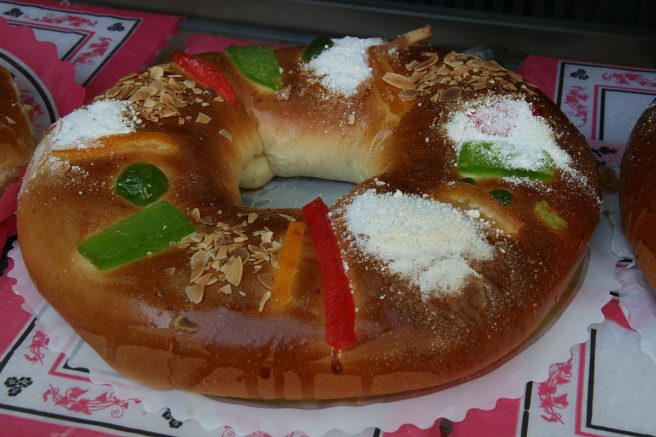
In Spain and throughout Latin America, Roscón de Reyes is eaten to celebrate the Fiesta de Los tres Reyes Mages or festival of the Three Magi on January 6. This cake is a sweet bread, garnished with dried and candied fruits.
Roscón de Reyes
During the early colonial period, the cakes baked in Louisiana varied depending on what areas of Europe colonizers were from. The Epiphany or Twelfth Night on January 6th marked the end of Christmas. However as the interest in celebrating a Christmas season shifted to one day, December 25, King Cake began to symbolize the beginning of the Carnival season. And today, the cake is eaten from January 6 until Mardi Gras Day.
Social clubs called krewes were established and in 1872 the Krewe of Rex gave us the King of Carnival and the official colors – purple, green, and gold symbolizing justice, faith, and power. Louisiana King Cakes are decorated accordingly.
I made this traditional King Cake below filled with a cinnamon-sugar mixture using the recipe from my book.
A typical Louisiana King Cake is made from bread or broiche dough.
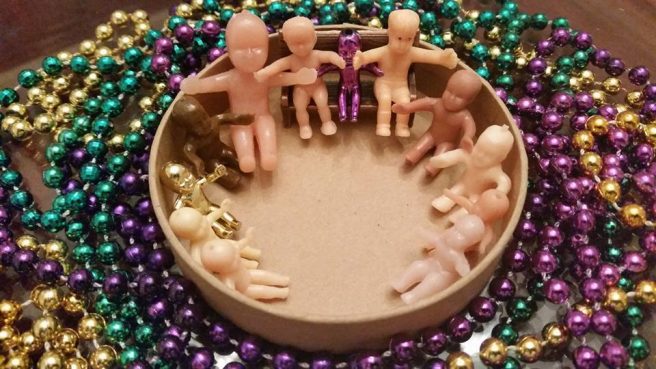
A local bakery in New Orleans named McKenzie supplied these krewes with King Cakes and as the popularity grew, either because of expense and/or availability, the owner substituted the porcelain trinket with a small plastic baby. And today, the King Cake babies come in all shapes, sizes, and colors.
Keila’s collection of King Cake Babies.
In Catholic tradition, the small plastic baby signifies the baby Jesus. And anyone who finds it is blessed and will have good luck. Another widely practiced custom is to crown whoever “gets the baby” king or queen for the day. But they are also obligated to buy the next cake.
Every year bakeries and chefs get more and more creative with the King Cakes, using different variety of doughs, and fruit fillings. And you can enjoy King Cake donuts, King Cake coffee, King Cake ice cream, King Cake liquor and . . .
. . . King Cake Burgers!
Food Drunk food truck’s King Cake Burger
Eating King Cake is the tastiest way to celebrate Carnival and you don’t have to leave your home to do it. You can find many recipes online. In addition to the frozen bread dough recipe in my THE KING CAKE BABY, here’s my Easy Peasy Pillsbury King Cake recipe using dough sheets. Just don’t forget the baby!
*
ABOUT THE AUTHOR
Before becoming a children’s book author, Keila Dawson worked as a teacher, school administrator, and educational consultant in the U.S., the Philippines, Japan, and Egypt.
Her debut picture book is THE KING CAKE BABY (Pelican Publishing Co. 2015), her second book, NO VOICE TOO SMALL: Fourteen Young Americans Making History, co-edited with Jeanette Bradley and Lindsay H. Metcalf (Charlesbridge) will release in September 2020.
Keila is a member of SCBWI, writes monthly author studies for the Reading for Research Month (ReFoReMo) blog, and reviews books for Multicultural Children’s Book Day. When Keila isn’t reading, writing, and visiting schools, she’s traveling, playing tennis, or digging in genealogical archives.
She is represented by Dawn Frederick, Red Sofa Literary
One lucky winner will get a signed copy of The King Cake Baby. Enter the Rafflecopter HERE until February 14, 2020, at 11:59 p.m. EST. U.S. addresses and zip codes only. When time expires, the winner will be notified via email. Good Luck!! I hope you get the baby!!







 Before becoming a children’s book author, Keila Dawson worked as a teacher, school administrator, and educational consultant in the U.S., the Philippines, Japan, and Egypt.
 Jama's Alphabet Soup