

Look what’s officially hitting shelves today!
This charming, whimsical tale very loosely inspired by the real life friendship of Julia Child and Simone Beck is cooked to fingertip-kissing perfection and definitely has my name written all over it.
I literally squealed with delight when I first saw Julie Morstad’s scrumptious, I-could-just-eat-you-all-up ink, gouache and Photoshop illos — so many adorable details and the childlike sophistication is oh-so-français. 🙂
True, this book had me at the cover, but when I read Kyo Maclear’s spritely celebration of good food, friendship, fearlessly pursuing your passions, growing young, and never forgetting how to have a marvelous time, I could almost hear the real Julia’s rousing cheer, chirrup and hoot of approval. After all, it was she who said, “That’s what human life is all about — enjoying things.”
In Julia, Child (Tundra Books, 2014), we meet cooking buddies Julia and Simca, who firmly believe it’s “best to be a child forever” and are therefore dismayed by all the big, busy, hurried, “wary and worried” grown-ups around them.
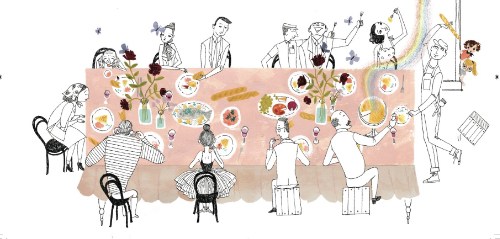
What to do? Cook special ‘growing young’ recipes, of course. They whip up a delectable feast complete with “fluffy clouds of cheese soufflé,” “perfect loaves of crusty baguette,” and “a golden compote of fresh peaches, sweet as summer sunlight . . . ” Magnifique!
The big busy people devour every morsel, but something isn’t right. Talk about greedy and grabby! Can the girls come up with another recipe to turn these adults into sensible children once again?
I’m so pleased Toronto-based author Kyo Maclear is here today to talk about this mouthwatering story, her best job ever, and what she’s learned from her children. Put on your best bib, help yourself to some Wonder Seeds, and bask in the joie de vivre. Bon Appétit!
* * *
 I’m pleased today to welcome Maryland poet
  Julia explores the complicated relationship humans have with food by fixing a personal lens on her own family. In artfully crafted scenes, (a mother keeping her daughter out of the kitchen so she won’t see her drinking, a young woman bringing home a bohemian boyfriend to dinner at her mother’s “immaculate table,” a woman aching for her deceased mother as she comes across her handwriting on recipe cards), the subtexts of pain, regret, loss, and contention are plated to perfection. Her descriptions of food are lyrical and sensual, her voice intimate and honest, her ability to align what is being eaten with what eats away at the heart and soul is powerful.




 Jama's Alphabet Soup