[review + recipe] The Secret Gardens of Frances Hodgson Burnett by Angelica Shirley Carpenter and Helena Pérez García

“As long as one has a garden one has a future; and as long as one has a future one is alive.” ~ Frances Hodgson Burnett

Since The Secret Garden has always been one of my favorite children’s books, I was especially excited to see Angelica Shirley Carpenter and Helena Pérez García’s recent picture book biography about Frances Hodgson Burnett.
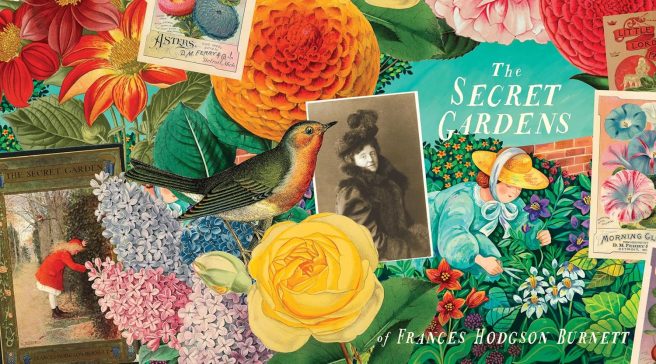
Learning how Burnett coped with hardship and adversity in her own life shed new light on my appreciation of the novel. Now I understand why gardens were so important to her, not only as places of beauty and inspiration, but of comfort and healing. I also found it intriguing that she had a luxurious lifestyle that was shocking by Victorian standards (a twice divorced smoker who spent time away from her children). 🙂

We first meet Fanny Hodgson as a girl who lived in “an ordinary house in an ordinary English village.” But Fanny herself was anything but ordinary because of her vivid imagination. In her world, “fairies filled the rosebushes” and “elephants and tigers prowled the lilacs.”
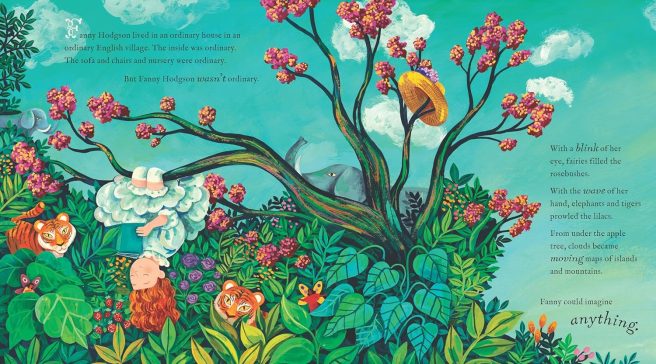
Her idyllic existence was upended when her father died (she was around six), and her family was forced to move to Manchester so her mother could run his store. The dull and grey city was a stark contrast to the beloved garden she’d left behind, but Fanny’s imagination sustained her, as she envisioned roses, violets, lilies and daffodils abloom in an old abandoned garden actually “filled with rubbish and ugly weeds.”
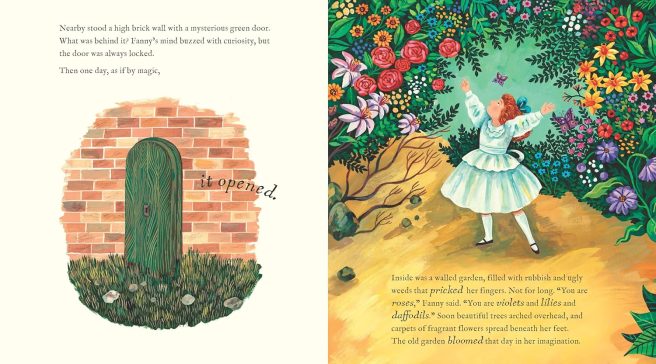
After a few years, her mother had to sell the store as businesses in Manchester failed. Short on money, Fanny’s family then relocated to a small village in Tennessee at the suggestion of her uncle, who thought her brothers could find work there. Unfortunately, they weren’t able to earn as much money as they’d hoped, so sometimes the family went hungry. Fifteen-year-old Fanny wanted to help, but there were no jobs for girls.

Undeterred, she put her imagination to work once again and invented her own job, opening the town’s first school. Her eight students paid with “cabbages, eggs, and potatoes,” and she read them Shakespeare. She also built a “secret room” in the woods behind her house, “weaving walls from branches and vines.”
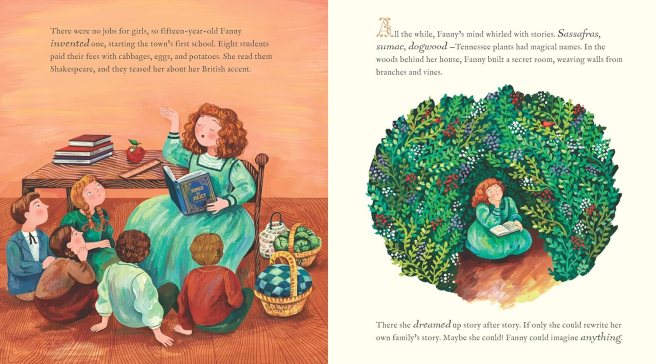
There, in her cozy sanctuary, she dreamed up stories. She knew that magazines paid for stories; could she sell one of hers? She earned money for writing supplies by picking and selling wild grapes at the market. She wrote a love story and sent it out — and to her surprise, sold it for thirty-five dollars — enough to feed her family for weeks!

Continue reading
[tasty review] Welcome to Our Table by Laura Mucha, Ed Smith, and Harriet Lynas

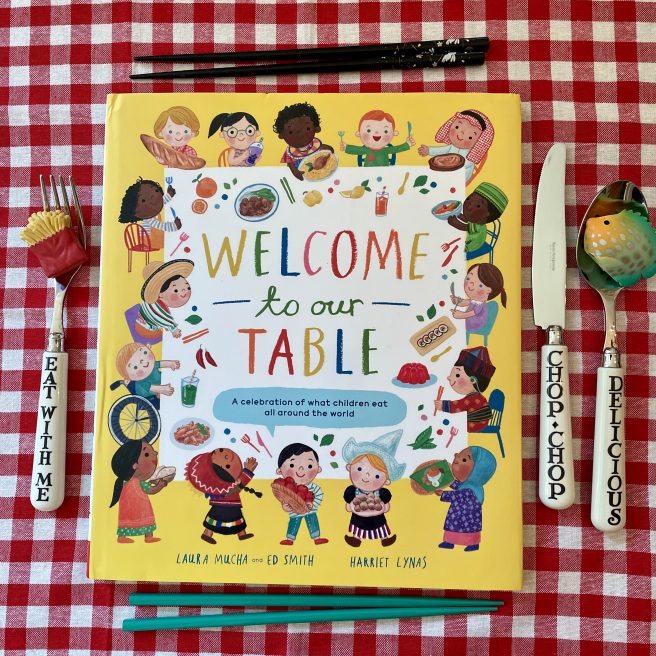
I couldn’t help but smile upon first seeing the sunny yellow cover with 16 happy kids at the table sharing dishes from their native countries. What an irresistible invitation to join them for a mouthwatering feast!

Even before you open the book, the message is clear: international, diverse, community, inclusive, fun and delicious. When you start reading, it’s so easy to relate: We are different, but we all love food! 

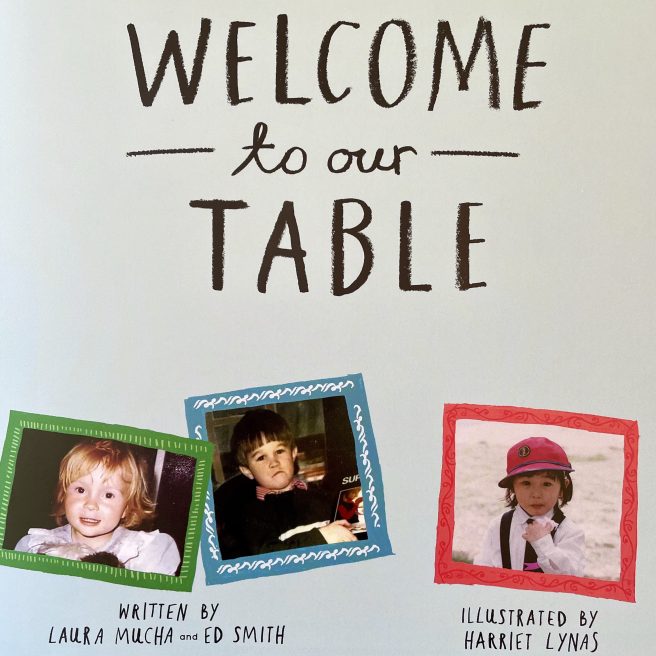
Welcome to Our Table: A Celebration of What Children Eat All Around the World (Nosy Crow, 2023) is an epic smorgasbord featuring hundreds of dishes and ingredients, both familiar and exotic, temptingly flavored with fascinating tidbits about how certain foods are grown and prepared.

Written by poet-author Laura Mucha and her chef-food writer husband Ed Smith, the 64-page compendium is served up with Harriet Lynas’s cheery, drool-worthy digital illustrations, sure to whet the appetite and arouse curiosity.

The mouthwatering menu contains 33 “courses” or topics, most featured on inventively designed, reader friendly double page spreads along with several single page spreads + sidebars. Friendly kids of multiple ethnicities are shown eating, serving, or interacting with various types of foods (interesting asides are conveyed via occasional speech bubbles).

After a brief introduction, Mucha and Smith set the table with descriptions of common eating utensils. Besides forks, knives, spoons and chopsticks, more than 1/4 of the world eats mainly with their hands. In India, Pakistan, Bhutan and Bangladesh, fingers are the way to go! And in places like South Korea, Italy or Nigeria, hands are preferred only for certain dishes (lettuce wraps, pizza, pounded yams).

Continue reading

[review + recipe + giveaway] Awesome Earth by Joan Bransfield Graham and Tania García

I’ve always been fascinated by volcanoes. When you grow up in Hawaiʻi, it’s a point of pride being able to claim that your home state has the largest active volcano on Earth (Mauna Loa), and it’s also the only state situated entirely on an archipelago. Kīlauea’s most recent (and ongoing) eruption on the Big Island started in December 2024, while Mauna Loa last spouted off in 2022.

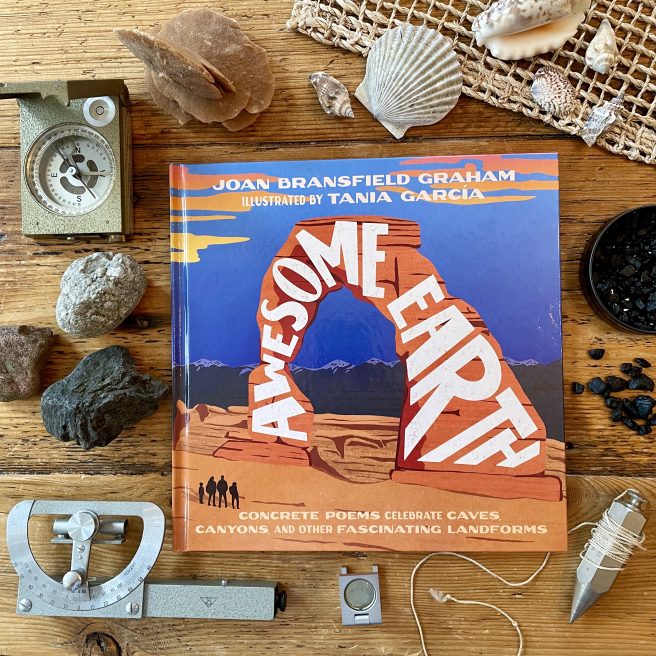
The breathtaking spectacle of molten lava slowly making its way to the ocean and thereafter creating new land is both humbling and awe-inspiring. When I read Joan Bransfield Graham and Tania García’s brand new poetry picture book, Awesome Earth: Concrete Poems Celebrate Caves, Canyons and Other Fascinating Landforms (Clarion Books, 2025), I was reminded of how our home planet is an ever evolving, dynamic entity full of beauty and wonder.

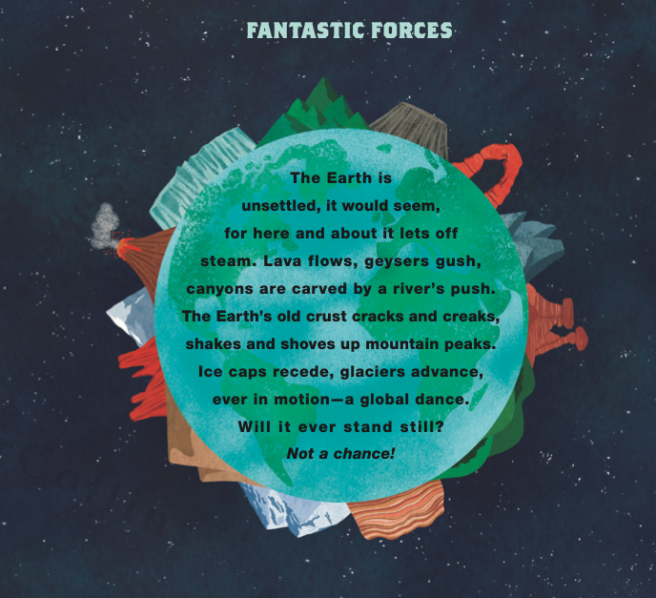
FANTASTIC FORCES

The earth is
unsettled, it would seem,
for here and about it lets off
steam. Lava flows, geysers gush,
canyons are carved by a river's push.
The Earth's old crust cracks and creaks,
shakes and shoves up mountain peaks.
Ice caps recede, glaciers advance,
ever in motion -- a global dance.
Will it ever stand still?
Not a chance!

Fun to read and loaded with fascinating information, Awesome Earth is Graham’s valentine to the planet and a budding geologist’s dream. Her use of concrete poetry to describe a variety of landforms is the perfect way to celebrate their physical attributes, whether Continent or Island, Hill or Valley, Plain or Plateau. After all, landforms are all about size, shape, and structure; they themselves are a kind of topographical poetry.

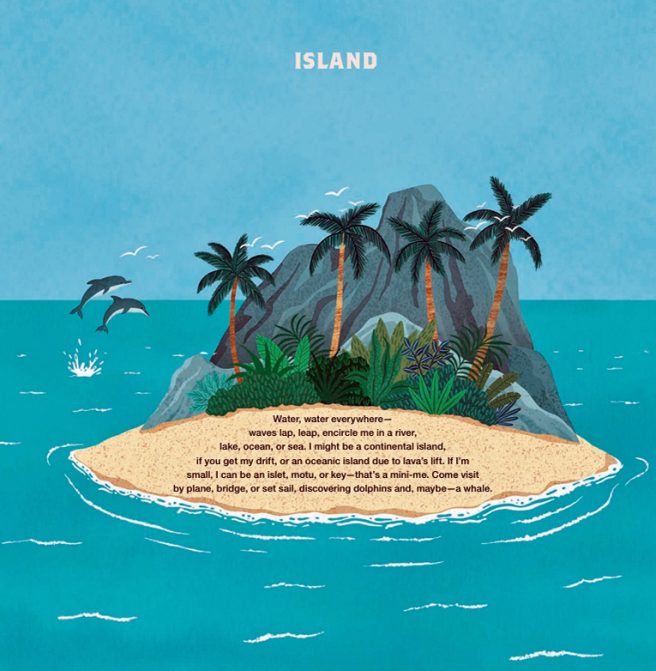
Kids will find the 20+ poems delightfully accessible as Graham strikes a friendly tone via (mostly) first person point of view and personification to establish a sense of immediacy and direct engagement. Who could resist an amiable Island explaining the difference between his continental and oceanic ilk, or smaller “mini-me” versions of himself? He even invites readers to visit sometime — so charming!

We also get a sense of Mountain’s pride and majesty, as he seeks the sky, “enrobed with snow,” piercing the clouds, and I’m only too willing to forgive Peninsula’s boast: “I’ve got miles and miles of rocky or sandy, dandy coast!”

Continue reading

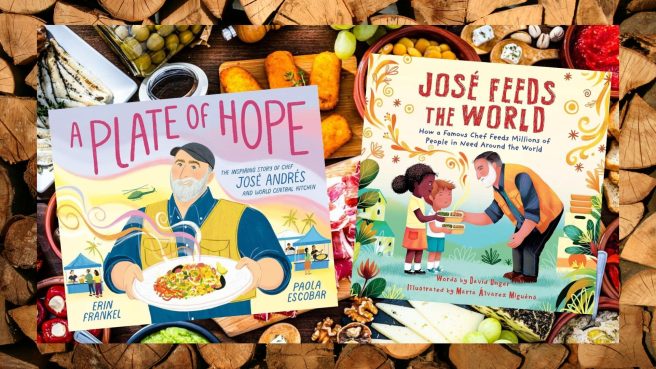
serving up a pair of cool picture books about josé andrés and world central kitchen

“Chefs like me feed the few, but our destiny is to feed the many. To be an army of goodness where a plate of food becomes a plate of hope…a light in dark times. Together, we can change the world through the power of food.” ~ Chef José Andrés

Since I’m a big fan of chef, restaurateur, and humanitarian José Andrés, I was happy to see both of these recently published picture books about his interesting life and amazing accomplishments.

Chef Andrés’s World Central Kitchen is truly a beacon of hope during tumultuous times of untold trauma, displacement and uncertainty due to natural and man-made disasters. Whether earthquake, hurricane, war, wildfire or pandemic, WCK is right there on the frontlines offering food, comfort, and a helping hand to local communities.

Chef Andrés received the Presidential Medal of Freedom on January 4, 2025. To date, WCK has served 450 million meals worldwide (photo via WCK.org).

You may know that in early January, Andrés received the Presidential Medal of Freedom, and that 2025 marks WCK’s 15th anniversary. Just recently, WCK provided free meals to firefighters, first responders and evacuees of the catastrophic wildfires in Los Angeles via food distribution centers as well as local restaurant and food truck partners.

So how did this incredible food aid/disaster relief nonprofit get started? What first inspired Andrés to become a chef, what continues to motivate him, and what are some of his core beliefs when it comes to food?

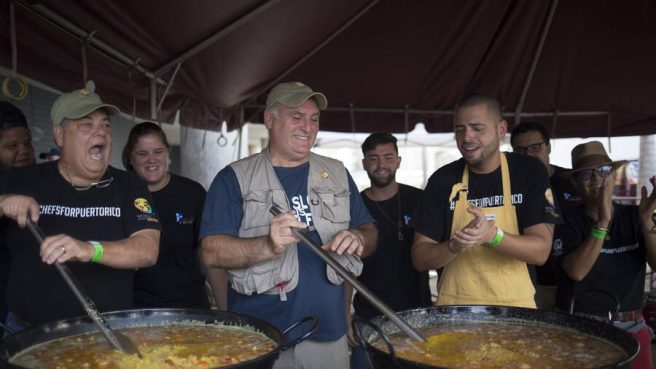
Chef Andrés and WCK volunteers cook paella in San Juan, Puerto Rico, October 2017 (photo by Eric Rojas/NYT).

Both books, A Plate of Hope and José Feeds the World trace José’s life from his childhood interest in cooking, to attending cooking school in Barcelona, to becoming an assistant chef at El Bulli, opening a tapas restaurant called Jaleo in Washington, D.C. (where he also volunteered at the DC Central Kitchen), to the 2010 Haiti earthquake, which motivated him to create World Central Kitchen.

When Hurricane Maria hit Puerto Rico in 2017, José and his WCK team got local people to volunteer after realizing they couldn’t do the work alone and there weren’t any other nonprofit organizations planning to feed the millions of people affected by the catastrophe.

As time passed, each new disaster presented different challenges requiring different solutions, and José found himself wanting to do more and more — establishing food distribution systems, flying in equipment to set up field kitchens, offering Meals Ready to Eat, etc. He also empowered local communities to use their skills and resources to help others as they had helped themselves.

Continue reading

reveling in Grant Snider’s Poetry Comics

We don’t usually speak of poetry and comics in the same breath. We may like and enjoy both, but tend to approach each separately on its own terms. Purists may even consider poetry and comics to be on opposite ends of the literary spectrum (gasp!).

Yet Grant Snider sees things differently. The popular “Incidental Comics” creator was keen on finding a closer connection between poetry and comics, as both “contain condensed language, strong imagery, and ideally leave the reader with a new insight.”

Author-illustrator, cartoonist, comic strip writer and orthodontist Grant Snider lives with his wife and five children in Wichita, Kansas.

Targeted for middle grade readers, Snider’s fun and inventive collection demonstrates this perfectly with an entirely new way of approaching and appreciating poetry. Did you ever think it would be possible to read a poem in a series of comic panels? Me neither. 🙂

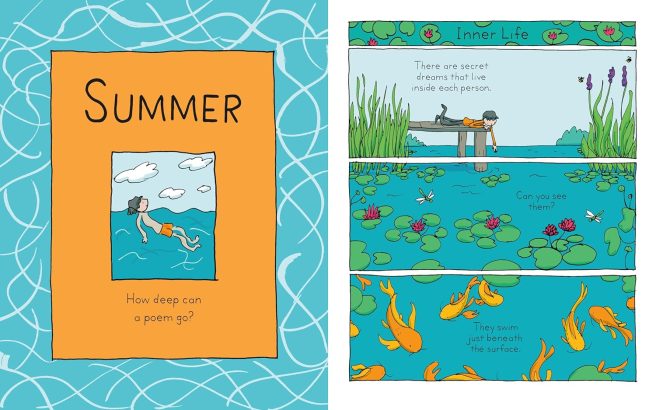
The poems in Poetry Comics (Chronicle Books, 2024) are organized by season, with each section offering insights into the poetry writing process. Title pages inspire and direct:

Spring: “I want to put down on paper the feeling of fresh possibilities.”

Summer: “How deep can a poem go?”

Fall: “I will wait for a poem to fall into my open arms.”

Winter: “A new page — my words huddle close to keep warm.”

Each season then ends with a variation of “How to Write a Poem.”

HOW TO WRITE A POEM #1

Find a quiet place.
A sharp pencil.
A blank page.
Sit still.
Keep quiet.
Wait.
A poem will rush in to fill the space.

Many of the poems are about nature (snails, tadpoles, butterflies, trees), while others examine universal human emotions and observations via kid-centric activities like running through sprinklers, waiting for the school bus, playing basketball, riding on roller coasters, climbing trees, reading good books, picking the perfect pumpkin, playing in the snow. Each poem is a sensorial impression of the here and now.

Continue reading