[review] Blue by Nana Ekua Brew-Hammond and Daniel Minter

“Blue skies smiling at me, nothing but blue skies do I see . . . ” ~ Irving Berlin

Blue likes me. It’s always been there, coloring my life with good things since childhood: my first Schwinn bike, Island of the Blue Dolphins, fountain pen Quink, favorite pearl bracelet, the sparkling azure of the Aegean one summer.

At age 9, I saw Elvis filming “Blue Hawaii” alongside the pineapple fields. He was driving a baby blue convertible. The first time I met Len in London he was wearing a navy blue sweater. These days, I sip Darjeeling in a Blue Calico teacup, delighted to spot the first bluebird every spring.

Blue just knows how to make an impression. From the cozy comfort of broken-in jeans to the bright optimism of a clear autumn sky, blue touches us all in ways ordinary and profound.

But now I must confess something. Until I read BLUE: A History of the Color as Deep as the Sea and as Wide as the Sky by Nana Ekua Brew-Hammond and Daniel Minter (Knopf BFYR, 2022), I knew very little about blue’s fascinating history, origins, and cultural significance. Imagine my surprise when this book magically appeared in my mailbox one day — simply out of the blue (thanks for the gift, Miss T.)! 🙂

Brew-Hammond begins her captivating narrative by citing how elusive and mysterious blue actually is. It’s “all around us,” in the sky and sea. Yet we can’t touch the sky and when we try to cup the sea, its blueness disappears. We may crush iris petals for a brilliant shade of blue, but when we add water, the color fades away.

But then blue appears in the strangest places, discovered throughout history in unexpected ways.

Blue rocks called lapis lazuli were mined as early as 4500 BC in Afghanistan. The ancient Egyptians used the stones to make jewelry and charms to ward off evil, and by 44 BC they (including Queen Cleopatra VII) applied a bluish mixture around their eyes made from ground lapis lazuli grains, plants and animal fat.
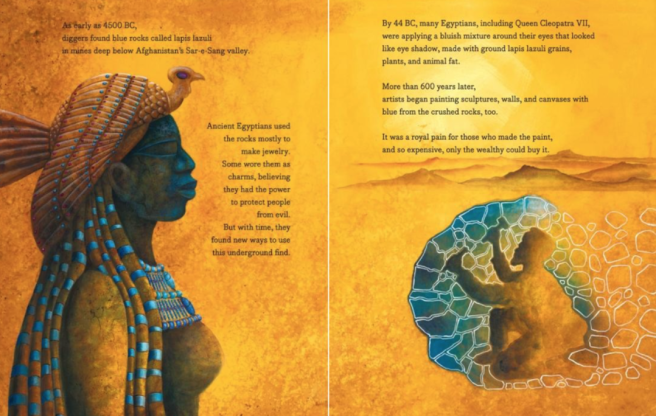
In another 600 years or so, artists began painting sculptures, walls, and canvases with blue made from the crushed rocks. Since this paint was expensive to produce, only the wealthy could afford it. This high-demand luxury prompted scientists, merchants, and dyers to search for more sources of blue.

Continue reading
[yummy review] La fiesta de las pupusas/The Fiesta of the Pupusas: El Salvador by Jorge Argueta and Gabriela Morán

“In El Salvador the full moon is a celestial pupusa.” ~ Francisco X. Alarcón

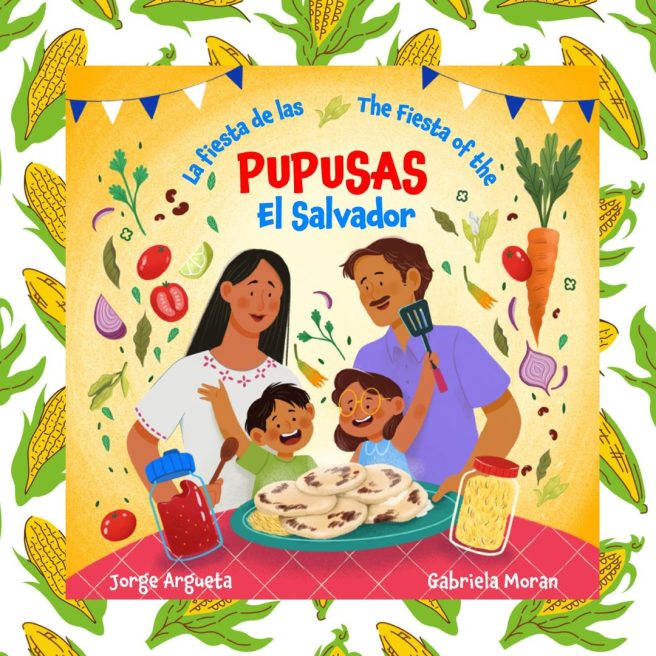
Right about now, I’m hungry for a warm, savory pupusa. Filling of choice? Pork, beans and melty cheese. Don’t skimp on the salsa roja or curtido! Officially declared the national dish of El Salvador in 2005, pupusas are the ultimate happy-making comfort food and the delectable subject of Jorge Argueta’s new picture book.

As a big fan of his bilingual cooking poem series published by Groundwood Books (Sopa de frijoles/Bean Soup (2009)Arroz con leche/Rice Pudding (2010)Guacamole (2012)Tamalitos (2013), and Salsa (2015)), I was excited to see La fiesta de las pupusas/The Fiesta of the Pupusas: El Salvador (Luna’s Press Books, 2024), charmingly illustrated by Salvadoran artist and graphic designer Gabriela Morán.

This joyful celebration of El Salvador’s favorite food is also a love letter to Argueta’s home country, where his family once owned a restaurant and he grew up with the colors, smells, and sounds of traditional foods being lovingly prepared by his mother and aunts in his own kitchen.

As the story opens, our friendly narrator explains that pupusas are a very popular, magical food in El Salvador, where it’s eaten morning, noon, and night. Pupusas are made from corn or rice flour, were once cooked in clay griddles, but are now made on big metal grills. And they’re round!

Las pupusas son redonditas, 
son como llantitas,
son como la letra O,
son como la luna,
son como el sol.

Pupusas are round,
like little tires,
like the letter O,
like the moon,
like the sun.

Though most pupusas are filled with beans and cheese, some are made with cheese and loroco, a tiny white fragrant flower:

 ¡Qué rico huele el loroco!
Es una flor blanquita como las nubes.
Picadita, la flor se revuelve con el queso
y se pone en la masa haciéndola una bolita.
La bolita se aplasta aplaudiendo.
Así se hacen pupusas de loroco.
¡Ayyy, qué loroco, más loco y qué delicioso!


Loroco smells so wonderful!
It’s a little flower, white as clouds.
Chopped-up loroco gets stirred in with the cheese
and kneaded in the corn dough to make a little ball.
You flatten the ball by clapping.
That’s how you make loroco pupusas.
Ahhh, loroco, it’s loco, and yummy in the tummy!
Continue reading

[artsy talk] Ashley Wolff on My Towering Tree

Happy to welcome back Vermont artist Ashley Wolff to talk about her latest picture book, My Towering Tree, written by Janna Matthies and published by Beach Lane Books (2024).

In Matthies’s lyrical ode to a special tree, a girl appreciates the natural wonders in her own back yard, from squirrel to garden to bee. Beneath the towering tree’s leafy canopy, she can think, breathe, rest, write, reflect, and simply be. She can also remember her dog who’s buried there beneath “a squarish stone,” and joyfully bask in the warm rays of sunshine streaming through the branches.

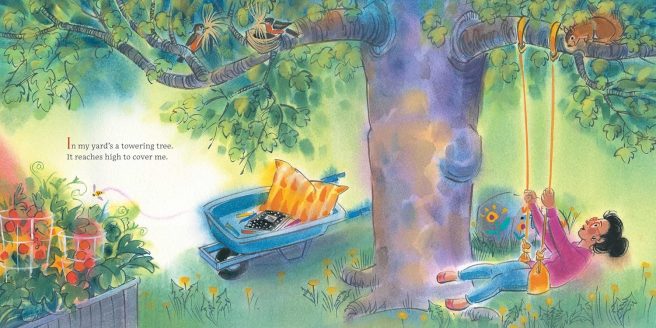
In my yard’s a towering tree. It reaches high to cover me.

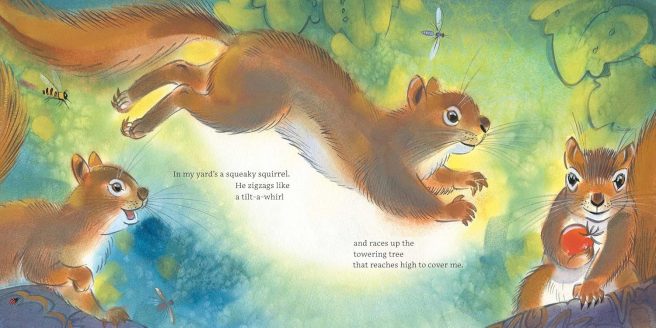
Ashley’s lush, color-saturated gouache and pastel illustrations bring Janna’s spare rhyming text to vivid, glorious life. Her dramatic use of scale in several double page spreads creates a sense of intimacy and introspection, while charming details such as the squirrel stealing a tomato, the girl blissfully reclining in a wheelbarrow, and her endearing notebook doodles keep us turning the pages. The majestic tree, with its thick sturdy trunk, generous branches teeming with wildlife, and foliage rendered in soft, fluid daubs of green is soothing and inviting.

In my yard’s a squeaky squirrel. He zigzags like a tilt-a-whirl and races up the towering tree that reaches high to cover me.

Big thanks to Ashley for dropping by to tell us more about creating the art for this lovely study in meditation and mindfulness, and for sharing so many wonderful reference photos. 🙂

*

Continue reading

[salty review] Potatoes for Pirate Pearl by Jennifer Concepcion and Chloe Burgett

Ahoy there, mateys!

Pardon for sayin’ so, but yer lookin’ a might peckish, mebbe a trifle peaked.

No worries, here be a tasty tater tale to tempt your tum-tum. Yarrr! We’re off to the high seas with Pirate Pearl and her perky parrot Petunia in pursuit of provisions. So twirl yer tricorns and climb aboard!

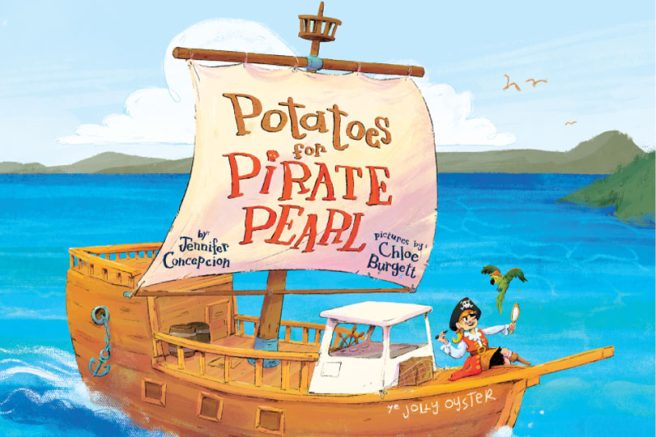
In the rib-tickling read-aloud, Potatoes for Pirate Pearl by Jennifer Concepcion and Chloe Burgett (Feeding Minds Press, 2023), a hungry pirate and her squawky sidekick learn how to plant, grow, and harvest potatoes, all while making a new friend.

Pearl and Petunia, who had been at sea for many months aboard the Jolly Oyster, were absolutely fed up with eating hardtack biscuits day after day. “I’ll make this codswallop walk the plank!,” Pearl said, just before she tossed their barrel of grub overboard.

Now what?

Luckily, with a “splish splash SQUAWK” they were soon able to make landfall to scope out some fresh grub. They “splashed through streams . . . hiked hills . . . and trooped through trees” when they spied a red barn and silo in the distance. “Thar she grows!”

Fading fast, Pearl and Petunia could barely drag themselves toward the farm. Just in the nick of time, a friendly landlubber named Farmer Fay came to the rescue. She carted them off to her kitchen to revive them with a steaming bowl of potato soup. Blimey, was it good!

Continue reading

[saucy review] Pasta Pasta Lotsa Pasta by Aimee Lucido and Mavisu DemiraÄŸ

Bucatini, capellini, spaghettini, tortellini!

Molto delizioso!

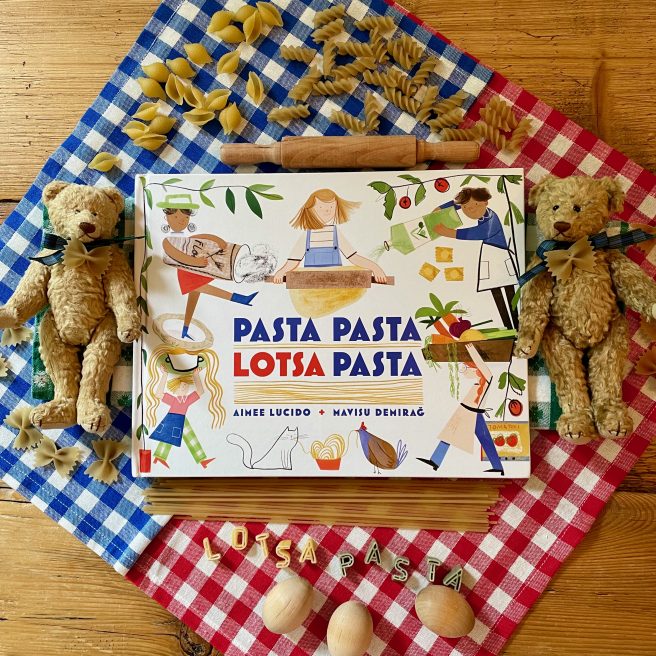
Italian pasta names make me happy. Joyful, lyrical, rhythmic — saying them is almost as good as eating them. Hungry? Time to put on a bib, grab a fork, and feast on Pasta Pasta Lotsa Pasta by Aimee Lucido and Mavisu DemiraÄŸ (Beach Lane Books, 2024).

Mangiamo!

In this lip smacking celebration of all things noodle-y, a family of picky eaters gathers for dinner. Their names just happen to rhyme with where they’re from as well as their pasta preferences. Told from a young girl’s point of view, the story begins with the arrival of her grandmother:

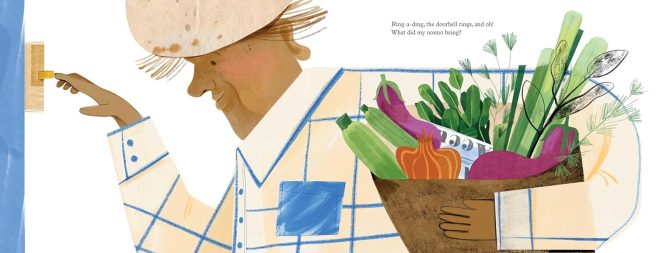
Ring-a-ding, the doorbell rings, and oh!/What did my Nonna bring?

Nonna Ana (who’s from Catania and only likes to eat lasagna) wheels in her chicken and some eggs. The girl and her mom get busy making the lasagna from scratch — combining ingredients, rolling out the dough and then cutting it into thin layers.

The next minute, the doorbell rings again. Nonno Titi arrives with a bag full of fresh veggies. “Nonno Titi from Tahiti only eats our spaghettini.” Papa and Mamma proceed to slice and cook the spinach, zucchini, eggplant and onions to go with the spaghettini.

Pasta pasta lotsa pasta/made for Nonno and famiglia!

Continue reading