dessert first, last, and in between

Now here’s a book that’s got my name written all over it.

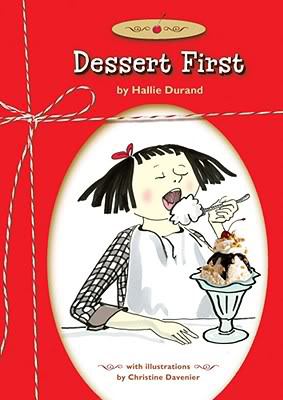
Regular readers of this blog may have noticed my subtle tendency total obsession with baking and sweets. Like most writers, I am especially mad for chocolate. Dessert First by Hallie Durand features some particularly decadent chocolate and more than satisfied my present craving.

Eight-year-old Dessert Schneider (whose family owns the Fondue Paris restaurant), is just the kind of spunky, quirky little minx I love to read about. She follows in the tradition of Eloise, Ramona, Junie B., and Clementine — the type of character who gets into the kind of mischief we’d secretly like to, if only we had the nerve.

Continue reading

poet of the day: gooney bird greene


 GOONEY BIRD IS SO ABSURD by Lois Lowry,
illustrated by Middy Thomas (HMH, 2009),
Chapter book for ages 6-10, 112 pp.

Gooney Bird? For National Poetry Month?

You can bet your underpants on it!

Is it true that if you warm your brain to the right temperature, you can write better poetry?

In Gooney Bird is So Absurd, the fourth book in Lois Lowry’s fabulous chapter book series, the lovable, irrepressible second grader who’s been captivating everyone with her brains and quirky fashion sense, proves this theory to be correct.

For the month of January, Mrs. Pidgeon is teaching her class at Watertower Elementary all about poetry. Gooney Bird gets right into the action by donning her special two-ponytail-brain-warming hat. She warns her curious, giggling classmates against calling it “underpants” to get a cheap laugh, and very wisely declares that like a poem, her green, frilly hat (perhaps underpants in another life) can be “whatever you want it to be.”

With each new chapter, the class learns about a different poetic form. They begin with couplets, then move on to haiku, limericks, list poems, and poems for many voices. They even learn about the importance of constructive criticism and revision. Thanks to Mrs. Pidgeon, the humorous and endearing antics of all the kids, and Gooney Bird’s ability to take charge, inspire, and spark excitement no matter what she says or does, none of it feels like “lessons.” Making poems is sheer joy, and Gooney Bird and her classmates discover, among other things, that a poem doesn’t have to rhyme, and “only has to be long enough to say what you want it to say.”

Early on, Mrs. Pidgeon tells the class that she likes to begin each morning by reading a poem, and reveals that her mother, Mrs. X, is in a nursing home and not doing too well. While going through an old trunk, Mrs. Pidgeon finds some of her mother’s poems, which she reads to her on her visits. She also shares several of these with the class, the most poignant being this list poem:

IT MAKES ME HAPPY TO REMEMBER:

A cake with pink candles,
A yellow hair ribbon,
A kitten named jingle,
The lace collar on my mother’s best dress,
Ruffled curtains in my bedroom,
The fragrance of honeysuckle,
And fireflies on summer evenings,
So many fireflies.
I wonder where the fireflies have gone.

Maybe you can guess what happens next. Bad news, but Gooney Bird steps up to the plate once again, by organizing the best, most important Poem for Many Voices the class has ever done. It’s beautiful how this final poem ties up all the plot points and incorporates everything the kids have learned about poetry throughout the month. Poetry is, above all, about feelings, and Gooney Bird and her classmates are full of heart and inherent wisdom.

If you’re not yet familiar with the Gooney Bird series, run to the library this minute and share them with your kids. They will instantly become fascinated with the red-headed girl who showed up on her first day of school wearing pajamas and cowboy boots, and they will love Mrs. Pidgeon, who says things like, “Poetry is not to be judged. You just savor it.”

About the books, Lowry says:

Gooney Bird Greene is the child I wish I could have been, because I was a terribly shy, self-conscious child (and) I envied desperately those children who were outgoing and self-confident . . . Each book focuses on a different teaching device. In the first book, Gooney teaches the class how to tell stories, and the second one deals with words. I have in mind several other things that this unusual and very outgoing, self-confident child can give to the whole class and her teacher. These books are fun to do.

The third book, Gooney the Fabulous, is about fables, and now, Gooney Bird is So Absurd, which was released just last month, features poetry. All the characters are spot-on believable; if you love Lois Lowry already, you will love her even more (I know, how is that possible)?

Okay, put on your brain warmer hats and get to work!

Click here to read an excerpt from Gooney Bird is So Absurd, and here for more information about the entire series.

*Snowball, pictured here with a dark chocolate raspberry egg on his nose, and teddy bear underpants on his head, would like everyone to read a Gooney Bird book to celebrate spring!

toast to toast


One slice or two?

I love you, toast, I do.

Forgive my dalliance with chewy English muffins and poppy seed bagels. My fascination with showy waffles. My unabashed drooling over muffins and pancakes and other batter beauties. When all is said and done, when a person is weary of gimmick and falderal, there is only you, my toast — simple, basic, and totally unassuming.

Why did I ever think anything could replace this bastion of breakfast? There are some (gasp!) who find toast boring and unresponsive. I dare say they have lost touch with their inner crumb.

When I was little, my older brother and I sometimes ventured to Grandma Kim’s house for breakfast. Both our parents worked, so we were left to our own devices much of the time. We’d arrive on her doorstep unannounced, and didn’t have to say a word. One look at us and she knew exactly what we wanted.

First, half a slice of sweet, cold, homegrown papaya. Next, two almost hard boiled eggs, not too runny in the middle. And then, the best part –a perfectly toasted slice of white bread, generously buttered all the way to the edges, with a coating of fresh guava jelly. Her signature presentation? The toast folded precisely in half, perfect for small hands and eager mouths. Biting into that combination of warm, chewy bread, butter and jelly, told us we were safe, loved, and always welcome.

Toast is the stuff dreams are made of.

Now, I’m not the only one who worships at the shrine of toast. Do you know Mercy Watson? Yes, she’s a pig, but no ordinary porker. She’s the porcine wonder who stars in her own series of early readers. I absolutely. Love. This. Series. I mean, we’re talking Kate DiCamillo here. With illos by Chris Van Dusen.

Mercy lives with Mr. and Mrs. Watson, who are all retro-50’s smiley and kind. They love and indulge her, and everything she does delights them. Her weakness? Hot buttered toast. Stacks and stacks of it. Her pursuit of and acute awareness of HBT makes for some rollicking good stories. So far, in Books 1-4, she’s “rescued” the Watsons from a falling bed, hijacked a pink cadillac, foiled an intruder, and dressed up as a princess for Halloween.

The latest installment, Mercy Watson Thinks Like a Pig, finds her in trouble for eating the neighbors’ newly planted pansies. She manages to escape Animal Control, and as in the other books, there is a big feast of HBT at the end for all concerned. Chris Van Dusen’s cartoony illustrations jack up the humor several notches with manic energy and hilarious facial expressions. If you can read one of these books and NOT crave HBT, there is something seriously wrong with you. Really.

I’ve just finished a slice of white toast with butter and guava jelly, and I miss Grandma Kim. I loved the sound of the toast popping up and the knife scraping the toast as she buttered it. Such is the power of simple food, lovingly prepared.

How do you like your toast?


More Toast Love:

Visit the Cyber Toaster Museum.

What about a toast-it note instead of a post-it?

Make some Bite Me/I’m Hot Toast!

Australian art on toast.

Uber cool musical toast.

And then there’s always this:

Butter me up!

breakfast with george


Every morning at 7 a.m., George Washington ate three hoecakes and drank 3 cups of tea for breakfast.

It sounds a little meager for a man six feet tall, especially since he had a country to run.

Until two weeks ago, I didn’t even know what a hoecake was. I’m guessing oodles of kids around the country are already on to George and his cakes, because they’ve read this cool book: George Washington’s Breakfast, by Jean Fritz (Putnam, 1998).

Young George W. Allen shares Washington’s name and birthday. Since he feels almost related to him, he wants to know everything he can about the father of our country. But one day at breakfast, George realizes he doesn’t know what Washington ate every morning. So begins an enthusiastic, determined quest for the answer, which drives the plot and makes for a fun, engaging read.

Kids will immediately note George’s dated use of a card catalog, but will admire his tenacity as he reads book after book, searching for the answer. They will also pick up some interesting facts about Washington as their anticipation steadily builds, so that by the time George finds out about the hoecakes, they’ll be anxious to try them.

The New York Times Book Review called George Washington’s Breakfast “delightful,” as it “combines history, biography, research, cooking, and a determined child.” After eating the hoecakes, George felt even more related to Washington than ever before.

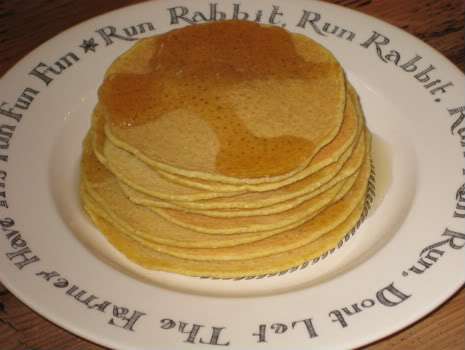
So what are they? A traditional Southern cornmeal pancake, originally cooked by field hands on the blade of a hoe over an open fire. Washington’s hoecakes were probably cooked on a griddle in the oven, though, and he liked them slathered with butter and dripping with honey.

GW’s meals were cooked in this fireplace at Mt. Vernon

Of course I simply had to try making some of my own. I opted for this modernized recipe, which calls for milk instead of water, and unlike the gargantuan recipe posted at the Mt. Vernon website, uses baking powder rather than yeast.

They make a nice change from traditional flour-based pancakes, and are good with maple syrup, honey, or butter and jam. For a fluffier (albeit less authentic) hoecake, use 1 cup of flour plus 1 cup of cornmeal.

Make some this weekend — it’s your patriotic duty!

Here’s a cute webpage showing some third and fourth graders enjoying hoecakes prepared by a library media specialist.

INFO BITES:

Washington was modest, courteous, and had flawless manners. He subscribed to the five-minute rule: all guests must be seated within five minutes of the dinner bell.

The Washingtons were among the first colonial Americans to acquire Wedgwood’s cream-colored ‘Queen’s Ware,’ and among the first to purchase porcelains brought back from Canton.

He also acquired the nation’s first service of French porcelain to grace state dinners.

His farms (8,000 acres) were self sufficient, providing most of the meat and produce he needed to entertain his constant flow of guests.

He had dinner at 3, tea at 6 or 7, and retired by 9 p.m.

Regarding behavior at the dinner table, Washington wrote:

Make no shew of taking great Delight in your Victuals, Feed not with Greediness; cut your Bread with a Knife, lean not on the Table, neither find fault with what you Eat.

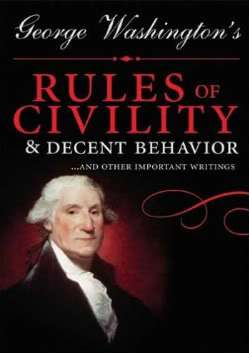
~ from Rules of Civility and Decent Behavior in Company and Conversation.