Sometimes in late summer, especially after we‘ve had a lot of rain, giant white mushrooms sprout up in our woods. Their tops can grow as large as dinner plates if the deer don’t take a bite out of them first.
They seem quite magical; I like to imagine fairies or gnomes using the flat mushroom tops as writing desks or tabletops, happily setting out their acorn teacups for special guests.
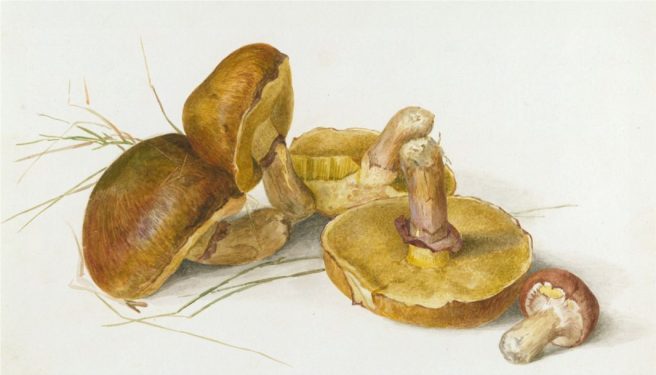
I actually became more interested in mushrooms about 20 years ago after learning about Beatrix Potter’s fascination with fungi, and then seeing her incredibly beautiful botanical drawings.
While most everyone knows Beatrix as the author and illustrator of the Peter Rabbit books, and perhaps as an ardent conservationist who helped preserve some 4,000 acres of pristine countryside in the Lake District, few may know she was also a dedicated naturalist who devoted about a decade of her life to mycology (the study of fungi), with a special interest in mushrooms.
I was understandably excited when Beatrix Potter, Scientist (Albert Whitman, 2020) came out last summer, because so far it’s the only picture book biography that takes a closer look at this lesser known aspect of Beatrix’s life.
Since spring is Beatrix Potter time in the Alphabet Soup kitchen, thought we’d serve up a blend of old and new, courtesy of Peter Rabbit and Jemima Puddle-duck.
For the last several days, while trying to decide which stories to talk about, we heard a constant quacking in the butler’s pantry. Stray feathers drifted in whenever we opened the front door, and the odd egg or two would appear in unexpected places — next to the toaster, inside the oatmeal box, in front of the clock.
Quite curious, wouldn’t you say?
Well, Clever Cornelius knew eggsactly what was up: Jemima Puddle-duck was jockeying for the spotlight.
Not wanting to quash her quack, we decided to share a newish board book in which she appears with Peter Rabbit, in addition to her classic tale published in 1908.
A SPRING SURPRISE
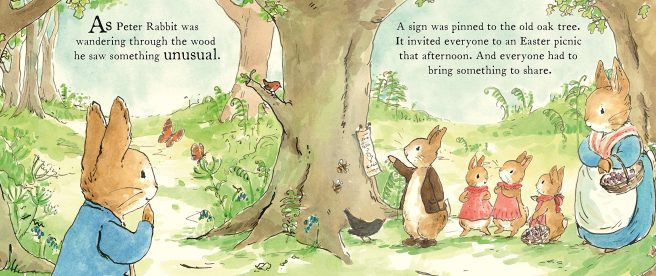
In A Spring Surprise, the fifth title in the adorable Peter Rabbit Tale board book series by Fiona Munro and Eleanor Taylor (Frederick Warne, 2019), Peter and his family are busy preparing for an Easter picnic.
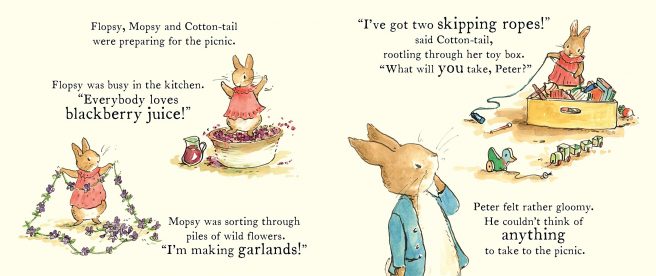
Everyone except Peter knows what they’re bringing. For Flopsy, Mopsy and Cotton-tail, it’s blackberry juice, wildflower garlands and jump ropes.
Wanting to bring something just as perfect, Peter goes around asking for suggestions. His mother, who’s making sandwiches, suggests “something sweet,” while Benjamin Bunny (busy with his kite) is in favor of “something fun.” Squirrel Nutkin tells him to “take something that’s a bit different.”
Well, this only makes Peter feel worse because he can’t think of anything sweet, fun, or different . . . until he suddenly spots something small and yellow amongst the bluebells. A flower? No, it’s moving! A butterfly?
“QUACK!”
Ooh, a tiny duckling! He scoops it right up. As he scampers along the path, he sees another, then another and another! Peter knows these ducklings belong to Jemina Puddle-duck, who must be worried sick. When he shows up with them at the picnic, Jemima is ecstatic, and everyone claps and cheers. Peter definitely couldn’t have brought anything sweeter, more fun or different to the picnic. 🙂
Now, despite the missing ducklings, Jemima really likes this story because she gets to do some quazy joyous quacking at the end, and the appearance of her four ducklings kinda picks up right where The Tale of Jemima Puddle-Duck leaves off.
Do you recall that somewhat harrowing farmyard tale?
“What one loves in childhood stays in the heart forever.” ~ Mary Jo Putney
Ho Ho Ho and Merry Merry!
How are you faring this holiday season? If you’re like me, you’re probably craving generous helpings of comfort, reassurance, and nostalgia to temper the reality of what has been the craziest, scariest, most distressing, heartbreaking, and unpredictable year ever.
As if she knew exactly what we needed, dear Susan Branch recently published Home for Christmas (Spring Street Publishing, 2020), a keepsake book that speaks to the very essence of the holiday: love, family, joy, cherished traditions and good food.
In a nutshell: good things come in small packages. There is so much more to this little book than meets the eye.
Yes, it contains Susan’s amiable handwritten text (does she ever get writer’s cramp?), a bevy of carefully chosen quotes, and of course, her charming watercolor illustrations.
She relates, in earnest and intricate detail, what her childhood Christmases were like, pointedly channeling her 9-year-old self in 1956.
Though I also loved her wonderful memoir trilogy, I found this book especially touching because her pure child’s heart fills every page.
Aside from being with family, when we say we want to be “home for Christmas,” perhaps what we truly mean is we wish we could be kids again, experiencing Christmas when it was magical, over-the-top exciting, and full of wonder. Before our adult selves equated the holiday with too much busyness, stress, reluctant obligations, and the whole bah-humbug thing, there was a time, when, with every ounce of our being, we believed.
Susan was inspired, in part, by Dorothy Thompson’s Once on Christmas (1938), which she had read to her nieces (photo by Susan Branch).
Just in case you’ve forgotten, Susan’s here to remind you — of the anticipation that steadily built to a fever pitch from right after Thanksgiving until the big day finally arrived.
Over the stream and across the field is the world of Brambly Hedge…
Are you a Brambly Hedge fan?
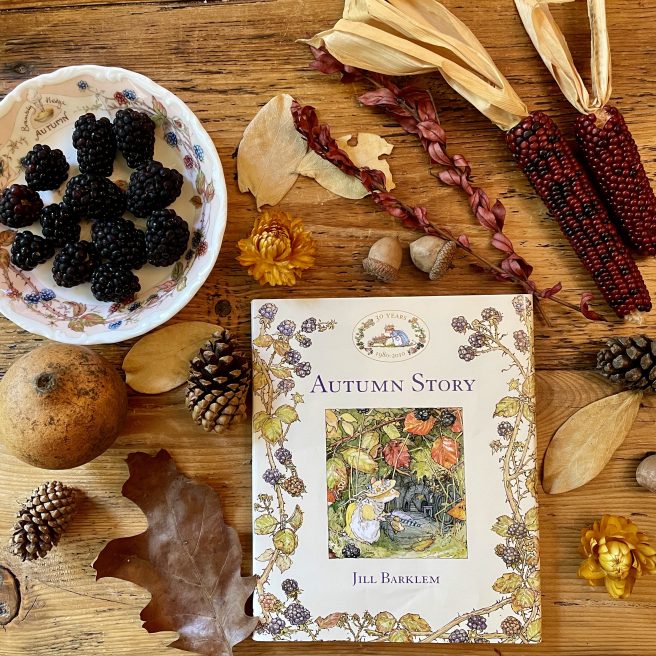
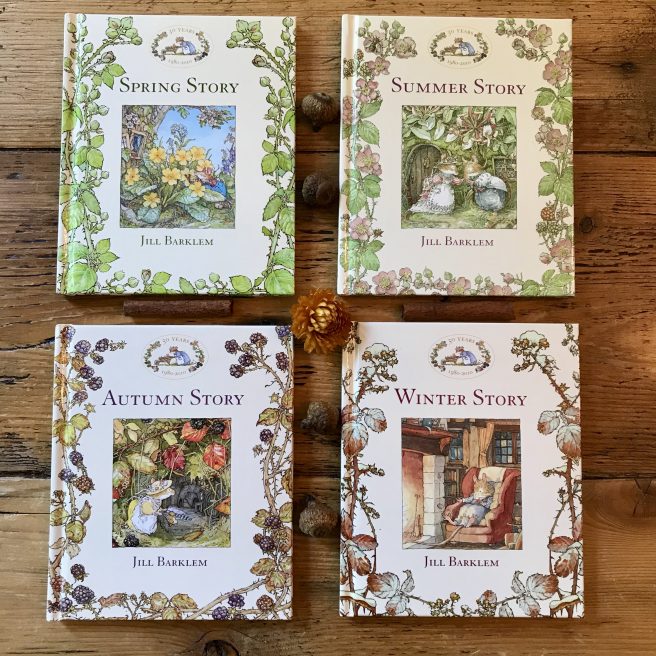
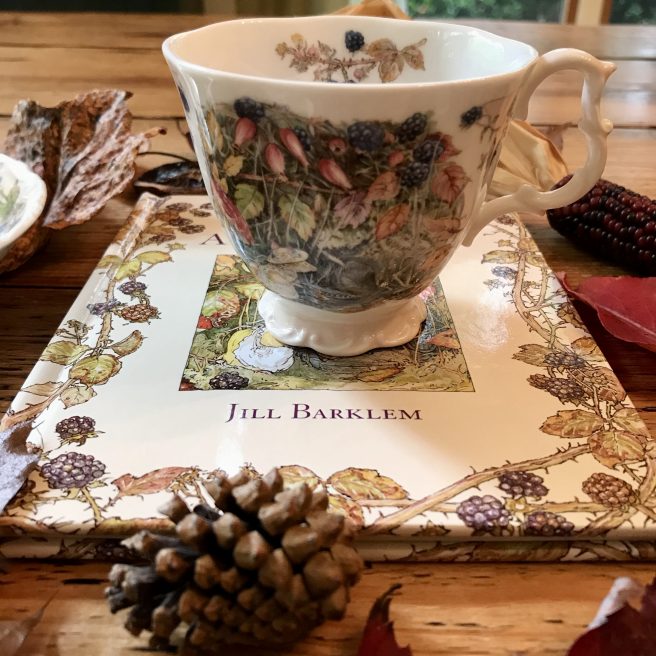
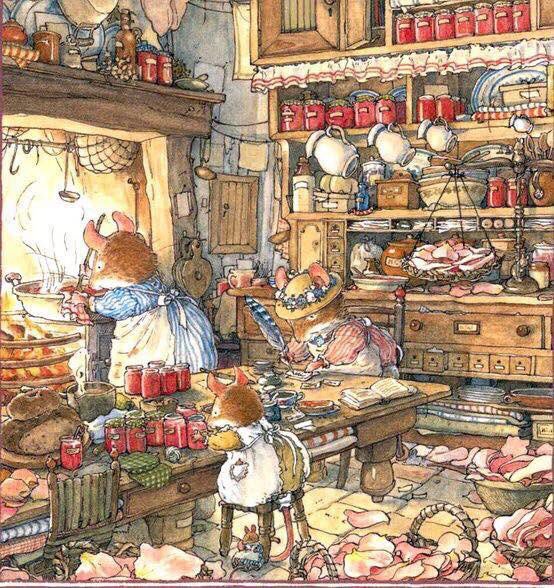
If so, then you probably know that Autumn 2020 marks 40 years since British author/illustrator Jill Barklem published the first four picture books in her charming series — Spring Story, Summer Story, Autumn Story, and Winter Story.
Released simultaneously by HarperCollins, they proved immensely popular among readers of all ages despite being written primarily for young children. To date they’ve been translated into 13 languages and have sold over 7 million copies.
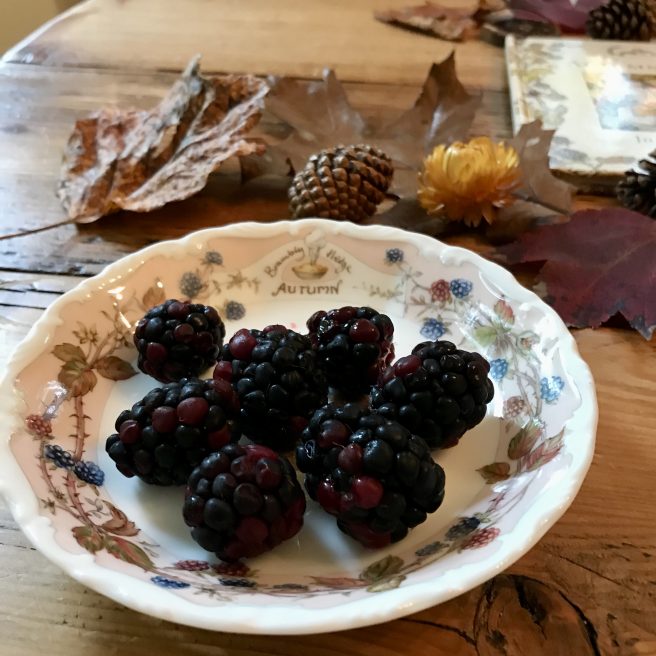
I was drawn to Barklem’s incredibly detailed illustrations long before I actually read the stories. This is not surprising for a longtime Beatrix Potter fan who can’t resist anthropomorphized animals dressed in smart clothes. In fact, I probably first saw Barklem’s adorable mice on pieces of Royal Doulton china.
Once I familiarized myself with all the characters and spent ample time in their idyllic English countryside, I was totally hooked. Brambly Hedge continues to attract generations of new readers with its emphasis on traditional values and universal themes such as family, friendship, community, seasonal self-sufficiency, and sustainability.
Author/illustrator Jill Barklem in her studio.
A nature lover since childhood, Jill was inspired by the countryside where she grew up, especially the ancient woodland, Epping Forest. At age 13 she suffered a detached retina, which prevented her from participating in sports, so she spent her afternoons indoors, concentrating on art and botany. Her love of drawing flowers and twigs eventually prompted her to study illustration at St. Martin’s School of Art in London.
She did not look forward to the long commute from Epping to London on the underground every day — but eventually made good use of her time by escaping into her own richly imagined world of mice who lived in the trunks and roots of trees and hedgerows.
This is how Wilfred Toadflax, Primrose Woodmouse, Poppy Eyebright, Mr and Mrs Apple, and all the others were first conceived. After graduating from St. Martin’s, Jill briefly worked for Lion Publishing, penning a few picture books and illustrating Bibles, but she didn’t feel she was doing her best work.
♥️ Special thanks to Marian from the Netherlands for inspiring me to write this post. 🙂
“You can have as much earth as you want,” he said. “You remind me of someone else who loved the earth and things that grow. When you see a bit of earth you want,” with something like a smile, “take it, child, and make it come alive.” ~ Archibald Craven (Frances Hodgson Burnett’s, The Secret Garden)
Guess who’s turning 60 on September 10?
Hint: he knows how to rock a waistcoat and cravat, is fluent in Italian, plays the guitar to relax, likes to tease fellow actor Gary Oldman about the size of his *ahem* manhood, almost voiced Paddington Bear in the movies, looks good WET (dry, and in-between), and even if you cook blue soup, he likes you just as you are.
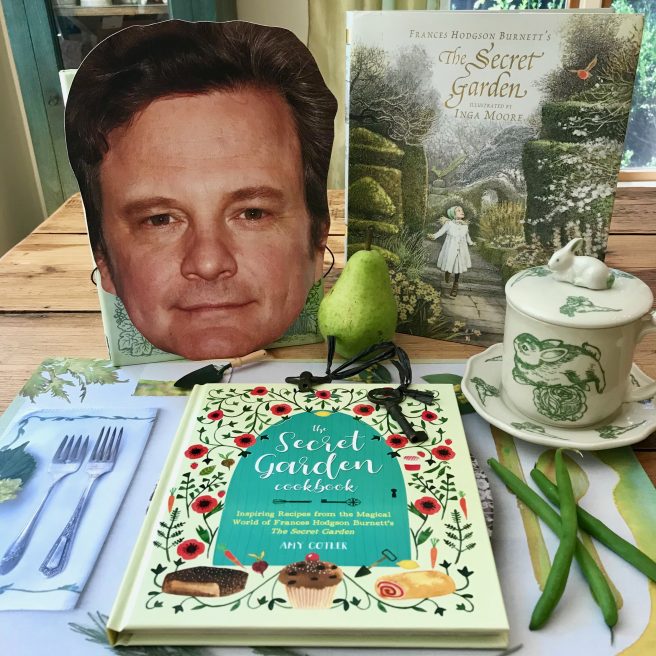
Yes, it’s Colin, aka my secret husband (SO secret, even he doesn’t know about it). Fine specimen of a human being, don’t you think? Doesn’t look a day over 39. 🙂
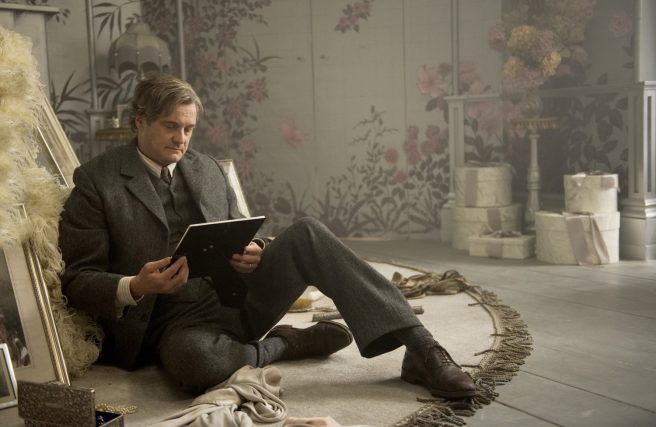
Colin Firth as Archibald Craven in The Secret Garden (2020).
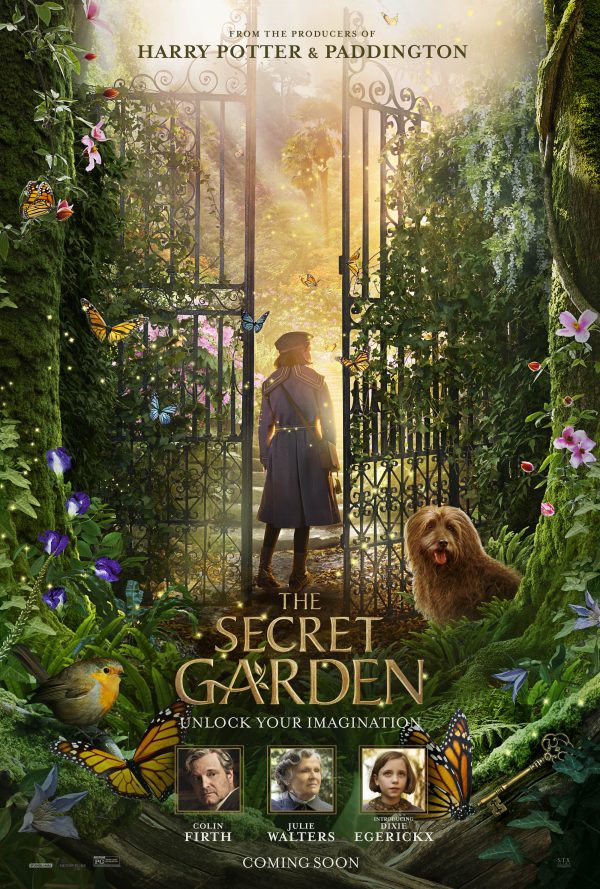
Unless you look at him playing Archibald Craven in the new Secret Garden movie. Have you seen it yet? They were all set for a big UK cinema premiere back in April, followed by the U.S. in August. But of course the pandemic changed everything, so instead, the movie went straight to video on demand beginning August 7, and will now open in UK cinemas October 23.
Colin, Colin, Colin, you’ve never looked so wretched, weary, or downtrodden. But Archibald is, of course, consumed with grief over the loss of his wife, making him inaccessible to his son and unable to properly care for his newly orphaned niece Mary Lennox, who comes to stay at Misselthwaite Manor.
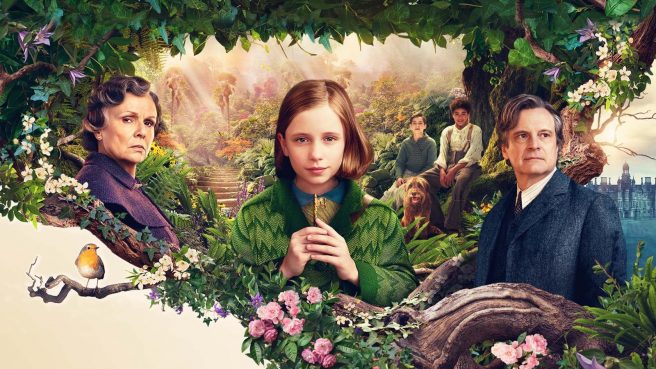
Mrs Medlock (Julie Walters), Mary Lennox (Dixie Egerickx), Colin Craven (Edan Hayhurst), Dickon (Amir Wilson) Archibald Craven (Colin Firth)
This new 2020 version (don’t worry, I promise not to be too spoilerish), is the fourth produced for the big screen, and Colin was attracted to the role because of the lavish garden scenes (which unlike previous films, were not confined to a single, walled-in area, but features an expansive, wide ranging terrain representing Mary’s unbounded imagination), as well as the “design concepts” of the castle, which really became a symbol for Archibald’s state of mind: dark, destructive, depressive. The creepiness of the house is highly atmospheric and underscores the tragic decline of what was once a joyful life.
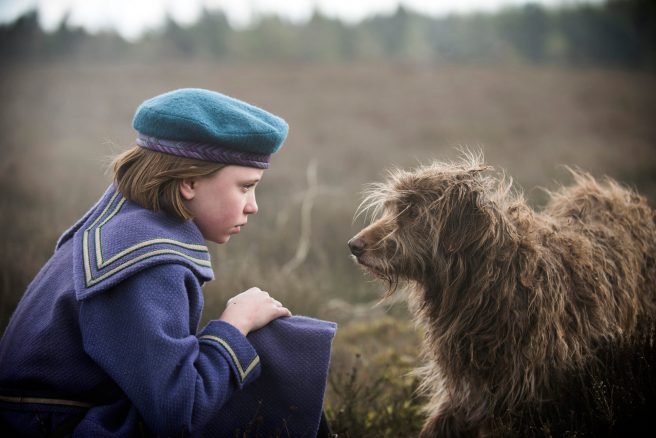
Colin doesn’t get much screen time in the new movie; this makes sense since the story revolves primarily around the three young people: Mary, Colin Craven, and Dickon. The time period has been moved up to 1947, after WWII, instead of the early 1900’s as the book was originally set, and there is a new “character,” a stray dog named Jemima (later Hector, when his gender is confirmed), who helps lead Mary to the garden wall and gate key along with the robin.
Mary with Hector (this scraggly pup is a scene stealer!)
The spirit remains true to the original — the transformation of sickly, morose, isolated children into happy and healthier souls who blossom and thrive with newfound friendship, fresh air, good and nourishing food, and the magic of making things come alive.
Did you know this was the second time Colin appeared in a Secret Garden adaptation? Thirty-three years ago, when he was just 27, he played an adult Colin Craven in the 1987 Hallmark TV movie that’s told as a flashback from the POV of an adult Mary. Colin only appears at the very end, when he reunites with Mary after the war . . . and there’s romance!
Colin as Colin Craven in the 1987 Hallmark TV movie.
So it seems fated that Colin appear in these films, since there is a ‘Colin’ who has a major role in the novel, and he actually played this Colin years ago. Something else that’s cool about the 1987 version is that it was filmed at Highclere Castle. As a Downton Abbey fan, I enjoyed seeing familiar exteriors and interiors. 🙂
In addition to studio sets, the new 2020 movie was filmed at various gardens around England and North Wales, on location in Yorkshire, and at Knebworth House in Hertfordshire. Knebworth is a cool place all its own, known for hosting awesome rock concerts (Stones, Paul McCartney, Elton John, Eric Clapton), and has been a choice setting for many other films, including “Nanny McPhee” and “The King’s Speech.” I imagine Colin feels quite at home there. 🙂
Poor Archibald. He needs some good food to restore his spirits!
The Secret Garden is one of my top three all-time favorite children’s novels, so it’s really icing on the cake to see Colin, however briefly, in two of the movies. Revisiting this classic, whether between the covers or up on a screen, tends to make me hungry because hearty farm-fresh Yorkshire fare helped restore Mary and Colin to optimum health. Okay, time to eat.











 Jama's Alphabet Soup