an unexpected party


“In a hole in the ground there lived a hobbit.”

So begins one of the greatest fantasies ever written. The Hobbit, by J.R.R. Tolkien, is deliciousness in itself, and this prelude to Tolkien’s masterwork trilogy, Lord of the Rings, begins with a tea party!

In Chapter One, “The Unexpected Party,” we are introduced to the diminutive Bilbo Baggins. In the bucolic world of Middle-earth, an entire race of people under four feet tall practice farming, eat at least six meals a day, never have to wear shoes, and prize socializing and comfort above all.

Bilbo is middle-aged and fairly well-to-do, and when the story begins, he is perfectly happy with his life just the way it is. He has two breakfasts, elevenses, lunch, afternoon tea, supper and an after-supper snack — and several pantries in the cellar full of provisions. The first time I read this story back in high school, I immediately wanted to live in The Hill with Bilbo and his friends.  They lived their lives with a certain gentle nobility and simple joy. I could identify with their shyness of the Big People, and found their charm irresistible.
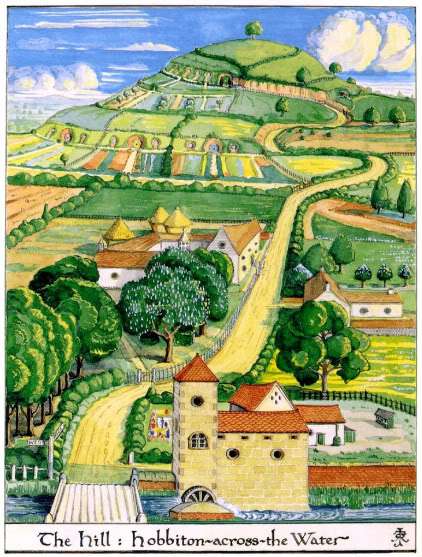
 

“By some curious chance one morning long ago in the quiet of the world, when there was far less noise and more green,” Bilbo was standing at his round, green front door smoking a pipe after breakfast when Gandalf the Wizard comes by.  He was taken with Gandalf because of his reputation for wonderful tales of goblins and wizards and dragons, and for making excellent fireworks. But he politely declines when Gandalf mentions he is seeking someone for an excellent adventure. Before hurrying back inside, he invites Gandalf to tea the following day, regretting it as soon as he shuts the door.
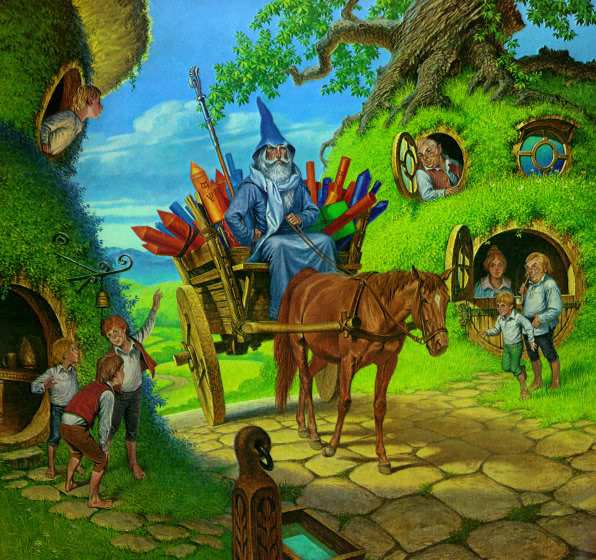
Relieved that he has avoided an unwanted adventure, Bilbo is flummoxed the next day when he is visited by not one or two, but a throng of dwarves — 13 to be exact, who act like they had been expected all along. Bilbo, the good host, invites them to tea, for “what would you do, if an uninvited dwarf came and hung his things up in your hall without a word of explanation?”

Gandalf finally arrives, and all this unexpected company keeps Bilbo hopping. Not only are they devouring all the seed-cakes he had baked especially for his after supper snack, but they keep asking for everything under the sun, except tea:

Some called for ale, and some for porter, and one for coffee, and all of them for cakes . . . A big jug of coffee had just been set in the hearth, the seed-cakes were gone, and the dwarves were starting on a round of buttered scones . . .

After the great Thorin Oakenshield arrives (a very important dwarf), he and Gandalf ask for red wine (no tea, thank you)! And the others, who haven’t stopped eating since they arrived, chime in:

‘And raspberry jam and apple-tart,’ said Bifur.
‘And mince-pies and cheese,’ said Bofur.
‘And pork-pie and salad,’ said Bombur.
‘And more cakes — and ale — and coffee, if you don’t mind,’ called the other dwarves through the door.
‘Put on a few eggs, there’s a good fellow!’ Gandalf called after him, as the hobbit stumped off to the pantries. ‘And just bring out the cold chicken and pickles!’

Feeling more and more put out, Bilbo feels obligated to invite them to supper, and they end up staying overnight (and ordering big breakfasts before retiring). After supper, the dwarves play beautiful music and sing about reclaiming the Lonely Mountain and its treasure, guarded by the dragon, Smaug:

Far over the misty mountains grim
To dungeons deep and caverns dim
We must away, ere break of day,
To win our harps and gold from him!

As they sang the hobbit felt the love of beautiful things made by hands and by cunning and by magic moving through him, a fierce and jealous love, the desire of the hearts of dwarves. Then something Tookish woke up inside him, and he wished to go and see the great mountains, and hear the pine-trees and the waterfalls, and explore the caves, and wear a sword instead of a walking-stick.

And so a somewhat reluctant, home-loving hobbit sets out on a grand adventure, which all began when unexpected guests arrived for tea.

Since one never knows when an opportunity like this will present itself, it is always best to have some seed-cakes on hand. This is an authentic recipe from 16-17th century England adapted for the modern kitchen. This type of sweet, almost bread-like round cake was very common during the Middle Ages, and is also described in Chaucer’s Canterbury Tales.

I think your dwarves will like it!

SEED CAKE

1-1/2 cups unbleached flour
1 cup cracked wheat flour
1 pkg. yeast
1/8 cup warm ale
1/8 tsp salt
4 oz (1 stick) sweet butter
3/4 cup sugar
2 eggs, beaten
1 T seed (crushed anise, caraway, coriander, cardamon, etc.)
1/2 – 1 cup milk

Sift together the flours and salt; set aside in large bowl. Dissolve yeast in warm ale, along with 1/8 tsp of the flour mixture. Cream together the butter and sugar. Beat in eggs and seeds. Make a well in the flour and add the dissolved yeast. Fold flour into yeast mixture, then fold in the butter. Slowly beat in enough milk to make a smooth, thick batter. Pour batter in an 8″ round greased cake pan. Bake in middle of oven at 350 degrees for 45 minutes, or until a toothpick inserted in the center comes out clean. Let cool slightly before turning onto a cake rack.
*

a teaspoon of tea and a few crumbs

“My greatest adventure was undoubtedly Proust.
What is there left to write after that?” ~ Virginia Woolf


Bonjour, Mon Amis!

Today I feel a certain je ne sais quoi.

It began right after I dipped my madeleine into a cup of linden tea.

This is dangerous, I know.

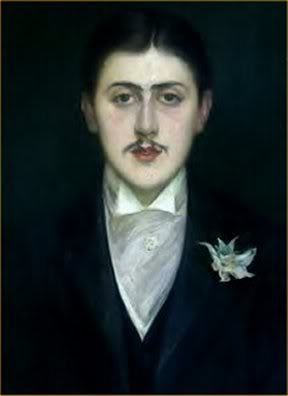
A certain Valentin Louis Georges Eugene Marcel Proust once did this, and he ended up writing 3200 pages.

That’s right. A few crumbs soaked in tea provoked a flood of memories, which became seven volumes* entitled, A La Recherche du Temps Perdu (Remembrance of Things Past, or, more recently translated as, In Search of Lost Time). Published between 1913-1927, this semi-autobiographical novel is the longest ever written. Ever.

Have you read any of it?

I’m feeling guilty that I haven’t. Especially since Graham Greene called Proust, “the greatest novelist of the twentieth century,” and most scholars seem to agree. But am I ready for four million words, and 2,000 literary characters?

Still, I like the tea and madeleine part. I also think that involuntary memory is a pretty cool thing. If you just happen to encounter the right inanimate object, it may provoke a complete memory, pure and untainted, just ripe for your creative powers to turn into art:

She sent for one of those squat, plump cakes called petites madeleines that look as though they have been molded in the grooved valve of a scallop shell . . . I carried to my lips a spoonful of the tea in which I had let soften a bit of madeleine. But at the very instant when the mouthful of tea mixed with cake crumbs touched my palate, I quivered, attentive to the extraordinary thing that was happening inside me. A delicious pleasure had invaded me, isolated me, without my having any notion as to its cause . . .

And suddenly the memory appeared. That taste was the taste of the little piece of madeleine which on Sunday mornings at Combray . . . when I went to say good morning to her in her bedroom, my aunt Leonie would give me after dipping it in her infusion of tea or lime blossom . . . as in that game in which the Japanese amuse themselves by filling a porcelain bowl with water and steeping it in little pieces of paper until then undifferentiated which, the moment they are immersed in it, stretch and bend, take color and distinctive shape, turn into flowers, houses, human figures, firm and recognizable, so now all the flowers in our garden and in M. Swann’s park, and the water lilies on the Vivonne, and the good people of the village and their little dwellings and the church and all of Combray and its surroundings, all of this, acquiring form and solidity, emerged, town and gardens alike, from my cup of tea.  ~ from SWANN’S WAY, by Marcel Proust, translated by Lydia Davis (Viking, 2002). 

A great disparity exists between Proust’s real life and his art. He was a sickly, asthmatic child with an unnatural attachment to his mother — a spoiled sycophant, a poseur, a snob and a hypocrite who squandered his youth trying to gain favor with the idle rich. He wasted his father’s money, suffered a series of unhappy affairs (he was a closet homosexual), and berated himself for not being born into the aristocracy. 

His mother had a huge influence on his imagination and use of memory in writing, but he was not able to effectively bring this retrospective aspect into his work until after she died. While the presence of a person, object, or location provides sensory stimulation, it is the absence of the same that actually catalyzes the imagination — enabling it to sift, enlarge, and shape experience into a form resembling art.

Because of his severe asthma, Proust lived in forced confinement for over a decade, sometimes never leaving his cork-lined bedroom for weeks at a time. There, he transformed a wasted life into a masterwork that explored the many dimensions, layers, and textures possible of his chosen genre. His international reputation as the most influential novelist of the 20th century remains undiminished.

With today’s renewed interest in the memoir, Proust is as popular as ever. Hardcore devotees, such as the members of the Proust Society, meet regularly to discuss the novel in manageable pieces, often devoting years to reach completion. Ultimately, Proust has something for everyone. A 25-year-old reader once called his Remembrance “the ultimate blog.”

MADELEINES
(12 servings)

2 eggs
3/4 tsp vanilla extract
1/8 tsp salt
1/3 cup white sugar
1/2 cup all purpose flour
1 T lemon zest
1/4 cup butter
powdered sugar for decoration

1. Preheat oven to 375 degrees. Butter and flour 12 madeleine molds; set aside.

2. Melt butter and let cool to room temperature.

3. In a small mixing bowl, beat eggs, vanilla and salt at high speed until light.

4. Beating constantly, gradually add sugar, and continue beating at high speed until mixture is thick and pale and ribbons form in bowl when beaters are lifted, 5 to 10 minutes.

5. Sift flour into egg mixture 1/3 at a time, gently folding after each addition.

6. Add lemon zest and pour melted butter around edge of batter. Quickly but gently fold butter into batter. Spoon batter into molds; it will mound slightly above tops.

7. Bake 14 to 17 minutes, or until cakes are golden and the tops spring back when gently pressed with your fingertip.

8. Use the tip of the knife to loosen madeleines from pan; invert onto rack. Immediately sprinkle warm cookies with powdered sugar. Madeleines are best eaten the day they’re baked.

9. Variation: Chocolate Madeleines: Omit lemon zest. Increase sugar to 1/2 cup. Substitute 1/4 cup unsweetened cocoa powder for 2 T of the flour; sift into batter with flour.

TIPS: Lemon-butter flavor is enhanced when madeleine is dipped into lime-flower (linden) tea, aka tilleul. Savor the experience, and record your memories!

***SSHHHH! Don’t tell! There is evidence to suggest that Proust did not eat a madeleine, but a soggy piece of toast instead. Tant pis!

 * In Search of Lost Time – Volume Titles:

Swann’s Way
Within a Budding Grove
The Guermantes Way
Sodom and Gomorrah
The Captive
The Fugitive
Time Regained

chocolate in kids’ books: fantasy or fallacy?


Um, some of you may have noticed that I’ve been a teeny bit obsessed with chocolate lately.

I’ve been dipping my nose in chocolate history and folklorepsychoanalyzing my relationship with chocolate, and trying hard to swallow my guilt. I’ve also been reading some well-known chocolatey fiction written for kids. 

Friends, I’ve detected a disturbing trend. 

Remember how I tried to figure out where my guilt came from? 

It could have been books!

Granted, I can’t remember exactly what I was reading back in the Pleistocene Period, when I was 8 or 9. But recently, I did re-read A Snout for ChocolateThe Chocolate Touch, Chocolate Fever, and Charlie and the Chocolate Factory. It’s pretty hard to miss these titles if you’re a kid between the ages of 6 and 10, and like every other human being on earth, inextricably drawn to anything chocolate.

First off, all these books are fantasies. Makes sense. Chocolate is the stuff of fantasy, at any age. It’s also something everyone covets. Who doesn’t dream of having as much chocolate as they like, without any dire consequences? So, in all these stories, chocolate is held up as the ideal prize, the desirable object, definitely something to shoot for.

And, in all these stories, the characters with a strong love for chocolate are held up as examples of what not to do. They all have to learn their lessons about being greedy, and what happens when you love something too much.

Take A Snout for Chocolate, by Denys Cazet (HarperCollins, 2006). In this early reader (ages 4-8), Grandpa decides to entertain his poxed grandson, Barney, with a funny story about the time he was a firefighter and had to rescue obese, haughty Mrs. Piggerman, whose snout gets stuck to a frozen box of chocolates. Grandpa uses a hairdryer to melt the ice, so that Mrs. Piggerman can be pried from the refrigerator and lugged outside by five or six firemen. Grandpa says it would have been much easier to move the refrigerator.                     Cover Image

Just a funny story about a fat pig who ate too much? Or the eternal stereotype of the fat woman gorging herself on bonbons? When Grandpa first enters Mrs. Piggerman’s house, he sees candy wrappers strewn about and mutters, “Uh-oh, someone is off their diet.” Then when the firemen enter her kitchen, all they see is her huge backside. Too much chocolate is to blame for her size and predicament.

The Chocolate Touch, by Patrick Skene Catling (Morrow, 1952), and Chocolate Fever, by Robert Kimmel Smith (1972), both geared for early middle grade readers, feature similiar themes. In Catling’s book, a take-off on the King Midas legend, John Midas is greedy about all candy, but chocolate in particular. One day he finds a silver coin and wanders into a candy shop, where he buys a small ball of chocolate wrapped in gold foil. When he finally tastes it, he declares it to be the most chocolatey chocolate ever.

           Cover Image      Cover Image

But from then on, everything he touches turns to chocolate — his toothpaste, his pencil and notebook, all his food. Chocolate becomes the ultimate curse when he kisses his mother and she turns into a lifeless, chocolate statue. He rushes back to the candy shop and is told he must choose between losing his chocolate touch or his mother. Though he dreads the thought of any more all-chocolate meals, he has finally realized his selfish greed and begs for the return of his mother. 

In Chocolate Fever, Henry is similarly obsessed with chocolate, but Kimmel Smith tries to debunk a few anti-chocolate myths by stating early on:

It didn’t make him fat.
It didn’t hurt his teeth.
It didn’t stunt his growth.
It didn’t harm his skin.
Most of all, it never, never gave him a bellyache.

Still, Henry pays the price for his undying chocolate love when he breaks out in brown spots all over his body, which even smell like chocolate. The doctors are flummoxed but fascinated and treat Henry like a circus freak. Afraid and tired of being being poked and prodded, Henry runs away, is picked up by a kind trucker, and gets hijacked by some thieves, all the while learning lessons about moderation, courage, and prejudice. The cure for chocolate fever? Vanilla pills. The message? Chocolate = bad. Vanilla (or any other flavor) = good.

Finally, I looked at one of my all-time favorite children’s books, Charlie and the Chocolate Factory by Roald Dahl (Knopf, 1964). Hands down, this is THE ultimate chocolate fantasy, geared for upper middle grade readers. Dahl’s descriptions of his chocolate factory paradise never lose their appeal or deliciousness. Who wouldn’t love a chocolate river, invisible chocolate bars for eating in class, a craggy fudge mountain, or chocolate being sent to you through your television?

                    Cover Image
 
But in Dahl’s book, the main character, Charlie, is not a chocolate glutton. He is, in fact, a poor boy living in a small house with his parents and two sets of grandparents. They have very little to eat and survive mostly on cabbage soup. His bleak, Dickensian existence garners so much sympathy from the reader, that when he gets the final golden ticket enabling him to visit Willy Wonka’s chocolate factory, we are more than overjoyed. It also helps that Charlie appears to be unselfish, mannerly and very humble.

Not so, Augustus Gloop, another golden ticket winner. He is the token fat boy in the story, whose only hobby is eating, especially chocolate bars. When he contaminates the river of hot chocolate by lapping it up like a dog, he gets sucked up a glass pipe, and does not reappear again until the story’s end, thin and repentant. Once again, chocolate gets punished.

But why not Charlie? Because he’s perfect in every way. He is the only child who does not meet an unsavory end, like Veruca Salt, the spoiled brat, who gets thrown down a rubbish chute by a hundred squirrels; or Violet Beauregarde, who turns into a huge blueberry because of her gum chomping obsession, or Mike Teavee, who gets sent out of this world by T.V., shrinks, and gets stretched a little too much.

I love Dahl’s sardonic wit and wild imagination, and understand his desire to instill lessons to be learned in the story. Though Charlie truly loves chocolate, he never had the chance to become greedy about it, since he only ate one chocolate bar every birthday. All the other children in the story are used for Dahl’s moralizing, and Charlie emerges unscathed, as he inherits the factory from Mr. Wonka at the end.

Does this mean that only deprived, humble children deserve chocolate? We get the impression that once Charlie and his family move into the factory, they will subsist on candy. No punishment for them, though, they’ve suffered enough already.

Children love these books. They laugh at Dahl’s wacky characters and can sympathize with both John Midas and Henry Green. They can see the consequences of greediness and excess from a safe distance. Those are all good things. But I wonder about the use, time and again, of fat kids being associated with chocolate, especially the image of a fat female pig. With all these satiric fantasies, chocolate is the common scapegoat, as it’s been for the last six decades. It’s very easy to internalize chocolate’s negative connotations without even realizing it. 

Women, especially, seem especially vulnerable:

I’d really like a piece of chocolate, but I really shouldn’t.
I’ve had a hard day; I deserve some chocolate.
Something this delicious has got to be sinful.
A minute on the lips, forever on the hips.

The ultimate fantasy still seems to be the ultimate punishment.

Well, I tell myself, no wonder. 

Chocolate, forgive us.


a heapin’ helpin’ of almanzo’s fried apples ‘n’ onions

Guess who came to dinner last night?  Almanzo Wilder! Well, sort of.

Since this is autumn and harvest season and all, I was in the mood to reread FARMER BOY.  Of course I was shamelessly salivating all the way through, as Laura described meal after meal full of farm-fresh produce. I marveled at Almanzo’s ability to polish off huge quantities of food, and still have room for pie (usually more than one piece)!  It was all I could do to keep myself from running to the farmer’s market, loading up on everything, then gorging myself.

I resisted this compulsion until I came to this passage

 “He knelt on the ice, pushing sawdust into the cracks with his mittened hands, and pounding it down with a stick as fast as he could, and he asked Royal,

 ‘What would you like best to eat?’

They talked about spareribs, and turkey with dressing, and baked beans, and crackling cornbread, and other good things. But Almanzo said that what he liked most in the world was fried apples ‘n’ onions.

When, at last, they went in to dinner, there on the table was a big dish of them! Mother knew what he liked best, and she had cooked it for him.”

Apples and onions? How wholesome! How healthy!! I could do that! This one simple dish really spoke to me. Onions from the dark earth mingling with apples that grew high in the sky. I loved that beautiful completeness, one which I discovered over and over again in the book.

The story takes place in 1866, when Almanzo was nine, one year before Laura was born.  The Wilders had a dairy farm up in Malone, New York, which in its prosperous years provided a sharp contrast to Laura’s pioneering childhood. Food was plentiful on the Wilder farm; lots to go around for Almanzo and his older brother, Royal, and sisters, Eliza Jane and Alice. But Almanzo was always hungry,and his insides gnawed and twisted as he waited for his turn to be served. Being the youngest, he always had to wait the longest for his food. Laura masterfully builds up this anticipation (the most effective of literary appetizers), so that when we finally read about the meal, it fills us up to the brim. 

Continue reading