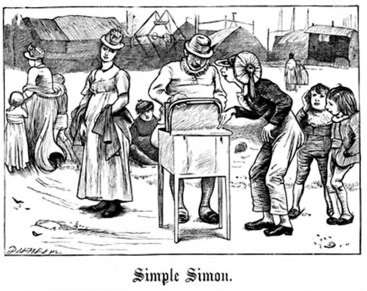
Simple Simon met a pieman going to the fair;
Said Simple Simon to the pieman, “Let me taste your ware.”
Said the pieman to Simple Simon, “Show me first your penny.”
Said Simple Simon to the pieman, “Sir, I have not any!
Even if you can’t remember the very first pie you ever sank your teeth into, chances are very good that you can recite the most well known pie encrusted nursery rhymes with a certain flair and bravado.
Whether you favor Simple Simon, Georgie Porgie, Little Jack Horner, or Sing a Song of Sixpence, let’s face it — they all taste good rolling around in our mouths, evoking happy childhood days when we cared more about cadence than calories.
As I mentioned back in November when I did Mother Goose Week, many of these seemingly innocuous rhymes have interesting histories and were written to satirize or immortalize political events. There really was a Jack Horner, for example; he was a steward to Richard Whiting, Bishop of Glastonbury (1461-1539). When Henry VIII began seizing all the abbeys for their gold and estates, Whiting tried to bribe the crown by offering the deeds to 12 manors, secreted in a large pie entrusted to Horner.On the way to London, Horner knew this bribe was futile, so he pulled out the deed for the “plum” of all estates, Mells Manor. Whiting was accused of treason and his abbey was destroyed, but Horner moved into Mells, where his descendants lived until the 20th century (no doubt enjoying all manner of pies).
But my favorite pieful nursery rhyme is Sing a Song of Sixpence:
Sing a song of sixpence a pocketful of rye,
Four and twenty blackbirds baked in a pie.
When the pie was opened the birds began to sing,
Oh wasn’t that a dainty dish to set before the king?
The king was in his counting house counting all his money,
The queen was in the parlour eating bread and honey.
The maid was in the garden hanging out the clothes,
When down came a blackbird and pecked off her nose!
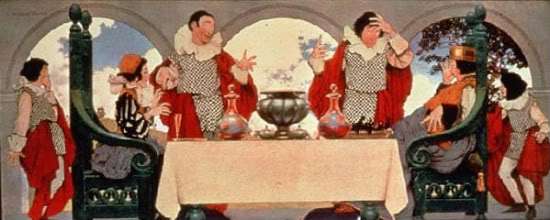
Apparently hiding living things in pie was pretty common in olden times as a form of banquet entertainment. Just when I thought live blackbirds were a pretty cool surprise, I come to find they also included other small animals, such as frogs, turtles and rabbits. The ultimate surprise, however, involved small people! Yes, diminutive individuals were hidden in pies, popping out to the delight of assembled guests, after which time they might stroll up and down the table doing tricks or reciting poetry.
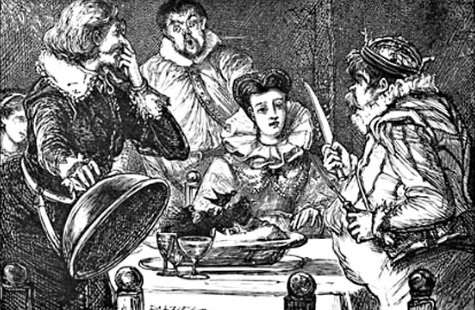
Probably the most famous of these little pie poppers was Jeffrey Hudson (1619 -1682), whose birthday is this Saturday. (Be sure to sing the birthday song in his honor, for he deserves your remembrance.)
At age seven, Jeffrey was served in a cold pie to surprise King Charles I and Queen Henrietta Maria (15 at the time) at a banquet given in their honor by the Duke and Duchess of Birmingham. Before Henrietta could cut into the pie, Jeffrey popped out, a perfectly proportioned 18″ little man, dressed in a suit of miniature armour. The Duke graciously presented Jeffrey to Henrietta as a gift, since upon seeing him she was keen to add him to her collection of oddities. Jeffrey was dubbed “Lord Minimus,” and became the Queen’s dwarf, trusted companion and court favorite for 18 years. He was charming, delightful and even inspired several poems and narratives.

Queen Henrietta Maria with Jeffrey Hudson by Van Dyck (1633) National Gallery, Washington, D.C.
Apparently he didn’t grow another inch until after he left court, was kidnapped by pirates twice, and descended into slavery for 25 years. I guess during this time he wasn’t called upon to hide in any more pies, so he allowed himself to grow another 45 inches. Though Simon’s rhyme is more well-known, I vote for Jeffrey Hudson as the ultimate pieman!
So, my friends, if your cherry is the pits, your custard won’t pass muster, and, God help you, your pecan has everyone positively peeved, consider prebaking a double crust, and then filling it with one or two of your shorter friends. This will guarantee your stature as an uber hostess, and no one will ever call you flaky.
Seconds and thirds:
 If you’re in a crafty mood, try making your own blackbird pie out of construction paper and a few art supplies.
Order this cute blackbird pie print by Debbi Hubs.
If you’re in the mood to let off a little steam, get a ceramic pie bird.
Best of all, for some musical pie, watch Nina Mae McKinney and the Nicholas Brothers in this fabulous old time soundie, “Pie Pie Blackbirds,” circa 1932! Sure to get your feet a tappin’ . . .
(Thanks to Linda Stradley, “The History of Pie,” What’s Cooking America, 2004.)


 Jama's Alphabet Soup