[review + recipe + giveaway] Awesome Earth by Joan Bransfield Graham and Tania García

I’ve always been fascinated by volcanoes. When you grow up in Hawaiʻi, it’s a point of pride being able to claim that your home state has the largest active volcano on Earth (Mauna Loa), and it’s also the only state situated entirely on an archipelago. Kīlauea’s most recent (and ongoing) eruption on the Big Island started in December 2024, while Mauna Loa last spouted off in 2022.

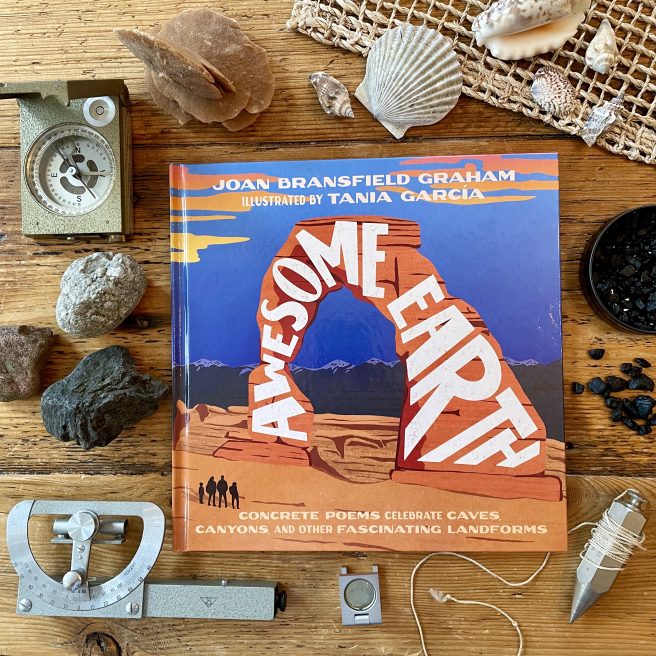
The breathtaking spectacle of molten lava slowly making its way to the ocean and thereafter creating new land is both humbling and awe-inspiring. When I read Joan Bransfield Graham and Tania García’s brand new poetry picture book, Awesome Earth: Concrete Poems Celebrate Caves, Canyons and Other Fascinating Landforms (Clarion Books, 2025), I was reminded of how our home planet is an ever evolving, dynamic entity full of beauty and wonder.
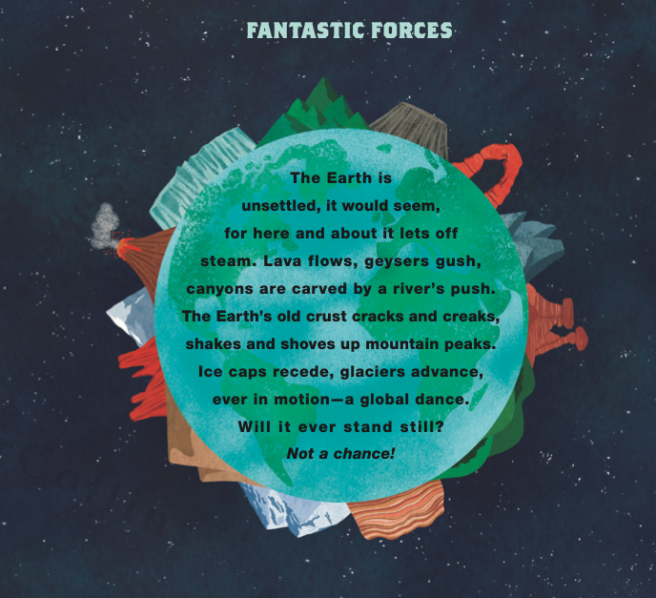
FANTASTIC FORCES

The earth is
unsettled, it would seem,
for here and about it lets off
steam. Lava flows, geysers gush,
canyons are carved by a river's push.
The Earth's old crust cracks and creaks,
shakes and shoves up mountain peaks.
Ice caps recede, glaciers advance,
ever in motion -- a global dance.
Will it ever stand still?
Not a chance!

Fun to read and loaded with fascinating information, Awesome Earth is Graham’s valentine to the planet and a budding geologist’s dream. Her use of concrete poetry to describe a variety of landforms is the perfect way to celebrate their physical attributes, whether Continent or Island, Hill or Valley, Plain or Plateau. After all, landforms are all about size, shape, and structure; they themselves are a kind of topographical poetry.

Kids will find the 20+ poems delightfully accessible as Graham strikes a friendly tone via (mostly) first person point of view and personification to establish a sense of immediacy and direct engagement. Who could resist an amiable Island explaining the difference between his continental and oceanic ilk, or smaller “mini-me” versions of himself? He even invites readers to visit sometime — so charming!
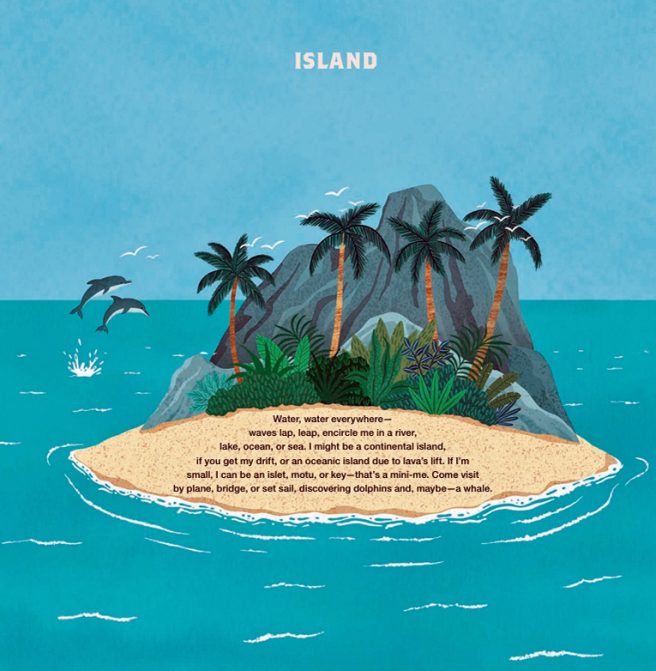
We also get a sense of Mountain’s pride and majesty, as he seeks the sky, “enrobed with snow,” piercing the clouds, and I’m only too willing to forgive Peninsula’s boast: “I’ve got miles and miles of rocky or sandy, dandy coast!”

Continue reading
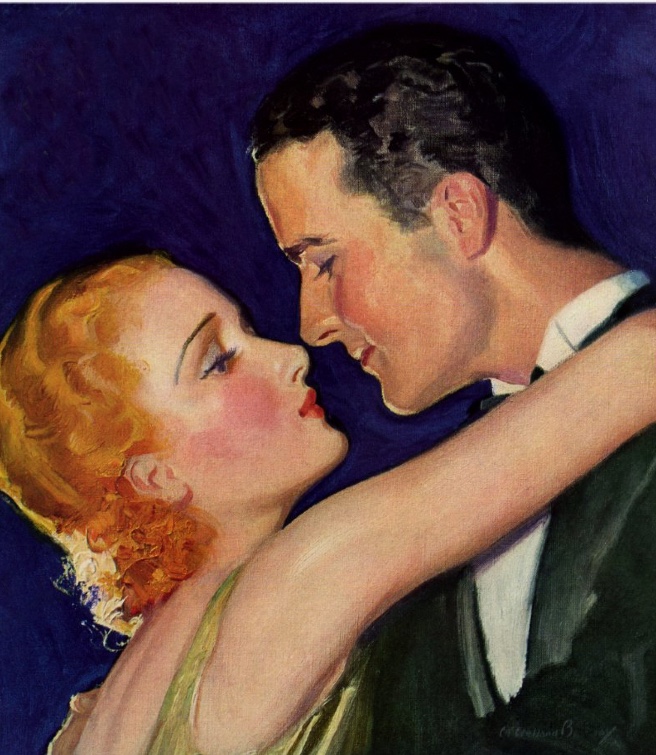
you say orange juice, i say eggplant (let’s call it love)

NOT A HOLLYWOOD MOVIE
by Lori Levy


We talk about love.
Sometimes I love you more, sometimes less, he says.
I feel the same way.
Think spectrum, range, hot warm cold
as in water from a faucet, the flow increasing, decreasing,
the temperature not always perfect, but good enough.
Or we could say it's a matter of orange juice, eggplant . . .

He is groggy in the morning. I wake up renewed and ready for the day.
Ready, first thing, to squeeze oranges for him.
He can't begin, doesn't want to begin,
without a glass of fresh juice
brought to him in bed. A simple act for me.
For him, a big ahh, quenching, invigorating.

I don't have patience to fry eggplants for dinner.
He does. He stands by the stove, tender with the slices,
spicing them exactly right, turning them exactly on time.
I devour the eggplant, stuff the browned slices into pita bread
with cheese or eggs, tomatoes, hummus. With anything, everything.

Some moments we meld --- grateful
to be living this life together.
Other times we argue like kids.
I tell him his way is mood-based, head in the sand, slow.
He says I have no priorities:
everything is important, demands attention.
Sometimes you can't stand me, right? he asks.
We laugh. This, too, is true.

Still, he craves my orange juice, I could die for his eggplant.
Hunger, Thirst. We could call it love.

~ as published by Young Ravens Literary Review (2020)

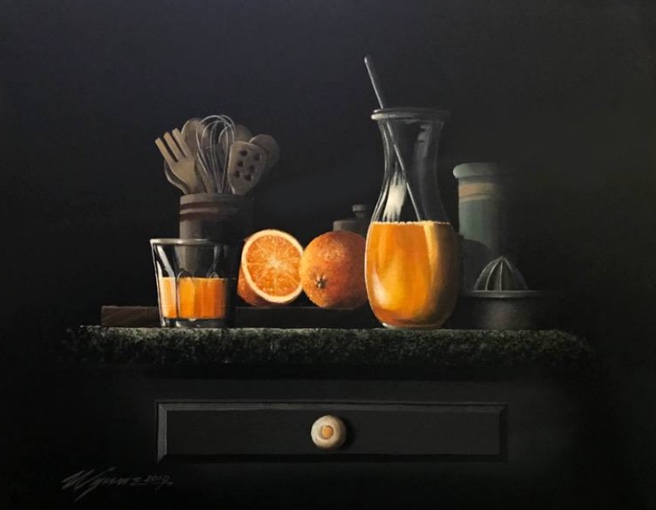
“Morning Juice” by Robert Wynne

*

Continue reading

reveling in Grant Snider’s Poetry Comics

We don’t usually speak of poetry and comics in the same breath. We may like and enjoy both, but tend to approach each separately on its own terms. Purists may even consider poetry and comics to be on opposite ends of the literary spectrum (gasp!).

Yet Grant Snider sees things differently. The popular “Incidental Comics” creator was keen on finding a closer connection between poetry and comics, as both “contain condensed language, strong imagery, and ideally leave the reader with a new insight.”

Author-illustrator, cartoonist, comic strip writer and orthodontist Grant Snider lives with his wife and five children in Wichita, Kansas.

Targeted for middle grade readers, Snider’s fun and inventive collection demonstrates this perfectly with an entirely new way of approaching and appreciating poetry. Did you ever think it would be possible to read a poem in a series of comic panels? Me neither. 🙂

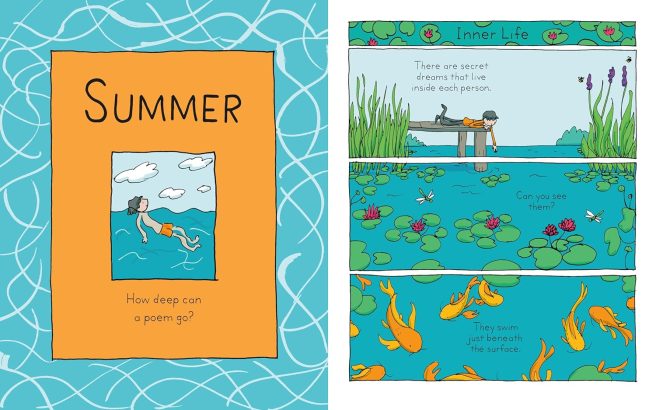
The poems in Poetry Comics (Chronicle Books, 2024) are organized by season, with each section offering insights into the poetry writing process. Title pages inspire and direct:

Spring: “I want to put down on paper the feeling of fresh possibilities.”

Summer: “How deep can a poem go?”

Fall: “I will wait for a poem to fall into my open arms.”

Winter: “A new page — my words huddle close to keep warm.”

Each season then ends with a variation of “How to Write a Poem.”

HOW TO WRITE A POEM #1

Find a quiet place.
A sharp pencil.
A blank page.
Sit still.
Keep quiet.
Wait.
A poem will rush in to fill the space.

Many of the poems are about nature (snails, tadpoles, butterflies, trees), while others examine universal human emotions and observations via kid-centric activities like running through sprinklers, waiting for the school bus, playing basketball, riding on roller coasters, climbing trees, reading good books, picking the perfect pumpkin, playing in the snow. Each poem is a sensorial impression of the here and now.

Continue reading

2024 Poetry Friday Archive

1. “Breakfast” by Merrill Leffler

2. “Eleanor Makes Macaroons” by James Russell Lowell

3. “Exchange of Letters” by Wendy Cope

4. “My Mother’s Colander” by Dorianne Laux

5. TAXI, GO! by Patricia Toht and Maria Karipidou

6. “Peeps” by Judy Fort Brenneman

7. “Waiting for Waffles” by Pam Lewis

8. “A Date with Spring” by John Agard, “The Trees” by Philip Larkin, and “Child’s Song in Spring” by Edith Nesbit

9. 2024 National Poetry Month Kidlitosphere Roundup

10. “Cinnamon” by Judy Lorenzen

11. BLESS OUR PETS by Lee Bennett Hopkins and Lita Judge

12. “The Orange” by Wendy Cope

13. PIE-RATS by Lisa Frenkel Riddiough and David Mottram

14. “Ode to Gray” by Dorianne Laux

15. “The Lesson” by Paola Bruni and “Ask Me” by Susan Gleason (from The Wonder of Small Things)

16. MISS MACDONALD HAS A FARM by Kalee Gwarjanski and Elizabet Vukovic

17.. “Pajama Days” by Joanna Zarkadas

18. ALOHA EVERYTHING by Kaylin Melia George and Mae Waite

19. RUMI: Poet of Joy and Love by Rashin Kheiriyeh

20. Two Barbara Crooker poems

21. “The Nomenclature of Color” by Richard Jones

22. PASTA PASTA LOTSA PASTA by Aimee Lucido and Mavisu Demirag

23. “Come Eat With Me and Be My Love” by Cathy Bryant

24. THE FIESTA OF THE PUPUSAS: El Salvador by Jorge Argueta and Gabriela Moran

25. “Blues” by Elizabeth Alexander

26. “Rationalization” by Betsey Cullen + Poetry Friday Roundup

27. Clements Brothers Blues

28. “Blue” by Joni Mitchell

29. “Blue Stars” by Richard Jones

30. “Fall Sanctuary” by Kory Wells

31. CLARA’S KOOKY COMPENDIUM OF THIMBLETHOUGHTS AND WONDERFUZZ by Sylvia Vardell and Janet Wong

32. GRAND OLD OAK AND THE BIRTHDAY BALL by Rachel Piercey and Freya Hartas

33. ANIMAL ALBUMS FROM A to Z by Cece Bell

34. “No More Nature Poems” by Alice N. Persons


no more nature poems?

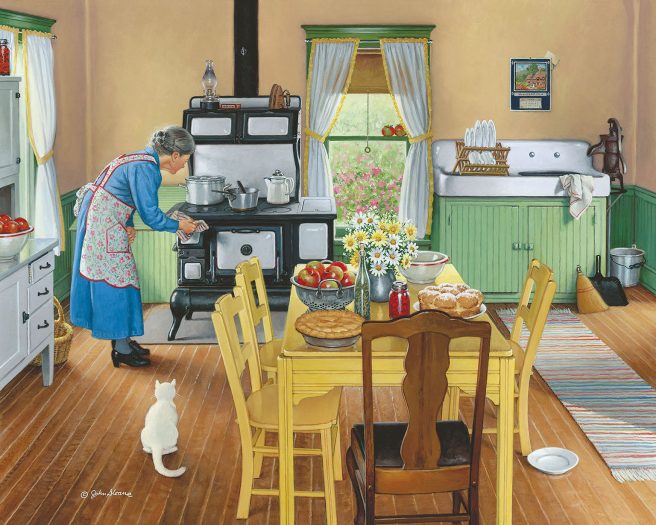
“Grandma’s Kitchen” by John Sloane.
NO MORE NATURE POEMS
by Alice N. Persons


Okay, plenty of us like to look at birds.
Flowers are swell, sunsets,
trees, the stars -- all dandy.
But let's face it --
it's all been said, described,
covered
by thousands of writers.
What could we possibly say
that would improve
on the ancient Chinese poets, anyway?
I concede that a few poets since Li Po
have hit one out of the park,
but how many of us are Hopkins or Oliver?

I'm a city woman.
Give me poems with kitchen tables,
toast crumbs,
books and magazines,
Grandmother's plates,
postcards from Florida,
baby pictures,
Scrabble tiles,
the smell of Sunday roast,
the feel of the seats in Dad's old car,
the Thanksgiving menu that never changed

what it was like to leave,
how it feels to go back;
what you left,
what you carry with you --
all the messy, vivid indoor life
of the heart.

~ from Thank Your Lucky Stars (Moon Pie Press, 2011).
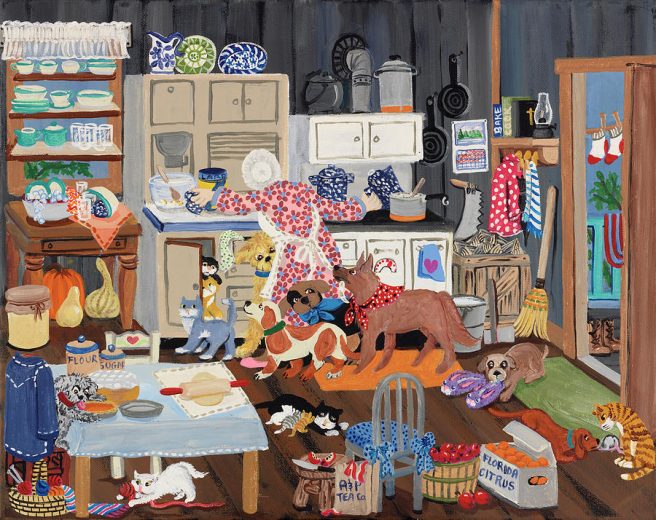
“Grandma’s Kitchen” by Carol Salas.

*

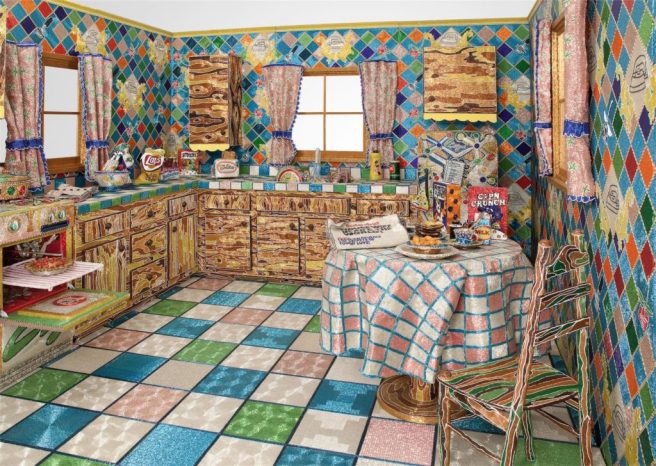
“Kitchen” by Liza Lou (1999).

Conversational and plain-spoken as always, Persons has a knack for fresh points of view that give us pause but ultimately ring true.

Continue reading