There’s nothing like having a party guest gleefully glide into your kitchen with a big smile, a cool poem, and a pot of soup! And this girl knows how to party!
Heidi’s critically acclaimed debut picture book, Come to My Party (Henry Holt, 2004), is a jubilant montage of rollicky-fun shape poems, with words curving and careening and wiggling and drifting and see-sawing across the pages — a perfect reflection of Heidi herself, who’s a nature-lovin’, rock climbin’, kick boxin’ children’s author always on the move. Zip, Pump, Fly! I’m giddy with excitement that Heidi decided to come to our party today!
She’s brought an ice skating poem that proves she’s just as agile and graceful on the page as she is in the rink. She was also the perfect person to co-edit an upcoming sports-themed poetry anthology. But I’ll let her tell you more about that project after serving up her poem.
“Little is nobler than presiding over a kettle of homemade soup.” ~ Marty Martindale, food writer and bon vivant
As you can see if you peek behind Chef Paddington through the dining room window, we recently had some proper snow, something that always happens in these parts during the third week of January.
I couldn’t have ordered more perfect weather for making the vegetable soup that’s included in Melissa Iwai’s charming picture book, Soup Day, a recipe I’d been wanting to try ever since I reviewed the book last year. Of course one doesn’t have to wait for snow to make soup, but in this case it deepened my connection to this sweet story of a mother and daughter in the kitchen.
The recipe is designed with simplicity, common ingredients, and child participation in mind. As the story suggests, asking hungry munchkins to help select colorful veggies at the grocers and later allowing them (with an adult’s guiding hand) to slice the soft ingredients like mushroom and zucchini, enables them to master new skills and develop a sense of pride. Melissa admits this is how she got her son Jamie to eat mushrooms!
And I say there is nothing more endearing than a college student learning how to make his first soup from his mother and his aunt. Via laptop, of course.
I was tickled pink to find Daniel Nyikos’s poem happily simmering over at Ted Kooser’s American Life in Poetry. Love the juxtaposition of old world and new, the easy family banter, and proof once again that love is the best seasoning for any soup.
POTATO SOUP by Daniel Nyikos
I set up my computer and webcam in the kitchen
so I can ask my mother’s and aunt’s advice
as I cook soup for the first time alone.
My mother is in Utah. My aunt is in Hungary.
I show the onions to my mother with the webcam.
“Cut them smaller,” she advises.
“You only need a taste.”
I chop potatoes as the onions fry in my pan.
When I say I have no paprika to add to the broth,
they argue whether it can be called potato soup.
My mother says it will be white potato soup,
my aunt says potato soup must be red.
When I add sliced peppers, I ask many times
if I should put the water in now,
but they both say to wait until I add the potatoes.
I add Polish sausage because I can’t find Hungarian,
Daniel’s poem prompted a recipe search for Hungarian Potato Soup. There were many variations, of course, some were clear and some were creamy. Some were simple concoctions of potatoes, water, milk, onions, salt and paprika — while others called for sour cream, celery, tomatoes, even garlic.
I also learned a bit more about Hungarian paprika and its varying degrees of hotness. Didn’t want to set my mouth on fire, so with apologies to Daniel’s aunt, I adapted a simple crock pot recipe and used both hot and sweet paprika. Like Daniel, I couldn’t find any Hungarian sausage, so substituted Polish Kielbasa. And like Daniel’s, my soup eventually turned into a “stew.” But it made a nice winter’s meal, along with crusty bread and fresh creamery butter. Next time, I’ll experiment with smoky paprika. I feel like part of the family now ☺.
*
HUNGARIAN POTATO AND SAUSAGE SOUP
5-6 russet potatoes, peeled and cut into 2″ cubes 4 cups low-sodium chicken broth 1 tablespoon sweet paprika 1 teaspoon hot paprika 1 teaspoon celery seeds 1/2 teaspoon salt 1 tablespoon olive oil 1 white onion, finely chopped 2 tablespoons finely chopped dill 1/8 teaspoon ground nutmeg 1 cup fat-free or low-fat milk 1 ring turkey kielbasa
Place potatoes, broth, paprikas, celery seeds and salt in 4-quart or large slow cooker. Stir to combine.
Heat oil in medium skillet over medium-high heat. Add onion and sauté until translucent, about 5 minutes. Transfer to cooker.
Cover. Cook on low 4 to 6 hours, or until potatoes are tender. Stir to break up potatoes into broth for a slightly chunky consistency.
Add dill, nutmeg, and freshly ground black pepper to taste. Stir in milk. Add sliced sausage and cover. Cook 20 to 30 more minutes, or until heated through.
————————————————————————-
Poet and fiction writer Daniel Nyikos was born in Germany to a Hungarian mother and an American father of Hungarian descent. He earned his B.A. and M.A. at Utah State University and is currently working towards his doctorate in Creative Writing at the University of Nebraska. I wonder if he has finally perfected his Potato Soup?
What was the first soup you ever made? Who taught you the recipe?
♥ Talented poet, proud grandmother and excellent cook Elaine Magliaro is hosting today’s Poetry Friday Roundup at Wild Rose Reader. Get thee hence and check out the full menu of poetic goodness being served up in the blogosphere this week.
Today I’m pleased to share a haibun by New Jersey poet Penny Harter, written just two months after she lost her husband Bill to cancer in 2008.
photo via Miss Mae
With tomorrow’s full moon and total lunar eclipse, an event ushering in winter’s cold and days when nights are at their longest and darkest, it seems especially fitting to reflect on how we process grief and loss.
For one who is grieving, the darkness seems interminable. What solace can a Long Night’s Moon, which remains in the sky all night and so high above the horizon, offer? Will the ritual of making a familiar soup bring comfort or revelation?
“It takes courage to grow up and be who you really are.” ~ E.E. Cummings (1894-1962)
It’s his fault I sign my name in lower case. Ever since I first encountered his “little lame balloon man” in high school, Cummings has remained one of my top five favorite poets of all time.
I find it interesting that while he loved to experiment wildly with form, diction and syntax, his subjects were pretty traditional — nature (especially Spring), childhood, and love. He was such a great champion of individuality, someone who believed poetry was a process rather than a product, and since he was also a painter, it makes perfect sense that he created poems as visual objects on the page. How could I not love such an out and out lyricist who toyed with typography? A playful innovator with a joyous childlike perception, Cummings infused his poetry with his own brand of vitality that never loses its freshness.


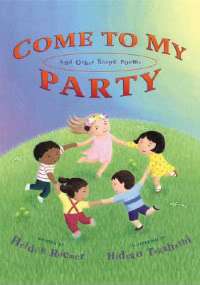 Heidi’s critically acclaimed debut picture book, Come to My Party (Henry Holt, 2004), is a jubilant montage of rollicky-fun shape poems, with words curving and careening and wiggling and drifting and see-sawing across the pages — a perfect reflection of Heidi herself, who’s a nature-lovin’, rock climbin’, kick boxin’ children’s author always on the move. Zip, Pump, Fly! I’m giddy with excitement that Heidi decided to come to our party today!




 believed poetry was a process rather than a product, and since he was also a painter, it makes perfect sense that he created poems as visual objects on the page. How could I not love such an out and out lyricist who toyed with typography? A playful innovator with a joyous childlike perception, Cummings infused his poetry with his own brand of vitality that never loses its freshness.
 Jama's Alphabet Soup