I’ve long been a big fan of illustrated cookbooks, often adding them to my collection without ever intending to make any of the recipes. I’m content to ooh and ahh over the beautiful art, happily satisfying my visual cravings.
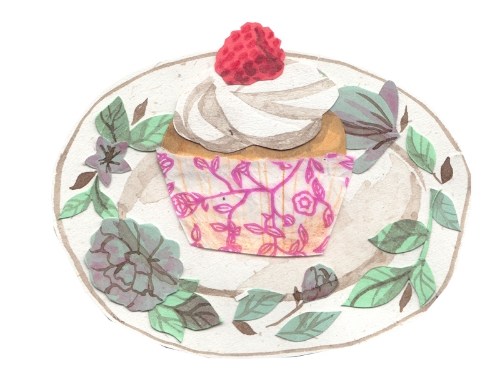
Emma was actually commissioned by the publisher to do the illustrations while in her last year at university; the recipes themselves were created by a team of recipe writers whose names, oddly enough, do not appear on the cover of the book. But Emma’s name is there, front and center, and she definitely deserves the spotlight, because it is her work that really makes this book shine.
In a perfect world, there’d be a poetry pie shop just minutes from home, where the heavenly aroma of freshly baked double crust fruit pies would lovingly call your name at precisely the right times.
Willingly seduced by juiced up sour cherries and rhubarb dallying with sugar, nutmeg and almond extract, or golden ripe peaches yielding to clover honey and ginger, you’d eagerly float on over, happily anticipating that blissful moment when you can wrap your mind and lips around a good helping of emotional truth.
Although most of us aren’t lucky enough to have such a magical shop nearby, we can still feast on the next best thing: Kate Lebo’s, A Commonplace Book of Pie (Chin Music Press, 2013), an uncommonly quirky, thought-provoking collection of 25 prose poems, cool ephemera, baking tips, and mouthwatering recipes stunningly illustrated by Jessica Lynn Bonin.
Suffering from a little “Downton Abbey” withdrawal? No need to get your knickers in a twist. Now you can nibble on this new gouda picture book until Series 4 debuts in the U.S. on January 5, 2014.
Whether you be man or mouse, Mouseton Abbey: The Missing Diamond by Joanna Bicknell, Nick Page and Tim Hutchinson (Make Believe Ideas, 2013), is sure to get your whiskers twitching with its veddy British tongue-in-cheese humor.
Resident family at Mouseton AbbeyThe staff
Whoever said, “when the cat’s away, the mice will play,” knew only half the story. Not only are there mice in this house, they own the place, which is not too shabby considering it dates back to the 13th century and now has over 300 rooms.
Thanks to Diane Shipley DeCillis, we now know why the course of true love never did run smooth.
Curtain up!
* * *
via Da Silvano
OPERA BUFFA
At La Dolce Vita, in the village,
the gnocchi lifts itself off the fork,
floats like a cloud in your mouth,
the marinara so fresh,
it ripens the tomatoes, garlic
and basil right on your tongue.
Clemenza’s in the kitchen
stirring the sauce,
telling everyone he really doesn’t eat
that much, it’s the fumes
that have permeated his body,
gotten under his skin
and made him fat.
My date Antonio closes his eyes
after each bite, groans, Marona, this is as good
as my mother’s.
Satisfied, he lays his folded napkin
on the empty plate and slumps
in the chair while I,
having saved room,
crane my neck looking for the waiter. What, you want dessert too?
He seems surprised.
I’d like to see what they have,
though I’ve committed it
to memory. Aren’t you full? he asks.
Am I full? I think to myself.
It’s bad enough that we have to die,
that I’m not taller, that my metabolism
is molto lento, but to dine with someone
who is indifferent
to a chilled plate
of Panna Cotta,
silky, quivering cream
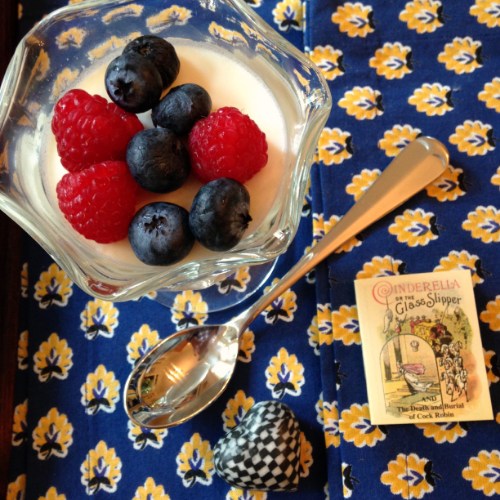
adorned with fresh berries,
or Torta Strega, cake
perfumed with liqueur,
filled with pastry cream
and finished
with hazelnut meringue.
I cannot live on lasagna alone
and the fact that Antonio
doesn’t sense this threatens
our chance for a future.
The waiter smiles as he unravels
the dessert menu, handwritten
on rough brown craft paper. Tiramisu
Umbrian Apple Tart
Selville Orange Sorbetto …
This is so beautiful, I say,
ordering the Panna Cotta. May I keep the menu?
Of course Signora, he says. And you sir?
No. Nothing for me,
just a cup of espresso.
Oh Antonio, Antonio what
are you thinking?
How can I trust a man
who doesn’t like sweets?
At La Dolce Vita
what could have been the start
of a beautiful romance—
snapped like a broken string
on a Stradivarius!
Okay Okay. I KNOW I’ve been a tad indecisive lately, asking you to call me Melon Head, then Apple Dumpling, and last week, Apple Pudding.
And not for a second would I presume to be as adorable as little bossy lady Lucy up there who without a doubt personifies the term of endearment, “Pumpkin,” like no one else.
But.
I am now a Pumpkin Girl, having braved the chilly winds and hoodie-cladded throngs of wriggly, hyper-adenoidal munchkins with their parental units who led the charge at Cox Pumpkin Farm this past weekend.
Oh, so brave! Are you impressed by the sacrifice? All just for you, natch.
Today we celebrate the joy that is pumpkinness with an iconic poem and some pumpkin pie. Are you wearing your orange bib? I notice you have on your Halloween mask again. That’s good too.
Often shared at Thanksgiving, this is an interesting poem because of Whittier’s reference to pumpkin carving in his boyhood, which suggests the practice predated widespread Irish immigration to the U.S. in the 1840’s (hat tip to American Scrapbook for that tidbit).
As you probably know, the Irish had the most influence on the celebration of Halloween (they used to carve out turnips to light the way on their midnight Autumn ramblings). In America they simply substituted pumpkins since they were so plentiful.
Whittier’s tribute to the pumpkin first appeared in the Boston Chronotype in 1846, and I must say I do like his mention of pumpkin pie!


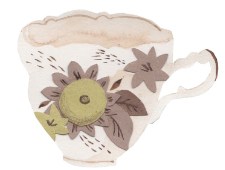 But since we’re all about tea and England this winter, I thought it would be nice to try something from Tea and Cake: Recipes for the Perfect Afternoon Tea (Hardie Grant, 2011), which features the lovely watercolor and paper collage work of London-based illustrator Emma Block.




 Jama's Alphabet Soup