Joni Mitchell: ultimate blue

“I sing my sorrow, and I paint my joy.” ~ Joni Mitchell
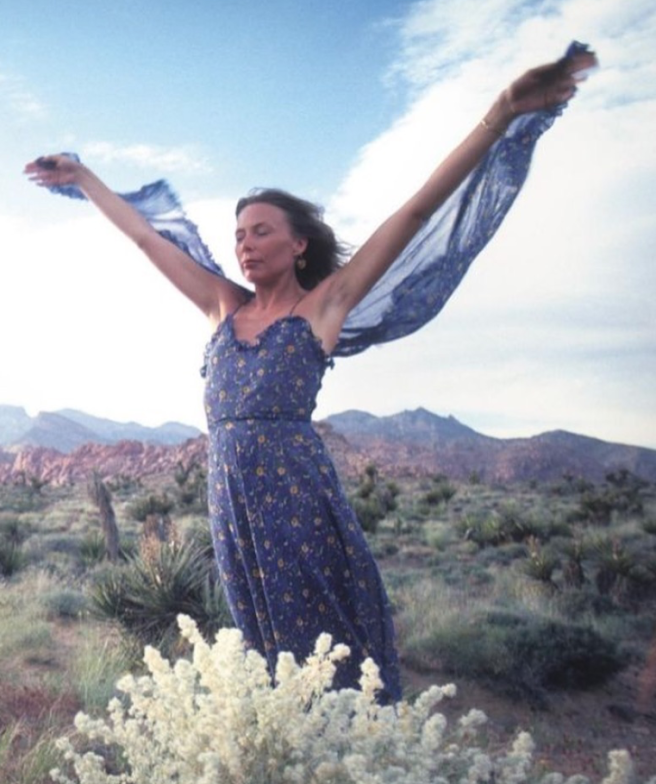
Joni Mitchell photographed in the Nevada desert by Henry Diltz (1978).

It’s no surprise that the ultimate “blue” song comes from a musician who’s also a painter.

Joni Mitchell has said that she applies the principles of painting to her songwriting. One of her old art teachers once told her, “If you can paint with a brush, you can paint with words.” In “Blue,” the title track from her iconic 1971 album, she sings the color of her heart — a plaintive love song and “somber lullaby” of haunting beauty.

Mitchell is one of the few singer-songwriters whose lyrics read like poetry. She’s largely inspired by personal memories, relating her stories through vivid imagery, striking metaphors, judicious use of rhyme and inventive turns of phrase. “Blue” is achingly honest; there is insecurity and resignation, but also optimism.

*
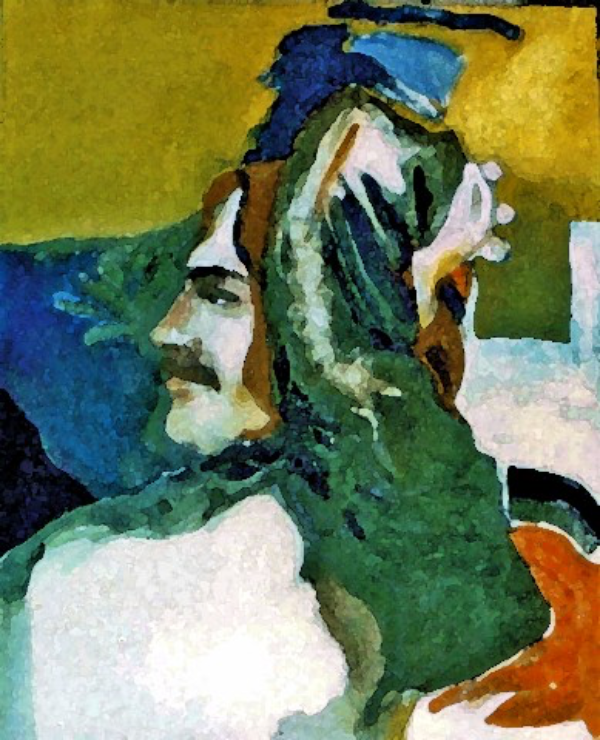
“Portrait of James Taylor” by Joni Mitchell (Christmas 1970).
BLUE
by Joni Mitchell

Blue songs are like tattoos
You know I've been to sea before
Crown and anchor me
Or let me sail away
Hey Blue, here is a song for you
Ink on a pin
Underneath the skin
An empty space to fill in
Well there're so many sinking now
You've got to keep thinking
You can make it thru these waves
Acid, booze, and ass
Needles, guns, and grass
Lots of laughs lots of laughs
Everybody's saying that hell's the hippest way to go
Well I don't think so
But I'm gonna take a look around it though
Blue I love you

Blue here is a shell for you
Inside you'll hear a sigh
A foggy lullaby
There is your song from me

~ copyright © 1971 Joni Mitchell Music, Inc. (BMI)

Continue reading

[review] Blue by Nana Ekua Brew-Hammond and Daniel Minter

“Blue skies smiling at me, nothing but blue skies do I see . . . ” ~ Irving Berlin

Blue likes me. It’s always been there, coloring my life with good things since childhood: my first Schwinn bike, Island of the Blue Dolphins, fountain pen Quink, favorite pearl bracelet, the sparkling azure of the Aegean one summer.

At age 9, I saw Elvis filming “Blue Hawaii” alongside the pineapple fields. He was driving a baby blue convertible. The first time I met Len in London he was wearing a navy blue sweater. These days, I sip Darjeeling in a Blue Calico teacup, delighted to spot the first bluebird every spring.

Blue just knows how to make an impression. From the cozy comfort of broken-in jeans to the bright optimism of a clear autumn sky, blue touches us all in ways ordinary and profound.

But now I must confess something. Until I read BLUE: A History of the Color as Deep as the Sea and as Wide as the Sky by Nana Ekua Brew-Hammond and Daniel Minter (Knopf BFYR, 2022), I knew very little about blue’s fascinating history, origins, and cultural significance. Imagine my surprise when this book magically appeared in my mailbox one day — simply out of the blue (thanks for the gift, Miss T.)! 🙂

Brew-Hammond begins her captivating narrative by citing how elusive and mysterious blue actually is. It’s “all around us,” in the sky and sea. Yet we can’t touch the sky and when we try to cup the sea, its blueness disappears. We may crush iris petals for a brilliant shade of blue, but when we add water, the color fades away.

But then blue appears in the strangest places, discovered throughout history in unexpected ways.

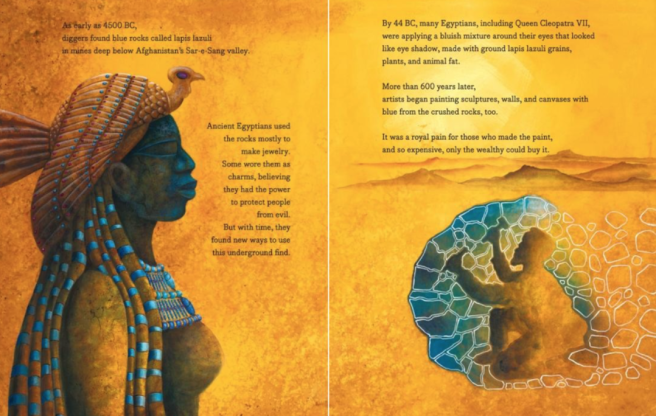
Blue rocks called lapis lazuli were mined as early as 4500 BC in Afghanistan. The ancient Egyptians used the stones to make jewelry and charms to ward off evil, and by 44 BC they (including Queen Cleopatra VII) applied a bluish mixture around their eyes made from ground lapis lazuli grains, plants and animal fat.

In another 600 years or so, artists began painting sculptures, walls, and canvases with blue made from the crushed rocks. Since this paint was expensive to produce, only the wealthy could afford it. This high-demand luxury prompted scientists, merchants, and dyers to search for more sources of blue.

Continue reading

Elizabeth Alexander’s “Blues”

“The Blue Room” by Suzanne Valadon (1923).
BLUES
by Elizabeth Alexander


I am lazy, the laziest
girl in the world. I sleep during
the day when I want to, 'til
my face is creased and swollen,
'til my lips are dry and hot. I
eat as I please: cookies and milk
after lunch, butter and sour cream
on my baked potato, foods that
slothful people eat, that turn
yellow and opaque beneath the skin.
Sometimes come dinnertime Sunday
I am still in my nightgown, the one
with the lace trim listing because
I have not mended it. Many days
I do not exercise, only
consider it, then rub my curdy
belly and lie down. Even
my poems are lazy. I use
syllabics instead of iambs,
prefer slant to the gong of full rhyme,
write briefly while others go
for pages. And yesterday,
for example, I did not work at all!
I got in my car and I drove
to factory outlet stores, purchased
stockings and panties and socks
with my father's money.

To think, in childhood I missed only
one day of school per year. I went
to ballet class four days a week
at four-forty-five and on
Saturdays, beginning always
with plie, ending with curtsy.
To think, I knew only industry,
the industry of my race
and of immigrants, the radio
tuned always to the station
that said, Line up your summer
job months in advance. Work hard
and do not shame your family,
who worked hard to give you what you have.
There is no sin but sloth. Burn
to a wick and keep moving.

I avoided sleep for years,
up at night replaying
evening news stories about
nearby jailbreaks, fat people
who ate fried chicken and woke up
dead. In sleep I am looking
for poems in the shape of open
V's of birds flying in formation,
or open arms saying, I forgive you, all.

~ from Body of Life (Tia Chucha Press, 1996).
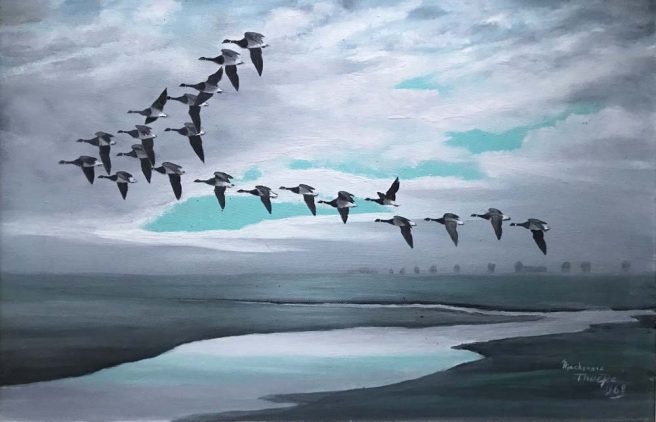
“Canada Geese Flying Over a Norfolk Marsh,” by MacKenzie Thorpe.

*

Continue reading

the reading blues

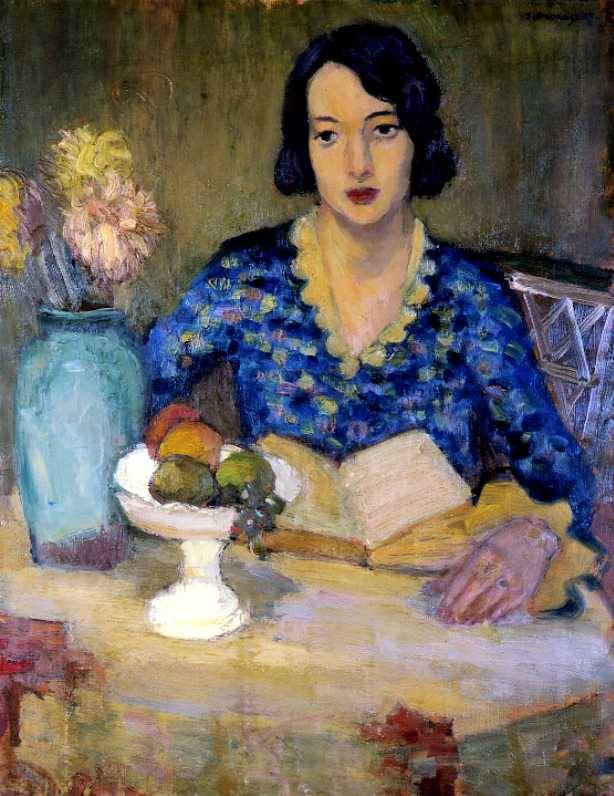
“Portrait of Artist’s Wife,” by Pronaszko Zbigniew (1935)


I’ve got the reading blues!

I love figurative paintings of readers, and have noted through the years that there are oodles of them. Most of the subjects are women, and many appear to be well-to-do, with the leisure to lounge on plush sofas or perch on uncomfortable chairs near a window, lost in the printed word.

Of course I always wonder what they’re reading and what their daily lives are like. Since I also love books, I feel a decided kinship with them, even though thousands of miles and more than a century may separate us.

Recently, readers dressed in blue have been calling out to me. Perhaps I’m drawn to blue’s peace, calm, and serenity. Spiritually, the color blue symbolizes the healing power of God — much needed in these terribly troubling times. And the readers themselves seem content and contemplative, making me feel better.

In any case, I hope you enjoy gazing at these blue readers, joining them, for just a few minutes, in their fascinating worlds (I also managed to dig up a few men). 🙂


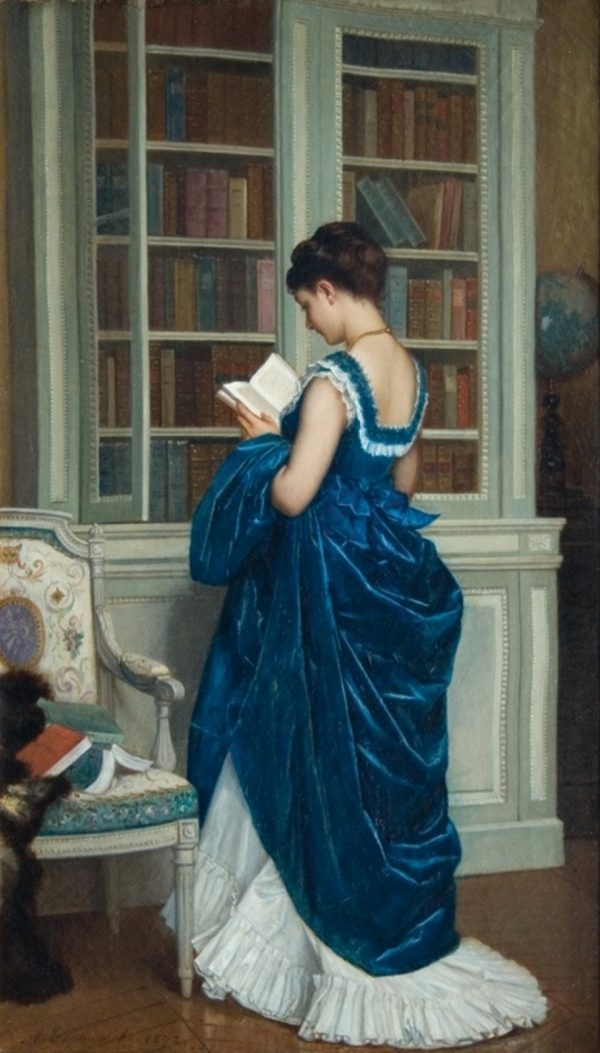
“In the Library,” by Auguste Toulmouche (1872)


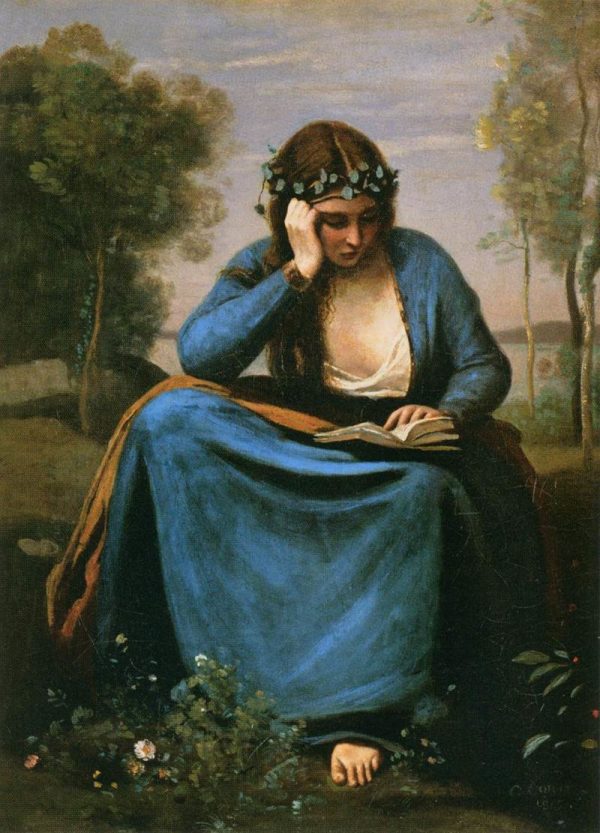
“The Reader Wreathed with Flowers,” by Jean-Baptiste Camille Corot (1845)


Continue reading

happy blue year!

“There’s a certain time of day after sunset when people naturally seem to feel the urge to gather by a fire or a stove or a hibachi or another common source of heat and food, and hunker down together to eat and drink. Call it the blue hour.” ~ Kate Christensen

 🎵 Blue on blue, heartache on heartache . . . 🎶

Remember that song? It comes to mind whenever I think about 2017 . . .

But now it’s 2018 — Happy New Year, Friends!

We’ve turned the page, so it’s time to shift our thinking.

BLUE IS GOOD!

In fact, it’s so good, I chose to make THINK BLUE my motto for 2018. 🙂

Last year my One Little Word was TRUTH. Poor Truth was tested, dragged through the mud, disguised, distorted, ignored, disregarded. Is that any way to treat one of the bedrocks of a civilized society? I think not.

I will always champion Truth, because no matter what you do to her, she prevails. She will always find a way to make herself known.

Since Truth is having an especially tough time right now, I wanted to support her with Two Little Words. I chose THINK BLUE after reading this poem:

*


HIS FAVORITE BLUE CUP
by Stephen Dobyns

Over the years — and Heart has had many years —
numerous objects have slipped from his possession,
some were lost, some fell apart, some got stolen.
That cowboy doll he loved as a child,
does a piece of it still remain? And the pen
he’s been looking for all week, where does it hide?
His favorite blue cup which the dog broke,
the green linen shirt that at last wore out,
the Chevy convertible that wound up in the junk yard —
Heart has come to think that all these objects are together
along with absent friends, departed family members
and pets that traveled over to the great beyond.
Somewhere, he believes, there’s a place made up
of previous houses, former gardens and furnished
with the vanished furniture his hands have touched.
There missing friends recline on once-loved chairs.
A cat gone for twenty years naps beneath a burning lamp.
Lost clothes fill the closets, lost books line the shelves.
The trees in front, cars in back: Heart would know them all.
These days Heart’s mind sometimes wanders.
He’s in a daze, he’s drifted off or gathering wool,
and he thinks at such times he, too, has disappeared,
that he’s rambling through his composite house,
sipping coffee from his blue cup, tossing a ball
for a mutt he owned when he was six or walking
arm and arm with a friend not seen for years.
You look pale, the friend says, you’ve gotten thinner.
I’ve been away, says Heart, I’ve been away.

~ from Poetry Magazine, 1999

via Nikolina Mazar

*

Continue reading