friday feast: a bear, a phone booth, and lots of irony

“Life is what happens to you while you’re busy making other plans.”
~
John Lennon
 

The other day I was looking for a poem about breakfast. Anything would do — pancakes, waffles, toast, eggs, bacon, or muffins.

Instead, I came across this quirky poem, “The Avalanche Club,” by Heather Christle. It made me giggle, but it also had the “Aha!” effect.

The poem is all about looking for one thing, in order to accidentally discover something else. How could I resist lines like these:

I complained to my friends.
I said I am looking for bears
and I am finding them everywhere
but I am not finding, for example,
a town in Tennessee
populated entirely by historians
who refute the Persian Wars.

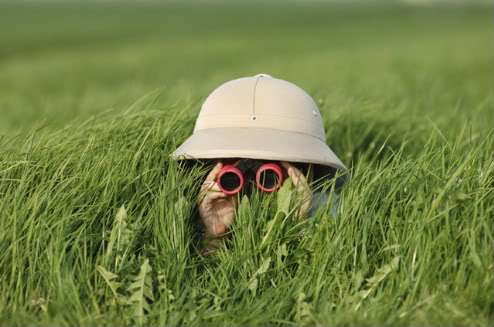
Aha! You may know I have also spent a fair amount of time looking for bears.


And then I read this:

Maybe you have a similar problem.
Maybe for you it’s phone booths
which you chose for their disappearance
and their mostly romantic history.
(entire poem is here.)

My god. This poet is reading my mail! For me, it’s bears and phone booths! (Sometimes, it’s even a bear inside my phone booth!) Double Aha.

So now, I’m all, “I’ve been searching for the wrong thing my whole life!” “I’m not seeing the forest for the trees!”

Of course I also thought about writing:

watch the tunnel vision
don’t overthink
there are many ways of seeing
the best ideas come when you’re not looking
it’s right in front of you, aka, the answer is in the manuscript
is everyone obsessive?

And so, I looked for breakfast and discovered bears.

Heather Christle looked for bears and found a way to make us re-examine our experience and perspective.

Of course, you may accidentally take away something entirely different from this poem.

What are your sights set on?

Look out!

Today’s Poetry Friday Roundup is at Biblio File.

Edited to add: Liz Scanlon came up with the perfect song for this post — “Bears,” written by Steve Fromholz. It is performed with perfection by Lyle Lovett on this video. The lyrics are in the comments. Thanks, Liz!

breakfast with george


Every morning at 7 a.m., George Washington ate three hoecakes and drank 3 cups of tea for breakfast.

It sounds a little meager for a man six feet tall, especially since he had a country to run.

Until two weeks ago, I didn’t even know what a hoecake was. I’m guessing oodles of kids around the country are already on to George and his cakes, because they’ve read this cool book: George Washington’s Breakfast, by Jean Fritz (Putnam, 1998).

Young George W. Allen shares Washington’s name and birthday. Since he feels almost related to him, he wants to know everything he can about the father of our country. But one day at breakfast, George realizes he doesn’t know what Washington ate every morning. So begins an enthusiastic, determined quest for the answer, which drives the plot and makes for a fun, engaging read.

Kids will immediately note George’s dated use of a card catalog, but will admire his tenacity as he reads book after book, searching for the answer. They will also pick up some interesting facts about Washington as their anticipation steadily builds, so that by the time George finds out about the hoecakes, they’ll be anxious to try them.

The New York Times Book Review called George Washington’s Breakfast “delightful,” as it “combines history, biography, research, cooking, and a determined child.” After eating the hoecakes, George felt even more related to Washington than ever before.

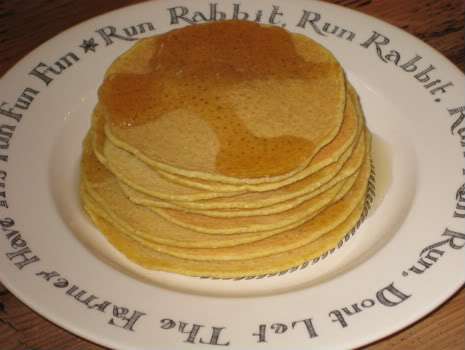
So what are they? A traditional Southern cornmeal pancake, originally cooked by field hands on the blade of a hoe over an open fire. Washington’s hoecakes were probably cooked on a griddle in the oven, though, and he liked them slathered with butter and dripping with honey.

GW’s meals were cooked in this fireplace at Mt. Vernon

Of course I simply had to try making some of my own. I opted for this modernized recipe, which calls for milk instead of water, and unlike the gargantuan recipe posted at the Mt. Vernon website, uses baking powder rather than yeast.

They make a nice change from traditional flour-based pancakes, and are good with maple syrup, honey, or butter and jam. For a fluffier (albeit less authentic) hoecake, use 1 cup of flour plus 1 cup of cornmeal.

Make some this weekend — it’s your patriotic duty!

Here’s a cute webpage showing some third and fourth graders enjoying hoecakes prepared by a library media specialist.

INFO BITES:

Washington was modest, courteous, and had flawless manners. He subscribed to the five-minute rule: all guests must be seated within five minutes of the dinner bell.

The Washingtons were among the first colonial Americans to acquire Wedgwood’s cream-colored ‘Queen’s Ware,’ and among the first to purchase porcelains brought back from Canton.

He also acquired the nation’s first service of French porcelain to grace state dinners.

His farms (8,000 acres) were self sufficient, providing most of the meat and produce he needed to entertain his constant flow of guests.

He had dinner at 3, tea at 6 or 7, and retired by 9 p.m.

Regarding behavior at the dinner table, Washington wrote:

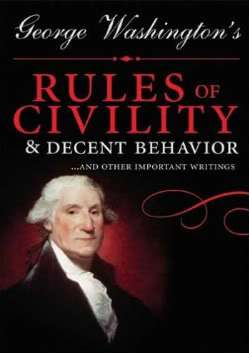
Make no shew of taking great Delight in your Victuals, Feed not with Greediness; cut your Bread with a Knife, lean not on the Table, neither find fault with what you Eat.

~ from Rules of Civility and Decent Behavior in Company and Conversation.