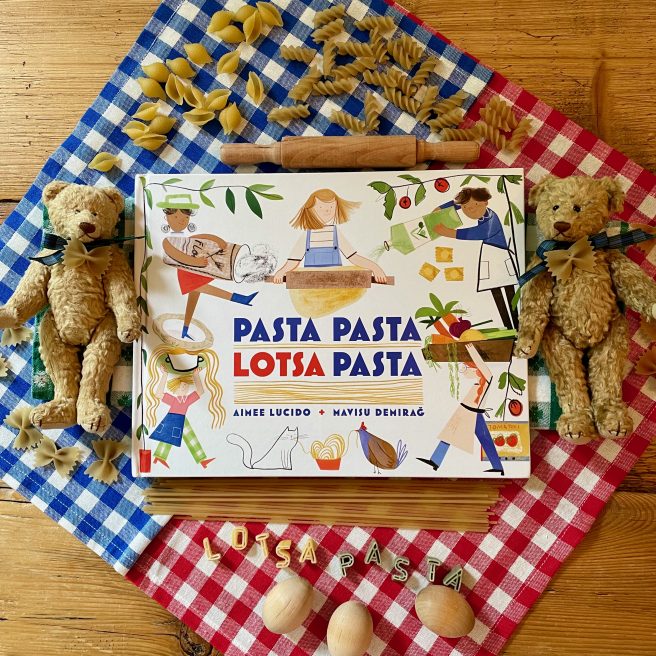
[saucy review] Pasta Pasta Lotsa Pasta by Aimee Lucido and Mavisu Demirağ

Bucatini, capellini, spaghettini, tortellini!

Molto delizioso!

Italian pasta names make me happy. Joyful, lyrical, rhythmic — saying them is almost as good as eating them. Hungry? Time to put on a bib, grab a fork, and feast on Pasta Pasta Lotsa Pasta by Aimee Lucido and Mavisu Demirağ (Beach Lane Books, 2024).

Mangiamo!

In this lip smacking celebration of all things noodle-y, a family of picky eaters gathers for dinner. Their names just happen to rhyme with where they’re from as well as their pasta preferences. Told from a young girl’s point of view, the story begins with the arrival of her grandmother:

Ring-a-ding, the doorbell rings, and oh!/What did my Nonna bring?

Nonna Ana (who’s from Catania and only likes to eat lasagna) wheels in her chicken and some eggs. The girl and her mom get busy making the lasagna from scratch — combining ingredients, rolling out the dough and then cutting it into thin layers.

The next minute, the doorbell rings again. Nonno Titi arrives with a bag full of fresh veggies. “Nonno Titi from Tahiti only eats our spaghettini.” Papa and Mamma proceed to slice and cook the spinach, zucchini, eggplant and onions to go with the spaghettini.
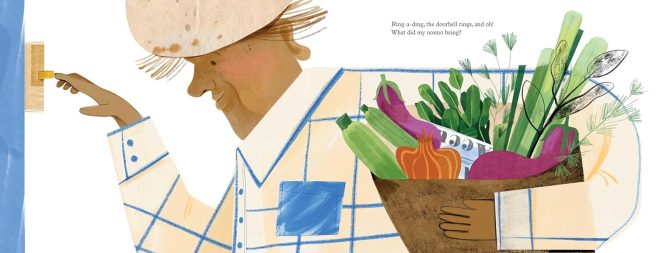
Pasta pasta lotsa pasta/made for Nonno and famiglia!

Continue reading
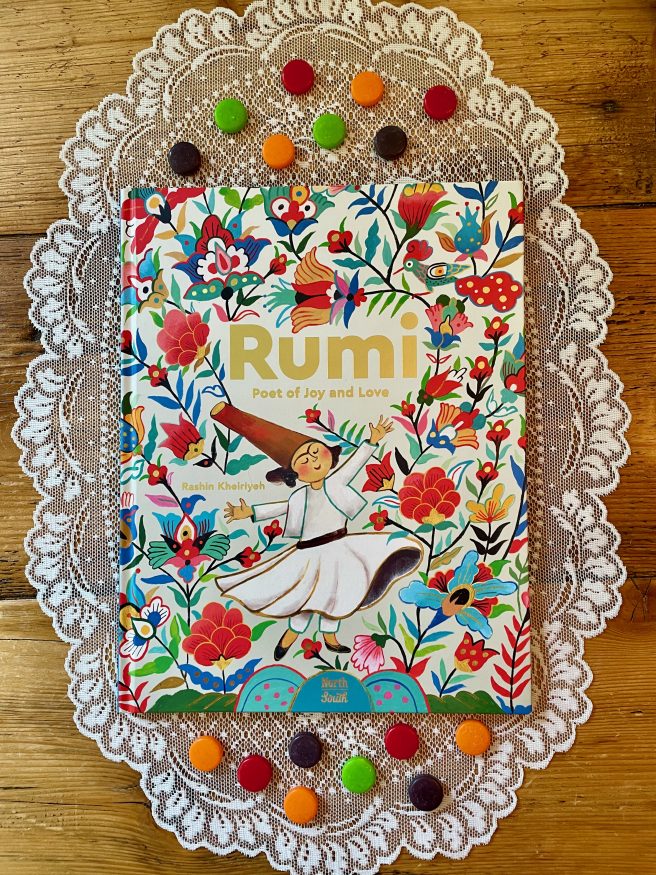
[review] Rumi: Poet of Joy and Love by Rashin Kheiriyeh

“Should you wish to be in heaven forever? Be a friend to everyone.” ~ Rumi

Can meeting the right friend change your life? Why is it important to share your story with others, and how is embracing everyone in love and friendship its own spiritual practice?

Whether through his relatable aphorisms or divine poetry, Rumi has touched us all. As one of the world’s most popular poets, this 13th century Persian scholar and Sufi mystic continues to teach, inspire, and open our hearts to humanity.

In her stunning picture book biography, Rumi: Poet of Joy and Love (NorthSouth Books, 2024), Iranian-American author-illustrator Rashin Kheiriyeh shows how a chance meeting with a stranger transformed an already revered scholar and theologian into a poet for the ages.

We first learn Rumi was born on “a crisp and colorful autumn day in Iran” (present day Afghanistan) on September 30, 1207. From the beginning he was a child of nature and reveled in the beautiful world around him. He chased butterflies and “delighted in the scent of roses and the songs of the birds.” Rumi especially loved to feed the birds; his favorite was the hoopoe, the symbol of wisdom.

Rumi’s father patiently answered his many questions, teaching his son all he knew. One day he shared these prescient words: “Learn generosity from the sun. It lights the world every day and asks for nothing in return.”

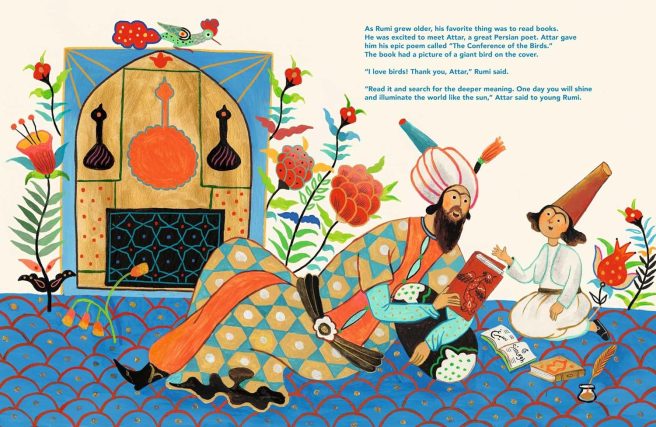
An avid reader, Rumi was excited one day to meet the great Persian poet Attar, who gifted him with a copy of his epic poem, “The Conference of the Birds.” Attar advised Rumi to “read it and search for the deeper meaning. One day you will shine and illuminate the world like the sun.”

In Attar’s poem, hundreds of birds (including the hoopoe) travel many miles in search of the mythical bird Sīmurgh to serve as their king. Only thirty birds survived this arduous journey, realizing when they reached their destination that they were actually the Sīmurgh. When together, they flew as one giant bird.

Years later, after Rumi had moved to Turkey with his family, he followed in the footsteps of his father and grandfather, with followers from near and far eager to study with him.

Continue reading

[tropical review] Aloha Everything by Kaylin Melia George and Mae Waite

Care to swim with the sea turtles, soar high above the earth with regal hawks, or hear wondrous tales of heroic voyagers navigating the Pacific by wind and stars?

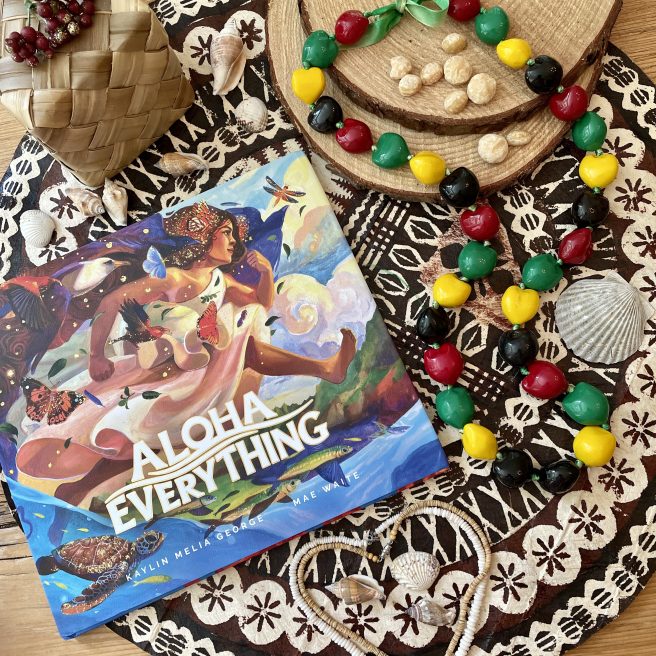
Then join a young Hawaiian girl as she takes a magical journey around the Islands in this gorgeous new picture book, Aloha Everything by Kaylin Melia George and Mae Waite (Red Comet Press, 2024). Through the traditional storytelling dance of the hula, she learns about the history, culture, and folklore of her homeland while embracing the true meaning of “Aloha.”

We first meet little Ano one enchanted night:

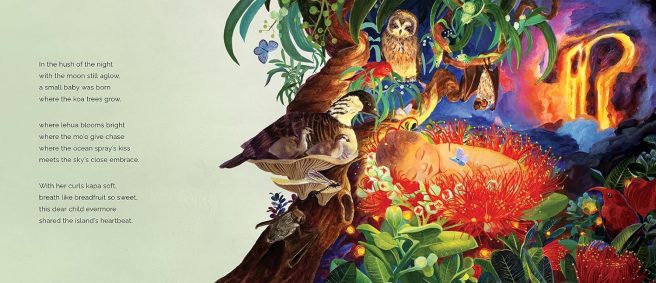
In the hush of the night
with the moon still aglow,
a small baby was born
where the koa trees grow,

where lehua blooms bright,
where the mo'o give chase,
where the ocean spray's kiss
meets the sky's close embrace.

With her curls kapa soft,
breath like breadfruit so sweet,
this dear child evermore
shared the island's heartbeat.

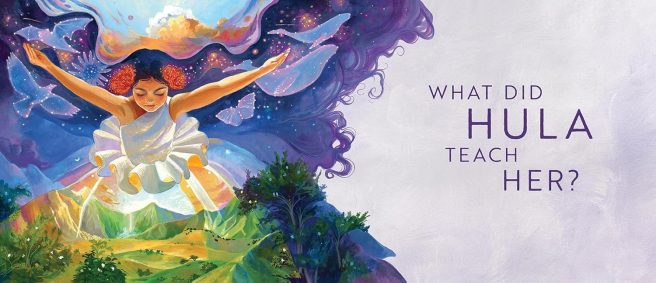
This fierce-spirited, courageous child, so swift and smart, grew in both mind and heart. She was indeed special, but still had much to learn. What did hula teach her with its generations of treasured stories and rich lore?

First, she learned how the islands were formed, and about the evolution of plants and wildlife. As “humble seeds burst to blooms,” and “rock eroded to sand . . . a world born ablaze turned to lush wonderland.” Soon creatures filled the land, sea and sky from “mauka to makai.” Clinging to a hawk’s wings, the girl surveyed all these wonders from her perch amid the clouds, while the majestic bird imparted his wisdom: “To our ‘āina be just./When we care for our earth,/then our earth cares for us.”

Continue reading

[review] Miss MacDonald Has a Farm by Kalee Gwarjanski and Elizabet Vuković

Veggie lovers: grab your trowels, spades, and watering cans. Warm weather’s here and it’s time to make delicious things grow.

In Miss MacDonald Has a Farm by Kalee Gwarjanski and Elizabet Vuković (Doubleday BFYR, 2024), we’re all invited to tag along with busy Miss MacDonald as she cultivates, harvests, and then cooks colorful crops of healthy, flavorful produce. With a pick-pick here, and a shuck-shuck there, she takes us from seed to table with hard work, patience, and careful tending.

Debut author Gwarjanski’s upbeat female-centric spin on the traditional “Old MacDonald” song, with its rhythmic, rollicking text, is equally fun to sing or read aloud. Since the verse scans so well, those familiar with the song will likely find it hard to resist vocalizing, especially with the jaunty tagline “E-I-E-I-GROW.”

So what is Miss MacDonald actually growing? Lettuce, peas, tomatoes, green beans, zucchini, potatoes, corn and pumpkins. She begins by planting lettuce:

Miss MacDonald has a farm.
She loves things that grow.


And on that farm,
she has some lettuce.

E-I-E-I-GROW

With a seed-seed here
and a sow-throw there,


here it shoots, there it sprouts,
everywhere it sprout-sprouts.


Miss MacDonald has a farm.
She loves things that grow.

(I can hear you singing!) 🙂

She then goes on to complete a different task for each of the other vegetables: waters her peas, weeds her tomato plants, picks her green beans, prunes her zucchini, hills her potatoes, shucks her corn, and finally washes and cans her pumpkins.

Continue reading

[artsy review] Gifts from Georgia’s Garden by Lisa Robinson and Hadley Hooper

American modernist painter Georgia O’Keeffe is best known for her meticulously rendered, large-scale depictions of flowers and stark desert landscapes — Oriental Poppies, serene Calla Lilies, fiery Red Canna, deer skulls and wildflowers floating above the horizon.

A fiercely independent nonconformist, O’Keeffe created abstract distillations of natural forms that gained international recognition and confirmed her stature as one of the most significant artists of the 20th century. O’Keeffe took a personal and provocative approach to art, seeking to create an equivalent of what she felt she was looking at, rather than merely copying it.

Beautiful front end papers.

In their gorgeous new picture book, Gifts from Georgia’s Garden: How Georgia O’Keeffe Nourished Her Art (Neal Porter/Holiday House, 2024), Lisa Robinson and Hadley Hooper focus on how O’Keeffe’s art-centric lifestyle as a sustainable gardener fed her muse and enabled her to flourish as a painter. Deeply inspired by place and environment, Georgia believed everything was art, and art was everything.

The book opens with Georgia at her easel, painting “flowers so lush and large they filled the canvas.” This microscopic perspective enabled the viewer to appreciate a flower’s minute details. She hoped to make people in the city slow down and take the time to really see the beauty that she saw.

Love the stunning case cover under the dust jacket!

But Georgia grew tired of New York and fled to New Mexico, where she felt free amidst its canyons, mesas and skyscapes. The scent of the soil reminded her of growing up on a farm in Wisconsin, where she had developed her “love of wide skies and sweeping vistas.”

The golden shimmer of a field of wheat;
rectangular rocks, twisted sticks, oval leaves;
barns with haylofts, windows, and doors.

Early on, she knew she wanted to become an artist.

Continue reading