Special Guest Post: Deborah Hopkinson on Independence Cake

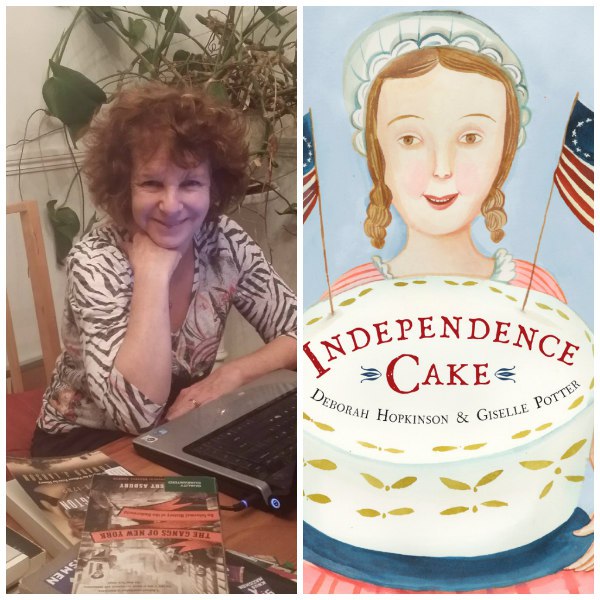
Award-winning author Deborah Hopkinson is here to talk about Independence Cake (Schwartz & Wade, 2017), her brand new picture book that officially hits shelves today.

Illustrated by Giselle Potter, this scrumptious “revolutionary confection” is a fictionalized account of how Amelia Simmons, who would go on to write the first American cookbook, bakes 13 Independence Cakes to celebrate George Washington’s inauguration.

Since I loved Deborah’s Fannie in the Kitchen (2001) and Beatrix Potter and the Unfortunate Tale of a Borrowed Guinea Pig (2016), I am especially excited about this new book: American culinary history! English dishes! Tea biscuits and flapjacks! CAKE! Another serving of this tasty read, please.

*

As an author for children and teens, I visit schools all over the country, and like to begin by asking students the difference between nonfiction and historical fiction. My new picture book, Independence Cake, is most decidedly fiction, as the subtitle makes clear: A Revolutionary Confection Inspired by Amelia Simmons, Whose True History is Unfortunately Unknown. In this light-hearted story with delicious illustrations by the incomparable Giselle Potter, we meet an orphan girl named Amelia, who is sent by the town to live with the fictional Bean family to help the exhausted mother of six sons and no daughter (“Definitely a recipe for domestic disaster in 1789”).
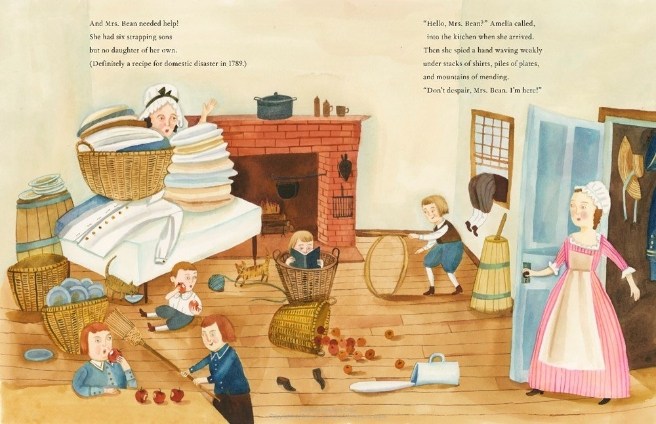
The real Amelia Simmons authored American Cookery, the first American cookbook. On the title page she identified herself as “An American Orphan.” Although historians know little about her, she may have been a “bound girl,” or indentured servant. In any case, the actual Amelia no doubt led a much harsher existence than her fictional counterpart.

In my story, Amelia’s reputation as a cook results in the town asking her to bake a special cake for George Washington at his 1789 inauguration. Amelia makes thirteen: one for each of the original colonies, which are carefully packed in wagons and driven off to New York to be pronounced “delicious” by the first president. (As the author’s note declares: this is entirely a confection!)

What is true about Amelia Simmons is that her cookbook expanded on traditional English cooking to include culinary influences and available ingredients in America. The legendary food historian Karen Hess, in an introduction to the second edition of American Cookery, published in Albany in fall 1796, speculated that the author may have lived near the Hudson Valley and been influenced by Dutch settlers. Simmons used terms such as “slaw” based on the Dutch “sla” for salad, and “cookey,” from “koekje.” In some recipes, Simmons substituted cornmeal for the oatmeal of English cooking, reflecting the influence of Native American traditions. Simmons seems to have been intentionally creating something new: the long subtitle of her cookbook notes that recipes are “Adapted to this Country, and All Grades of Life.”

The recipe for “Independence Cake” first appears in this second edition, directly following one for “Election Cake,” of which it is a variation; both contain raisins, brandy, and spices, similar to a traditional English fruitcake or plum cake. The cakes were part of the holiday spirit that surrounded early election days. Amelia’s patriotic fervor may have led her to call one “Independence Cake.”
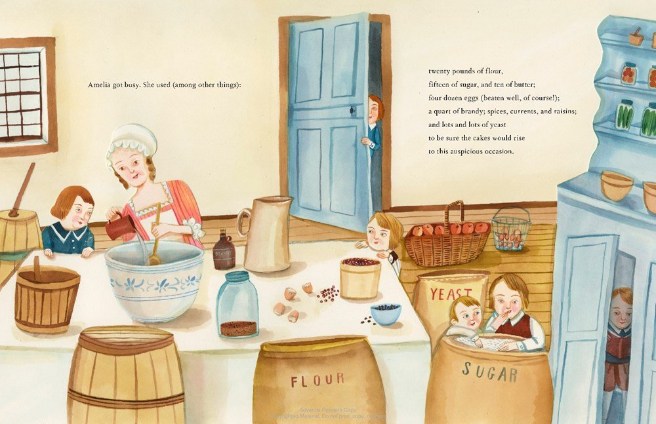
I like to imagine Amelia as an American version of Daisy in Downton Abbey – a cook eager to try new things and embrace the future, although clearly Amelia had a pinch of Mrs. Patmore in her too. Here’s a snippet from her book in which she opines about the character-building properties of cultivating apple trees:

Apples…. ought to be more universally cultivated, excepting in the compactest cities. There is not a single family but might set a tree in some otherwise useless spot, which might serve the two fold use of shade and fruit; on which 12 or 14 kinds of fruit trees might easily be engrafted, and essentially preserve the orchard from the intrusions of boys, &c. which is too common in America.

If the boy who thus planted a tree, and guarded and protected it in a useless corner, and carefully engrafted different fruits, was to be indulged free access into orchards, whilst the neglectful boy was prohibited–how many millions of fruit trees would spring into growth–and what a saving to the union. The net saving would in time extinguish the public debt, and enrich our cookery.”

Although I wrote Independence Cake long before the 2016 presidential election, I noticed some bakers took the election season as an opportunity to share historical tidbits about the culinary tradition of election cakes. I’ve included a few below.

And speaking of elections, given Amelia’s interest, noted above, in extinguishing the public debt, she might well have wished for a political career herself.

Except, of course, in 1789 women couldn’t vote. But that’s another story.

To read more about the history of Election Cakes:

NPR: A History of Election Cakes
http://www.npr.org/sections/thesalt/2016/10/23/498974733/a-history-of-election-cake-and-why-bakers-want-to-makeamericacakeagain

Bon Appetit: “Election Cake” Makes a Modern Day Resurgence
http://www.bonappetit.com/entertaining-style/trends-news/article/election-cake-history

What’s Cooking America: Election Day Cake History and Recipe
https://whatscookingamerica.net/History/Cakes/ElectionCake.htm

*

Deborah Hopkinson is the award-winning author of more than 45 books for young readers including picture books, historical fiction, and nonfiction.  She has won the SCBWI Golden Kite Award for picture book text twice, for Apples to Oregon and A Band of Angels. Other titles include Sweet Clara and the Freedom Quilt, winner of the IRA Award; and Sky Boys, a Boston Globe-Horn Book Honor book. In addition to Independence Cake (May 2017), she just published a contemporary picture book, A Letter to My Teacher (April 2017).

Deborah’s nonfiction includes Titanic, Voices from the Disaster, which received a YALSA Excellence in Nonfiction honor and a Robert F. Sibert Honor and Dive! WWII Stories of Sailors and Submarines in the Pacific. Her nonfiction picture book, Keep On! The Story of Matthew Henson, Co-Discoverer of the North Pole, won an Oregon Book Award.

Visit Deborah Hopkinson online at www.deborahhopkinson.com, or follow her on Twitter @deborahopkinson and Instagram @deborah_hopkinson

*
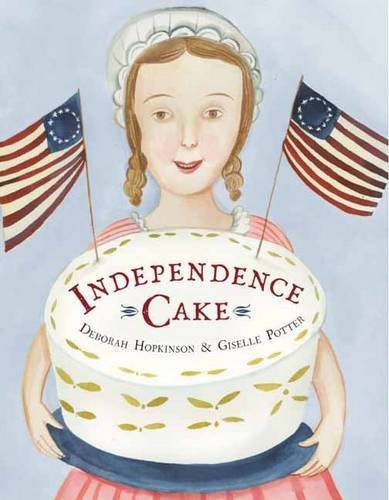
 

INDEPENDENCE CAKE: A Revolutionary Confection Inspired by Amelia Simmons, Whose True History is Unfortunately Unknown
written by Deborah Hopkinson
illustrated by Giselle Potter
published by Schwartz & Wade (May 2017)
Historical Fiction Picture Book for ages 4-8, 44 pp.
*Includes Authors Note and Original Recipe
**Starred Review from Publishers Weekly**

*

📕 MORE 📘

♥ Check out the other stops on Deborah’s Double Blog Tour!
♥ Enjoy this interesting blog post about Election Cakes (+ a recipe) at Revolutionary Pie.

♥ See my reviews of Fannie in the Kitchen (+ Griddle Cakes) and Beatrix Potter and the Unfortunate Tale of a Borrowed Guinea Pig.


Copyright © 2017 Jama Rattigan of Jama’s Alphabet Soup. All rights reserved.
Save

Save

Save

Save

Save

Save

Save

Save

nine cool things on a tuesday

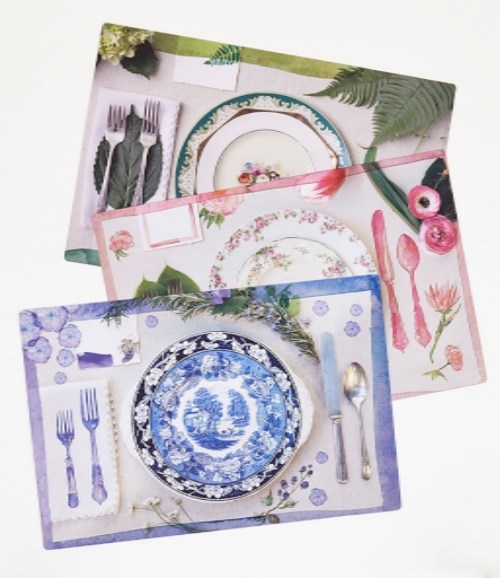
Forest Feast Paper Placemats

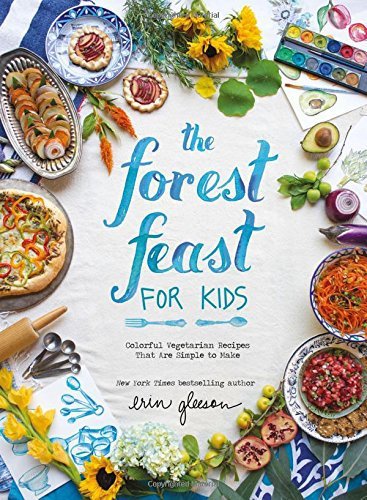
1. Northern California author, food photographer, and blogger Erin Gleeson has written a new cookbook, The Forest Feast for Kids (Abrams BYR, 2016)  that will be released on February 16 and is now available for pre-order! If you’re familiar with her popular blog or first book, The Forest Feast (Stewart, Tabori & Chang, 2014), you know that she features simple, delicious vegetarian recipes + gorgeous photos + fanciful hand-lettering and watercolors.


Kids will enjoy learning how to make healthy dishes inspired by fresh local produce and Gleeson’s beautiful natural surroundings (have you seen her idyllic cabin in the woods?). “In addition to its recipes—which span meals, party food, snacks, and beverages—this nonfiction book includes ideas for crafty table decoration, party ideas, an illustrated guide on kitchen safety, and a glossary of culinary terms.”

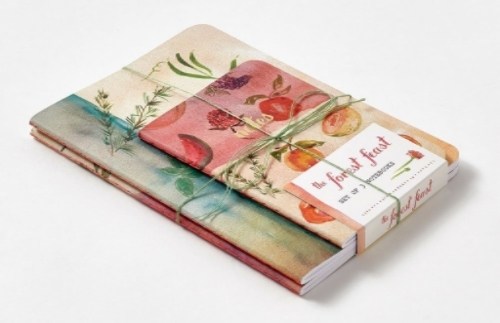
Forest Feast Notebook Bundle


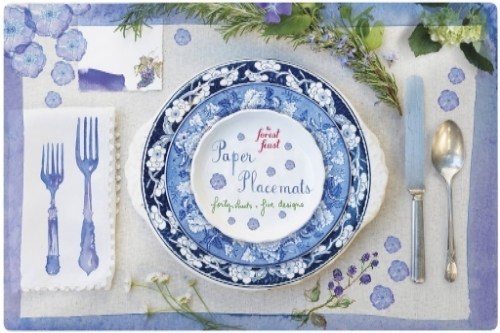
To complement Erin’s cookbooks, there are lovely notebooks, a meal planner/ shopping list magnetic notepadpaper placemats (these come in five stunning designs), notecards with envelopes and a wall calendar — all perfect for adding some warmth, color and fun to your day. 🙂

*

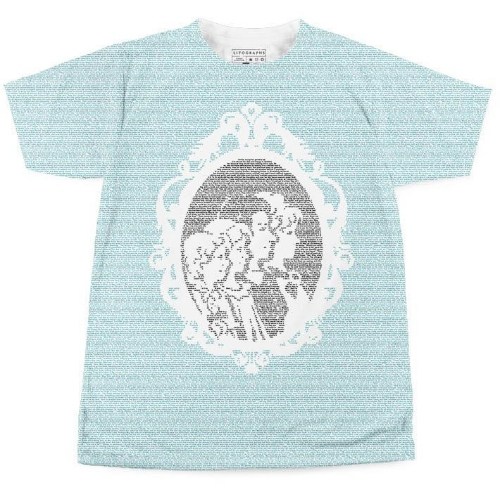
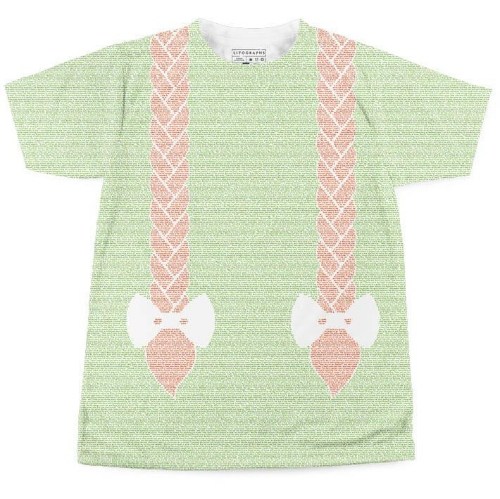
2. Have you checked out Litographs? They make cool t-shirts, tote bags, temporary tattoos and posters using the full text of literary works. They’re adding new designs all the time to their collection of classic and contemporary books. I like that they’ve partnered with the International Book Bank to send a new book to a community in need for every t-shirt, tote bag, poster or every 5 tattoos they sell. They offer free shipping to anywhere in the U.S. Sounds like a win-win to me!

Little Women
Anne of Green Gables

Check out this video to see how they make their t-shirts:

*

3. I’m still thinking about Margie Culver’s “15 Dog Books” series at Librarian’s Quest. If you follow her blog you know that Margie writes the best book reviews — always insightful and thoroughly engaging. After she lost Xena, her beloved chocolate lab and constant companion of 15 years, she decided to pay tribute to this extraordinary dog by featuring 15 recently published dog books (picture books, chapter books, novels, and Maira Kalman’s Beloved Dog).


As much as I loved the reviews, I enjoyed even more the anecdotes and stories about Xena she included in each post. Whether you’re a dog lover or not, I think you’ll be moved and inspired by how Margie describes the deep human-canine connection, the intelligence, fierce loyalty, courage, and playfulness of dogs she’s experienced firsthand and as these traits are explored in the stories, several of which are told from a dog’s point of view.

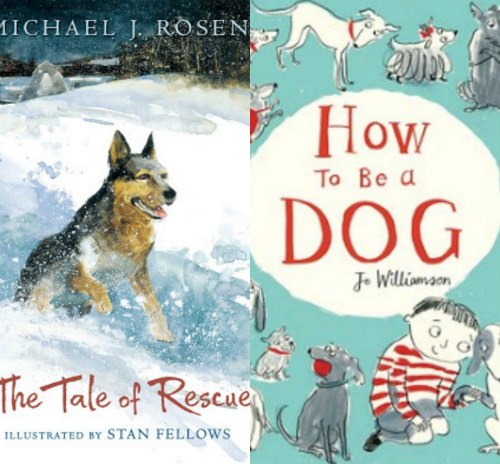
There’s something for every reader in Margie’s chosen 15, whether you’re a fan of humor, suspense, family stories, or adventure. Click here to go to the first post in the series featuring Michael J. Rosen’s The Tale of Rescue, illustrated by Stan Fellows (Candlewick, 2015), and you’ll likely want to read on and on.

*

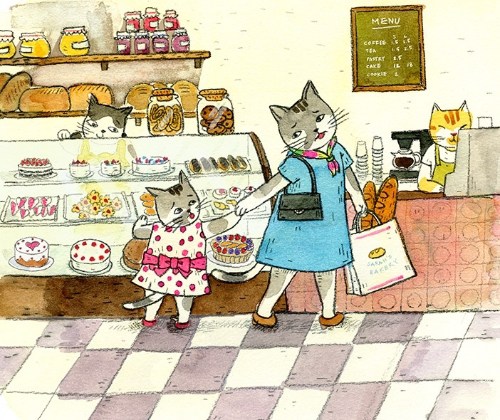
“Cat Bakery” by Aram Kim

4. Every once in awhile, while casually browsing Pinterest, I’ll stumble upon a cute illustration that makes me smile. Not too long ago, “Cat Bakery” by Aram Kim meowed at me, so naturally I had to find out more about the artist. I was tickled pink to discover that in addition to adorable dog and cat pictures, NYC-based Aram has a thing for drawing food! 🙂 I promptly bookmarked her site with plans to contact her in the future.

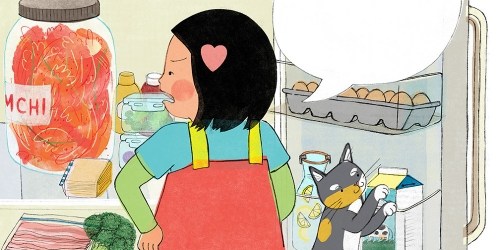
Spread from Aram’s WIP, “Kimchi Pancakes”

It could have been the cats, the bakery, spicy kimchi, or a mutual love of dumplings, but out of the blue Aram emailed me a couple of weeks ago, after following a 7-Imp link to my review of Miracle on 133rd Street. She was happy to discover Alphabet Soup and told me she’s currently working on a food-related picture book called Kimchi Pancakes. Yum! Her debut picture book, Cat on the Bus (Holiday House, 2016), will be out this Fall. Generous Aram also created a special “Cat Bakery” blog header for Alphabet Soup (feast your eyes ⬆⬆⬆). Totally purrrfect, of course! Is there anything better than connecting with kindred spirits? Just goes to show the power of FOOD! Be sure to visit Aram’s website to see more of her charming work!

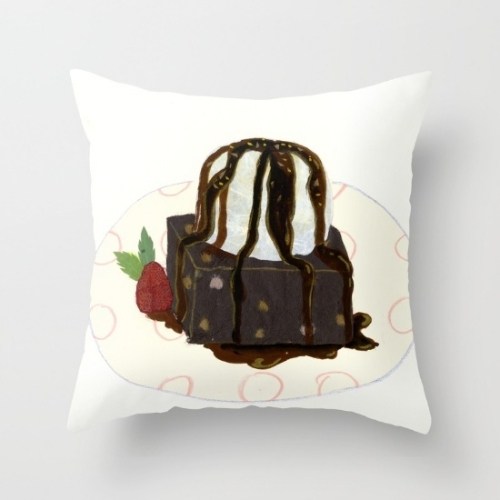
You can purchase some of Aram’s designs on t-shirts, phone cases, tote bags, etc., at Society 6. Click on the image to find out more about this yummy Brownie Sundae throw pillow.

*

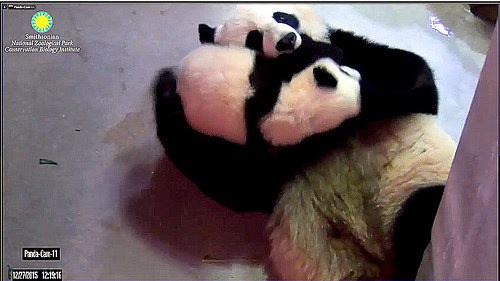
5. Any time you need a little lift, click over to the National Zoo’s Giant Panda Cam, where you can visit with mama panda Mei Xiang and her adorable cub Bei Bei. While it’s fun to watch Mei munch munch munch on bamboo leaves and catch Bei Bei rolling around on the floor or napping, probably the most adorable thing is when Mei cuddles with Bei Bei. So sweet and heart-melting! But you have to be vigilant and check in frequently. Love watching them!


*

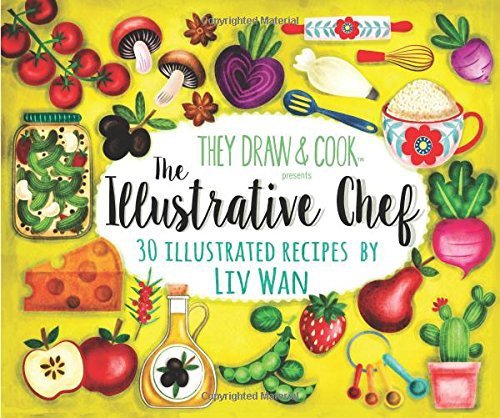
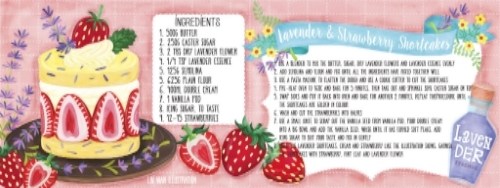
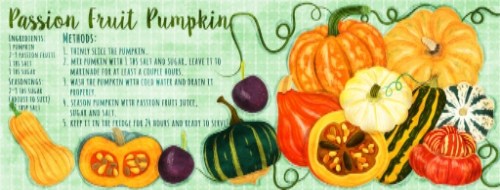
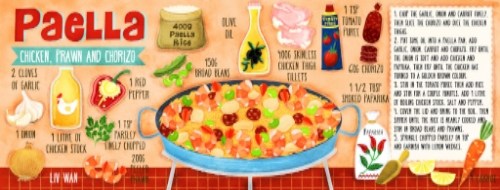
6. Always a pleasure to drop by They Draw & Cook to see what’s new. This tasty site now features more than 5400 recipes illustrated by artists from around the world, and founders Nate and Salli have so far published 10 books — some are collections featuring single artists, while others feature a curated selection of artists. The Illustrative Chef, the latest in the single artist series, features the bold and vibrant stylings of Edinburgh based former-professional-chef-turned-illustrator Liv Wan. If her bright, eye-popping colors don’t wake you up, nothing else will.


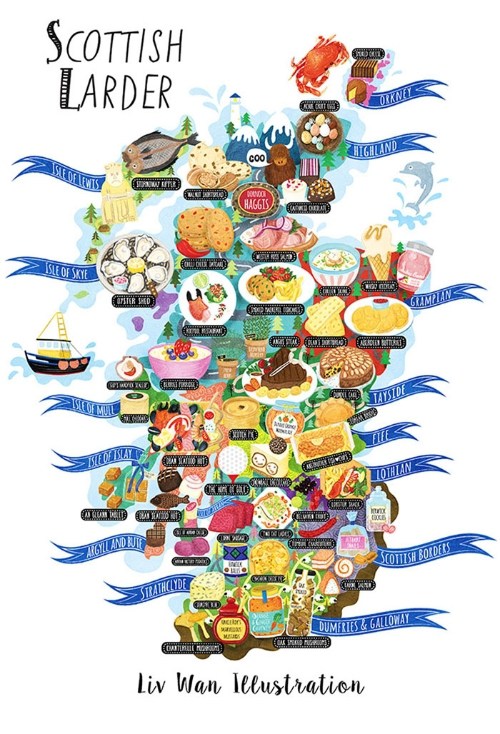
In addition to the recent TDAC book, Liv has published a cookbook of Taiwanese recipes and a children’s book about the Edinburgh Zoo. She’s also worked on projects for the likes of The Royal Botanical Garden Edinburgh, the Highland Council and the UK Foodies Festival, among others. I love her food maps!

Be sure to visit Liv’s beautiful website to see more of her work — guaranteed to make you feel happy!

*

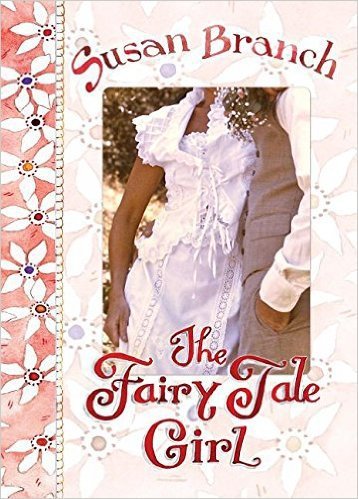
7. If you’re a Susan Branch fan, you’ve likely already read The Fairy Tale Girl (Spring Street Publishing, 2015) which came out last Fall. I purchased a copy for myself and several for Christmas gifts, but have yet to crack it open — though it’s right there at the tippy top of my tottering TBR pile. Since I thoroughly enjoyed A Fine Romance: Falling in Love with the English Countryside (2013), I can’t wait to read this first of two prequels (the second prequel, Martha’s Vineyard, Isle of Dreams, will be out in May).


Based on the diaries Susan has kept since she was in her 20s, THE FAIRY TALE GIRL is book one of a two part series. Together the books are an illustrated memoir, charmingly designed in Susan’s style with her whimsical watercolors and personal photographs. It’s an enchanting story of love and loss, mystery and magic that begins in a geranium-colored house in California, and ends up, like any good fairy tale, on the right side of the rabbit hole, in a small cottage in the woods on the New England Island of Martha’s Vineyard.

THE FAIRY TALE GIRL humorously explores Susan’s journey as an artist and as a girl/woman, from the 1950s through the 1980s. In the first book of the series we get a revealing view of Susan’s early life as the oldest of eight children and the marriage she imagined would be forever; it’s filled with inspiration, romance and discovery, and a leap into the unknown.

If you’ve read The Fairy Tale Girl, how did you like it?

*

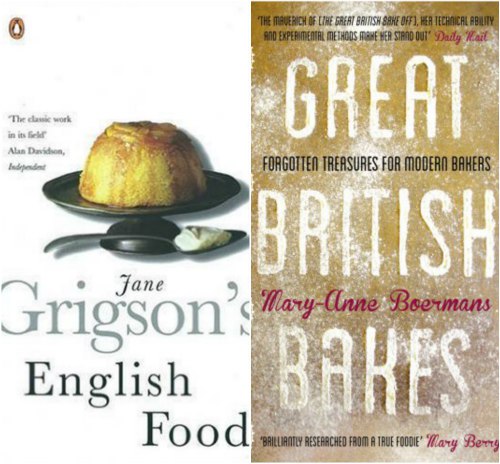
8. Just in case you missed it, wanted to point you to Cynthia D. Bertelsen’s excellent blog series, “On the Shelves of Elves: A Baker’s Dozen of British Cookbooks for the Christmas Season” at Gherkins and Tomatoes.

Even though traditional American cuisine is British to the core, with borrowings – not appropriations – from other cultures, the media lately has been full of commentaries such as this. In an attempt to put a more scholarly and rational spin on it, I am beginning by pointing out 13 relatively recent British cookbooks, all with a historical slant. Just in time for Christmas giving, BTW, these books well illustrate the vast and diverse and key source recipes that indeed formed the roots of what is called Southern, and American, cuisine. 


This series is obviously an Anglophile’s delight, great not only for those interested in culinary history and exploring the wider context associated with traditional British foods and its influences on American cooking, but with books such as Mary Gwynn’s WI Cookbook (2015), that traces the activities of the Women’s Institute, we see how the roles of women changed over several decades as they gradually moved from the private world of their households into the public sphere inhabited by men.

Fine and fascinating, for the W.I. appeared to be much like the Junior League, a similar American organization for women. Both groups arose at a time when social mores restricted women’s activities and both groups produced cookbooks for charitable purposes, a practice that began during the Civil War years in America (1861-1865). 


Start here with Book #1, Florence White’s Good Things in England (1932), then check out the other 12 titles in the series, all listed in the post.

*


9. Speaking of food illustration, I’ve mentioned Boston-based artist Kendyll Hillegas a couple of times since I interviewed her back in 2014, and with good reason. She continues to amaze me with her meticulously crafted realistic food portraits. She was one of the most generous Indie Spotlight interviewees, taking the time to describe her process step-by-step in great detail.


All along, she’d been answering illustration questions on her tumblr blog, Instagram, etc., and now, due to popular demand, she’s started her own YouTube Channel, where she’ll continue to offer tips and demonstrations for aspiring artists and illustration junkies. Now you can see just how she works her magic, layer by layer, with fascinating time-lapse videos. Check out the work of this very talented artist if you haven’t already done so; she also just happens to be one of the sweetest people I’ve met online.

Here’s her introductory video:

*

Alrighty, that’s it for this time. Have a great Tuesday and a happy, productive week! Don’t forget to be kind.

——————————————————

Copyright © 2016 Jama Rattigan of Jama’s Alphabet Soup. All rights reserved.
loving ann arnold’s the adventurous chef: alexis soyer (+ a little rice pudding)

If 19th century French chef Alexis Soyer were alive today, he’d likely have his own cooking show. His name brand sauces, cookbooks and kitchen utensils would fill store shelves, velvet berets would be all the rage, and lines of fans would snake around the block at all his public appearances.

Though he was deliciously famous during Victorian times and has been called the first celebrity chef, today Soyer is curiously the man history forgot.

I’ve been fascinated by his life and work ever since reading Ann Arnold’s beautifully written and illustrated picture book biography. You may know Ann as the illustrator of Alice Waters’s now classic Fanny at Chez Panisse, which is ‘the book’ that got me hooked on illustrated cookbooks.

In The Adventurous Chef: Alexis Soyer (Farrar, Straus and Giroux, 2002), Ann outlines Soyer’s life from his humble beginnings in the tiny French town of Meaux-en-Brie (1809), till his death from Crimean fever in London at the age of 48. He was quite a colorful and flamboyant character who enjoyed amusing people — not only a celebrated chef with a social conscience, but also an inventor, entrepreneur, and prolific cookbook author.

Continue reading

SOUP’S ON: Arnold Hiura in the Kitchen Interview!

Kau Kau: the all-purpose Hawaiian pidgin term for food (derived from the Chinese “chow chow”).

photo by Shuzo Uemoto

I’m very pleased to welcome Arnold Hiura to alphabet soup today, not only because he has written a fabulous new book about Hawai’i’s culinary history, but because this interview has given me the opportunity to reconnect with an old college classmate.

Arnold and I were both English majors at the University of Hawai’i, where we took the same Shakespeare class in grad school. I was no fool — I made sure I sat next to him, hoping that some of his brains and writing talent would rub off on me. ☺

After graduation, Arnold taught English for a few years at Punahou, a prestigious private school on O’ahu. One of his students was none other than a certain Barry Obama. Fast forward to last December, when the Obamas were in Hawai’i for Christmas. They dined at one of their favorite restaurants, Alan Wong’s in Honolulu, at which time Chef Wong gifted the President with a copy of Kau Kau: Cuisine & Culture in the Hawaiian Islands. I love how things come full
circle — how small and friendly the world can be, how food brings people together.

Continue reading