
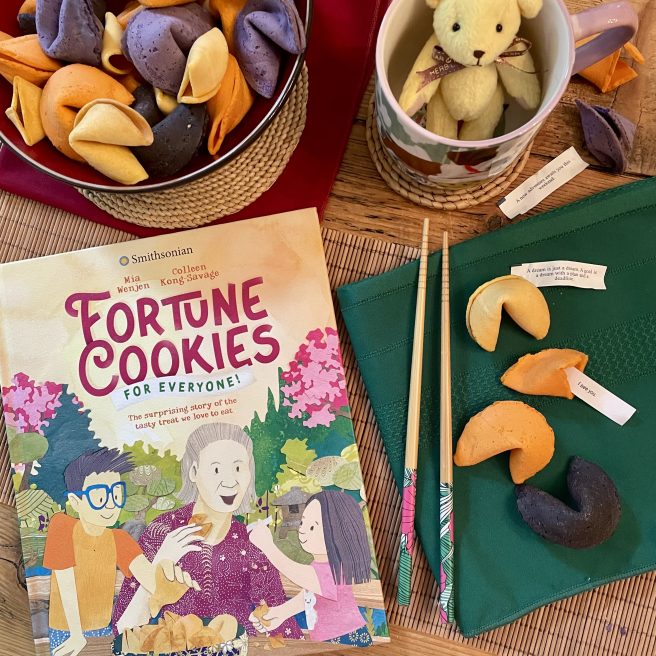
Everyone looks forward to cracking open a fortune cookie after finishing a mouthwatering Chinese meal. What does the future hold (“You will meet a handsome stranger”)? What handy bit of wisdom awaits (“A closed mouth gathers no feet”)?
While we all enjoy these fun and pithy messages, it’s logical to assume fortune cookies are a Chinese invention, when in fact they most likely originated in Japan. What’s more, most people in China haven’t even heard of fortune cookies, let alone eaten them! 😯
In Fortune Cookies for Everyone!: The Surprising Story of the Tasty Treat We Love to Eat (Smithsonian/Red Comet Press, 2025), Mia Wenjen and Colleen Kong-Savage serve up a captivating intergenerational tale flavored with sides of history, mystery, and cultural pride. Learning about a food’s interesting backstory makes it even tastier, don’t you think?

As the story opens, Grandma Miyako has ordered Chinese takeout for her grandchildren Kenji and Keiko. After they’ve feasted on their favorites — salt and pepper squid, garlic pea pods, and beef lo mein — she hands them their fortune cookies, mentioning that she knew who invented them.
The kids are excited to hear more about that in the “long and twisty story” Grandma tells using her scrapbook. When she was a girl, Makoto Hagiwara, the man who ran the Japanese Tea Garden in Golden Gate Park, served tea with miso-flavored fortune cookies he made by hand using a kata (iron mold).

Because the cookies were so popular, Hagiwara asked Grandma’s best friend Yukiko’s father (who owned a bakery) to help him. Mr. Okamura was happy to do so, suggesting they change the cookie flavor to sweet vanilla and butter to make them more appealing to Americans.
Continue reading












 Jama's Alphabet Soup