serving up a pair of cool picture books about josé andrés and world central kitchen

“Chefs like me feed the few, but our destiny is to feed the many. To be an army of goodness where a plate of food becomes a plate of hope…a light in dark times. Together, we can change the world through the power of food.” ~ Chef José Andrés
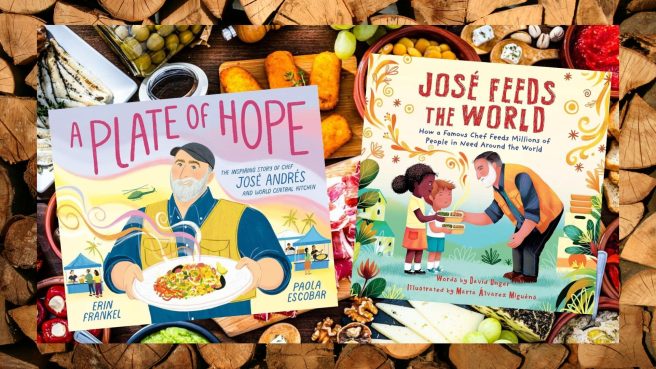
Since I’m a big fan of chef, restaurateur, and humanitarian José Andrés, I was happy to see both of these recently published picture books about his interesting life and amazing accomplishments.

Chef Andrés’s World Central Kitchen is truly a beacon of hope during tumultuous times of untold trauma, displacement and uncertainty due to natural and man-made disasters. Whether earthquake, hurricane, war, wildfire or pandemic, WCK is right there on the frontlines offering food, comfort, and a helping hand to local communities.
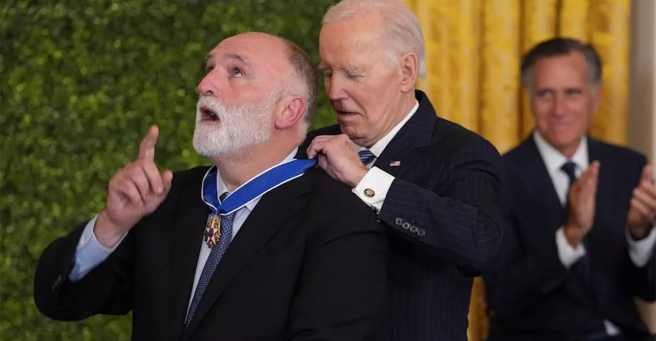
Chef Andrés received the Presidential Medal of Freedom on January 4, 2025. To date, WCK has served 450 million meals worldwide (photo via WCK.org).

You may know that in early January, Andrés received the Presidential Medal of Freedom, and that 2025 marks WCK’s 15th anniversary. Just recently, WCK provided free meals to firefighters, first responders and evacuees of the catastrophic wildfires in Los Angeles via food distribution centers as well as local restaurant and food truck partners.

So how did this incredible food aid/disaster relief nonprofit get started? What first inspired Andrés to become a chef, what continues to motivate him, and what are some of his core beliefs when it comes to food?
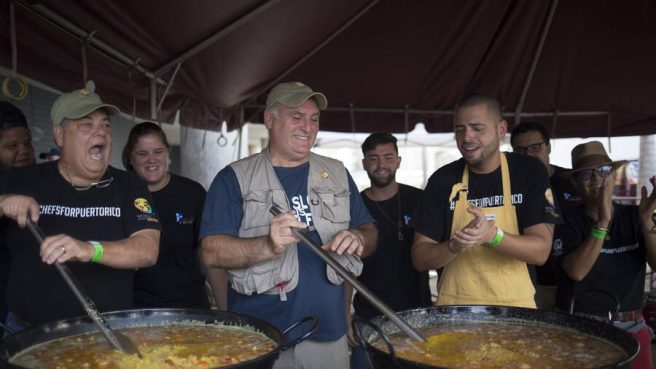
Chef Andrés and WCK volunteers cook paella in San Juan, Puerto Rico, October 2017 (photo by Eric Rojas/NYT).

Both books, A Plate of Hope and José Feeds the World trace José’s life from his childhood interest in cooking, to attending cooking school in Barcelona, to becoming an assistant chef at El Bulli, opening a tapas restaurant called Jaleo in Washington, D.C. (where he also volunteered at the DC Central Kitchen), to the 2010 Haiti earthquake, which motivated him to create World Central Kitchen.

When Hurricane Maria hit Puerto Rico in 2017, José and his WCK team got local people to volunteer after realizing they couldn’t do the work alone and there weren’t any other nonprofit organizations planning to feed the millions of people affected by the catastrophe.

As time passed, each new disaster presented different challenges requiring different solutions, and José found himself wanting to do more and more — establishing food distribution systems, flying in equipment to set up field kitchens, offering Meals Ready to Eat, etc. He also empowered local communities to use their skills and resources to help others as they had helped themselves.

Continue reading

[review] Blue by Nana Ekua Brew-Hammond and Daniel Minter

“Blue skies smiling at me, nothing but blue skies do I see . . . ” ~ Irving Berlin

Blue likes me. It’s always been there, coloring my life with good things since childhood: my first Schwinn bike, Island of the Blue Dolphins, fountain pen Quink, favorite pearl bracelet, the sparkling azure of the Aegean one summer.

At age 9, I saw Elvis filming “Blue Hawaii” alongside the pineapple fields. He was driving a baby blue convertible. The first time I met Len in London he was wearing a navy blue sweater. These days, I sip Darjeeling in a Blue Calico teacup, delighted to spot the first bluebird every spring.

Blue just knows how to make an impression. From the cozy comfort of broken-in jeans to the bright optimism of a clear autumn sky, blue touches us all in ways ordinary and profound.

But now I must confess something. Until I read BLUE: A History of the Color as Deep as the Sea and as Wide as the Sky by Nana Ekua Brew-Hammond and Daniel Minter (Knopf BFYR, 2022), I knew very little about blue’s fascinating history, origins, and cultural significance. Imagine my surprise when this book magically appeared in my mailbox one day — simply out of the blue (thanks for the gift, Miss T.)! 🙂

Brew-Hammond begins her captivating narrative by citing how elusive and mysterious blue actually is. It’s “all around us,” in the sky and sea. Yet we can’t touch the sky and when we try to cup the sea, its blueness disappears. We may crush iris petals for a brilliant shade of blue, but when we add water, the color fades away.

But then blue appears in the strangest places, discovered throughout history in unexpected ways.

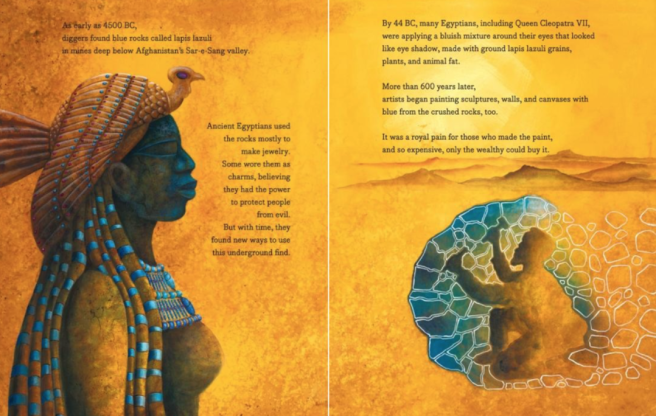
Blue rocks called lapis lazuli were mined as early as 4500 BC in Afghanistan. The ancient Egyptians used the stones to make jewelry and charms to ward off evil, and by 44 BC they (including Queen Cleopatra VII) applied a bluish mixture around their eyes made from ground lapis lazuli grains, plants and animal fat.

In another 600 years or so, artists began painting sculptures, walls, and canvases with blue made from the crushed rocks. Since this paint was expensive to produce, only the wealthy could afford it. This high-demand luxury prompted scientists, merchants, and dyers to search for more sources of blue.

Continue reading