
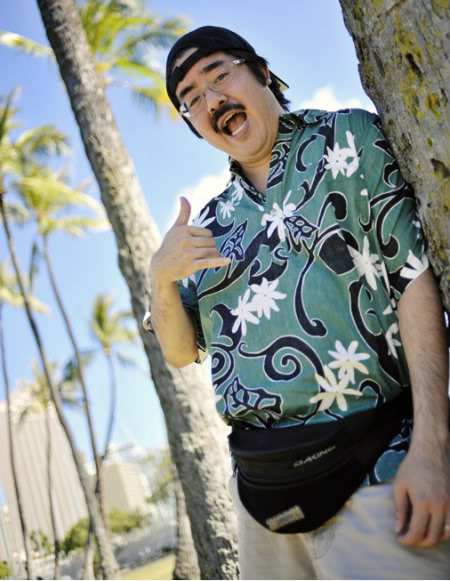
Since we’re all about Hawai’i this week, thought I’d share one of the semi-autobiographical poems from Lee Tonouchi’s first poetry collection, Significant Moments in da Life of Oriental Faddah and Son: One Hawai’i Okinawan Journal (Bess Press, 2011).
A staunch advocate of Pidgin (Hawai’i Creole English), Lee has been tireless in his efforts to change the negative misconceptions of it being a defective, bastardized form of English primarily used by ignorant or lazy speakers.
HCE is, in fact, a truly endemic language that originated in the late 19th century plantation culture. It facilitated communication between English-speaking residents and various non-English speaking immigrants who arrived in the Islands as contract laborers.
The existing pidgin Hawaiian spoken on the plantations eventually evolved into the lingua franca adopted by all local residents as words, inflections and idioms borrowed from Hawaiian, Cantonese, Japanese, Okinawan, Korean, Portuguese, Filipino, Spanish, and modern slang were thrown into the mix. Truly a tie that binds, Pidgin is a colorful, dynamic force in local Hawaiian culture; it levels the playing field among speakers of all ages, ethnicities, socio-economic and academic backgrounds.
I love the authentic, pitch-perfect local Pidgin voice in Lee’s poem, the way he uses elements of humor to broach more serious subjects, and how poignantly he conveys feelings of humiliation and marginalization.

Why I Hate Teachers Who Nevah Seen Star Wars
by Lee A. Tonouchi
I wear long pants,
long sleeve shirt,
but too late
everybody in school
already seen da shame
I trying for hide.Aftah Star Wars comes out
all da kids start calling me
CHEWBACCA,
cuz I full Okinawan,
so outta everybody
in da school
I get da hairiest arms,
da hairiest legs,
and da hairiest head.
And even though I no mo’ hair
on my face
I guess to dem das
close enough related
dat apparently I can pass
for being
one WOOKIE.Bad enough da teacher,
her, she no even notice
all da red dots on my arms,
da puka patches of skin
on top my limbs
for wea all my fur
used to be.Da worstest is when
da teacher helps dem,
by supplying ’em
wit da invisible weapon
dey need
for turn me
into one human ripper wallet.“Mrs. Oshio, you get Scotch tape?”
dey ask.
And she GEEVS ’em.
And not jus one piece.
Da WHOLE ROLL.And when she ask wot da tape for,
dey say we just playing Star Wars.
She no catch on
when dey tell
I playing da role of Chewbacca
and I going be
their prisoner.~ from Oriental Faddah and Son, Copyright © 2011 Bess Press.
The ending of this poem made me think of Lord of the Flies and the ongoing problem of bullying in today’s schools. I’ve read many poems where Pidgin is used for comedic effect, but Lee is especially adept at maximizing its potential to explore powerful themes beneath the guise of simple, unassuming narratives.

Oriental Faddah and Son just received a Ka Palapala Po’okela Honorable Mention for Excellence in Literature (the Hawai’i Book Publisher’s Association recognizes the best in locally published books every year). It contains 51 poems tracing the author’s life from childhood through adulthood. His search for personal identity reveals the multiple layers of marginalization* he has experienced as a fourth generation Okinawan American:
- As a Pidgin speaker in a place where English is the dominant language spoken by those with political, social and economic power
- As a local Asian in Hawai’i (“Oriental”) vs. an Asian American living in the continental United States
- As an Asian growing up in a place where “mainstream portrayals of adolescents are white continental Americans”
- As a local Okinawan in a place dominated by local Japanese, where discriminatory attitudes held by Japan Nationals (‘Okinawans are second-class citizens’) continue to be replicated in Hawai’i
- As an Okinawan American vs. Okinawans of the motherland who did not emigrate to Hawai’i
- As an Okinawan American haunted by his parents’ and grandparents’ ethnic history and identity
I thoroughly enjoyed reading Lee’s poems and learning a little more about Okinawan culture, portrayals of which have been largely overshadowed by the collective focus on WWII Japan and the internment. The examination of interpersonal relationships and imbalances of power — sometimes amusing, sometimes disturbing or sad — are ultimately moving and have universal resonance. The poems offer uncommon insight into this under-represented segment of Hawai’i’s ethnically diverse population and merit mindful reading.
***
*quote and paraphrases from Associate Professor Micheline M. Soong’s introductory essay, “So What’s It About?: A Boy and His Life of Multiple Marginalizations.”
***
 The always warm and lovely Linda Baie is hosting today’s Roundup at TeacherDance. Enjoy all the fabulous poems being shared around the blogosphere this week and enjoy your Memorial Day weekend. Summer’s here!
———————————————-
Copyright © 2012 Jama Rattigan of Jama’s Alphabet Soup. All rights reserved.
 Because I’ve always wished that this “spirit of Aloha” was more prevalent in the United States, I was especially pleased to read



 Jama's Alphabet Soup