jared and jama dish on alan wong’s pineapple room

“Wong has always been able to take well-loved and highly recognizable dishes and put a spin on them, and nowhere is this talent more apparent than at The Pineapple Room.” ~ Jo McGarry, Midweek.

    
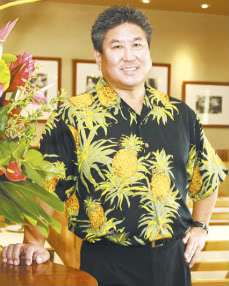
    photo credit: Tina Yuen, PBN

Pictured above is internationally acclaimed chef and restaurateur Alan Wong, whose name is synonymous with the best of Hawai’i Regional Cuisine. Last month when we were on O’ahu, we treated ourselves and nine of our favorite relatives to dinner at The Pineapple Room, one of three restaurants Wong owns in Hawai’i.

Though I had dined before at his flagship restaurant in downtown Honolulu (an Obama favorite), and loved his creative dishes which blend different ethnic cooking styles, this was my first time at The Pineapple Room. 

Continue reading

Surfer of the Century: riding the waves with duke kahanamoku


Happy Nonfiction Monday!

Since it’s Asian Pacific American Heritage Month, and the Summer Olympics are just around the corner, I thought it was the perfect time to take a closer look at a very cool picture book biography: Surfer of the Century: The Life of Duke Kahanamoku, by Ellie Crowe.

I heard his name a lot growing up in Hawai’i. He was an icon, a legendary hero, and lived according to his self-defined Creed of Aloha

In Hawai’i we greet friends, loved ones or strangers with Aloha, which means with love. Aloha is the key word to the universal spirit of real hospitality, which makes Hawai’i renowned as the world’s center of understanding and fellowship. Try meeting or leaving people with Aloha. You’ll be surprised by their reaction. I believe it and this is my creed.

I knew that Duke had won Olympic medals for swimming and that he was the father of surfing. But I didn’t know about the hardships he faced in order to reach his goals, particularly with regard to discrimination.

Call me naive. I grew up on a small island populated by people of every color. I never saw or heard of anyone being refused service in a restaurant because of the color of his/her skin. So I was surprised to learn that although he was sought after and admired because of his athletic brilliance, Duke was often treated like a non-person — being stared at or ignored, deemed a “strange looking, dark-skinned native from a distant land.”

I like how Crowe highlights many of the crucial events in Duke’s life with dramatic scenes that really stick in the reader’s mind: when he broke three Amateur Athletic Union world records to qualify for the U.S.Olympic team, and his times were so fast the officials in New York refused to believe them; when he missed his 100-meter freestyle race at his first Olympic games in Stockholm because he had overslept; when he rescued eight fishermen from a capsized boat in California with his surfboard; or when he was the only surfer able to ride a gargantuan wave, as described at the beginning of the book:

Surf’s up!

Eager surfers gripped their wooden surfboards and stared out at the monster waves. Spawned far out at sea, the thirty-foot “Bluebirds” streaked across miles of ocean in a solid line, crashing in white foam on Waikiki Beach. Such huge waves occurred only on extraordinary occasions, the result of underwater earthquakes or volcanic eruptions. Who dared surf the Bluebirds?

Only one surfer mastered the gigantic waves that day in 1917 — Duke Kahanamoku. He rode a thundering Bluebird for almost two miles, from the deep blue ocean to the white sand beach.

This story, of how a poor beachboy from Waikiki won 6 Olympic medals, introduced surfing to America, Australia and New Zealand, held the world’s fastest swimming record for twelve years, became Sheriff of Honolulu, and then official ambassador for the Islands, is sure to fascinate and inspire adults and kids alike. Beyond his official honors and medals, one remembers his modesty, courage, determination and good sportsmanship, no matter what the obstacle.

On an interesting side note, Ellie Crowe says in a Honolulu Star Bulletin interview that she first wrote about Duke’s early years in Duke’s Olympic Feet, which she submitted to Lee and Low Books.


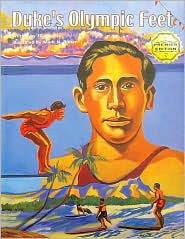
 DUKE’S OLYMPIC FEET by Ellie Crowe
(Island Heritage, 2002), ages 1-6

When she didn’t receive an answer, she went ahead and published the book with Island Heritage, a regional publisher. Two years later, Lee and Low editor, Louise May, offered to publish Crowe’s manuscript, apologizing for the delay, but explaining that it had been buried on her desk. Crowe showed Louise the published book, and together they worked on a full biography geared for a national audience, which became Surfer of the Century.

This book received a starred review from School Library Journal, was named a Bloomsbury Review Editor’s Favorite 2007, and was one of only two books listed as a Notable Children’s Book for the Kiriyama Prize, which recognizes outstanding books about the Pacific Rim and South Asia. The striking art deco style illustrations done in gouache air brush by Richard Waldrep perfectly complement the era with gorgeous blues of ocean, pool, and sky.

For a complete roundup of today’s nonfiction features, see Anastasia Suen’s Picture Book of the Day blog.

friday feast: voices on the wind


“Because I know my mother’s language, I’ve enjoyed exchanging thoughts with other Polynesians to discover our alikenesses and our differences. And because I know my father’s, I can explain to others what we have had here and lost and what we still retain.”
~ Mary Kawena Pukui (1895-1986)


Imagine having a name that is like a poem:

Mary Abigail Kawena ‘ula-o-ka-lani-a-Hi’iaka-i-ka-poli-o-Pele-ka-wahine-‘ai-honua Na-lei-lehua-a-Pele Wiggin Pukui.

The Hawaiian part means: “The rosy glow in the sky made by Hi’iaka in the bosom of Pele, the earth-consuming woman. The crimson lehua wreaths of Pele.”

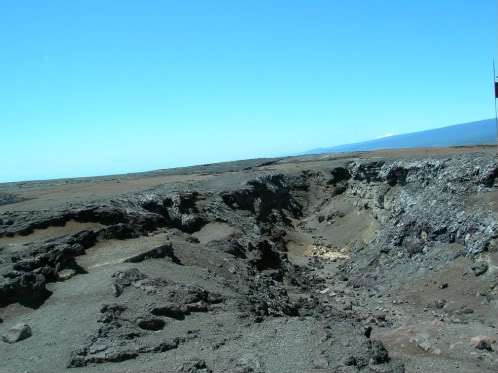
                   Volcanoes National Park, Island of Hawai’i

Now imagine spending the first six years of your life in a remote part of the world, a place of barren lava wastelands and green mountain forests. There are no outsiders, no influences from the Western world. There is only you and your grandmother, Po’ai, a former dancer in Queen Emma’s court, who teaches you everything she knows about ancient Hawai’i, through chants and hula. You learn geneaology, history, folklore, social behavior, herbal healing, music, family history and crafts.

The spoken word is powerful, sacred, and conveys everything you need to know about an entire civilization, so you listen carefully, watch, imitate and remember.

Mary Pukui, or Kawena (kah-VEH-nah), as she was fondly known, is a Hawaiian treasure. The daughter of a Hawaiian mother and a Caucasian father from Salem, Massachusetts, Kawena was a bridge between the old world and the new. Without her life’s work as an author, linguist, composer, dancer, teacher, ethnographer, historian, editor and translator, much of what we now know about the real Hawai’i would have been lost forever.

Her unusual upbringing, of being raised by her maternal grandmother, was authentic to the old Hawaiian custom of hanai. After Po’ai passed away, Kawena returned to her parents’ home, where her father spoke only English, and her mother, only Hawaiian.   

By this time, the Americans had taken over Hawai’i. Though the New England missionaries had brought written language, they had also banned Hawaiian in the schools. When she was fifteen, Kawena tried to help a new student, and was severely punished for speaking Hawaiian. Her parents withdrew her from school, but the hurt and humiliation she suffered lasted a lifetime.
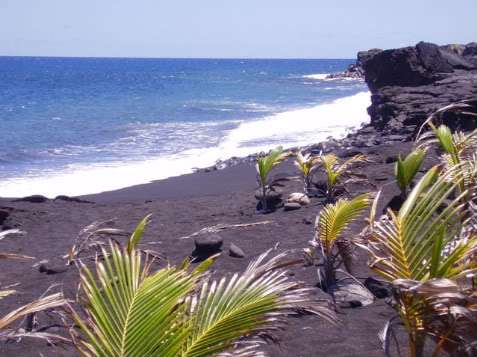
                     Black sand beach, Island of Hawai’i

Kawena grew up respecting both of her cultures, and could think in Hawaiian and English. But she saw how the world was changing, and was afraid that all things Hawaiian would be lost forever. As a teenager, she began to record words, sayings, bits of poems and proverbs that she remembered on scraps of paper. With the help of a neighbor, she also began translating folklore and poetry, and wrote down family stories.

She eventually worked for the Bishop Museum, where she translated Hawaiian newspapers and manuscripts, and gathered oral histories. She recorded more Hawaiian words and expressions on index cards. After 50 years of diligent annotating, her collection of 10,000 word entries became the most detailed, accurate and complete Hawaiian-English dictionary ever published.

And all those scraps of paper? Her lifelong collection of poetical sayings became ‘Olelo No’eau (Bishop Museum Press, 1983), her masterwork, considered to be the “finest compendium of traditional Hawaiian insight and lore, handed down through generations of oral tradition.”

It is easy to see how poetic the Hawaiian language is purely by sound — each vowel is enunciated, and only eight consonants are used — a musical syllabics resembling rolling waves in the sea. But more remarkable is that the Hawaiians thought poetically, describing the world and their emotions using the metaphors of nature. Animism, where every rock, tree, animal or plant has a soul or spirit, was central to their beliefs.

Like the Eskimos with their many ways of describing snow, the Hawaiians described rain in ways very specific to character and location:
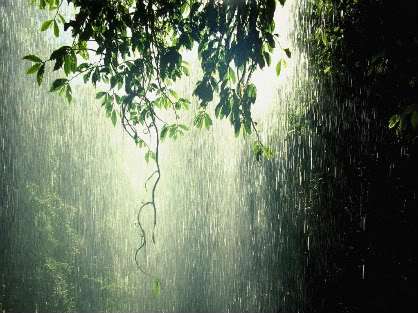
Ka ua hehi ‘ulu o Pi’ihonua.
The rain that treads on the breadfruit leaves of Pi’ihonua.

Ka ua ho’opala ‘ohi’a.
The rain that ripens mountain apples.

Ka ua kani ko’o o He’eia.
The rain of He’eia that sounds like the tapping of walking canes.

Ka ua kapua’i kanaka o Palawai.
The rain of Palawai which sounds like human footsteps.

Ka ua kau la’au o Pahala.
The tree-resting rain of Pahala.

Ka ua Kupunikapa o Lanakila.
The hold-fast-to-the-clothing rain of Lanakila.

Ka ua Lanipa ‘ina o ‘Ulupalakua.
The sky-crackling rain of ‘Ulupalakua.

Ka ua ‘o’ili’ili maka akua.
The rain that appears here and there to denote the presence of a god.

Ka ua po’o nui o ke kuahiwi.
The big-headed rain of the mountain.

(all poetical sayings from ‘Olelo No’eau)
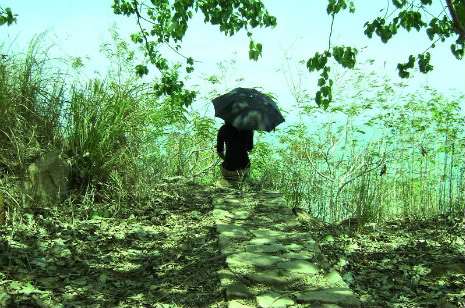
It is easy to see that in such a world, every natural detail is keenly observed, deeply revered, and honored with its own unique lyrical expression. And it is awe inspiring that poetry — whether in the form of chant or song, was the medium of preservation, education, inspiration and entertainment — practiced by commoners as well as kings. A spoken word was exhaled with the breath of the speaker, and once uttered, it was carried by the winds for generations.

I leave you with an original mele hula (a song for the dance), composed by Kawena in the early 1930’s with her mother, Pa’ahana Wiggin. The chant is organized around four indispensable words which denote four directions: luna (above), lalo (below), mauka (inland), and makai (toward the sea), and is often taught to kindergarten children in the original Hawaiian. Picture the children performing a sitting hula while chanting — gesturing above, below, inland, and toward the sea.

E’IKE MAI
(translation below)

I luna la, i luna
Na manu o ka lewa

I lalo la, i lalo
Na pua o ka honua

I uka la, i uka
Na ulu la’au

I kai la, i kai
Na i’a o ka moana

Ha ‘ina mai ka puana
A he nani ke ao nei.
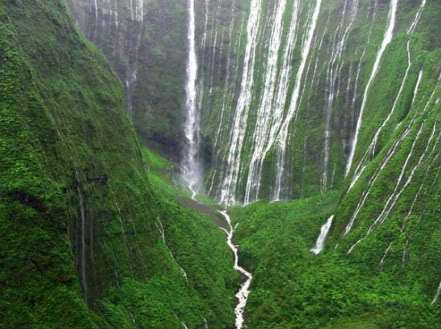

Mt. Wai’ale’ale on Kaua’i, the wettest spot on earth and place of origin, Hawaiian Island chain


BEHOLD

Above, above
all birds in air

below, below
all earth’s flowers

inland, inland
all forest trees

seaward, seaward
all ocean fish

sing out and say
again the refrain

Behold this lovely world.

Mary Kawena Pukui earned two honorary doctorates, and is the only native Hawaiian ever to be nominated for a Nobel Prize in Literature.

For some audio and video samples from the Bishop Museum archives featuring Kawena, click here.

This week’s Poetry Friday Roundup is at Two Writing Teachers.

Quick Pronunciation Guide:

a — ah

e — ay

i —
ee

o —
oh

u —
oo