[review + recipes + giveaway] Celebrating Jane Austen’s 250th Birthday

It is a truth universally acknowledged that when a certain 18th century English author turns 250, worldwide fans who ardently admire and love her will want to commemorate this important milestone all year.

Today we’re celebrating Jane Austen’s birthday with a brand new historical fiction picture book and two teatime treats. Few writers have the distinction of being read and studied continuously for more than two centuries. We have Jane to thank for focusing on the internal lives of complex characters, and of course, her witty and ironic social commentary.
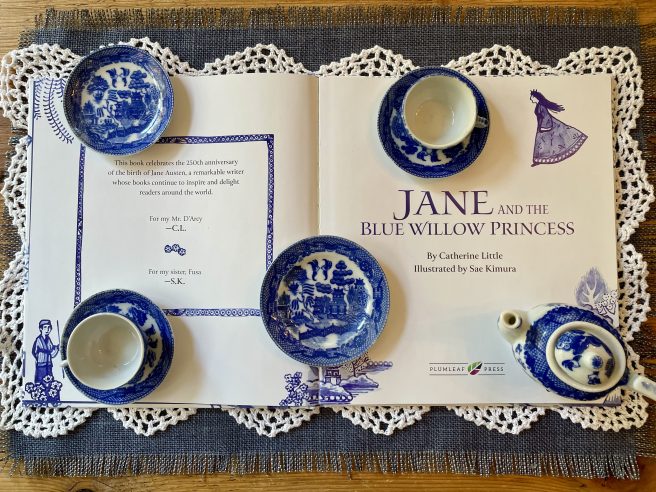
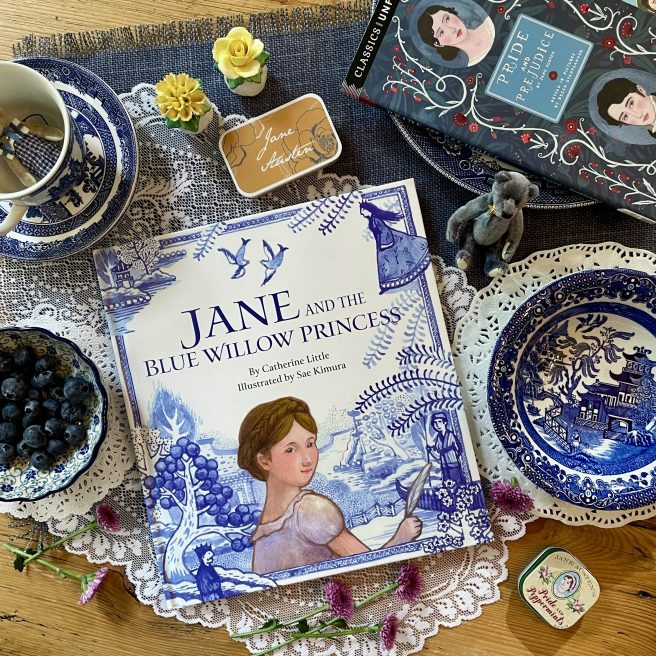
Because of my love for china, I was especially excited to read Jane and the Blue Willow Princess by Catherine Little and Sae Kimura (Plumleaf Press, 2025). Published especially to commemorate the 250th anniversary of Austen’s birth, this delightful story was inspired by a fragment of Blue Willow pattern china unearthed during a November 2011 archaeological dig at Steventon, where Jane spent the first 25 years of her life and drafted her first three novels.
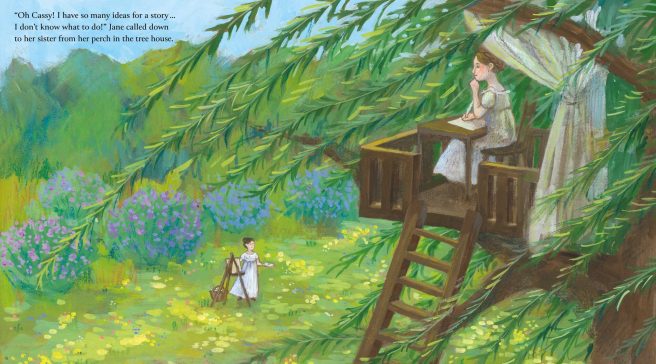
As the story opens, we find Jane perched up in her treehouse calling down to her sister Cassy (who’s at her easel). She has so many story ideas she doesn’t know what to do.

Cassy is relieved when Mother appears in the garden carrying a tray with blue and white teacups and plates; Jane has been working hard and needs a break. As the three of them enjoy tea and cheese toasties (Jane’s favorite snack), Mother asks Jane about the story she’s writing for Father’s birthday.

Continue reading
[review] Suka’s Farm by Ginger Park, Frances Park, and Tiffany Chen

My grandmother and I had a unique way of communicating. Our made-up language was a hodgepodge of Korean, Hawaiian Creole English (Pidgin), broken English and American slang. We stuck to simple subjects as we watched our favorite soaps or gossiped about other family members.

While in middle school, I sometimes greeted her with a simple “Ohayō” or “Kon’nichiwa,” and she would shush me, her face like thunder. Since many of my classmates were Japanese, I naturally echoed some of what they said. My mom finally explained why Grandma got upset: from 1910 to 1945 the Japanese had occupied her homeland; Koreans were assigned Japanese names and the Korean language had been banned.

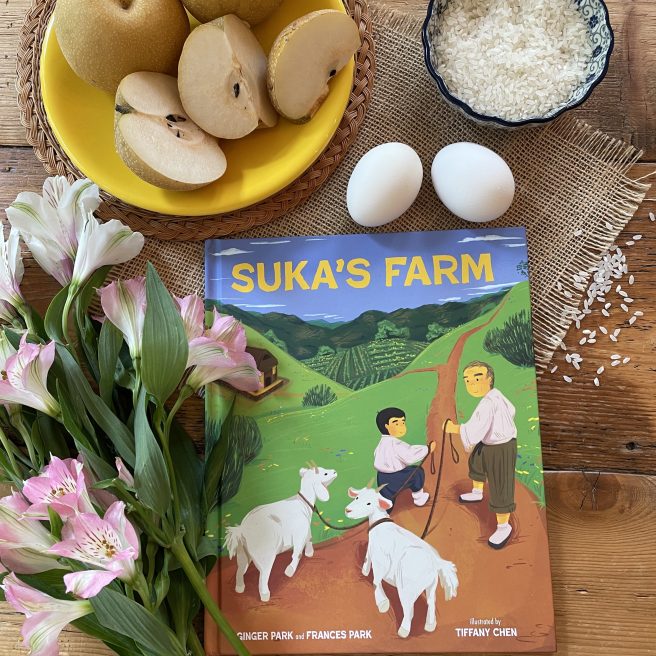
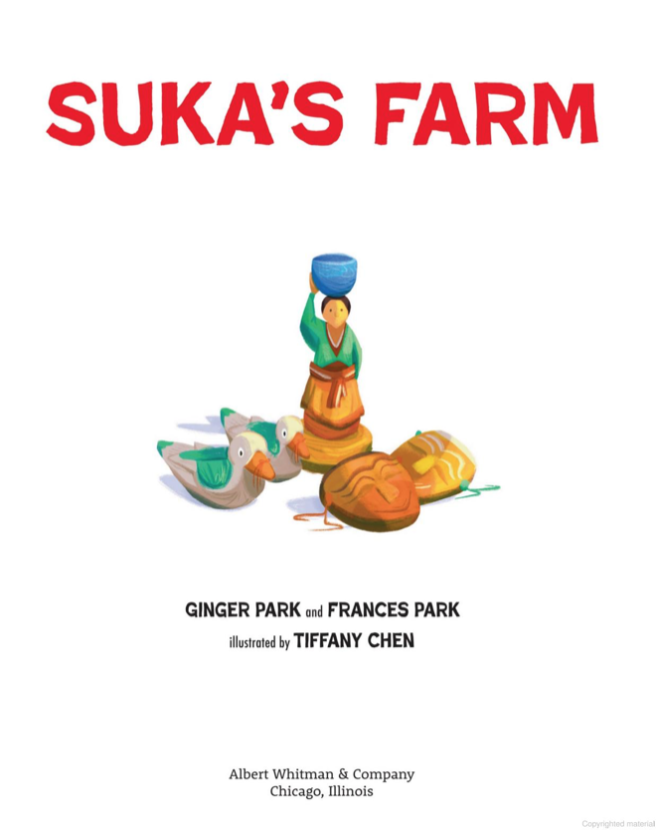
I thought of her while reading Suka’s Farm (Albert Whitman, 2025), a new picture book by Ginger Park and Frances Park, set in 1941 Korea. Illustrated by Tiffany Chen, this touching story of an unlikely friendship between an elderly Japanese farmer and a hungry Korean boy warms the heart and offers a much-needed glimmer of hope for humanity.

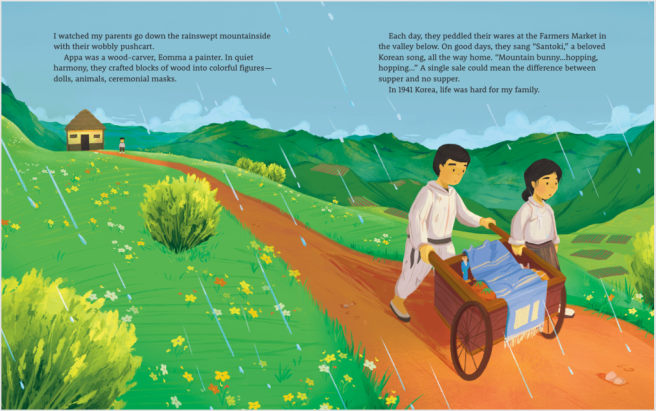
As the story opens, we learn Kwan lives on a quiet mountainside with his artisan parents, who eke out a living by selling their woodcarvings at the Farmers Market. Times are hard as they struggle to get by with meager bowls of rice porridge for supper. One night, Kwan overhears his worried parents say they only have a handful of rice left.

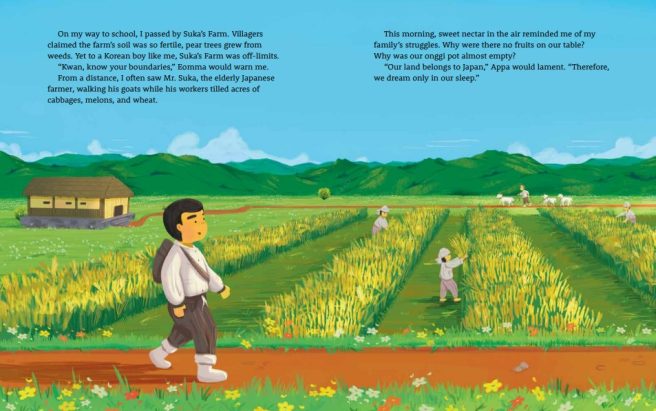
When Kwan passes Suka’s Farm on his way to school the next morning, he’s reminded of his family’s struggles. He sees pear trees growing from fertile soil, and acres of cabbages, melons and wheat — yet none of these foods ever appear on Kwan’s table. That’s because the land belongs to Japan, and Suka’s Farm is off-limits to Korean boys like him.

Still, Kwan is determined to help his family and, “as if in a dream without boundaries,” he steps onto the farm and musters up the courage to ask gruff Mr. Suka for a job. Kwan respectfully introduces himself as Aoki, the Japanese name he’d been assigned by law.

Mr. Suka is dismissive and rejects Kwan’s offer of work. How could a child help him? Kwan explains he could help with the goats, begging Mr. Suka because his family is hungry. Mr. Suka tells Kwan to go to school, but just as the boy is leaving the barn, he calls him back. He agrees to let Kwan work on a trial basis.

So, the next day, Kwan arrives before dawn, bearing a gift for Mr. Suka from his parents — a carved wooden goat. Though puzzled by the gift, he thanks Kwan, then introduces him to his little herd of goats, each of which has a name. Kwan and the goats, whom Mr. Suka loves like family, become fast friends.

Continue reading

[sippable review + giveaway] The Chocolate King by Michael Leventhal and Laura Catalán

What could be more comforting on a cold winter’s day than rich, velvety hot chocolate? Sip the steamy, frothy goodness from your favorite cup and all’s right with the world.

No matter how you get your daily chocolate fix – bar, bonbon, chip or cocoa – a good way to enhance your enjoyment is to learn more about chocolate’s fascinating history.

Like me, some of you fellow chocoholics are familiar with chocolate’s origins in Mesoamerica and how Don Hernán Cortés brought cacao to Spain after conquering the Aztecs in the early 16th century. But did you know Jewish traders played a critical role in popularizing chocolate around the world?

In his debut picture book, The Chocolate King (Apples & Honey Press, 2022), Michael Leventhal highlights chocolate’s little known Jewish connection. When Spanish Jews were forced to flee the country during the Inquisition, they took their chocolate making skills with them.

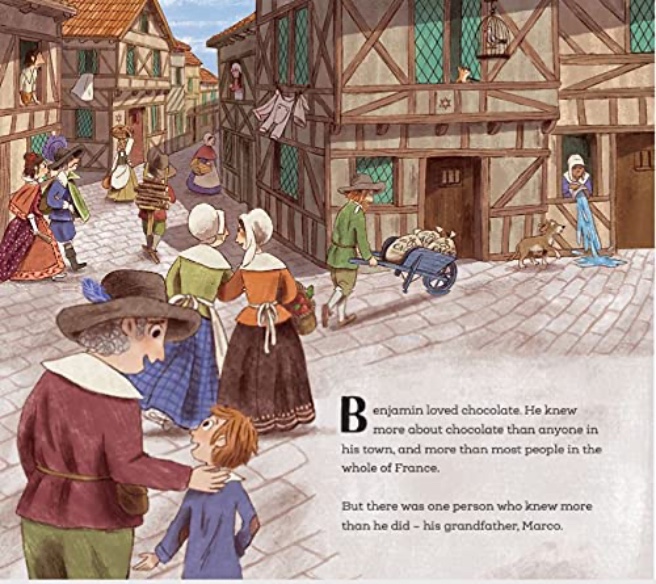
This tasty bit of historical fiction is set in early 17th century Bayonne, where we meet young chocolate lover Benjamin. Not only does he love to eat chocolate, he knows more about it “than most people in the whole of France.” 

Continue reading

[mouthwatering review + recipe] The Fabulous Tale of Fish & Chips by Helaine Becker and Omer Hoffmann

“Fish ‘n’ chips!
Chips ‘n’ fish!
Such a crispy, tasty dish!”

It wasn’t until I moved to London in the late 70s that I tasted authentic fish ‘n’ chips for the first time.

Whether cod and chips from a neighborhood chippy, or a plate of divine lemon sole at Geale’s in Notting Hill, it was all so good. Nothing could compare to those golden brown fillets, fried up light and crispy in a beer batter, each crunchy bite yielding to tender, flaky fish inside. Is there any meal more quintessentially British?

Naturally, I assumed fish ‘n’ chips was invented by an Englishman. But after reading The Fabulous Tale of Fish & Chips by Helaine Becker and Omer Hoffmann (Green Bean Books, 2021), I surprisingly learned it was a Jewish immigrant named Joseph Malin who opened the very first fish ‘n’ chips shop in the UK. Established in 1860, Malin’s of Bow in London’s East End remained in operation for over a century. Now that’s a lot of fish and taters!

In her flavorful fishtory, Becker surmises how fish met chips to become “one of the greatest and most popular dishes of all time.”

Young Joseph Malin loves everything about fish — catching, selling, and especially, eating it. Though his entire family works from dawn to dusk in their fish shop, they struggle to make ends meet. 

One day Joseph has a brilliant idea — what if they try to sell cooked instead of raw fish? After all, he loves his grandmother’s delicious fried fish — a special family recipe handed down through several generations. Her secret is coating the fish in flour, dipping it in beaten egg, then coating it with matzoh meal before frying it in hot oil. 

Because of its crispy crust, the fried fish is just as tasty the next day when families like Joseph’s, who are forbidden to cook on the Sabbath, can eat it cold.

Continue reading