

After all, she’s the one who had a fascinating, glamorous career as a news correspondent and producer for Jordan and Dubai Television. The one who interviewed royalty and heads of state, cosmonauts, opera singers, musicians, and world-renowned scientists. The one who attended openings of Parliament, lunched in the royal palaces in Jordan, and who, once upon a time, attended the New English School in Kuwait with Queen Rania.Maha once told me that she likes to keep busy. Since moving to the U.S. in 1998, she has shifted her focus to writing for children. And why not? She has four of her own — two teenage girls, and two boys under the age of 10, a little posse that would decidedly challenge even the most resilient of supermoms, while at the same time providing neverending story fodder.Just last month, Maha’s first picture book, The White Nights of Ramadan, was released by Boyds Mills Press (my review is here). The “white nights” refer to three days in the middle of
Ramadan — the full moon, and the days before and after. In Maha’s native Kuwait and other countries in the Persian Gulf Region, these days mark the candy festival called Girgian, which is highly anticipated by children.

Since we’re right in the middle of the holy month, it’s the perfect time for Maha to tell us all about her book and share a special family recipe. She’s visiting today from her home in Fairfax, Virginia, where, in her “spare” time, she’s busy working on her MFA from Vermont College and building a career as an image consultant.
Welcome to alphabet soup, Maha, and congratulations once again on the publication of your first picture book! How does it feel to finally be able to call yourself a “published children’s author?” Is it what you expected?
Thank you, Jama, for this wonderful opportunity. I feel honored to be selected as an interviewee on alphabet soup. I get to laugh every time I read it. It’s well organized, and so much fun to read.
In terms of being a published children’s author, the feeling is very special, but there is also a lot of responsibility that comes with it. For me, there’s the self-imposed pressure of wanting to produce another book and the feeling of being overwhelmed about finding a new idea. There’s also the What If factor: What if the book does not sell? What if it is not perceived well? I had not anticipated that beforehand. So I’m dealing with that along with enjoying the fact that the book is now published.
Please tell us how The White Nights of Ramadan evolved. What did you learn from this experience?
The idea of writing about Ramadan came from my own need to find a book about this month that was a fun read. I was able to find several books that captured the month of fasting very well, but they seemed very encyclopedic. I had the chance to speak at an interfaith event held at Church of the Redeemer that the Arabic school I belong to arranged with the church and Am Kolel Synagogue. We had several interactive children’s events, but when it came time to sharing a book, there were none that seemed to work for the children.
So I decided to write my own. At the time I did not feel there was a market for this kind of book. I wrote the book in rhyme. It was a fun read, but the meter did not quite work all the way through. Several stanzas seemed forced. It sat in my folders for some time. And I continued to market other works to various publishing houses.

One day, I got a letter from Boyds Mills Press. I had sent them a story that was about a cultural event, but it ended up on someone else’s desk. The letter said that the subject did not exactly work for a picture book, but to keep them in mind for other works and to email him if I had something. Of course I panicked a little. Actually, I panicked a lot, and then I suggested a folk tale, which I had recently written. It was not what this editor was looking for.

The response was, “What is Girgian?” I explained that it was a candy festival. Eventually, I attended the SCBWI conference, at which the author of these correspondences was a speaker. I got to meet Larry Rosler in person and he told me that he would like for me to try writing a story about Girgian and preferably not in rhyme. I had been living with the characters of my story for several months and it took a very short time to come up with the story in prose. It was accepted and we took it from there.

Working with Larry is like living a beautiful dream. He is so very kind. I am overwhelmed by how wonderful he is in terms of expressing himself and how warm he comes across and how masterful he is as an editor. To have the opportunity to work with him and the team at Boyds Mills Press is such a great honor.
Aside from its focus on Girgian, what do you think sets your book apart from the many other children’s books about Ramadan? Were you trying to dispel any popularly-held misconceptions? If so, which ones?
My children were somewhat frustrated and wanted to be able to share books with friends that described the month of Ramadan in an incidental way, as part of a story. Most books talked about the fasting part in a somewhat didactic way, so it was not an easy read for them.
In terms of Ramadan, the fasting is a major part of it, but the reasons behind the fasting are what make it meaningful. Muslims fast to place themselves at equal footing with those less fortunate. Nothing makes you relate to someone deprived of food more than the pinching ache of hunger.
But what I wanted to show was that Ramadan is not a month of suffering, but a month that holds beautiful meanings of sharing and interacting with family and friends. Even young children plead with their parents to fast, if only for a day. It makes them proud to be able to accomplish such a feat, and it gives them a chance to get closer to family and friends.
Generally, how old are children when they begin to fast? Did you find it difficult when you first began? Is it difficult now?
Children are not required to fast until they are in their teens. However, many children start to practice at around 6 or 7. I remember fasting the last three days of Ramadan when I was 6. I had a cousin who was one year older and he started that same year, and my best friend at the time also fasted for Lent. We all got so much attention; it was well worth it, and we felt so grown up.

As an adult it is not very difficult. I think the first day was tough in some years because my biggest problem on the first day was developing headaches from caffeine withdrawal. I no longer drink caffeinated coffee, if I have coffee at all, and that made it so much easier. It is somewhat difficult for teens in schools, but they go to school fasting and take food with them, in case they have to break their fast. If they do they can make up missed days in the winter when the days are shorter.
How did you feel when you first saw Ned Gannon’s illustrations? Was his vision close to the one you had in mind? What do you think his art brings to your story?
When I first saw Ned Gannon’s illustrations I loved how elaborate they were. I saw a black and white sketch first and he had captured the details so well. I have to say I absolutely loved his use of color and the effect of light and shade that seem to be his signature. I feel he captured the essence of the festival and the country and the characters superbly.
Please tell us the story behind your dedication: “To Mom and Dad, I walked and walked.”
Oh, that may seem funny now, but when I was about 5, I was learning to read. I actually learned to read English before Arabic, even though I lived in Kuwait. I had to bring home books from school to practice and one of the books was called, “I Walked and Walked.” The main character walks and encounters a dog, then a cat and so on through a series of events. My dad wanted me to read the book so that I made no mistakes. So I would start: “I walked and walked and what did I see?” (All is well so far.
Then, on the second line, I would say “I saw a bog” (instead of dog), and I would have to start the book all the way from the start. Sometimes I would mess up on the very last sentence! I have to say there were tons of tears, but my dad, a physician, told me that he wanted me to perfect the English language. “One day you’ll be better than me in language,” he said. “I learned English in medical school and that was really tough. I want you to do it now when you’re young.” Of course I still remember the book word for word to this day.
What was your childhood like? Which books did you love most?
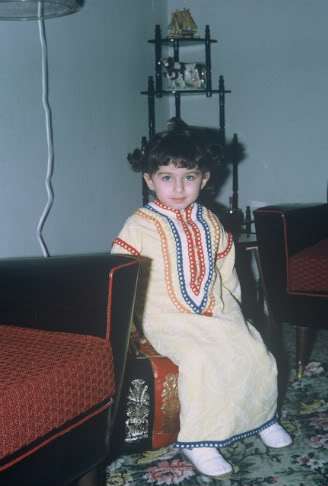
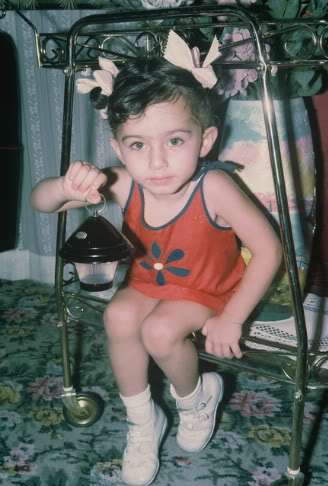
I had a lovely childhood. My dad worked for Getty Oil Company in Kuwait and we had friends from all over the world living in this American campus. Our house was on the sea shore and I spent long hours discovering sea life and picking shells and building sand castles. The weather is very warm in Kuwait and with the exception of a few weeks in winter, walking along the beach is a year long affair.
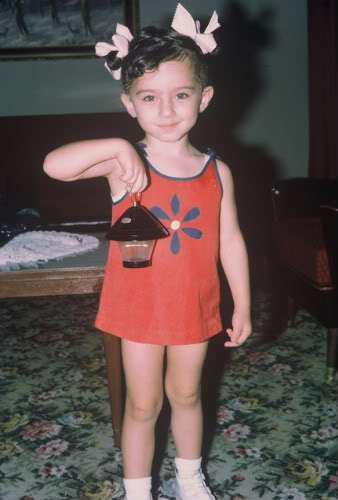
I loved to draw and write from a very young age. I loved reading Charlotte’s Web, Paddington Bear. Jack London’s Call of the Wild and White Fang were my favorites and so were all the Enid Blyton books I could get my hands on. I also loved the Famous Five and Agatha Christie mysteries. But what I also enjoyed reading were books in Arabic.
There was this series called “The Green Library,” that revolved around folktales and legends. They are so rich in detail and I bought the entire series as an adult and sometimes read them to capture the nostalgia of my childhood.
Why did you decide to re-craft your journalistic training into writing for children, and how does it influence your work today?
I have just started my MFA at Vermont College of Fine Arts, and I know how much more I still have to learn. Learning to write for children well is a lifetime commitment. I find my journalistic background feeds my work every day in two ways. First, it gave me several unique experiences and perspectives to draw on, and second, it made me able to work fast. Journalistic deadlines are cut-throat. Television satellite feeds teach you the value of every nano second. I feel that I can rework my children’s writing fast, if I have to.
I am so much in awe of how much you do. How do you manage to balance your writing life with your personal life?

Balancing home life is very hard sometimes. My teen daughters are a blessing. They are very independent and help me out with my younger boys. In the summer especially, they help with babysitting. One of my daughters loves to cook and she’s really good at it, so she takes over the cooking. During the year it’s hit or miss. I try to plan ahead, but sometimes you get things from left field so you have to improvise. Usually things tend to work themselves out. Writing gets squeezed in very early or very late in the day, or both.
Picture books are still a tough sell. Any advice for those hoping to break in?
I think that if you enjoy writing picture books keep on writing them. Don’t worry about the market. Write for your own personal enjoyment first, which makes for better writing, and this leads to publication. I think the key is to want to write for writing itself, versus having publication be your main focus. Also, try to constantly read as many picture books as you can. It’s amazing how that can spark ideas.
I sold my second fiction picture book to Boyds Mills Press, and I’m working on a third, which is a little different, because it is nonfiction.
Describe yourself in 5 words.
Always wanting to do more.
Passions besides reading and writing.
I love antique stores and yard sales; I’ve also recently learned to bead bracelets. I enjoy doing watercolor painting with my son, who recently started art lessons with renowned watercolor artist Lou Negri.
3 fondest wishes.
I wish for my children to all find a field of study that gives them lifelong enjoyment.
I wish to find that magic button that once pressed gives one total peace of mind.
I wish for world peace and the end of stereotyping and alienating of people and nations that choose other ways of life.
5 favorite foods.
Anything my mother cooks. I hate to brag, but my mom cooks Asian, Italian, and Mediterranean food like an expert gourmet chef. I also love seafood from my days living by the sea. Fishermen walked along the shore in front of our house with boxes filled with fish so fresh they still moved!
Please describe your favorite childhood food-related memory.
I grew up in a close-knit family of four. On weekends my dad had a ritual of getting up early to make a special breakfast dish that had hummus as its main ingredient, but which is served warm. So we would have stations. My mom would make the hummus, my dad would toast the bread (which went into the dish); my brother would mince garlic, and I would squeeze lemons.
We had a little garden so I also got to get the fresh herbs. Then the ingredients were mixed together with hot water and the dish was dressed up with pine seeds sauteed in olive oil. This breakfast dish is tangy and with green olives its flavors danced on your tongue. Of course we would have this with mint tea. The dish is called Fatet Hummus.
Please share a recipe with us, something you might prepare for Iftar (meal taken at sunset to break the fast during Ramadan).
Iftar food often starts with soup and then mostly stews and savory pastries, but the thing most associated with the month is the Ramadan desserts. I make five or six different desserts through the month. Some take a long time to make, while others have fast prep time and are just as tasty.
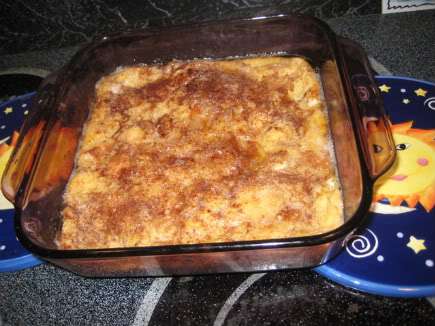
For instance, I make a basic bread pudding, but the moment it’s done baking, I drench it with sweetened condensed milk and whipped cream. It is awesome. I also make pastries with homemade pancake-like pastry, filled with walnuts (or pecans), cinnamon and sugar, deep fried and drenched in homemade syrup. This dessert is also perfect with substitute sugar and works with store-bought puff pastry which you can bake, instead of fry.
BREAD PUDDING WITH CONDENSED MILK TOPPING
4 eggs, lightly whisked (or 5 egg whites)
1 12-oz can evaporated milk (you could use fat-free)
1 T sugar
1 tsp ground cinnamon
1/2 tsp ground nutmeg
1/3 cup raisins (optional)
1 T butter cut into small patsTopping:1 can sweetened, condensed milk
1 8-oz tub of Cool WhipPreheat oven to 325 degrees F.Spray an 8″ x 8″ baking dish with non-stick spray.Place bread in baking dish.In a separate bowl, whisk eggs, evaporated milk, sugar, cinnamon and nutmeg (and raisins, if you are using them), and pour over bread in baking dish. Use a spoon to push down the bread to ensure it is soaked well with the milk mixture.Put pats of butter on top.Bake uncovered for 25 minutes at 325 degrees F, and for an additional 5 minutes at 400 degrees F, or until golden brown.
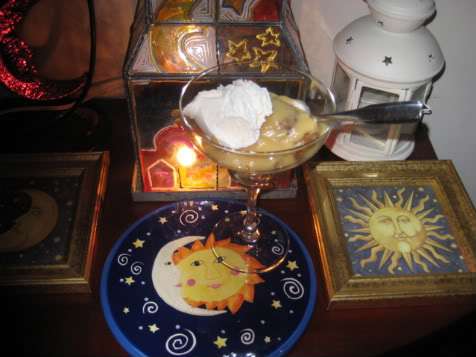
Remove from oven, scoop immediately into individual serving ramekins/glass bowls. Drizzle with sweetened condensed milk (to taste). Add a dollop of Cool Whip.
*Store extras covered in fridge. This pudding tastes great the second day. Just microwave for 30 seconds and add condensed milk and Cool Whip and it tastes just as fresh as on the first day.
*You could add chocolate chips and toasted pecans to this recipe over the Cool Whip, but it tastes really good plain.
—————————–
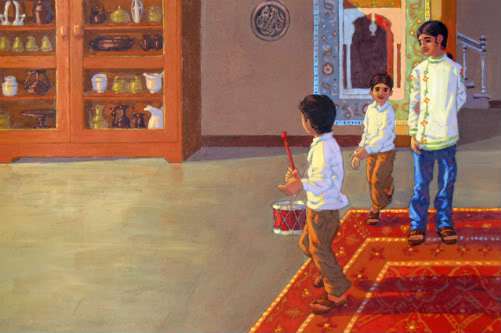
*Interior images posted by permission, copyright © 2008 Ned Gannon, published by Boyds Mills Press. All rights reserved.



 Jama's Alphabet Soup