love is in the air

Just for you: A perfect evocation of love in anticipation of Valentine’s Day. ♥️

“Les Amoureux” by Marc Chagall (1928).
TOUCH THE AIR SOFTLY
by William Jay Smith

Now touch the air softly, step gently, one, two …
I’ll love you ’til roses are robin’s egg blue;
I’ll love you ’til gravel is eaten for bread,
And lemons are orange, and lavender’s red.

Now touch the air softly, swing gently the broom.
I’ll love you ’til windows are all of a room;
And the table is laid, And the table is bare,
And the ceiling reposes on bottomless air.

I’ll love you ’til heaven rips the stars from his coat,
And the moon rows away in a glass-bottomed boat;
And Orion steps down like a river below,
And earth is ablaze, and oceans aglow.

So touch the air softly, and swing the broom high.
We will dust the grey mountains, and sweep the blue sky:
And I’ll love you as long as the furrow the plough,
As however is ever, and ever is now.

~ from The Girl in Glass: Love Poems (Books & Co., 2002)

*

“Lovers with Daisies,” by Marc Chagall (1949-59).

I was totally enchanted by every word of this lyrical gem, which is alternately titled “A Pavane for the Nursery.” Something about, ‘step gently, one, two’ struck me as an ingenuous invitation to delight.

This poem has been set to music by several composers, is a popular choral piece, and is often sung or recited at weddings.

A former U.S. Poet Laureate, William Jay Smith once said, “Great poetry must have its own distinctive music; it must resound with the music of the human psyche,” and this poem certainly bears that out.

Smith favored traditional poetic styles to free verse, hence his use of a rhymed metrical-stanzaic structure here. His pronouncements are charming as well as disarming despite the formal style. Who can resist “the moon rows away in a glass-bottomed boat,” or “we will dust the grey mountains and sweep the blue sky”?
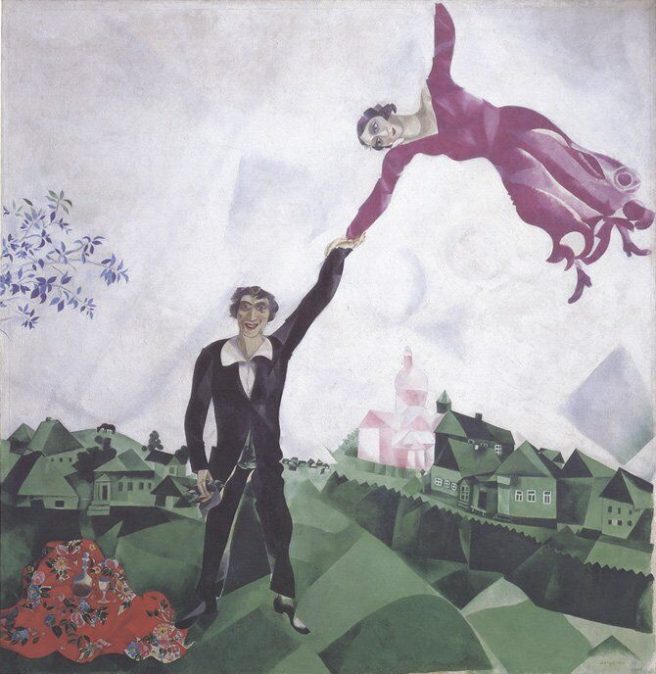
“La Promenade,” by Marc Chagall (1918).

Brooms are symbols of good luck, as they can be used to “sweep away” evil spirits or bad fortune. According to an old Welsh custom, newlyweds should enter their new home by stepping over a broom so luck will follow them. Similarly, if a bride and groom jump over a broom during their marriage ceremony, good luck and fortune will flourish in their union.

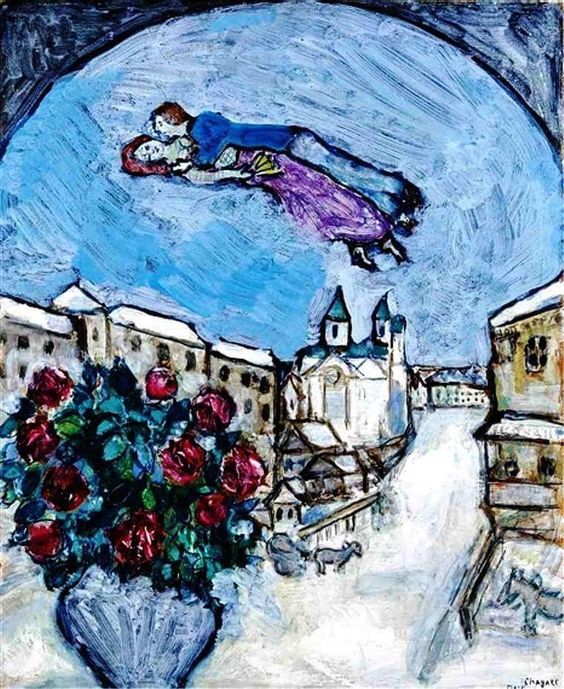
Upon reading this poem, I thought immediately of Marc Chagall. After all, he’s considered “the ultimate painter of love.” He masterfully captured the euphoria of love with his levitating lovers, who blissfully float on air, defying gravity, soaring beyond earthly realms as one. 

“Bride and Groom of the Eiffel Tower,” by Marc Chagall (1938-39).

His wife Bella was not only the love of his life, but the muse who inspired his best work. He said, “Is it not true that painting and color are inspired by love? In art, as in life, all is possible when conceived in love.”

I thought Chagall’s flying lovers a good match for Smith’s poem, for it is the life-sustaining purity of air that blesses those united in love, enfolding them in their own universe.
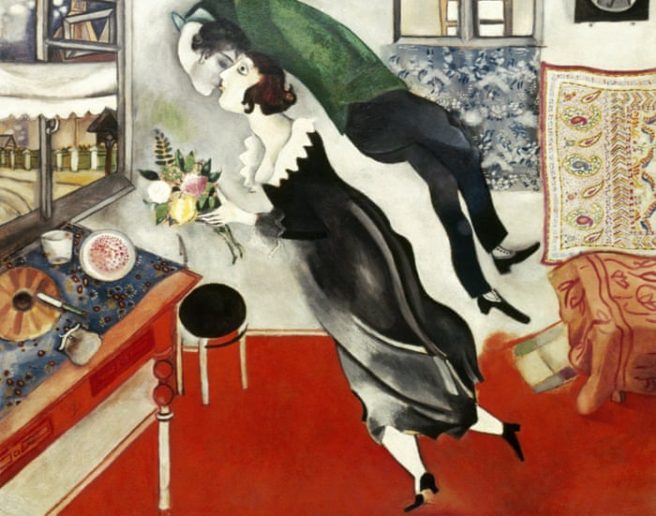
“Birthday” by Marc Chagall (1924).

After listening to several renditions of this poem put to music, I decided my favorite is by Minnesota folk musician Peter Mayer. His crisp, warm, fluid acoustic treatment is perfection.

♥️ HAPPY VALENTINE’S DAY! ♥️

*
The lovely and talented Carol Varsalona is hosting the Roundup at Beyond LiteracyLink. Waltz on over to check out the full menu of poetic goodness being served up around the blogosphere this week. Enjoy your weekend and watch out for cupid’s arrows next week. 🙂


Copyright © 2023 Jama Rattigan of Jama’s Alphabet Soup. All rights reserved.

marc chagall’s blue world

“Only love interests me, and I am only in contact with things that revolve around love.” ~ Marc Chagall

“Lovers in Blue” (1914)


I’m a longtime Marc Chagall fan, and during this, my THINK BLUE year, I’m finding his work especially nourishing.

Who can resist his beautiful paintings– poetic inner dreamscapes replete with joy and childlike imagination? We are reminded that truth of vision is neither linear nor precise, but often abstract. He asks us to feel what he feels.


“Le Paysage Bleu” (1949)


French art critic Raymond Cogniat said this about Chagall’s work:

The most obviously constant element is his gift for happiness and his instinctive compassion, which even in the most serious subjects prevents him from dramatization . . .  Musicians have been a constant during all stages of his work. After he first got married, ‘lovers have sought each other, embraced, caressed, floated through the air, met in wreaths of flowers, stretched, and swooped like the melodious passage of their vivid day-dreams. Acrobats contort themselves with the grace of exotic flowers on the end of their stems; flowers and foliage abound everywhere.

Sigh. And he said this about Chagall’s use of color, which is what initially attracts the viewer and captures his attention:

The colors are a living, integral part of the picture and are never passively flat, or banal like an afterthought. They sculpt and animate the volume of the shapes. . . they indulge in flights of fancy and invention which add new perspectives and graduated, blended tones . . . His colors do not even attempt to imitate nature but rather to suggest movements, planes and rhythms.

Chagall was able to convey striking images using only two or three colors. Look what he was able to do with BLUE!

Sometimes up is down, and down is up. Chagall painted his heart on the canvas. He once said:

In our life there is a single color, as on an artist’s palette, which provides the meaning of life and art. It is the color of love . . . If I create from the heart, nearly everything works; if from the head, almost nothing.

These days there seems to be a shortage of love in this country. A good antidote is to immerse oneself in Chagall’s work — the stunning, swirling blues of moonlight, romance, memory, compassion, holiness, fantasy, truth. A blue face, a blue angel, a blue village, all help to heal a broken world.


“Lovers in the Sky” (1928-30)


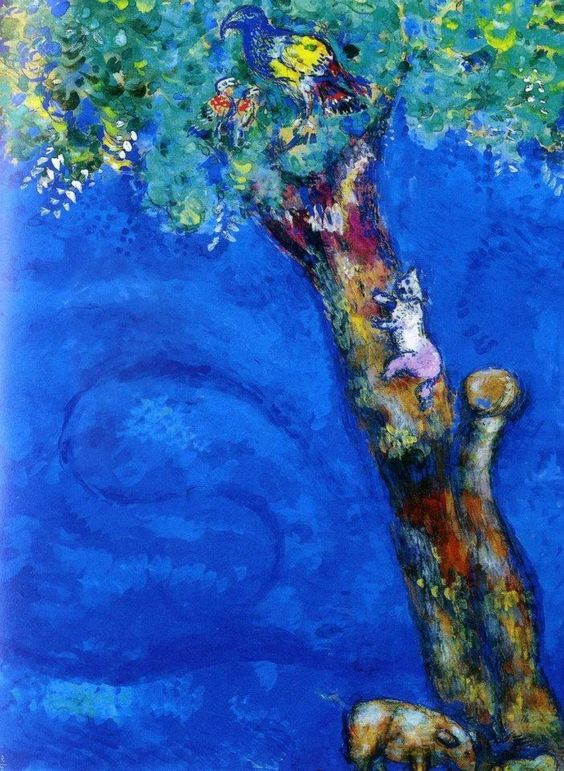
from Fables of La Fontaine (1997)


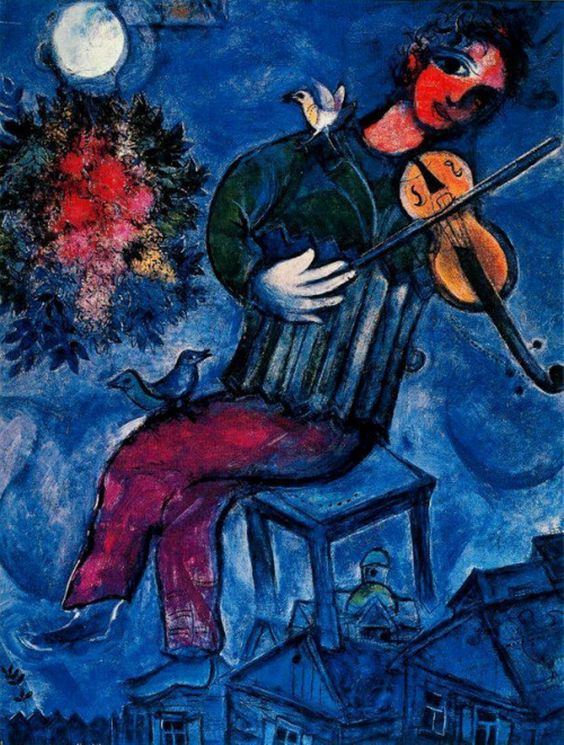
“Le Violoniste Bleu” (1947)


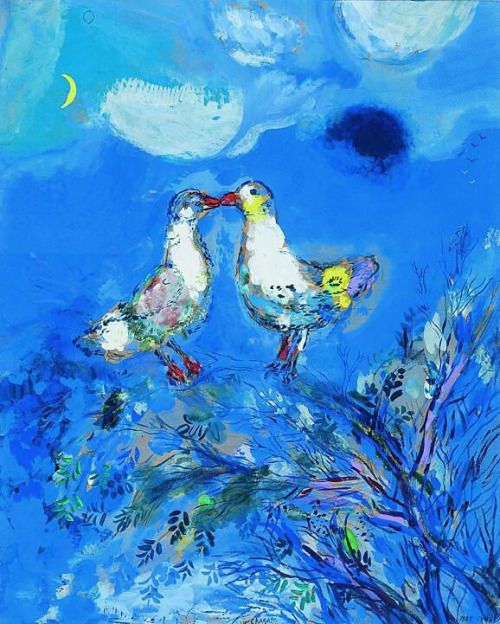
“Two Pigeons” (1925)


“Enfant avec une Colombe” (1977)


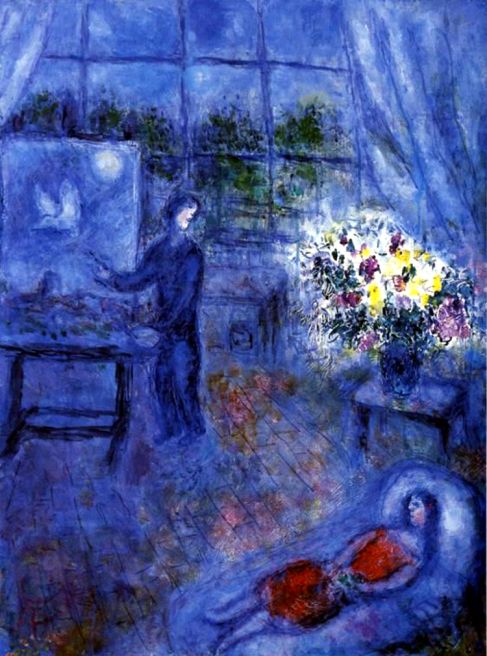
“Artist and His Model” (1973)


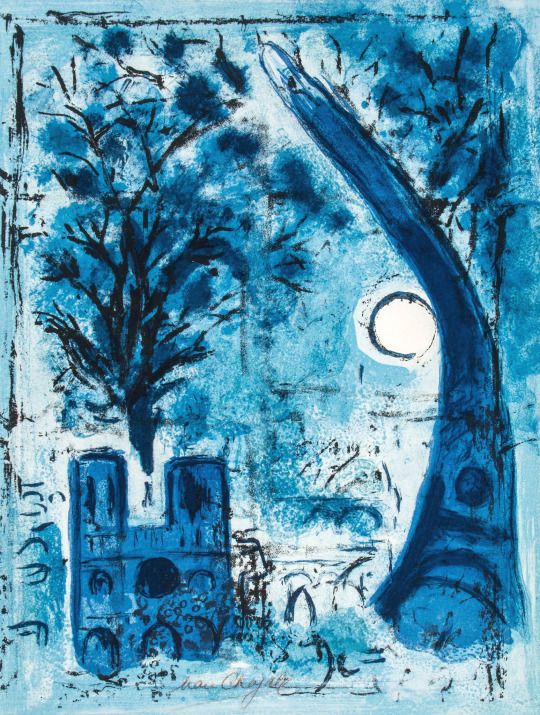
“Notre Dame et La Tour Eiffel” (1960)


“The Wedding” (1980)


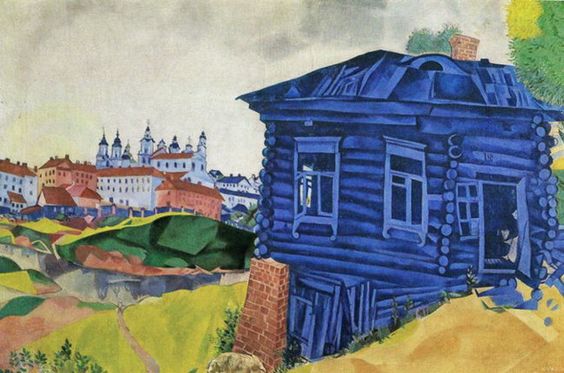
“The Blue House” (1917)


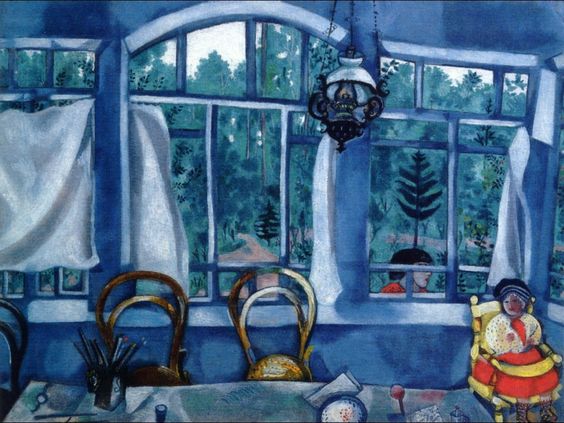
“Window Over a Garden” (1917)


“Ebony Horse/Arabian Nights” (1948)


“The Painter” (1978)


“Le Rêve de Chagall sur Vitebsk” (1950-53)


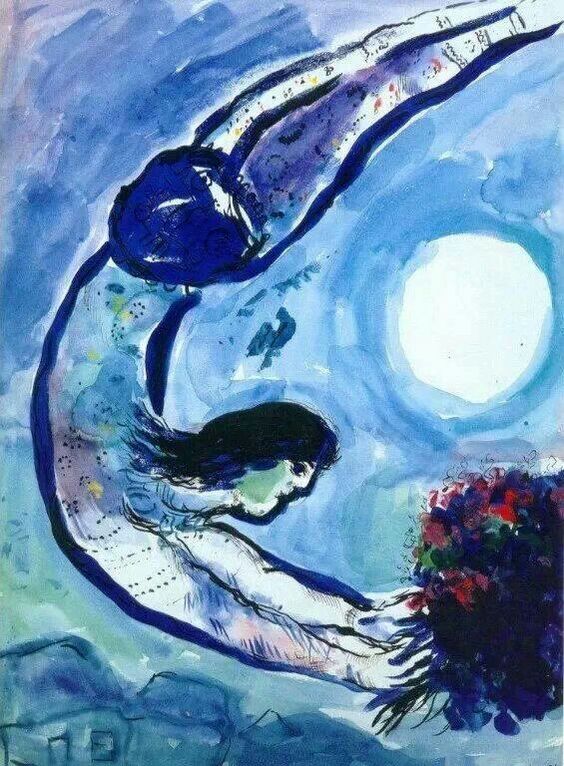
“Acrobat with Bouquet” (1963)


“Lovers Among Lilacs” (1930)


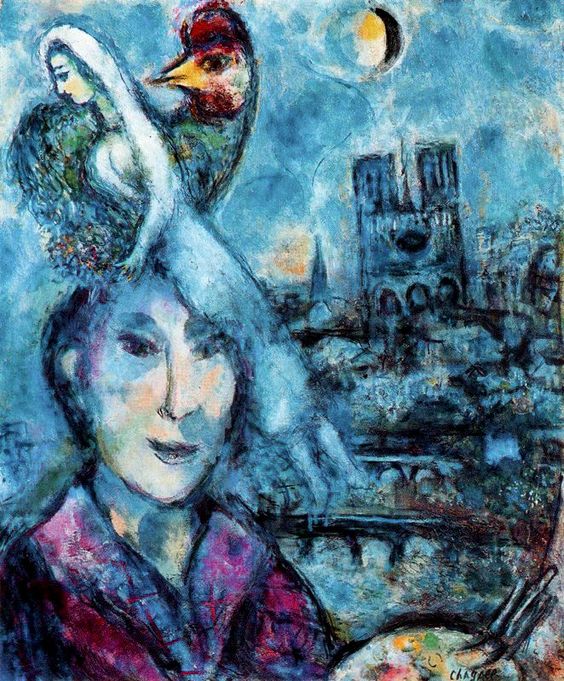
“Self Portrait” (1959-1968)


“Monotypes en couleur” (1963)


“Le Champ de Mars” (1954-55)


“The Juggler of Paris” (1969)


“Le Cirque, Paris” (1967)


“Le Cirque, Paris” (1967)


“The Lovers” (1929)


“Lovers in Moonlight” (1938)


“Animal dans les fleurs” (1952-59)


“Blue Village” (1975)


“Around Her” (1945)


“Blue Face” (1967)


“Blue Angel” (1937)


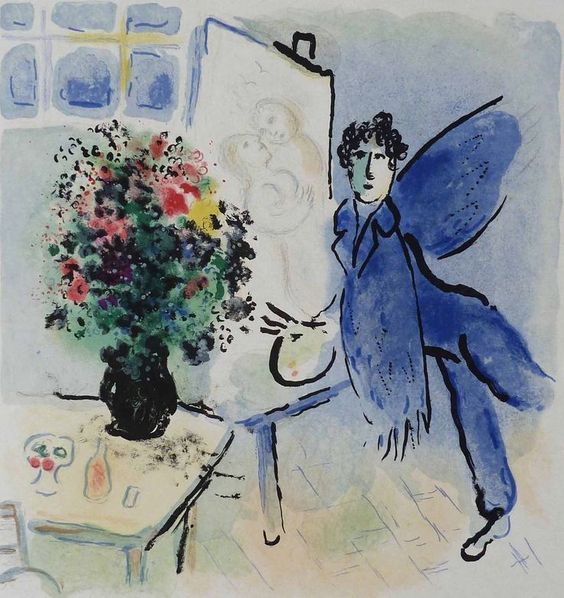
“The Blue Studio” (1973)


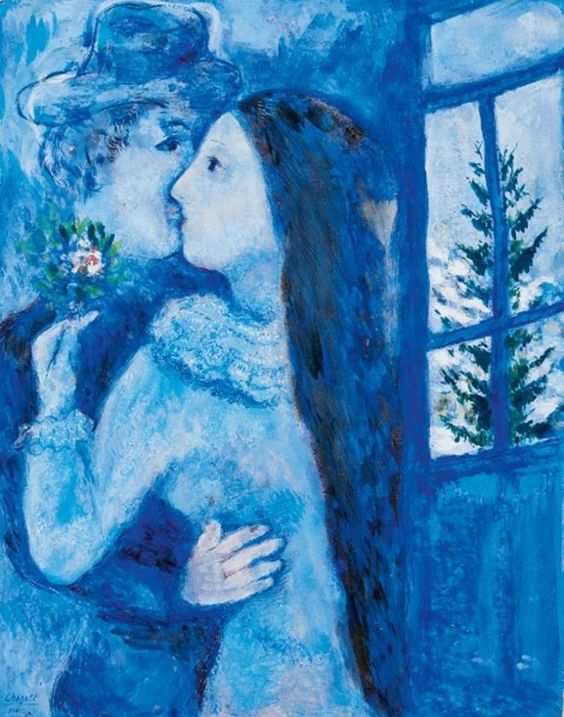
“Les Amoureux en Bleu” (1930)


“I had only to open my bedroom window, and blue air, love, and flowers entered with her.” ~ Marc Chagall

*


HAPPY TUESDAY

HOPE YOU SOAR

THINK BLUE

🥣 🥣 🥣 🥣 🥣


Copyright © 2018 Jama Rattigan of Jama’s Alphabet Soup. All rights reserved.