“Blue skies smiling at me, nothing but blue skies do I see . . . ” ~ Irving Berlin

Blue likes me. It’s always been there, coloring my life with good things since childhood: my first Schwinn bike, Island of the Blue Dolphins, fountain pen Quink, favorite pearl bracelet, the sparkling azure of the Aegean one summer.
At age 9, I saw Elvis filming “Blue Hawaii” alongside the pineapple fields. He was driving a baby blue convertible. The first time I met Len in London he was wearing a navy blue sweater. These days, I sip Darjeeling in a Blue Calico teacup, delighted to spot the first bluebird every spring.
Blue just knows how to make an impression. From the cozy comfort of broken-in jeans to the bright optimism of a clear autumn sky, blue touches us all in ways ordinary and profound.

But now I must confess something. Until I read BLUE: A History of the Color as Deep as the Sea and as Wide as the Sky by Nana Ekua Brew-Hammond and Daniel Minter (Knopf BFYR, 2022), I knew very little about blue’s fascinating history, origins, and cultural significance. Imagine my surprise when this book magically appeared in my mailbox one day — simply out of the blue (thanks for the gift, Miss T.)! 🙂

Brew-Hammond begins her captivating narrative by citing how elusive and mysterious blue actually is. It’s “all around us,” in the sky and sea. Yet we can’t touch the sky and when we try to cup the sea, its blueness disappears. We may crush iris petals for a brilliant shade of blue, but when we add water, the color fades away.
But then blue appears in the strangest places, discovered throughout history in unexpected ways.
Blue rocks called lapis lazuli were mined as early as 4500 BC in Afghanistan. The ancient Egyptians used the stones to make jewelry and charms to ward off evil, and by 44 BC they (including Queen Cleopatra VII) applied a bluish mixture around their eyes made from ground lapis lazuli grains, plants and animal fat.
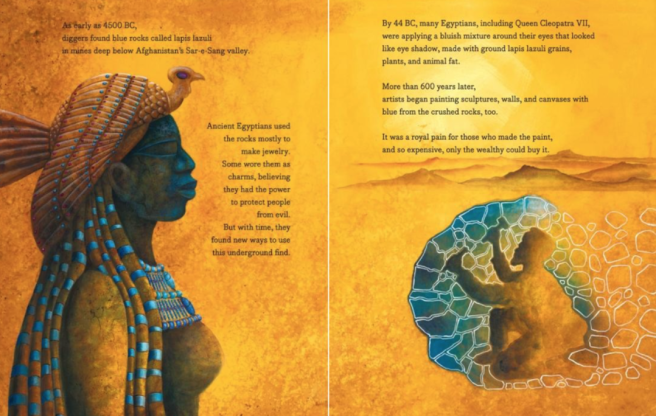
In another 600 years or so, artists began painting sculptures, walls, and canvases with blue made from the crushed rocks. Since this paint was expensive to produce, only the wealthy could afford it. This high-demand luxury prompted scientists, merchants, and dyers to search for more sources of blue.
Continue reading Jama's Alphabet Soup