[peaceful review] Woods & Words: The Story of Poet Mary Oliver by Sara Holly Ackerman and Naoko Stoop

“Whoever you are, no matter how lonely, / the world offers itself to your imagination, / calls to you like the wild geese, harsh and exciting — / over and over announcing your place / in the family of things.” ~ Mary Oliver
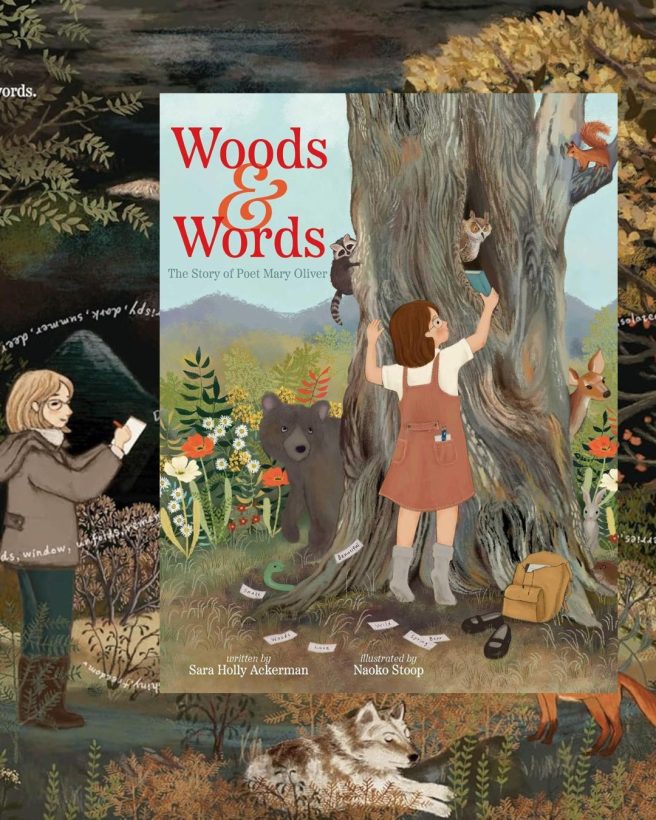
Beloved American poet Mary Oliver is well known for her sensitive, pure-hearted observations of the natural world, but did you know she credited her love of nature and poetry with saving her life?

Thanks to Woods & Words: The Story of Mary Oliver by Sara Holly Ackerman and Naoko Stoop (Beach Lane Books, 2025), young readers will learn how a lonely girl survived a difficult childhood by finding refuge in the woods and writing about the wonders she found there. Her lifelong practice of walking in the wild and treating poetry as central to her very existence would earn her literary acclaim, but more importantly, the rare status of being a popular, best-selling poet in an otherwise poetry-indifferent age.
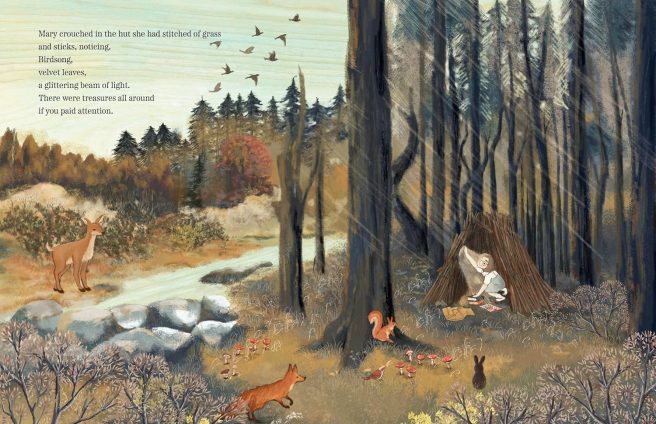
We first see young Mary in the woods, crouched in a grass-and-sticks hut she had stitched herself, “noticing” treasures like birdsong, velvet leaves, and “a glittering beam of light.”

Whenever she felt confined by classroom walls, she made the woods her school. There, she wrote, filling stacks of notebooks, alone except for books by favorite poets like Poe, Blake, and Whitman.

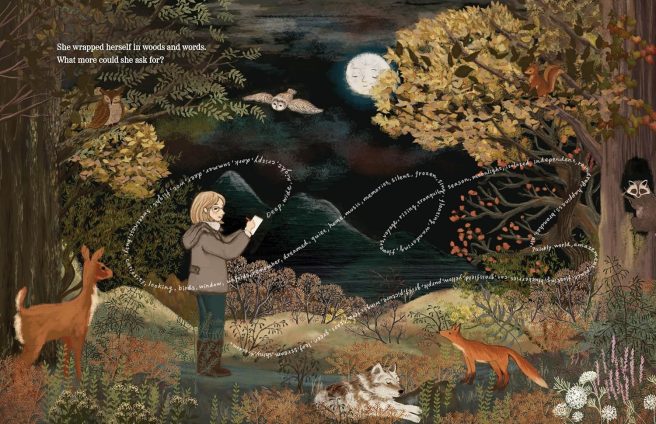
The spring after graduating from high school, Mary drove to Steepletop in upstate New York, where she stayed in an old farmhouse where the poet Edna St. Vincent Millay once lived. She helped Edna’s sister organize papers and “wrapped herself in woods and words. What more could she ask for?”
One day, Mary saw a visitor at the kitchen table — it was love at first sight! Mary and Molly became inseparable, capturing the world around them, Mary with her words, Molly with her camera.
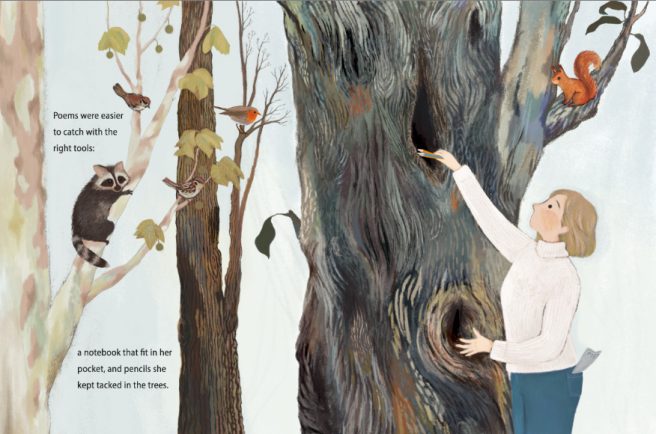
They eventually settled in Provincetown, Massachusetts, where Mary continued to walk the woods or along the shore, searching for poems: “There were always poems if you paid attention,” whether under leaves, on the backs of black snakes, or prompted by the sweet or rotten smells she encountered. She carried a pocket notebook and stashed pencils in trees so she’d always be ready.

Continue reading
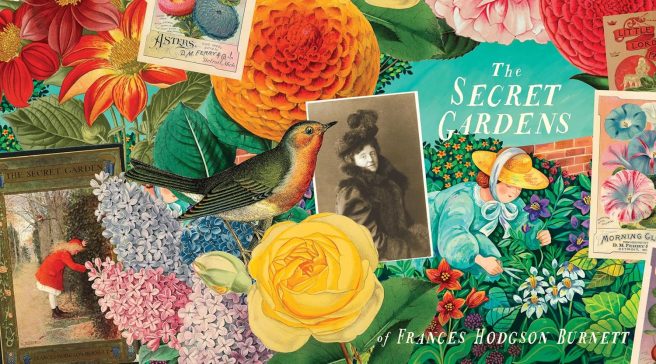
[review + recipe] The Secret Gardens of Frances Hodgson Burnett by Angelica Shirley Carpenter and Helena Pérez García

“As long as one has a garden one has a future; and as long as one has a future one is alive.” ~ Frances Hodgson Burnett

Since The Secret Garden has always been one of my favorite children’s books, I was especially excited to see Angelica Shirley Carpenter and Helena Pérez García’s recent picture book biography about Frances Hodgson Burnett.

Learning how Burnett coped with hardship and adversity in her own life shed new light on my appreciation of the novel. Now I understand why gardens were so important to her, not only as places of beauty and inspiration, but of comfort and healing. I also found it intriguing that she had a luxurious lifestyle that was shocking by Victorian standards (a twice divorced smoker who spent time away from her children). 🙂

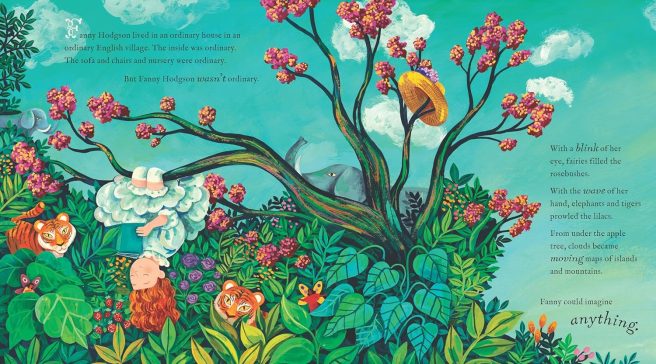
We first meet Fanny Hodgson as a girl who lived in “an ordinary house in an ordinary English village.” But Fanny herself was anything but ordinary because of her vivid imagination. In her world, “fairies filled the rosebushes” and “elephants and tigers prowled the lilacs.”

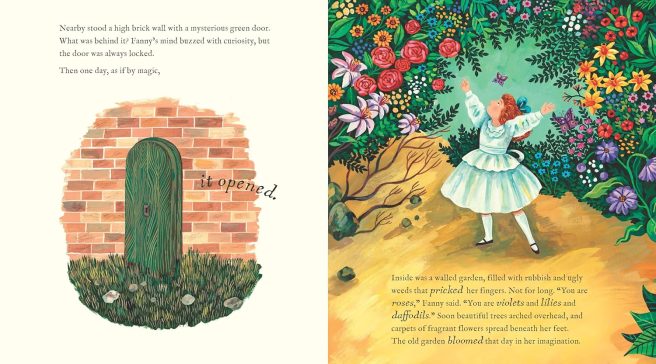
Her idyllic existence was upended when her father died (she was around six), and her family was forced to move to Manchester so her mother could run his store. The dull and grey city was a stark contrast to the beloved garden she’d left behind, but Fanny’s imagination sustained her, as she envisioned roses, violets, lilies and daffodils abloom in an old abandoned garden actually “filled with rubbish and ugly weeds.”

After a few years, her mother had to sell the store as businesses in Manchester failed. Short on money, Fanny’s family then relocated to a small village in Tennessee at the suggestion of her uncle, who thought her brothers could find work there. Unfortunately, they weren’t able to earn as much money as they’d hoped, so sometimes the family went hungry. Fifteen-year-old Fanny wanted to help, but there were no jobs for girls.

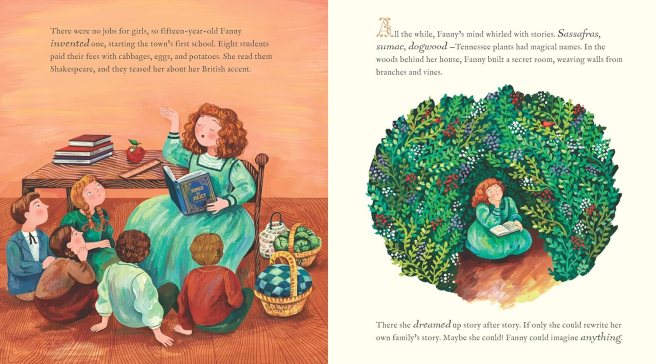
Undeterred, she put her imagination to work once again and invented her own job, opening the town’s first school. Her eight students paid with “cabbages, eggs, and potatoes,” and she read them Shakespeare. She also built a “secret room” in the woods behind her house, “weaving walls from branches and vines.”

There, in her cozy sanctuary, she dreamed up stories. She knew that magazines paid for stories; could she sell one of hers? She earned money for writing supplies by picking and selling wild grapes at the market. She wrote a love story and sent it out — and to her surprise, sold it for thirty-five dollars — enough to feed her family for weeks!

Continue reading

serving up a pair of cool picture books about josé andrés and world central kitchen

“Chefs like me feed the few, but our destiny is to feed the many. To be an army of goodness where a plate of food becomes a plate of hope…a light in dark times. Together, we can change the world through the power of food.” ~ Chef José Andrés

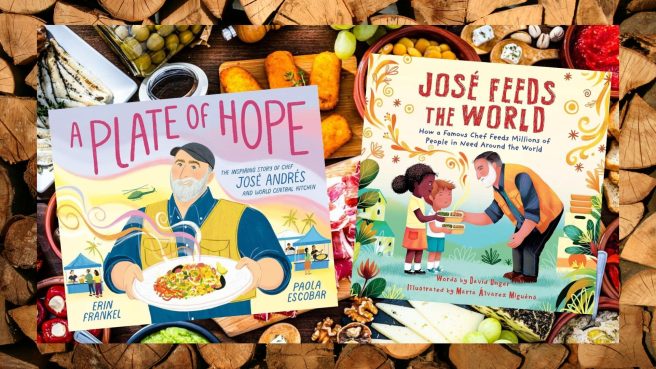
Since I’m a big fan of chef, restaurateur, and humanitarian José Andrés, I was happy to see both of these recently published picture books about his interesting life and amazing accomplishments.

Chef Andrés’s World Central Kitchen is truly a beacon of hope during tumultuous times of untold trauma, displacement and uncertainty due to natural and man-made disasters. Whether earthquake, hurricane, war, wildfire or pandemic, WCK is right there on the frontlines offering food, comfort, and a helping hand to local communities.

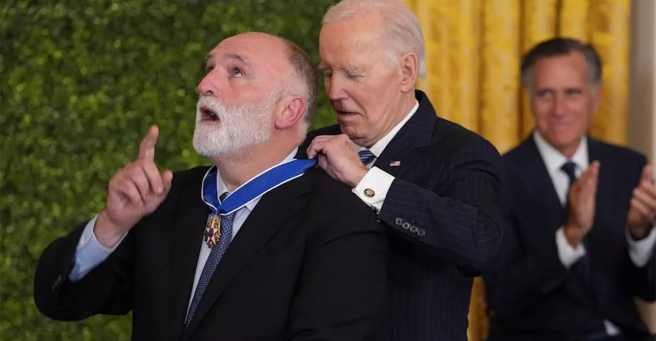
Chef Andrés received the Presidential Medal of Freedom on January 4, 2025. To date, WCK has served 450 million meals worldwide (photo via WCK.org).

You may know that in early January, Andrés received the Presidential Medal of Freedom, and that 2025 marks WCK’s 15th anniversary. Just recently, WCK provided free meals to firefighters, first responders and evacuees of the catastrophic wildfires in Los Angeles via food distribution centers as well as local restaurant and food truck partners.

So how did this incredible food aid/disaster relief nonprofit get started? What first inspired Andrés to become a chef, what continues to motivate him, and what are some of his core beliefs when it comes to food?

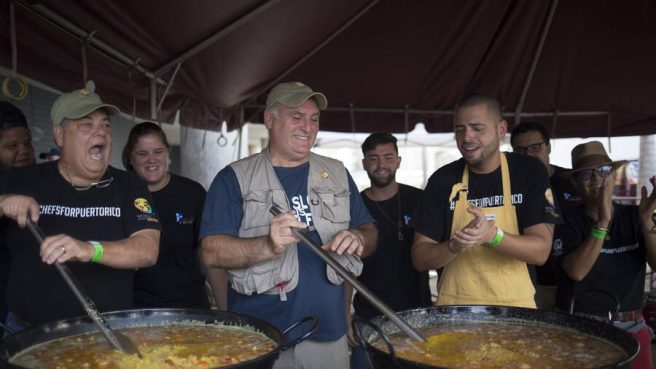
Chef Andrés and WCK volunteers cook paella in San Juan, Puerto Rico, October 2017 (photo by Eric Rojas/NYT).

Both books, A Plate of Hope and José Feeds the World trace José’s life from his childhood interest in cooking, to attending cooking school in Barcelona, to becoming an assistant chef at El Bulli, opening a tapas restaurant called Jaleo in Washington, D.C. (where he also volunteered at the DC Central Kitchen), to the 2010 Haiti earthquake, which motivated him to create World Central Kitchen.

When Hurricane Maria hit Puerto Rico in 2017, José and his WCK team got local people to volunteer after realizing they couldn’t do the work alone and there weren’t any other nonprofit organizations planning to feed the millions of people affected by the catastrophe.

As time passed, each new disaster presented different challenges requiring different solutions, and José found himself wanting to do more and more — establishing food distribution systems, flying in equipment to set up field kitchens, offering Meals Ready to Eat, etc. He also empowered local communities to use their skills and resources to help others as they had helped themselves.

Continue reading

nine cool things on a tuesday

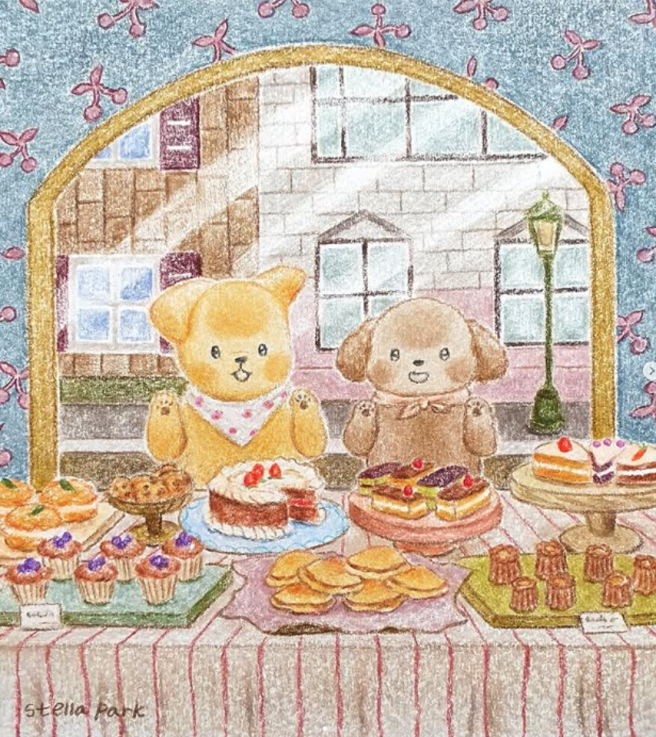
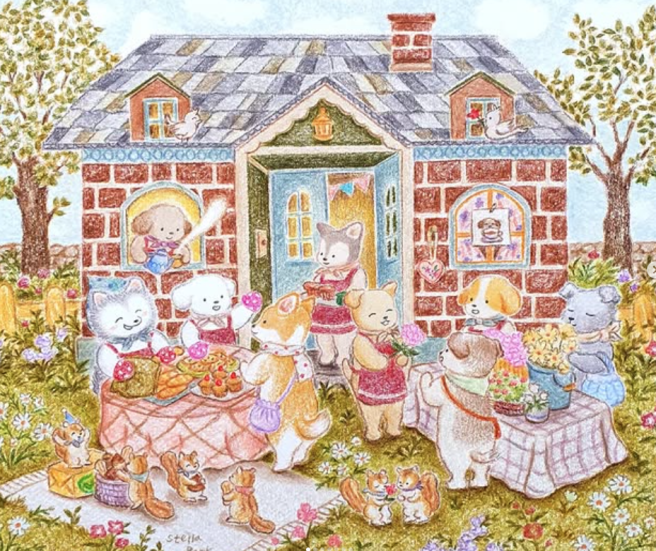
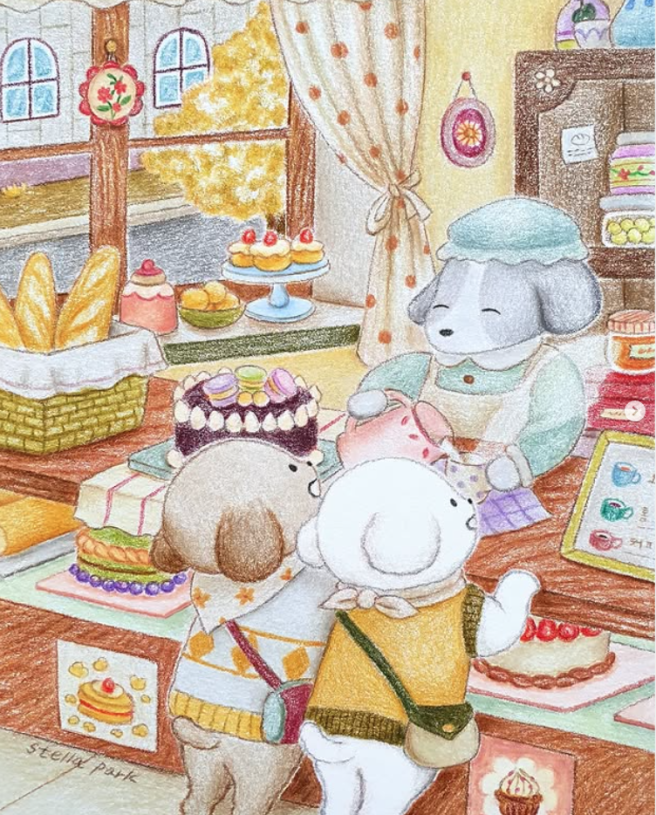
1. Happy February! What sweet treat do you fancy today? It may be cold and wintry outside, but Stella Park’s adorable animal pictures will warm you right up. 🙂

Based in Seoul, South Korea, Stella studied media design at Dongduk Women’s University, and then worked as a children’s art teacher before becoming a full-time freelance illustrator.

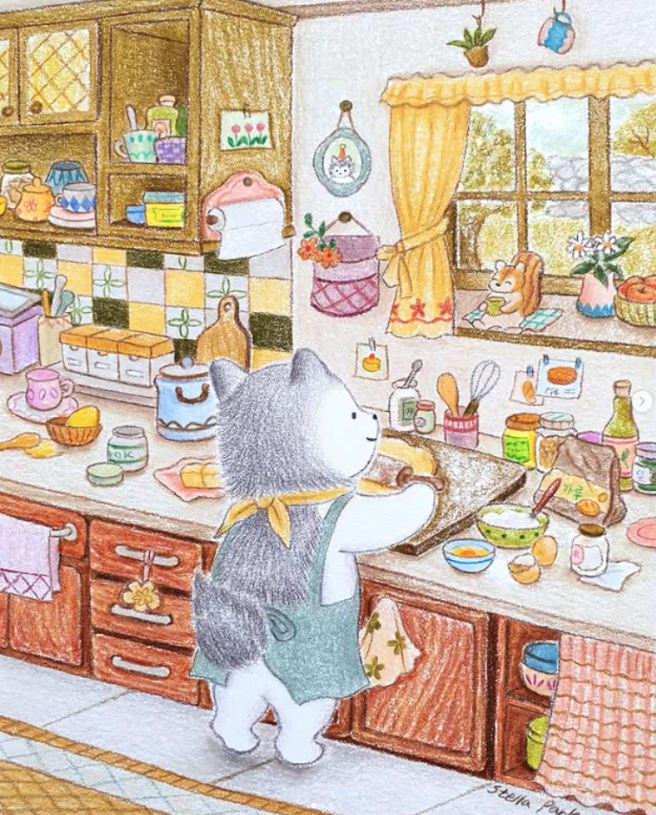
Her medium of choice is colored pencils. The slower pace of hand rather than digital drawing allows her more time to reflect and enjoy the process. She’s confident in her ability to draw subjects close to her heart and finds much fulfillment doing so. She loves sharing happiness and positivity through her art via soft fuzzy textures and heartwarming details.

Earlier in her freelance career she was mainly inspired by daily life and memorable scenes from her travels. Recently, however, she’s been depicting animal characters in cozy domestic scenes — mainly dogs and cats baking, shopping, sharing meals and playing together. She’s already published a couple of books in Korea, and I hope her work finds its way into the U.S. children’s picture book market sometime soon. Isn’t her artistic sensibility perfect for it? 🙂

For lots more, visit Stella’s Website and Instagram.

*

Continue reading

[review + recipe] Granny Smith Was Not An Apple by Sarah Glenn Fortson and Kris Aro McLeod

Happy National Apple Month!

Time to wrap your lips around apple pie, crumble, crisp, pandowdy, buckle, slump, cobbler and dumpling. Inhale the heavenly fragrance of cinnamon and nutmeg. Sip some warm cider. When it comes to apples, they can’t be beat for variety and versatility.

What’s your favorite type of apple? I’m partial to Red Delicious, Golden Delicious, and Granny Smith because they’re pretty much available year round. Have you ever wondered whether Granny Smith was a real person?

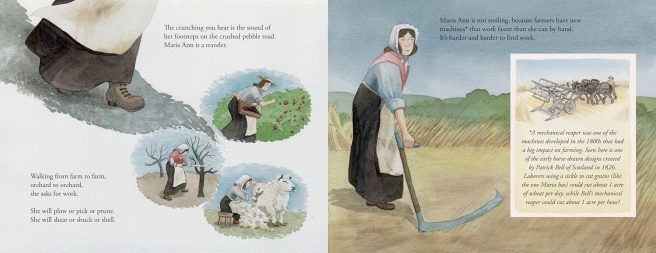
I recently found out in this crunchy picture book biography, Granny Smith Was Not An Apple: The Story of Orchardist Maria Ann Smith by Sarah Glenn Fortson and Kris Aro McLeod (Peter Pauper Press, 2023).

Back in the 1800’s, Maria Ann Smith, an English “tough to the core” itinerant worker and orchardist, struggled to find work when manual laborers were being replaced with faster, more efficient farm equipment.

Since she and her husband could barely support their family, Maria Ann helped deliver babies in her village (historically, midwives were called ‘Granny’). She received payment in the form of food and clothing, then eventually worked in an apple orchard, where she learned about grafting and harvesting.

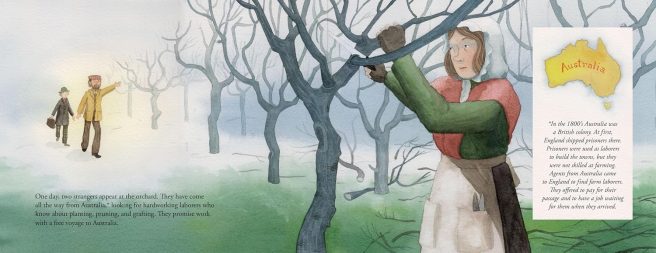
One day, two foreign agents arrived at the orchard looking for experienced laborers to work in Australia with a free voyage. Ignoring her neighbors’ warnings not to go, Maria and her family boarded the ship to Australia, enduring the arduous 4-month journey during which her five children fell ill. Maria kept her spirits up by thinking about a better life.

Continue reading