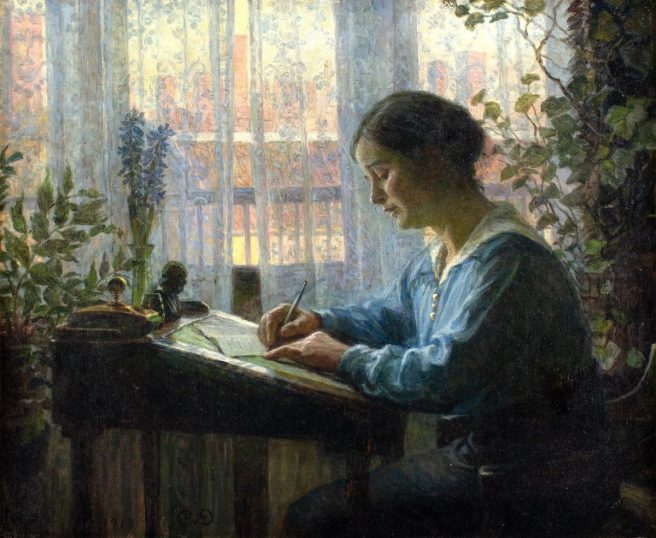
a letter to our better selves

“Else’s Letter” by Caroline van Deurs (1918)
ELEGY FOR THE PERSONAL LETTER 
by Allison Joseph


I miss the rumpled corners of correspondence,
the ink blots and crossouts that show
someone lives on the other end, a person
whose hands make errors, leave traces.
I miss fine stationery, its raised elegant
lettering prominent on creamy shades of ivory
or pearl grey. I even miss hasty notes
dashed off on notebook paper, edges
ragged as their scribbled messages—
can't much write now—thinking of you.
When letters come now, they are formatted
by some distant computer, addressed
to Occupant or To the family living at—
meager greetings at best,
salutations made by committee.
Among the glossy catalogs
and one time only offers
the bills and invoices,
letters arrive so rarely now that I drop
all other mail to the floor when
an envelope arrives and the handwriting
is actual handwriting, the return address
somewhere I can locate on any map.
So seldom is it that letters come
That I stop everything else
to identify the scrawl that has come this far—
the twist and the whirl of the letters,
the loops of the numerals. I open
those envelopes first, forgetting
the claim of any other mail,
hoping for news I could not read
in any other way but this.

~ from My Father's Kites. © Steel Toe Books, 2010.

*

I fell in love with letter-writing when I got my first penpal in second grade. Cindy lived in Erie, Pennsylvania, a world away from Hawaii, and I thought her life was positively exotic. Four distinct seasons, magical snowstorms, a huge lake!

What a thrill to receive genuine-for-real mail addressed to me! Such fun to describe what I was up to in my neatest hand. While in third grade, Cindy and I practiced our shaky cursive. It was nothing short of miraculous for my thoughts to cross an ocean and a continent to reach my special friend, all for only 4 cents!

I love envelope art!
Continue reading

eight legs of terror

“There’s a Spider in My Tub” by John Kenn Mortensen (2013).
CONFESSION 
by Sarah Russell


There’s a spider in the bathtub.
I saw him last night, and he’s still there
this morning, though I gave him fair warning
when I brushed my teeth before bed.
I need to take a shower.
But there’s a SPIDER.
In the BATHTUB.
My Dr. Schweitzer is arguing with my Eek.
He’s small –
smaller than a shirt button –
and round and 8 legs look like 3 too many.
But he’s in the BATHTUB.
Where I SHOWER.
NAKED.
I turn on the water, and he wiggles
a couple of legs but the spray doesn’t hit him,
so I don’t get a pass from Karma.
Then my Eek takes over,
and I get a piece of toilet paper,
and he wiggles 2 legs again but doesn’t run
so my Eek doesn’t get to plead self-defense.
I try to make it painless –
a squish and done – but then I wonder
if he was just trying to say hello,
and the shower’s kind of lonely
without him in there waving at me.

~ copyright © 2018 Sarah Russell as posted at Your Daily Poem.

*

art by Michael Sowa.

EEK! Has this ever happened to you?!

This poem made me laugh and shudder at the same time. Because we see so many spiders in our house, I rarely argue with my Dr. Schweitzer anymore. No waffling with my conscience, no reverence for life. It’s either us or them.

Scariest scenario: I’m staggering upstairs to bed and when I reach the top landing, a wolf spider’s there to greet me (gasp! heart clutch!). I wouldn’t hesitate to kill a smaller spider. But this one’s HUGE. And FURRY. These are the largest species we see indoors.

Continue reading

of flip flops and lollipops

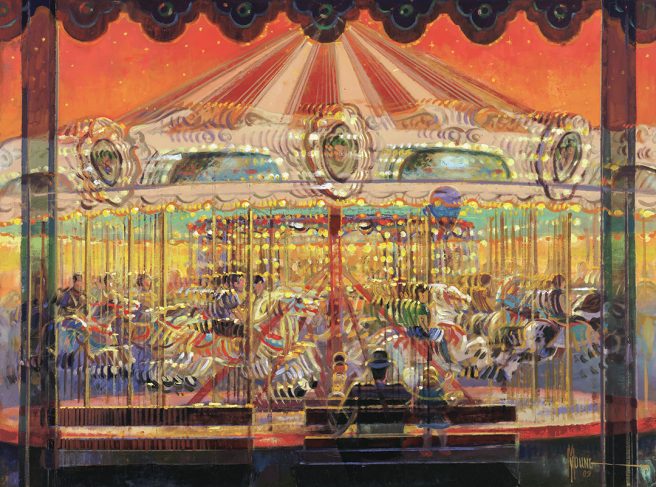
“Merry Go Round” by Michael Young.
WHERE I COME FROM
by Sally Fisher


We didn't say fireflies
but lightning bugs.
We didn't say carousel
but merry-go-round.
Not seesaw,
teeter-totter
not lollipop,
sucker.
We didn’t say pasta, but
spaghetti, macaroni, noodles:
the three kinds.
We didn’t get angry:
we got mad.
And we never felt depressed
dismayed, disappointed
disheartened, discouraged
disillusioned or anything,
even unhappy:
just sad.

~ from Good Question, Bright Hill Press, 2015.
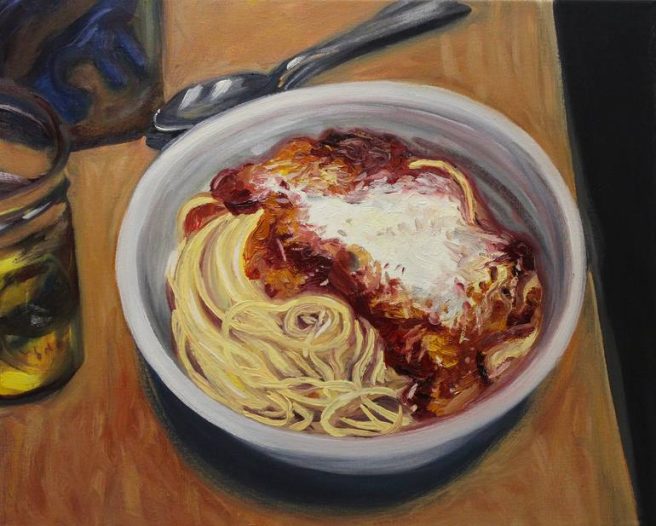
“Spaghetti” by Michael Serafino.

*

They say variety is the spice of life, and this is certainly true when it comes to regional vocabulary. Don’t you love how there are different terms for the same things, and what you choose to use signals where you’re from?

“Sunshine, Lollipops and Rainbows” by Holly Ellsworth-Rose.

I smiled and nodded in recognition while reading this poem — and fondly thought about my late mother-in-law. A staunch New Englander, for her it was ‘pocketbook’ not purse, ‘divan’ not couch, ‘bubbler’ instead of water fountain. We never had trouble communicating, but our use of different terms kept our conversations lively and interesting.

Continue reading

you say orange juice, i say eggplant (let’s call it love)

NOT A HOLLYWOOD MOVIE
by Lori Levy


We talk about love.
Sometimes I love you more, sometimes less, he says.
I feel the same way.
Think spectrum, range, hot warm cold
as in water from a faucet, the flow increasing, decreasing,
the temperature not always perfect, but good enough.
Or we could say it's a matter of orange juice, eggplant . . .

He is groggy in the morning. I wake up renewed and ready for the day.
Ready, first thing, to squeeze oranges for him.
He can't begin, doesn't want to begin,
without a glass of fresh juice
brought to him in bed. A simple act for me.
For him, a big ahh, quenching, invigorating.

I don't have patience to fry eggplants for dinner.
He does. He stands by the stove, tender with the slices,
spicing them exactly right, turning them exactly on time.
I devour the eggplant, stuff the browned slices into pita bread
with cheese or eggs, tomatoes, hummus. With anything, everything.

Some moments we meld --- grateful
to be living this life together.
Other times we argue like kids.
I tell him his way is mood-based, head in the sand, slow.
He says I have no priorities:
everything is important, demands attention.
Sometimes you can't stand me, right? he asks.
We laugh. This, too, is true.

Still, he craves my orange juice, I could die for his eggplant.
Hunger, Thirst. We could call it love.

~ as published by Young Ravens Literary Review (2020)

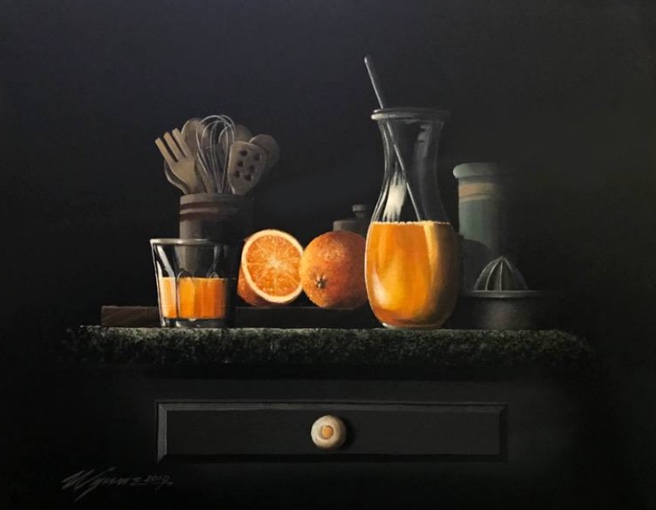
“Morning Juice” by Robert Wynne

*

Continue reading

reveling in Grant Snider’s Poetry Comics

We don’t usually speak of poetry and comics in the same breath. We may like and enjoy both, but tend to approach each separately on its own terms. Purists may even consider poetry and comics to be on opposite ends of the literary spectrum (gasp!).

Yet Grant Snider sees things differently. The popular “Incidental Comics” creator was keen on finding a closer connection between poetry and comics, as both “contain condensed language, strong imagery, and ideally leave the reader with a new insight.”

Author-illustrator, cartoonist, comic strip writer and orthodontist Grant Snider lives with his wife and five children in Wichita, Kansas.

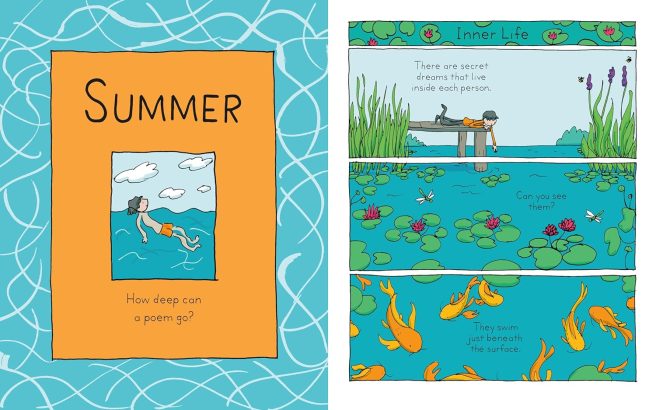
Targeted for middle grade readers, Snider’s fun and inventive collection demonstrates this perfectly with an entirely new way of approaching and appreciating poetry. Did you ever think it would be possible to read a poem in a series of comic panels? Me neither. 🙂

The poems in Poetry Comics (Chronicle Books, 2024) are organized by season, with each section offering insights into the poetry writing process. Title pages inspire and direct:

Spring: “I want to put down on paper the feeling of fresh possibilities.”

Summer: “How deep can a poem go?”

Fall: “I will wait for a poem to fall into my open arms.”

Winter: “A new page — my words huddle close to keep warm.”

Each season then ends with a variation of “How to Write a Poem.”

HOW TO WRITE A POEM #1

Find a quiet place.
A sharp pencil.
A blank page.
Sit still.
Keep quiet.
Wait.
A poem will rush in to fill the space.

Many of the poems are about nature (snails, tadpoles, butterflies, trees), while others examine universal human emotions and observations via kid-centric activities like running through sprinklers, waiting for the school bus, playing basketball, riding on roller coasters, climbing trees, reading good books, picking the perfect pumpkin, playing in the snow. Each poem is a sensorial impression of the here and now.

Continue reading