*enters kitchen, eats three pieces of chocolate, then takes out the soup pot. . . *
Hello, Cutie Pies!
Yes, we’re finally back. 🙂
It’s so good to know I can type a few words, find you here, and share this small, safe space with you — cause things in this world seem to be getting scarier and more tumultuous with each passing day.
It’s heartbreaking to see what’s happening to our country with everyone fighting and on edge all the time.
We’re exhausted, frustrated, demoralized, fearful. We feel broken and powerless in the face of unmitigated hate, corruption, and greed.
And then there’s the profound sadness — three recent mass shootings, and the loss of Toni Morrison and Lee Bennett Hopkins last month.
What to do? How to cope?
Toni Morrison’s words inspire, ground, and uplift:
This is precisely the time when artists go to work. There is no time for despair, no place for self-pity, no need for silence, no room for fear. We speak, we write, we do language. That is how civilizations heal.
I know the world is bruised and bleeding, and though it is important not to ignore its pain, it is also critical to refuse to succumb to its malevolence. Like failure, chaos contains information that can lead to knowledge — even wisdom. Like art.
Many of us think of French cooking as complicated, time consuming and just plain intimidating. We assume it requires special ingredients we don’t usually have on hand and sophisticated equipment.
And to teach French cooking to kids? Sounds like a recipe for disaster, doesn’t it?
A full-time French teacher to elementary school-aged boys and author of the popular eat. live. travel. write. blog, she runs after school cooking classes twice a week for 7-14-year-olds called Les Petits Chefs and Cooking Basics. They meet in the science lab to whip up such classic favorites as macarons, madeleines, pains au chocolat, and baguettes. They make short crust and choux pastry from scratch, and with proper knife skills, chop, slice and dice fruit and veggies to make berry galettes, ratatouille, steak frites, and beef and carrot stew.
So what makes this particular kids’ cookbook a standout among the zillions of others?
B.J.’s a former librarian whose poems have appeared in oodles of periodicals and anthologies, including Highlights for Children, Spider Magazine, The Poetry Friday Anthology for Celebrations, One Minute Till Bedtime, The Best of Today’s Little Ditty, Dear Tomato, and the National Geographic Book of Nature Poetry.
Yes, this girl’s been busy scribbling away in her Florida hideaway, and her first picture book is rollicking good fun. She’s taken the classic “There Was An Old Lady” cumulative nursery rhyme and given it a Floridian spin — a cool way to introduce kids to some of the critters who hang out in her part of the country.
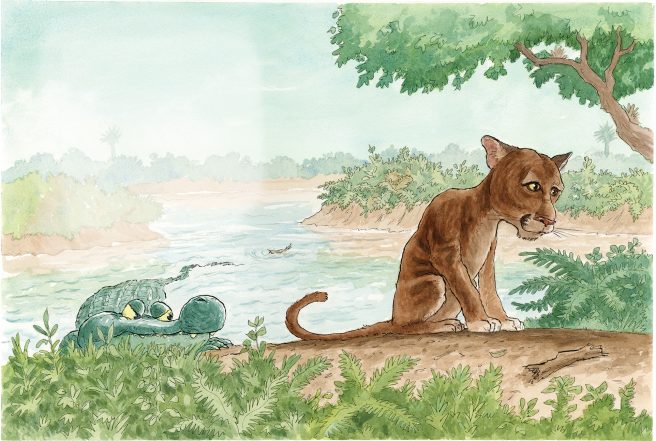
Seems B.J.’s Gator swallows a moth — who knows why — and it makes him cough. Only one thing to do: swallow a crab to grab the moth. But the crab “skittered and scuttled and gave him a jab.” What to do? Swallow an eel to nab that crab!
As you can imagine, this was just beginning of Gator’s problems. He keeps swallowing more creatures, bigger and bigger each time (have you seen the stomach on that guy?) until he actually gulps an entire lagoon! Hoo Boy!
You’ll have to read the book to find out what happens to this guzzling gator and all those bewildered animals in his belly. Kids will love turning the pages to see what animal’s next (ray! pelican! panther! manatee! shark!). Of course this story is a riot to read aloud with its catchy rhymes, repetition, bouncy rhythm and amphibious alliteration (cough, cough). And David Opie has amplified the hilarity with his emotive, dynamic illustrations.
Just had to ask B.J. all about her publishing journey, tinkering with the text, and yes, she’s sharing a recipe (did someone say PIE?)!
#58 in an ongoing series of posts celebrating the alphabet
Please help yourself to some of Susan Branch’s Christmas Coffee Cake 🙂
Ho Ho Ho!
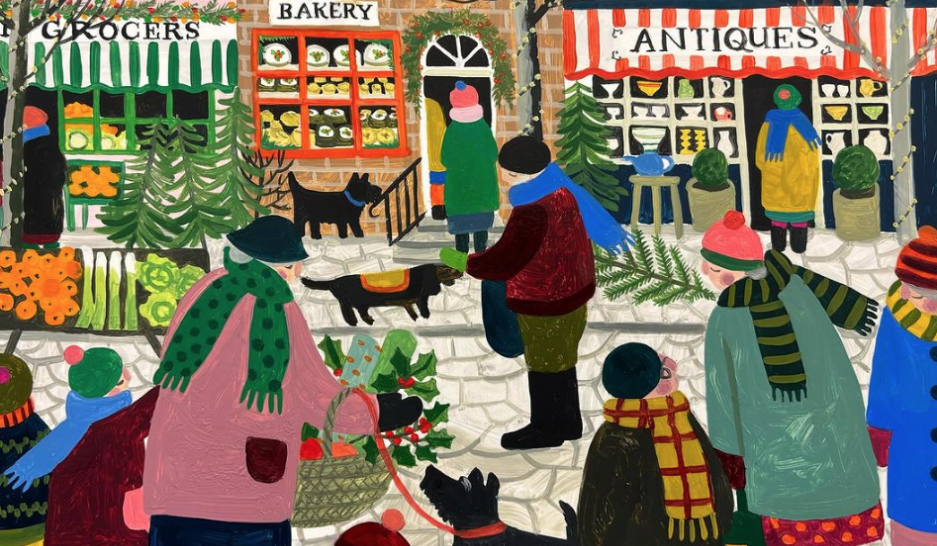
To celebrate the season, here’s an old fashioned Christmas abecedarian by American poet Carolyn Wells. This verse was first published as a picture book by McLoughlin Brothers in 1900, and describes how many of us still define Christmas more than a century later.
*
A CHRISTMAS ALPHABET by Carolyn Wells
A is for Angel who graces the tree.
B is for Bells that chime out in glee.
C is for Candle to light Christmas Eve.
D is for Dreams which we truly believe.
E is for Evergreens cut for the room.
F is for Flowers of exquisite perfume.
G is for Gifts that bring us delight.
H is for Holly with red berries bright.
I is for Ice, so shining and clear.
J is the Jingle of bells far and near.
K is Kriss Kringle with fur cap and coat.
L is for Letters the children all wrote.
M is for Mother, who’s trimming the bough.
N is for Night, see the stars sparkling now.
O is for Ornaments, dazzling with light.
P for Plum Pudding that tasted just right.
Q the Quadrille, in which each one must dance.
R is for Reindeer that gallop and prance.
S is for Snow that falls silently down.
T is for Turkey, so tender and brown.
U is for Uproar that goes on all day.
V is for Voices that carol a lay.
W is for Wreaths hung up on the wall.
X is for Xmas, with pleasures for all.
Y is for Yule log that burns clear and bright.
Z is for Zest shown from morning till night.
“It is important to have a child spend time in the kitchen — the most secure, comfortable, loving place in the house. The smell of food cooking, your mother’s or father’s voice, the clang of the utensils, and the taste of the food: These memories will stay with you for the rest of your life.” ~ Jacques Pépin
Jacques Pépin once asked his then two-year-old granddaughter Shorey Wesen whether she liked blueberries. She said she loved them, adding that they contained antioxidants. This early precociousness regarding food wasn’t especially surprising, since both her father and grandfather are professional chefs, and her mother Claudine cooks for the family every day, using fresh ingredients either from their home garden or nearby organic markets.
From about the age of five, whenever Shorey visited her grandparents, she’d stand on a wooden box next to Jacques so she could “help” him cook. Simple tasks like washing the lettuce, helping to gather herbs from the garden, or passing tools or ingredients, made Shorey comfortable in the kitchen and more enthusiastic about eating the food she helped prepare.
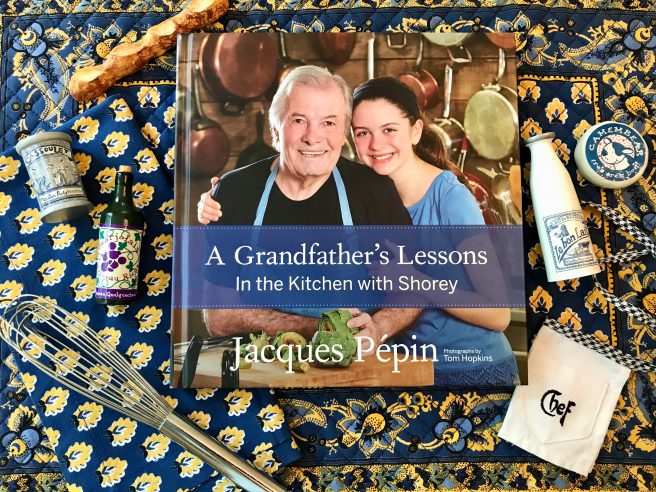
For both Shorey and her mom, there was no such thing as “kid’s food.” They learned to eat what the grown-ups were eating, subsequently developing a gourmand’s palate. This, along with Jacques’s longstanding philosophy that “great meals are always the ones that are shared with family and friends,” form the basis for A Grandfather’s Lessons: In the Kitchen with Shorey (Houghton Mifflin Harcourt, 2017).
Deviled Eggs with Salmon Caviar
Just as he taught Claudine how to cook in one of his PBS cooking series, Jacques shares cooking basics with 13-year-old Shorey in this accessible collection of 75 recipes, 36 of which have companion 10-minute videos hosted at Sur La Table.
This is less a “children’s” cookbook than a primer for novice cooks of any age, with simple and elegant recipes presented via clear, step-by-step instructions, beautiful color photographs, Jacques’s winsome line art, engaging headnotes full of tips and family stories, and occasional quotes from Shorey. Recipes were chosen in line with Shorey’s favorites and what she would have the most fun making.
Shorey’s Raspberry Cake
The book opens with lessons on setting the table and good table manners, followed by sections featuring Hors d’Oeuvres, Soups and Salads; Eggs, Sandwiches, Pizza, and Breads; Fish and Shellfish; Poultry and Meat; Pasta and Quinoa; Vegetables; Desserts and Confections; and Decorating for Fun.






 Jama's Alphabet Soup