

I first met him in the fourth stall on a cool, misty Saturday morning in Portobello Road market, London. The dowdy, red-cheeked antique dealer told me four teddies had come in the day before. Three of them sat there placidly. But one spoke.
“I like you.”
“How much for this teddy?” I asked.
“Twenty quid,” said the woman, nodding. “That one is a bit of a flirt.”
I looked closer. His fur was badly worn, and there was a big bald spot on the back of his head. His joints were very weak. Should I?
“You already have too many bears,” my husband reminded me.
Turning to go, I saw how disappointed the bear was.
“Please,” he said. “I won’t be any trouble.” He was too old and tired to hold his head up.
For hours, I dodged vegetable carts and pushy people, while gleaming silver teaspoons, clown puppets, felt hats, Victorian jewelry, and mysterious clocks tried to tempt me. But it was no use. Even the hurdy-gurdy man, with his clever monkey and cheeky parrot, couldn’t make me forget. I had to go back.
I pushed through the crowd, weaving in and out, so worried I had missed my chance. When I finally got back to the fourth stall, the others were gone but he was still there, staring forlornly at the ground.
When I picked him up, he said, “I waited. I knew you’d come back.”
He told me his name was Pudding. “You know, dessert. The best part.”
I wrapped Pudding up carefully and took him home to America. Later, I found him in a bear book. He was more than 50 years old. As a collectible, his age, maker, condition and rarity determined his monetary value. What nonsense! Who could presume to put a price on a battle-worn appearance which spoke of dunks in a rain barrel and drags along the sidewalk?
I have seen the saddest threadbare remnants of a bear and have felt his soul, alive and reaching. Once a bear has been loved by a human being, its expression is forever marked. How much for that faraway look, 50 years in the making?
The teddy bear is childhood’s most enduring toy. Never judgmental, teddies are equally loved by both sexes, in all age groups. I had lots of dolls as a child, but no bears. I might have lived the rest of my life bearless, if it hadn’t been for Brideshead Revisited. Do you remember Sebastian Flyte, carrying Aloysius around Oxford University? Evelyn Waugh modeled Aloysius after John Betjeman’s bear, Archibald Ormsby-Gore. Betjeman, a poet who also attended Oxford, died with Archibald in his arms.
Seeing Aloysius made it more than okay to have a bear. I made up for the missing bears in my childhood by acquiring close to 300 bears. Pudding is very special, though, because he came from England.
Today, I’m sharing “Teddy Bear,” by A.A. Milne, who would have been 126 years old today. Though he wanted to be remembered for his other writing, Winnie the Pooh still reigns supreme. Milne captured the very essence of friendship in those stories, and nothing matters more than that.
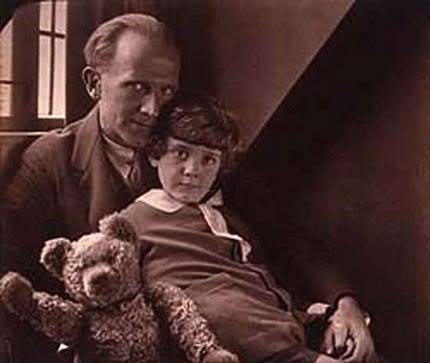
“Teddy Bear” was first published in PUNCH magazine (1923), and was later included in When We Were Very Young (1924). This was the world’s first introduction to Edward Bear, aka Winnie the Pooh. I hope you have some extra honey for him.
TEDDY BEAR
by A.A. Milne
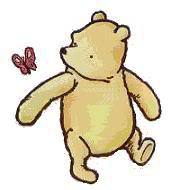
A bear, however hard he tries
Grows tubby without exercise.
Our Teddy Bear is short and fat,
Which is not to be wondered at;
He gets what exercise he can
By falling off the ottoman,
But generally seems to lack
The energy to clamber back.
Now tubbiness is just the thing
Which gets a fellow wondering;
And Teddy worried lots about
The fact that he was rather stout.
He thought: “If only I were thin!
But how does anyone begin?”
He thought: “It really isn’t fair
To grudge one exercise and air.”
Today’s Poetry Friday Roundup is at Farm School.

“Promise me you’ll always remember: You’re braver than you believe, and stronger than you seem, and smarter than you think.”
~ Christopher Robin to Pooh, by A.A. Milne
 Jama's Alphabet Soup