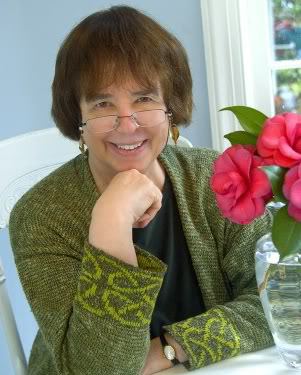
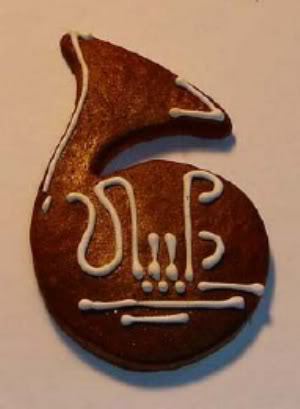
April Halprin Wayland, our very first Potluck Poet this month, always writes "Happy Birthday" in raisins to members of her family. We think this is the coolest idea and wanted to send our very own greetings. ☺
In case you missed her delicious poem and recipe, click here. Mmmm, Lemon Waffles.
And don’t forget she’s doing the Poem-a-Day Challenge and is posting a new poem and the story behind the poem each day at her website. Go over there and nibble on a few words.
HAAAAAAAAAAAAAAAAAAAAAAAAAAPY BEARTHDAY, APRIL!
♥ Check out all the 2011 Poetry Potluck posts here.
#12 in the Poetry Potluck Series, celebrating National Poetry Month 2011.
If someone had told me 23 years ago that one day I’d be inviting Jane Yolen over to my cyber kitchen to share a poem and recipe, I’d think he or she had eaten way too many Alice B. Toklas brownies.
Well, right now my head’s buzzing and I’m floating on air because here she is, and I couldn’t be more astonished or pleased. All those years ago, I had the distinct pleasure of listening to Jane talk about picture books at a Mid Atlantic SCBWI Conference. I learned soooo much and was impressed by her enthusiasm, generosity, graciousness, candor, and overall brilliance.
#11 in the Poetry Potluck Series, celebrating National Poetry Month 2011.
Why, yes. That would be Herr Mozart himself, escorting the lovely Tabatha Yeatts, who’s bringing a tasty bit of music history to the party today.
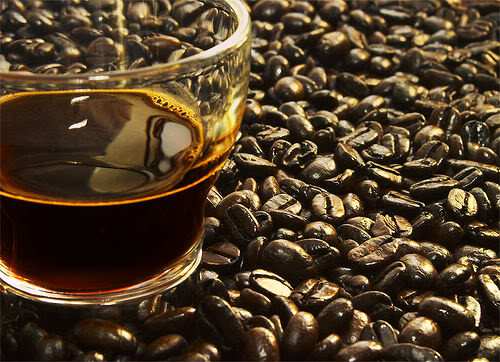
Please help yourself to a cup of rich, steamy Viennese coffee and make yourself comfortable. Nothing like the combination of coffee, chocolate, cinnamon and cream to alert you to the beauty in the world.
via Jeremy Choo
You may know that besides being a brilliant composer, dear Wolfie was somewhat of a prankster. He took great pleasure in razzing those he loved best. He was great friends with Austrian horn player Joseph Leutgeb, whom he met while Leutgeb played in the Archbishop of Salzburg’s private orchestra. Mozart composed concerti especially for Leutgeb, and some of the scores are “embellished” with coarse jokes, crude asides and blatant name-calling — all in the spirit of fun.
Consider this bizarre narrative, parts of which were strategically placed in Mozart’s autograph score for his Horn Concerto No.1 in D major, written in 1791:
For you, Mr. Donkey—Come on—quick—get on with it—like a good fellow—be brave—Are you finished yet?—for you—beast—oh what a dissonance—Oh!—Woe is me!!—Well done, poor chap—oh, pain in the balls!—Oh God, how fast!—you make me laugh—help—take a breather—go on, go on—that’s a little better—still not finished?—you awful swine!—how charming you are!—dear one!—little donkey!—ha, ha, ha—take a breath!—But do play at least one note, you prick!—Aha! Bravo, bravo, hurrah!—You’re going to torture me for the fourth time, and thank God it’s the last—Oh finish now, I beg of you!—Confound it—also bravura?—Bravo!—oh, a sheep bleating—you’re finished?—Thank heavens!—Enough, enough!
Tsk, tsk. Boys will be boys. Good thing Herr Leutgeb had a good sense of humor, fully realizing how much Mozart respected his extraordinary musicianship (further evidenced by the difficulty of the composition). There’s a little more to this story, but first let’s hear from Tabatha:
I enjoy writing about history and spotlighting a particular moment. My daughter plays French horn and I have heard her practice Mozart’s horn concertos many times. I offer my sincere respect to horn players.
MOZART SENDS CONCERTOS TO THE HORN PLAYER JOSEPH LEUTGEB
by Tabatha Yeatts
Leutgeb accepted these gifts
as the challenges they were —
tributes wrapped in golden paper,
fastened with knots that would take
months to untangle.
He laughed as he read them.
The audacity!
He imagined his friend
sharpening the nib of his pen,
finishing the rondo with a flourish: “Play that,
if you can!
When you have conquered these notes,
wrestled them to the ground,
beaten them with only your
hands and heart, and
your fierce and delicate mouth
to sustain you,
I will come discover myself
in your bell-smooth,
heart-ringing voice.”
Leutgeb must have indeed had a fierce mouth, for the French horn he played back then was valveless. He would have had to produce different pitches by varying lip pressure and/or changing the position of his hand in the bell of the instrument. The four horn concerti and quintet Mozart wrote for Leutgeb remain among the finest ever composed for the instrument. Nice to know that close friendships can inspire utmost brilliance for all parties concerned.
*sips a little more coffee and rubs hands together*
Much as I love hearing about Mozart’s little nasties, the part of the story I like best is about when Leutgeb moved from Salzburg to Vienna. In order to supplement his meager income as a musician, he opened a cheese shop! Wolfgang’s father Leopold lent Leutgeb some money to help him get started, describing the shop as “the size of a snail’s house.” No doubt there were traces of Kugelkase, Schloss, or Mondseer on Leutgeb’s breath as he raised his horn to his lips. ☺
Naturally, Tabatha has brought us something cheesy to top things off. Possibly the best ingredient in these little savories is the “hot air” that fills them, so make sure you don’t use up all of yours when practicing your next horn concerto. Puff away and enjoy!
CONCERTO CHEESE PUFFS
1/2 c. butter
2 c. water
2 c. flour
1 t. salt
1/2 t. pepper
6 large eggs
2-1/2 c. shredded cheese (you choose what kind – I have used various combinations of sharp and regular cheddar, Monterey Jack, mozzarella, and Mexican blend, all with success)
1 t. baking powder
crushed garlic or garlic powder (optional)
Combine water and butter in a saucepan; add salt and pepper. Bring to a rapid boil. Add flour all at once, beating vigorously with a wooden spoon until mixture forms a ball and comes away from sides of pan. Remove from heat; cool 5 minutes. Add eggs one at a time, beating vigorously by hand or in a food processor for ten seconds after each addition. Continue beating 1-2 minutes or process 20 seconds until smooth. Blend in shredded cheese, baking powder, and garlic to taste. Drop 2″ balls of dough onto lightly greased cookie sheets. Bake in a 400-degree F oven for 20 minutes or until puffed and lightly browned. (Optional: Just before serving brush tops with a little butter and sprinkle with grated cheddar cheese and garlic. Heat at 400 degrees for about five minutes or until cheese is melted.) ———————————————————————————
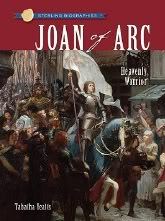
Tabatha Yeatts, a native of Blacksburg, Virginia, has published three biographies for young adults (Joan of Arc, Thomas Edison, Mae West), and two other nonfiction titles: Forensics: Solving the Crime (Oliver Press, 2001), and The Holocaust Survivors (Enslow, 1998). She’s also written dozens of articles and stories for such publications as The Christian Science Monitor, Cricket, and Logic Puzzles (I especially like her piece on Pippi Longstocking). She blogs regularly at The Opposite of Indifference, where she participates in Poetry Friday and Art Thursday. I love the rich combination of music, art, poetry, tidbits and observations she shares with her readers — always something fascinating to learn there. Tabatha currently lives with her family in Maryland, where the air is filled with the aroma of warm cheese puffs and the sonorous notes of the French horn. Find out more at her official website.
#9 in the Poetry Potluck Series, celebrating National Poetry Month 2011.
Poetry lovers, slip on your black satin bibs and saunter right up to the table. For today, black berets only, please.
Goodbye sweetness and light, hello dark and sexy.
When it comes down to it, really down to it, who do you love? Barbara Crooker knows.
via Linnie
Very likely you’ve seen her “Ode to Chocolate” online, or maybe in her newest poetry collection, MORE (C&R Press, 2010). I love this swagger of a poem, the way it tempts and teases, plays to the rebel, takes no prisoners. Not an ounce of milquetoast, no hem or haw. Dark, baby, dark. Deep, decadent, divine.
ODE TO CHOCOLATE by Barbara Crooker I hate milk chocolate, don’t want clouds of cream diluting the dark night sky, don’t want pralines or raisins, rubble in this smooth plateau. I like my coffee black, my beer from Germany, wine from Burgundy, the darker, the better. I like my heroes complicated and brooding, James Dean in oiled leather, leaning on a motorcycle. You know the color.
Oh, chocolate! From the spice bazaars of Africa, hulled in mills, beaten, pressed in bars. The cold slab of a cave’s interior, when all the stars have gone to sleep.
Chocolate strolls up to the microphone and plays jazz at midnight, the low slow notes of a bass clarinet. Chocolate saunters down the runway, slouches in quaint boutiques; its style is je ne sais quoi. Chocolate stays up late and gambles, likes roulette. Always bets on the noir.
Barbara: “Ode to Chocolate” came out of a prompt I was doing with a women’s retreat, one where I’ve led the poetry workshop for oh, 26-27 years now. I was looking for a food prompt, and did a Google search on chocolate + poems, coming up blank. So I decided to write one of my own! The group still fondly remembers me breaking off small bits of a very dark chocolate bar and passing them out, almost like communion. They wrote some really neat poems as well.
I first encountered “Ode to Chocolate” at Diane Lockward’s Blogalicious, when she hosted a Poetry Salon in honor of Barbara’s MORE. Loved it, of course, and thus began my hunger for more Barbara poems.
Shortly after I posted Diane’s “If Only Humpty Dumpty Had Been a Cookie” for Poetry Friday, I received an email from Barbara, who offered to send me a batch of gluten free cookie recipes, several of them containing chocolate. We talked about “Ode to Chocolate,” “Ode to Olive Oil,” and the general deliciousness of food poetry. Yes, here was a woman after my own heart, extolling gravy and writing fondly about her mother’s piecrust. Sweet serendipity; there was more.
We discovered that the same novelist and professor, Asa Baber (who for many years wrote the “Men” column in Playboy magazine), had been pivotal in both our lives as fledging writers. Barbara met Asa at a conference; the advice he so kindly offered set her on the right path. Asa was my first college English professor in Hawai’i, the one who convinced me to pursue creative writing. He was unconventional and disarmingly handsome with a deep, dark tan. My James Dean, a master of je ne sais quoi. Simply no limits to the power of chocolate and poetry, happy connections being the greatest gift of all.
So, back to Barbara’s gluten free recipes. Last week, I made her Chocolate Shortbread, which is so, sooooooo good. The entire house smelled of rich chocolate, butter and vanilla all afternoon. I kind of drifted around from room to room in a deep chocolate reverie, thinking that if food is poetry, this cookie is the perfect love sonnet. As it turns out, the recipe actually represents the special love of a mother for her son:
Barbara: April is National Autism Awareness Month, and the reason I have all these gluten-free recipes is that being gluten (wheat, rye, oats, barley) and casein (milk, dairy products) -free has made a huge difference in our son’s ability to navigate the world. He’s 27 now, still living at home, and I’m still baking for him.
CHOCOLATE SHORTBREAD
1/2 cup butter, soft (or 1/4 tub Earth Balance non-dairy “butter”)
1/4 cup brown sugar
1/2 tsp. vanilla
6 oz. semi-sweet chocolate chips, melted
1 cup gluten free flour
1 tsp. xanthan gum
Mix butter, sugar, vanilla; add chocolate. Stir dry ingredients together, add. Press into a small (8-10″) spring form pan. Press fork around edges to make a design; prick holes in top with fork. Bake at 300 degrees for 45 minutes. Cool in pan. Cut into wedges while warm (then cut into smaller pieces, if desired).
Note: Barbara likes Bette Hagman’s Gluten-Free flour mixture.
————————————————————————-
Barbara Crooker has written more than 625 poems published in over 1,950 anthologies, books, and magazines such as Yankee, The Christian Science Monitor, Nimrod, Poetry International, and The Beloit Poetry Journal. She’s the recipient of the 2007 Pen and Brush Poetry Prize, the 2006 Ekphrastic Poetry Award from Rosebud, the 2004 WB Yeats Society of New York Award, the 2003 Thomas Merton Poetry of the Sacred Award, and many more. She’s been nominated an amazing 26 times for the Pushcart Prize and also received a 1997 Grammy nomination for her part in the audio version of the popular anthology, Grow Old Along With Me – The Best is Yet to Be (Papier Mache Press).
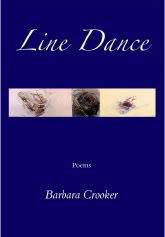
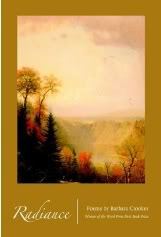
She’s authored ten chapbooks (two won national competitions), and published three full-length poetry collections: Radiance (2005 Word Press First Book Prize, 2006 Paterson Poetry Prize finalist), Line Dance (2009 Paterson Award for Literary Excellence), and More (2010). Her work has been read on the BBC, the ABC (Australian Broadcasting Company), and by Garrison Keillor on The Writer’s Almanac over a dozen times. You can find many of Barbara’s poems online, referenced at her official website.
♥ I love this:
What more can a person
hope for, in this world of a thousand sorrows,
than a life that was made for song, than a body
sometimes able to take wing?
~from “My Life as a Song Sparrow,” included in MORE, one of two prizes offered in my Poetry Book Giveaway.
♥ To listen to Barbara read “Ode to Chocolate,” click here.
#8 in the Poetry Potluck Series, celebrating National Poetry Month 2011.
Irene with her debut middle grade novel, Leaving Gee’s Bend.
When poet and author Irene Latham was at a booksigning for her debut novel Leaving Gee’s Bend last year, she spied a postcard book containing pieces from the National Museum of Women in the Arts. She decided to use some of the paintings as prompts for the poem-a-day-challenge she usually does every April. Twelve of those poems are included in her second book of poetry, The Color of Lost Rooms (Blue Rooster Press, 2010), which explores the themes of love and loss within the context of history, nature and art.
I find ekphrastic poems fascinating, a kind of triple treat. There’s the work of art itself (something we might encounter for the first time or be invited to ponder anew), the poet’s response to the art, and then the pleasure of comparing our own reactions with the poet’s. Irene says she really responds to visual art on an emotional level, and that the paintings she eventually wrote about chose her. I know just what she means. It’s wonderful wholly entering the world of a painting that speaks to you.










 Jama's Alphabet Soup