When we were little, we likely heard about the cow jumping over the moon and the dish running away with the spoon. We learned the moon was made of green cheese, and that when the man in the moon tumbled down too soon, he burned his mouth eating porridge.
Whether in nursery rhyme or popular folklore, the moon continues to charm us. No surprise that kids are especially captivated by its presence in the night sky and curious about its changing appearance.
In Sweet Dreams: Moon Poems for Bedtime (Schiffer Kids, 2025), beloved Alabama poet Charles Ghigna serves up a delightful platter of lunar treats illustrated by Jacqueline East. The fourteen short poems in the collection invite young readers to explore the moon’s many guises, whether playful, evocative, majestic or enchanting.
When night has fallen and children are tucked safely in their beds, they can imagine the moon as a lollipop, orange, pumpkin, ice cream cone or lost balloon. They can see the moon as artist, magician, or guardian of safety.
In less than a week, millions of Koreans will be celebrating Chuseok, a mid-Autumn harvest festival that’s one of the biggest holidays of the year. They will travel from all over to visit their ancestral hometowns, where they’ll spend time with their families, honor their ancestors and share a big feast.
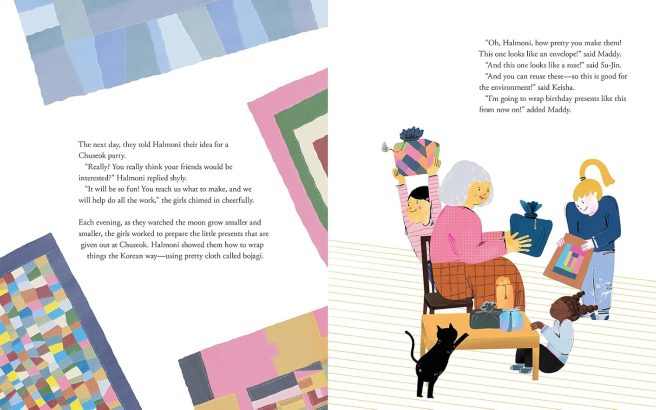
Since my family didn’t observe this wonderful holiday when I was growing up in Hawaii, I knew very little about it until I read Giving Thanks with Halmoni: Celebrating Chuseok, the Korean Harvest Festival by Kathleen Choi and Sook Nyul Choi, illustrated by Il Sung Na (Red Comet Press, 2025).
Children’s books about Chuseok are actually few and far between, so this delectable title is a very welcome offering. Love that it was written by the same mother-daughter team who collaborated on one of my favorite Korean American picture books, Halmoni and the Picnic (1993). I still remember how excited I was when first reading it 32 years ago (back then, picture books by and about Korean Americans were almost non-existent). How wonderful that all these years later, the Choi family is bringing us yet another heartwarming intergenerational tale. 🙂
The halmoni (grandmother) in this new story has recently moved to America. She describes Chuseok (which coincides with the big, bright Harvest Moon), to her granddaughter Su-Jin and her friends Maddy and Keisha, who notes that it sounds a lot like Thanksgiving. Later, when Su-Jin tells her friends that Halmoni likely misses hosting Chuseok dinner with her family and friends in Korea, the girls decide to ask Halmoni to help them throw a Chuseok party for all their friends.
Halmoni is only too happy to oblige, while the girls are excited to pitch in with all the preparations. As the moon grows smaller and smaller, Halmoni first shows the girls how to wrap special Chuseok presents with a pretty cloth called bojagi.
When the moon finally disappears, it’s time to begin serious preparations. The next night, a tiny sliver of the moon appears; while it grows each night after that, Halmoni and the girls shop for ingredients and make several traditional dishes such as Korean scallion pancakes (pajun), japchae noodles, a traditional beef stew called galbijjim, and three-color vegetables.
There’s nothing more nourishing or restorative than a bowl of homemade soup, especially when your mother makes it. 🙂
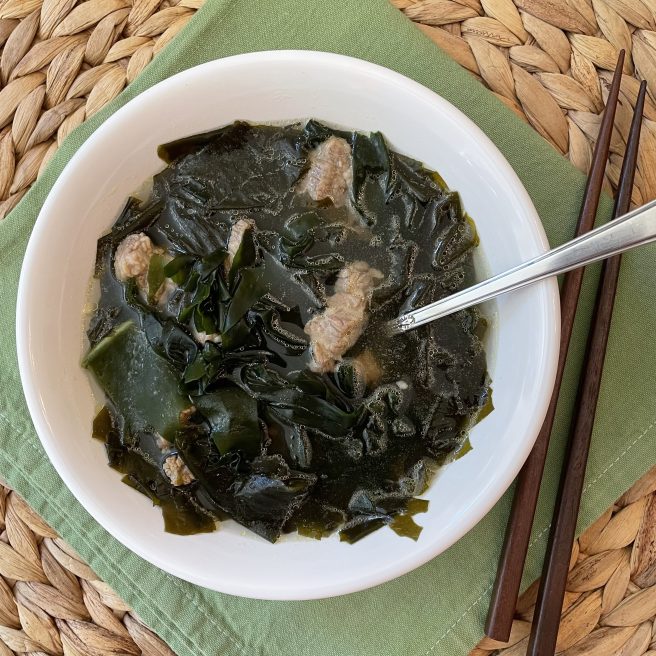
If we had a cool rainy day, if someone was feeling under the weather, or whenever she just felt like it, my mom made Korean miyeok-guk (seaweed soup). Though she cooked many delicious dishes, this soup was easily the most comforting and I always loved devouring my fair share.
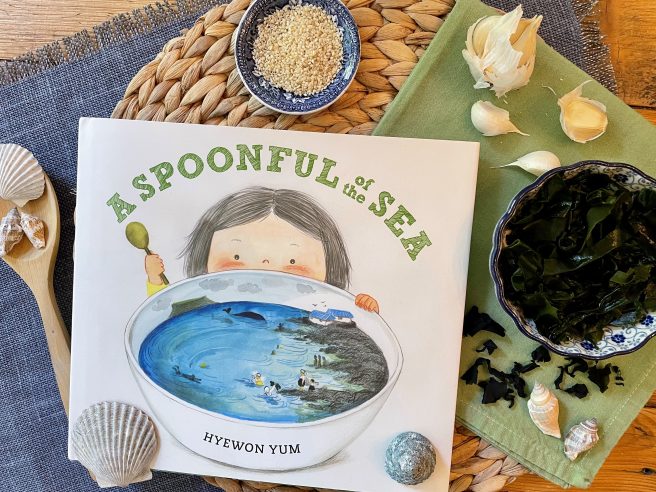
But for all those years of eating miyeok-guk while growing up, I only recently learned about its cultural significance thanks to Hyewon Yum’s touching new picture book, A Spoonful of the Sea (Norton Young Readers, 2025).
I didn’t know that in Korea, miyeok-guk is a traditional birthday soup honoring and celebrating mothers, and that this custom dates back more than a thousand years! Referencing Jeju Island’s revered haenyeo (female free divers), Yum has lovingly created an inspiring tale of family history and heritage told through a matriarchal lens.
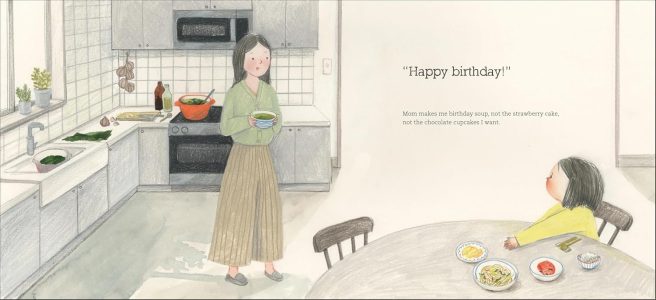
As the story opens, a girl is given a bowl of her mother’s seaweed soup on her birthday. Disappointed it’s not the strawberry cake or chocolate cupcakes she actually wanted, she pouts over the briny-smelling soup that “looks like sea water.” But while she’s stirring it, her mom explains why the soup is so special.
“Better than a thousand days of diligent study is one day with a great teacher.” ~ Japanese proverb
Hooray for September and a brand new school year!
As a grade school student, I loved having new clothes, fresh school supplies, putting covers on assigned textbooks, making sure my quarter for lunch was safely stashed in my coin purse. I could hardly wait to open my spiral notebook and write on a clean page with a freshly-sharpened No. 2 pencil.
Most of all, I looked forward to meeting my new teacher.
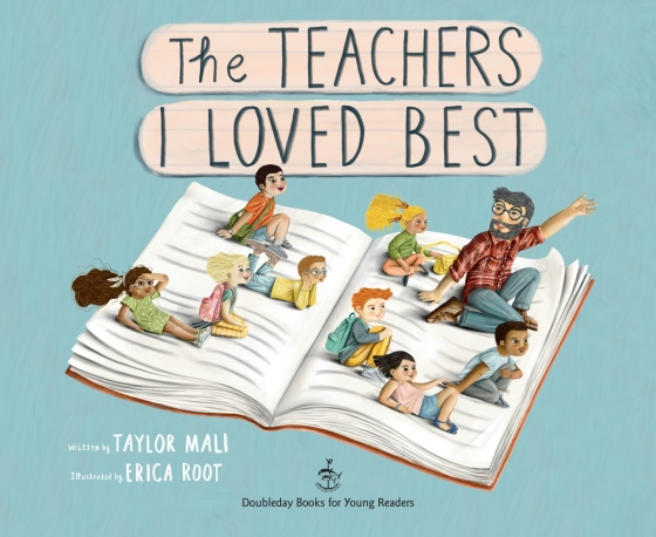
Reading The Teachers I Loved Best by Taylor Mali and Erica Root (Doubleday BFYR, 2023) brought to mind my own favorites, making me appreciate them even more.
In his uplifting rhyming ode, Mali celebrates the extra-special, dedicated educators (classroom teachers, principals, librarians) who leave a lasting impression on all of us. “A great teacher is anyone who makes you work hard — harder than you ever thought you could — who makes you want to be better than just . . . plain . . . good.”
He goes on to laud their willingness to go above and beyond to bring out the best in their students, whether coaching from the sidelines to instill confidence, gently pushing to keep them on track, or being demanding “with the goal of commanding understanding.” The teachers he truly loved most were the ones who challenged and inspired him to give his all every single day.
He mentions his science teacher, who had the class dramatize the way the solar system worked, an art teacher he madly loved who dressed in “white paint-splattered smocks all of the time,” and every music teacher he ever had who encouraged him despite his bad, off-key singing voice.
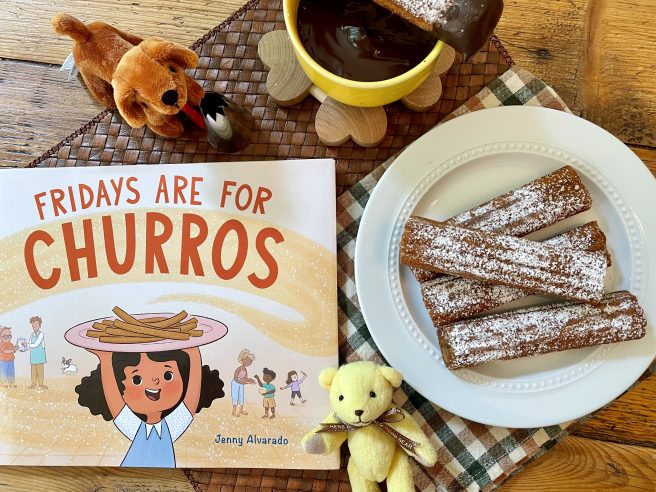
Hungry? Can you smell the heavenly aroma of fried sweet dough dipped in cinnamon sugar? Now that you’re here, please help yourself to some warm apple-filled churros — dip yours in chocolate if you wish, and enjoy!
These crisp-on-the-outside, airy-light-on-the-inside snacks are featured in the delectable new picture book, Fridays are for Churros by Jenny Alvarado (Holiday House, 2025). Celebrating food, family, and community, this fun story warms the heart, showing how good neighbors can help renew cherished traditions and strangers can become friends.
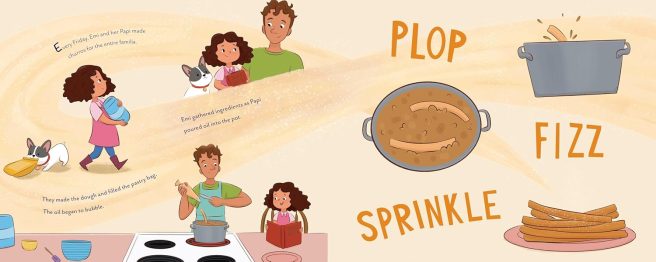
We first learn that Emi and her Papi make churros for their entire family every Friday. Emi gathers ingredients while Papi pours oil into the pot. Together, they make the dough and fill the pastry bag. Then with a Plop, Fizz, and Sprinkle, the churros are ready, its sweet scent swirling throughout the house as the familia arrive. How they chatter and laugh! Emi loves this feeling of ‘home.’
But then Emi and Papi must move to a big city for Papi’s new job. Such a busy place full of people, but no familiar faces, and on Fridays, no churros. Papi is usually too busy working.
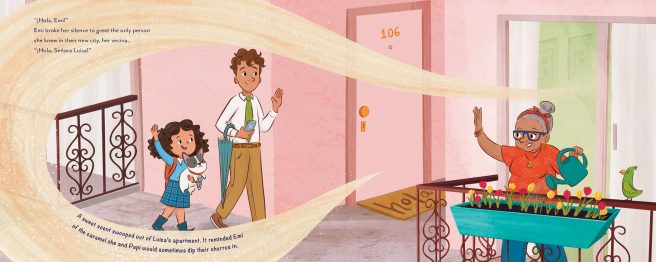
One day as they arrive at their apartment, Emi and Papi see and then greet their new neighbor Señora Luisa. A sweet scent swoops out from her open door, reminding Emi of the caramel she and Papi used to dip their churros in. This gives Emi an idea. She would make the churros herself!
After checking the recipe, Emi realizes she doesn’t have enough flour and sugar, and can’t find the piping tip. Could she borrow these things from Señora Luisa? Her neighbor is happy to help; she has farina but no sugar or piping tip. She suggests Emi ask Tomas in 212.




 Jama's Alphabet Soup