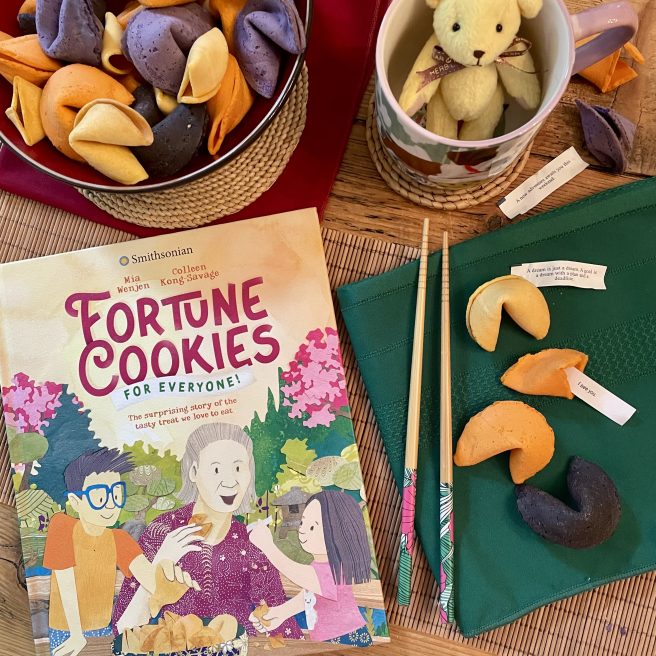
[crunchy review] Fortune Cookies for Everyone! by Mia Wenjen and Colleen Kong-Savage

Everyone looks forward to cracking open a fortune cookie after finishing a mouthwatering Chinese meal. What does the future hold (“You will meet a handsome stranger”)? What handy bit of wisdom awaits (“A closed mouth gathers no feet”)?

While we all enjoy these fun and pithy messages, it’s logical to assume fortune cookies are a Chinese invention, when in fact they most likely originated in Japan. What’s more, most people in China haven’t even heard of fortune cookies, let alone eaten them! 😯

In Fortune Cookies for Everyone!: The Surprising Story of the Tasty Treat We Love to Eat (Smithsonian/Red Comet Press, 2025), Mia Wenjen and Colleen Kong-Savage serve up a captivating intergenerational tale flavored with sides of history, mystery, and cultural pride. Learning about a food’s interesting backstory makes it even tastier, don’t you think?
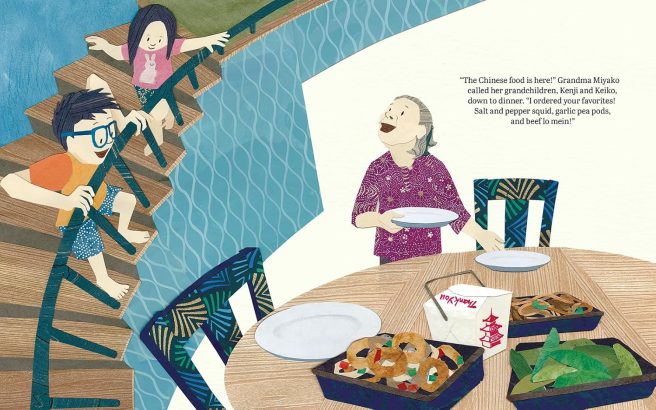
As the story opens, Grandma Miyako has ordered Chinese takeout for her grandchildren Kenji and Keiko. After they’ve feasted on their favorites — salt and pepper squid, garlic pea pods, and beef lo mein — she hands them their fortune cookies, mentioning that she knew who invented them.

The kids are excited to hear more about that in the “long and twisty story” Grandma tells using her scrapbook. When she was a girl, Makoto Hagiwara, the man who ran the Japanese Tea Garden in Golden Gate Park, served tea with miso-flavored fortune cookies he made by hand using a kata (iron mold).
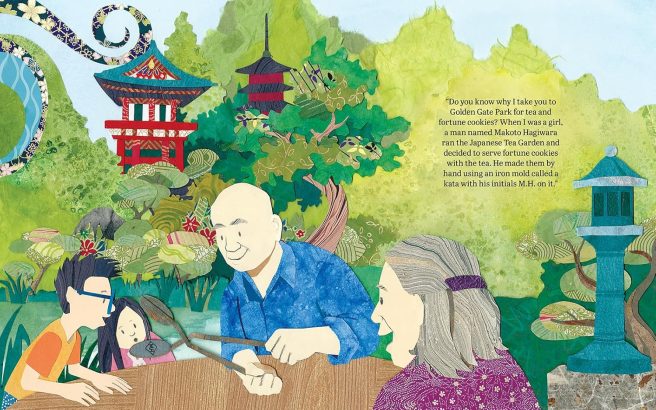
Because the cookies were so popular, Hagiwara asked Grandma’s best friend Yukiko’s father (who owned a bakery) to help him. Mr. Okamura was happy to do so, suggesting they change the cookie flavor to sweet vanilla and butter to make them more appealing to Americans.

Continue reading
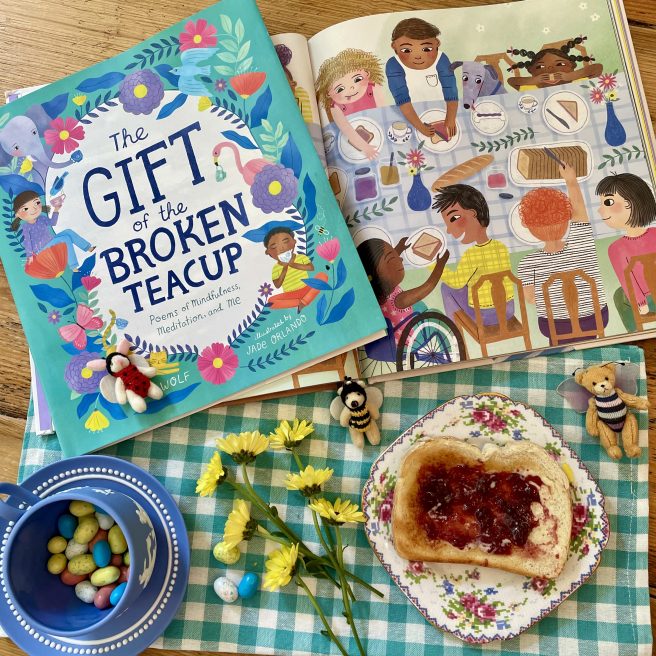
[mindful review+ giveaway] The Gift of the Broken Teacup by Allan Wolf and Jade Orlando

Imagine standing beneath a tall tree in a quiet snow-laden forest, your soul abloom with heightened awareness. Or perhaps you’re lying on your bed, eyes closed, envisioning a butterfly fluttering just above you, its wings stirring up the gentle air before it softly lands on your fingers, nose and eyelids.

Whether immersing yourself in nature or traveling within, moments of calm introspection can help offset the stresses of daily life, rejuvenate the spirit and restore balance. In The Gift of the Broken Teacup: Poems of Mindfulness, Meditation, and Me (Candlewick, 2025), poet Allan Wolf and illustrator Jade Orlando invite young readers to open their minds, think deeper, and enjoy the benefits of being fully present in their daily lives.

This insightful collection explores the essence of mindfulness by offering strategies for self actualization and emotional literacy. With an emphasis on positive values like empathy, kindness, gratitude and respect, this child-friendly primer for being in the world truly inspires and empowers.

Thirty poems are presented in three sections — Mindfulness, Meditation, and Me — with the opening poem introducing the book’s overarching themes of acceptance, openness, and intention.

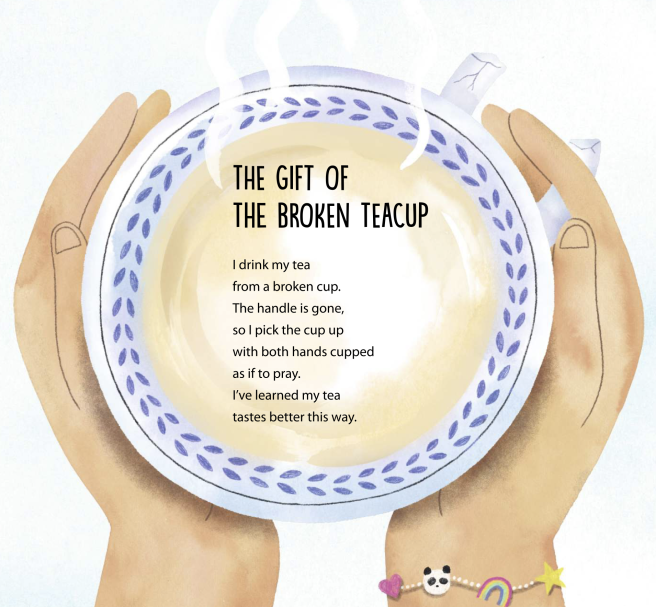
THE GIFT OF THE BROKEN TEACUP

I drink my tea
from a broken cup.
The handle is gone,
so I pick the cup up
with both hands cupped
as if to pray.
I've learned my tea
tastes better this way.

I like the speaker’s non judgmental attitude and willingness to embrace the broken cup for what it is, ultimately discovering an unexpected gift. Good lesson: always remain open to possibilities, trust yourself.

Continue reading

[review] This Moment is Special: A Día de Muertos Story by John Parra

Come November 1-2, Mexicans and other Latino communities around the world will be observing Día de Muertos (Day of the Dead), a traditional fiesta to honor and remember deceased loved ones.

Celebrations will include using marigolds and calaveras (skeletons), decorating family gravesites, constructing altars with photos, memorabilia and offerings of the departed’s favorite foods and beverages; as well as holding community gatherings with music, dancing, feasting, and masquerading as death.

Rather than being a somber, mournful occasion, this much anticipated holiday is a time to welcome the spirits of departed ancestors to a joyful reunion with the living on Earth.

In This Moment is Special: A Día de Muertos Story (Paula Wiseman/S&S, 2025) by award-winning author-illustrator John Parra, a young boy practices mindfulness as he prepares for the fiesta throughout the day. He treasures each moment with family and friends — moments time will turn into the precious memories of a life well lived.

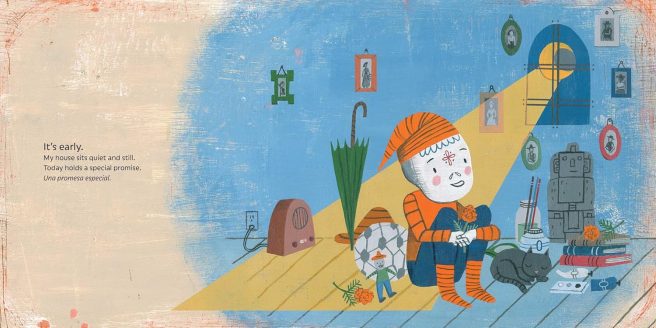
We first meet him early in the morning as he anticipates what’s ahead with hope and excitement:

Today holds a special promise. Una promesa especial.

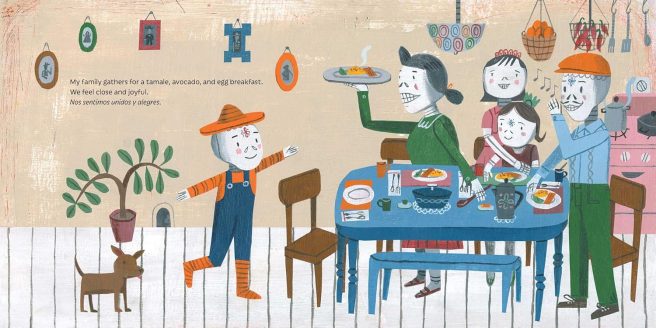
Oh, the possibilities! He first shares “a tamale, avocado and egg breakfast” with his family, who, like him, have donned calaveras paint. Next, he and his sister take the bus to school, where he pushes his mind “to discover and learn” subjects like history, language, geography and science.

Continue reading

[review] Giving Thanks with Halmoni by Kathleen Choi, Sook Nyul Choi and Il Sung Na

In less than a week, millions of Koreans will be celebrating Chuseok, a mid-Autumn harvest festival that’s one of the biggest holidays of the year. They will travel from all over to visit their ancestral hometowns, where they’ll spend time with their families, honor their ancestors and share a big feast.

Since my family didn’t observe this wonderful holiday when I was growing up in Hawaii, I knew very little about it until I read Giving Thanks with Halmoni: Celebrating Chuseok, the Korean Harvest Festival by Kathleen Choi and Sook Nyul Choi, illustrated by Il Sung Na (Red Comet Press, 2025).

Children’s books about Chuseok are actually few and far between, so this delectable title is a very welcome offering. Love that it was written by the same mother-daughter team who collaborated on one of my favorite Korean American picture books, Halmoni and the Picnic (1993). I still remember how excited I was when first reading it 32 years ago (back then, picture books by and about Korean Americans were almost non-existent). How wonderful that all these years later, the Choi family is bringing us yet another heartwarming intergenerational tale. 🙂

The halmoni (grandmother) in this new story has recently moved to America. She describes Chuseok (which coincides with the big, bright Harvest Moon), to her granddaughter Su-Jin and her friends Maddy and Keisha, who notes that it sounds a lot like Thanksgiving. Later, when Su-Jin tells her friends that Halmoni likely misses hosting Chuseok dinner with her family and friends in Korea, the girls decide to ask Halmoni to help them throw a Chuseok party for all their friends.

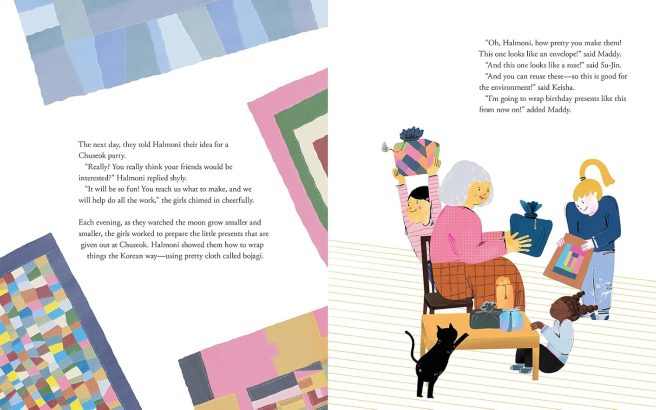
Halmoni is only too happy to oblige, while the girls are excited to pitch in with all the preparations. As the moon grows smaller and smaller, Halmoni first shows the girls how to wrap special Chuseok presents with a pretty cloth called bojagi.

When the moon finally disappears, it’s time to begin serious preparations. The next night, a tiny sliver of the moon appears; while it grows each night after that, Halmoni and the girls shop for ingredients and make several traditional dishes such as Korean scallion pancakes (pajun), japchae noodles, a traditional beef stew called galbijjim, and three-color vegetables.

Continue reading

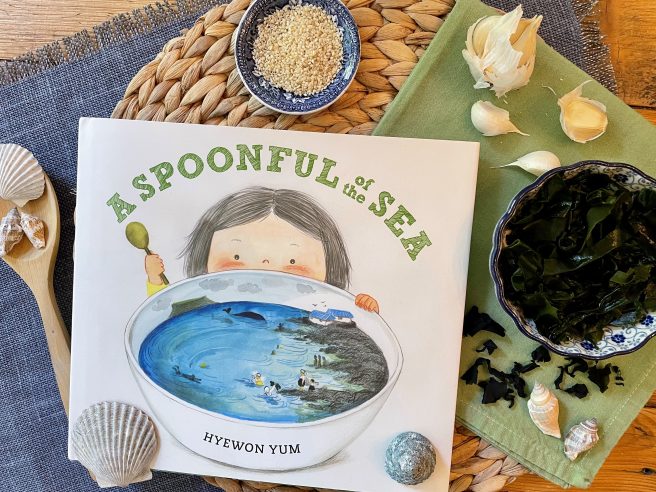
[briny review] A Spoonful of the Sea by Hyewon Yum

There’s nothing more nourishing or restorative than a bowl of homemade soup, especially when your mother makes it. 🙂

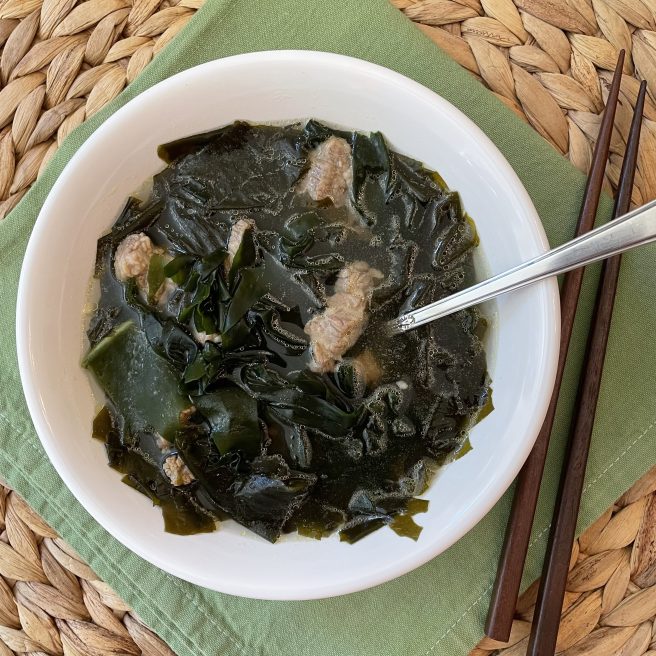
If we had a cool rainy day, if someone was feeling under the weather, or whenever she just felt like it, my mom made Korean miyeok-guk (seaweed soup). Though she cooked many delicious dishes, this soup was easily the most comforting and I always loved devouring my fair share.

But for all those years of eating miyeok-guk while growing up, I only recently learned about its cultural significance thanks to Hyewon Yum’s touching new picture book, A Spoonful of the Sea (Norton Young Readers, 2025).

I didn’t know that in Korea, miyeok-guk is a traditional birthday soup honoring and celebrating mothers, and that this custom dates back more than a thousand years! Referencing Jeju Island’s revered haenyeo (female free divers), Yum has lovingly created an inspiring tale of family history and heritage told through a matriarchal lens.

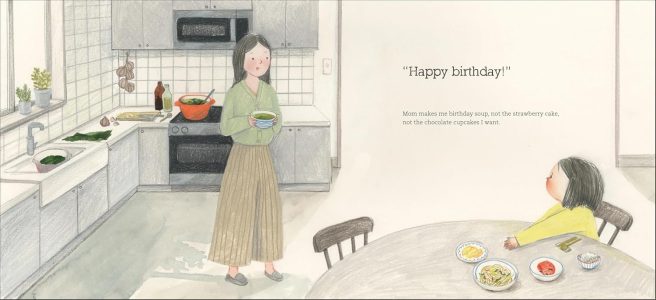
As the story opens, a girl is given a bowl of her mother’s seaweed soup on her birthday. Disappointed it’s not the strawberry cake or chocolate cupcakes she actually wanted, she pouts over the briny-smelling soup that “looks like sea water.” But while she’s stirring it, her mom explains why the soup is so special.

Continue reading