I consider it a rare gift to discover a new-to-me poet, one whose work immediately resonates and whets my appetite for more.
Reading Freya Manfred’spoems for the first time was like taking a rejuvenating breath of fresh air, or drinking a tall glass of cool water on a warm day. She often writes about nature and human relationships; her plain-spoken words, generous spirit and clear-sighted wisdom shifted my perspective. Here are two poems I found especially moving.
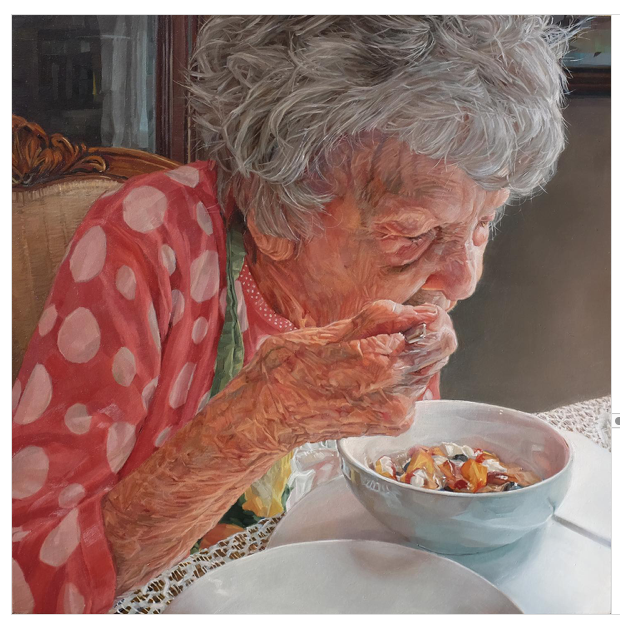
“Breakfast” by Amy Werntz (oil on panel).
IMAGINE THIS by Freya Manfred
When you’re young, and in good health, you can imagine living in New York City, or Nepal, or in a tree beyond the moon, and who knows who you’ll marry: a millionaire, a monkey, a sea captain, a clown.
But the best imaginers are the old and wounded, who swim through ever narrowing choices, dedicating their hearts to peace, a stray cat, a bowl of homemade vegetable soup, or red Mountain Ash berries in the snow.
Imagine this: only one leg and lucky to have it, a jig-jagged jaunt with a cane along the shore, leaning on a walker to get from grocery to car, smoothing down the sidewalk on a magic moving chair, teaching every child you meet the true story
Happy to share another insightful poem by California poet Lori Levy today. Last time she wrote about her love of eggplant, wanting to make it her special hobby. Now, what about a peach?
Sometimes we just have to be still and let joy find us.
*
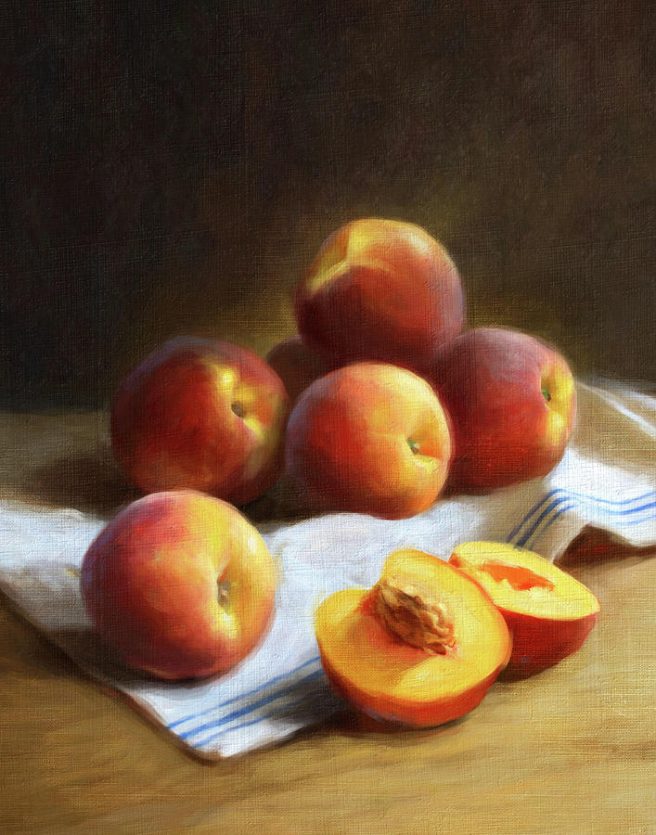
“Summer Peaches” by Robert Papp via Fine Art America.
PEACH
by Lori Levy

A woman writes about a peach.
I don't know the woman, don't know why,
out of all the poems and stories in a book I've just read,
I remember her and her peach --
how, as she bites into it one August afternoon
while reading on her patio, birds chirping around her,
scent of roses in the air, her depression lifts.

Nothing more than a peach, but it's enough,
the taste just right, juicy and sweet,
fresh from the local farmers' market.
Or maybe it's the woman herself, not expecting anything,
but ready somehow. Open, alert, ripe as her peach.
Four months of crying, grieving,
numb from the death of her husband, and, suddenly,
there it is for a moment: a thrill
she thought she'd never feel again.

A peach. But it could just as well be a baked potato
on a blanket at the beach, as it was for me once,
picnicking with family as the sky turned as luscious
as this woman's peach.

An awakening. A jolt to the senses.
We search and search, and the moment we stop
and pay attention, it's here, not there, and simple as
a peach on a patio. Or a slice of chocolate cream pie
by an open window, sun pouring in.
Or just the sun, a patch on the table,
like a note. A reminder.

~ posted by permission of the author (first published in Iris Literary Journal, March 2023).
#65 in an ongoing series of posts celebrating the alphabet.
Welcome to the Poetry Friday Roundup at Alphabet Soup!
So glad you’re here. Hope you’re having a good September. 🙂
Today we’re celebrating Alphabet Soup’s 18th blogiversary with one of my favorite (and oh-so-appropos) poetic forms, the abecedarian. Recently stumbled upon this gem by new-to-me poet Tom Disch (1940-2008).
A prolific award-winning author of speculative fiction as well as a noted poet, Disch was also a librettist, essayist, theater critic, and author of historical novels, computer-interactive fiction and children’s books (perhaps you’re familiar with his novella, The Brave Little Toaster (1980)). Of all these genres, he wished to excel most in poetry (Dana Gioia considered him a genius).
Love his conversational tone, sharp wit and matter-of-fact storytelling, which gives the poem a fresh, spontaneous feel. I haven’t read an abecedarian quite like this one before (so fun!); I like how his mind works.
“You will be pleased to know I stand obediently for the national anthem, though of course I would defend your right to remain seated should you so decide.” ~ Ira Glasser
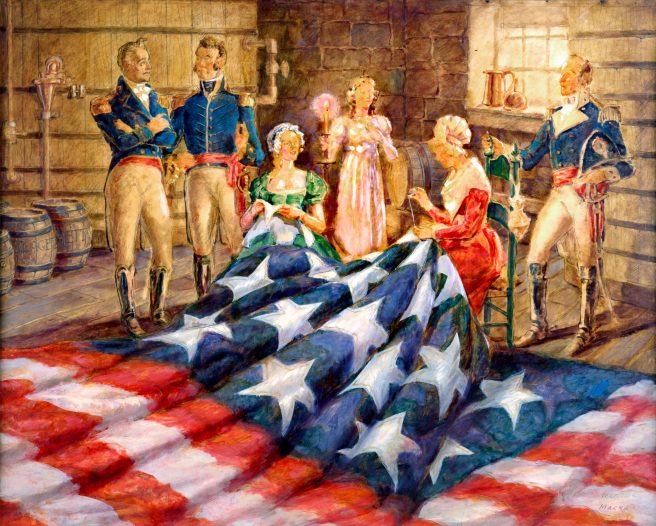
“Placing the Stars on the Flag That Inspired Francis Scott Key to Write Our National Anthem, Claggett’s Brewery, Baltimore, 1812-1814,” by Robert McGill Mackall (1962). This depicts Mary Pickersgill and her nieces in 1813, sewing the flag that would become known as the Star-Spangled Banner.
A NEW NATIONAL ANTHEM by Ada Limón
The truth is, I’ve never cared for the National Anthem. If you think about it, it’s not a good song. Too high for most of us with “the rockets red glare” and then there are the bombs. (Always, always, there is war and bombs.) Once, I sang it at homecoming and threw even the tenacious high school band off key. But the song didn’t mean anything, just a call to the field, something to get through before the pummeling of youth. And what of the stanzas we never sing, the third that mentions “no refuge could save the hireling and the slave”? Perhaps, the truth is, every song of this country has an unsung third stanza, something brutal snaking underneath us as we blindly sing the high notes with a beer sloshing in the stands hoping our team wins. Don’t get me wrong, I do like the flag, how it undulates in the wind like water, elemental, and best when it’s humbled, brought to its knees, clung to by someone who has lost everything, when it’s not a weapon, when it flickers, when it folds up so perfectly you can keep it until it’s needed, until you can love it again, until the song in your mouth feels like sustenance, a song where the notes are sung by even the ageless woods, the short-grass plains, the Red River Gorge, the fistful of land left unpoisoned, that song that’s our birthright, that’s sung in silence when it’s too hard to go on, that sounds like someone’s rough fingers weaving into another’s, that sounds like a match being lit in an endless cave, the song that says my bones are your bones, and your bones are my bones, and isn’t that enough?
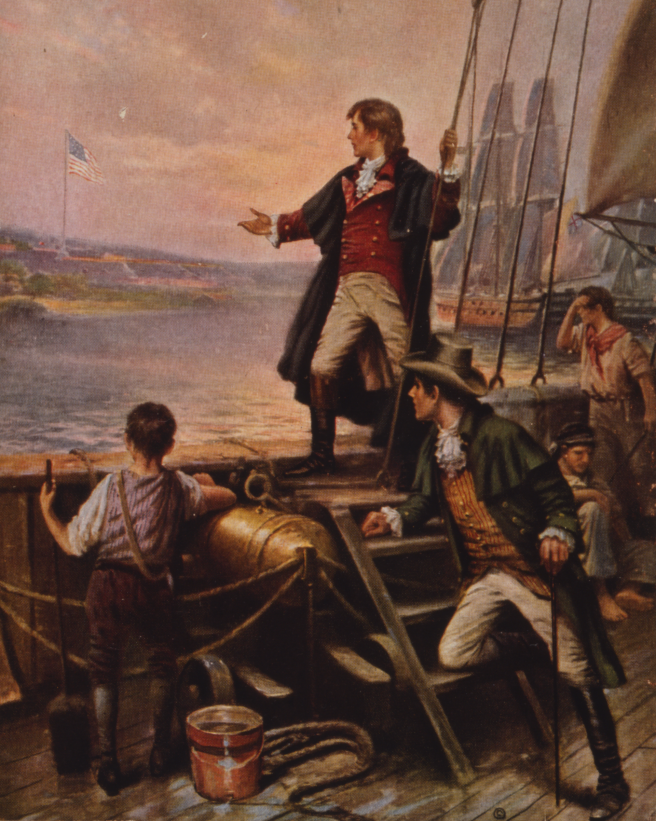
“By Dawn’s Early Light” by Edward Percy Moran (1913) – Francis Scott Key observing the flag the morning after the Battle of Baltimore, Fort McHenry, Baltimore, Maryland.
*
Distress or dissent?
Limón’s poem is especially relevant right now, not only because we are a country in crisis, but because 211 years ago, on September 14, 1814, American lawyer Francis Scott Key wrote his poem, “Defence of Fort M’Henry,” which became the lyrics for our national anthem.
Prose-like, lyrical, elegant, and accessible, his poems — often about his day-to-day life, are truly a joy to read. Love how he establishes a natural intimacy with the reader, revealing profound insights in a way that seems effortless.
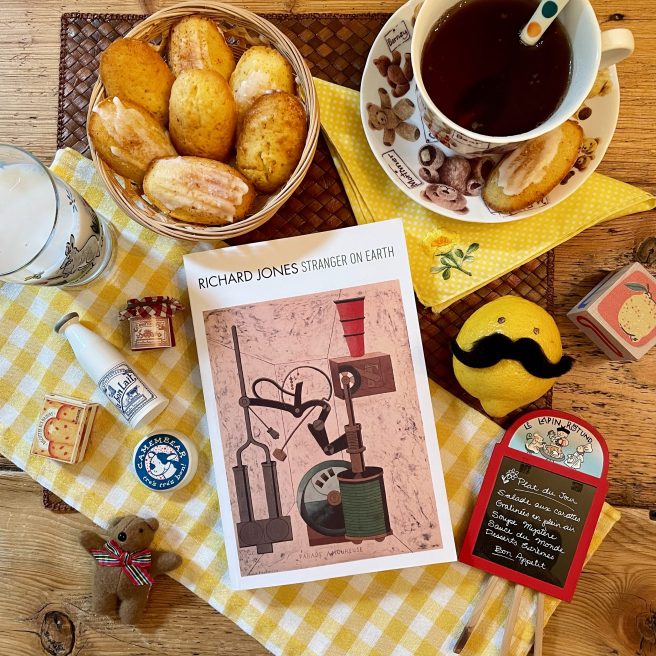
Recently I’ve been savoring his 2018 collection, Stranger on Earth (Copper Canyon Press). The poems are presented in seven sections — a nod to Marcel Proust’s 1913 seven-volume novel, Remembrance of Things Past (a.k.a. In Search of Lost Time). Jones reads Proust often, finding inspiration in the detailed stream-of-consciousness recollections transformed into a compelling art form.
Here’s a favorite poem from Stranger on Earth, a sweet moment shared by Jones and his daughter that’s perfect for Father’s Day.
*
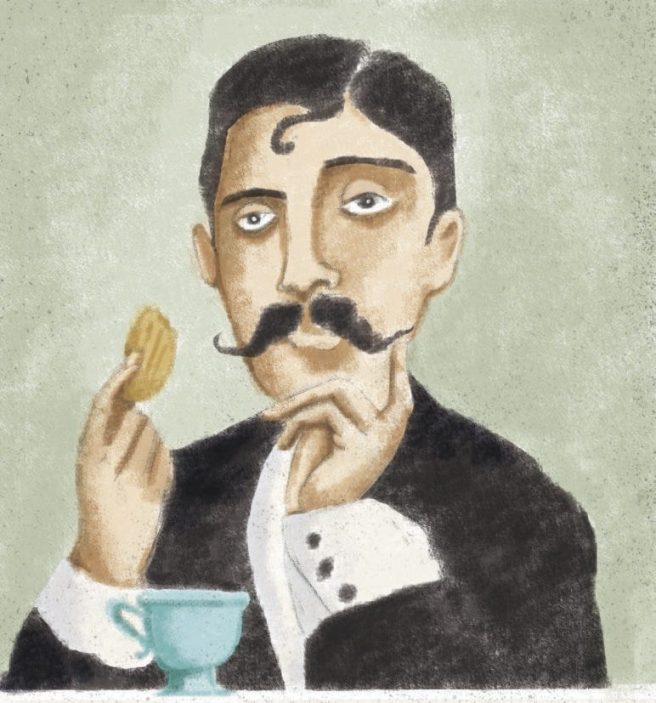
“Marcel Proust” by Nurit Spivak Kovarsky.
MADELEINES by Richard Jones
I stay up all night reading Proust, turning pages in the golden glow of a tall lamp, happy in a little circle of light and dreaming of Paris. It's like sitting up late with my closest friend or listening to my own innermost thoughts. There has awakened in me that anguish which, later on in life, transfers itself to the passion of love, and may even become its inseparable companion.
When the sun comes down the lane with ten thousand French candles, I climb the stairs and softly open the door to find my seven-year-old daughter still sleeping. I sit on the edge of her bed; she turns and slowly wakes. After my wife's, nothing is more beautiful than my daughter's eyes opening in the morning, her green eyes catching the light.
"Let's have tea and madeleines," I say, and we set out on a journey to taste in reality what so charmed Proust's fancy. Sarah finds the red mixing bowls. I fill the kettle and tell her about the recluse who spent his life in a cork-lined room scented with camphor, happy to lie in bed and write endless pages about his past, revealing the essence of every moment. Sarah breaks eggs; I measure sugar and whisk. Together we practice French: sucre, livre, roman, je t'aime.
Sarah pours the lemon-scented batter into the heavy, scalloped pan. "Would you write such a book?" she asks, licking the spatula. "Would my father go in search of lost time, remembering the past so?"
I open the oven door and tell her there is no place I'd rather be than here with her, though I wonder, will she remember this years hence -- the lemon-scented batter, the morning light -- and, amid the ruins of everything else, will the immense architecture of memory prove faithful?
The timer chimes. Sarah arranges the madeleines on a painted tole tray, sprinkles clouds of powdered sugar, and carries the tray to the terrace. Now we are in Paris at her favorite café. I am her solicitous white-aproned waiter, attentive to mademoiselle's every need, undone and unclosed by how small and beautiful her hands are. She tells me that instead of tea like Monsieur Proust, she would prefer milk. Thin towel over my arm, I hold the milk bottle, present the label; she approves and I pour the milk. "Merci avec bonté," she says, lifting her glass to the sunlight.
"I'll always remember these madeleines," I say. "Will you?" I ask, toasting her glass with my teacup. "Certainly. And your books will remind me." "All things find their way into a poem." "Like madeleines do," she proclaims, drinking down her tumbler of milk until nothing is left but the line of a thin mustache, like Proust's.



 Jama's Alphabet Soup