At department parties, I eat cheeses my parents never heard of—gooey pale cheeses speaking garbled tongues. I have acquired a taste, yes, and that's okay, I tell myself. I grew up in a house shaded by the factory's clank and clamor. A house built like a square of sixty-four American Singles, the ones my mother made lunches With—for the hungry man who disappeared into that factory, and five hungry kids. American Singles. Yellow mustard. Day-old Wonder Bread. Not even Swiss, with its mysterious holes. We were sparrows and starlings still learning how the blue jay stole our eggs, our nest eggs. Sixty-four Singles wrapped in wax— dig your nails in to separate them.
When I come home, I crave—more than any home cooking—those thin slices in the fridge. I fold one in half, drop it in my mouth. My mother can't understand. Doesn't remember me being a cheese eater, plain like that.
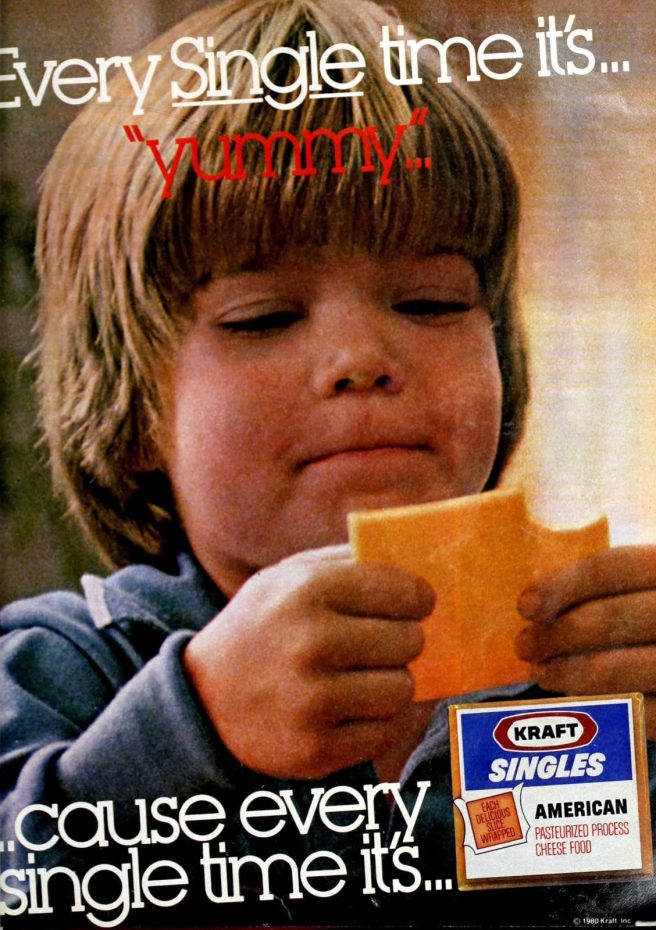
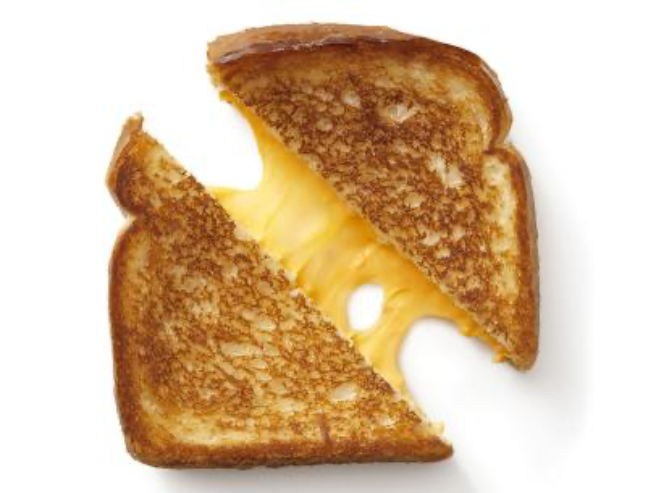
Raise your hand if you grew up with Kraft American Singles — *looks around* — okay, I see that’s most of you. 🙂
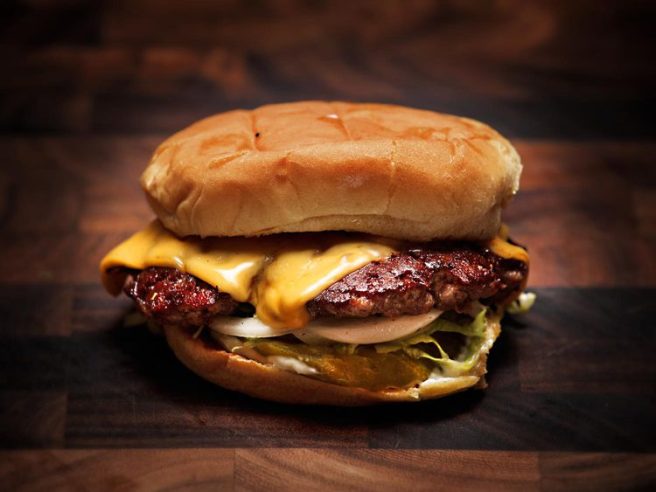
photo byJ. Kenji López-Alt/Serious Eats
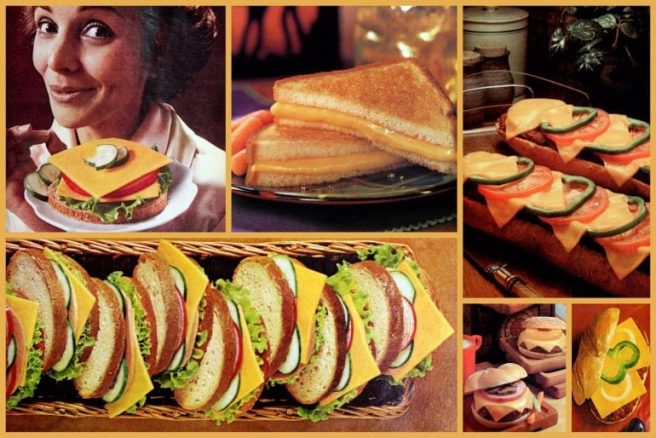
Did your Mom tuck them in your lunchbox sandwiches along with baloney or ham? Did you ever snack on a slice to satisfy between-meal munchies? Remember how your mouth watered as you anticipated that first bite of a juicy grilled burger with melty cheese oozing down the sides? Or best of all, what about the fine art of slowly pulling apart a warm grilled cheese sandwich just to see how far those gooey strings would s-t-r-e-t-c-h?
Happy to share another insightful poem by California poet Lori Levy today. Last time she wrote about her love of eggplant, wanting to make it her special hobby. Now, what about a peach?
Sometimes we just have to be still and let joy find us.
*
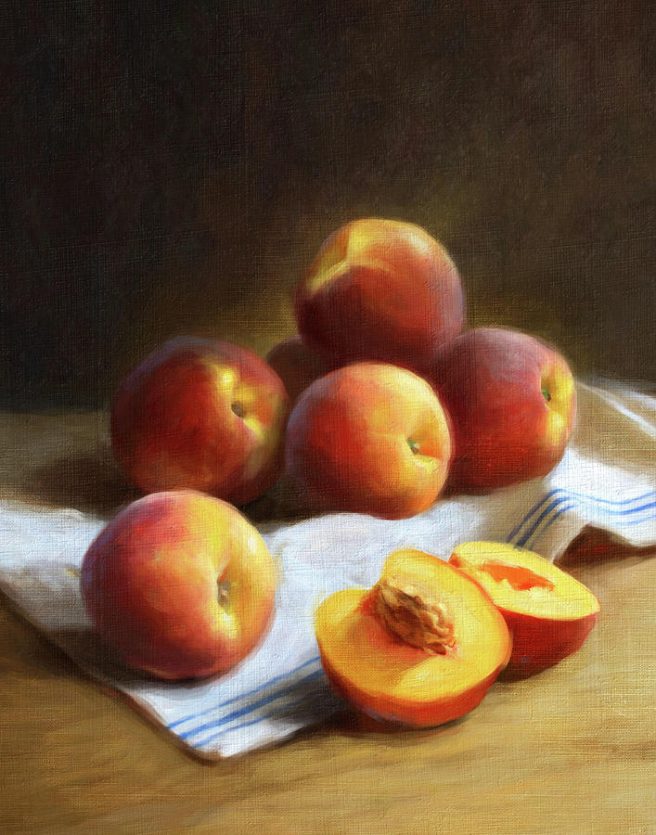
“Summer Peaches” by Robert Papp via Fine Art America.
PEACH
by Lori Levy

A woman writes about a peach.
I don't know the woman, don't know why,
out of all the poems and stories in a book I've just read,
I remember her and her peach --
how, as she bites into it one August afternoon
while reading on her patio, birds chirping around her,
scent of roses in the air, her depression lifts.

Nothing more than a peach, but it's enough,
the taste just right, juicy and sweet,
fresh from the local farmers' market.
Or maybe it's the woman herself, not expecting anything,
but ready somehow. Open, alert, ripe as her peach.
Four months of crying, grieving,
numb from the death of her husband, and, suddenly,
there it is for a moment: a thrill
she thought she'd never feel again.

A peach. But it could just as well be a baked potato
on a blanket at the beach, as it was for me once,
picnicking with family as the sky turned as luscious
as this woman's peach.

An awakening. A jolt to the senses.
We search and search, and the moment we stop
and pay attention, it's here, not there, and simple as
a peach on a patio. Or a slice of chocolate cream pie
by an open window, sun pouring in.
Or just the sun, a patch on the table,
like a note. A reminder.

~ posted by permission of the author (first published in Iris Literary Journal, March 2023).
Prose-like, lyrical, elegant, and accessible, his poems — often about his day-to-day life, are truly a joy to read. Love how he establishes a natural intimacy with the reader, revealing profound insights in a way that seems effortless.
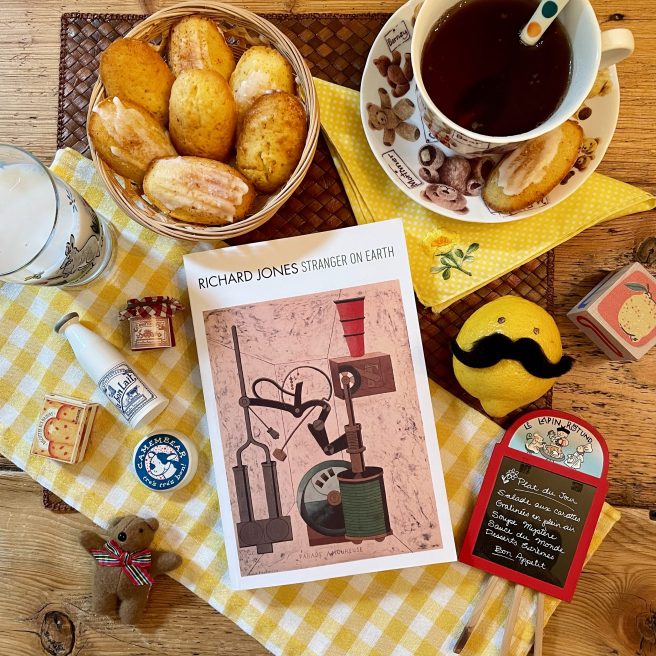
Recently I’ve been savoring his 2018 collection, Stranger on Earth (Copper Canyon Press). The poems are presented in seven sections — a nod to Marcel Proust’s 1913 seven-volume novel, Remembrance of Things Past (a.k.a. In Search of Lost Time). Jones reads Proust often, finding inspiration in the detailed stream-of-consciousness recollections transformed into a compelling art form.
Here’s a favorite poem from Stranger on Earth, a sweet moment shared by Jones and his daughter that’s perfect for Father’s Day.
*
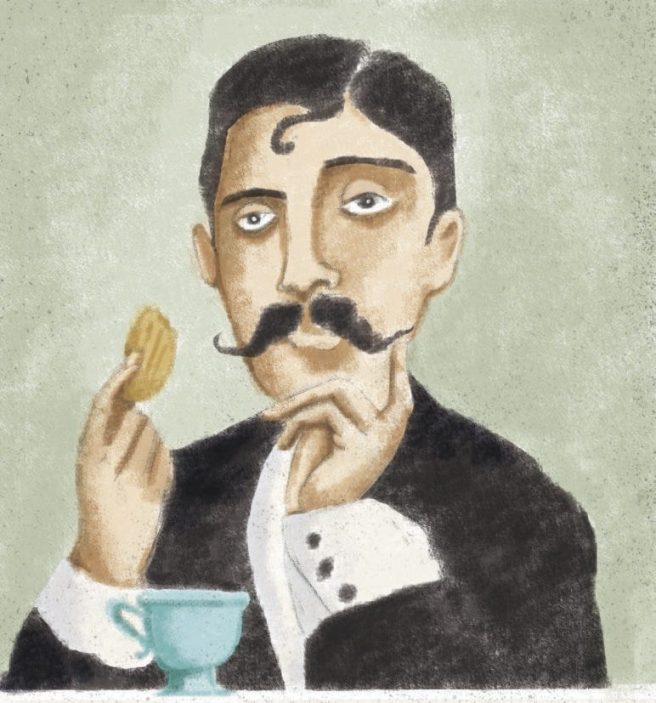
“Marcel Proust” by Nurit Spivak Kovarsky.
MADELEINES by Richard Jones
I stay up all night reading Proust, turning pages in the golden glow of a tall lamp, happy in a little circle of light and dreaming of Paris. It's like sitting up late with my closest friend or listening to my own innermost thoughts. There has awakened in me that anguish which, later on in life, transfers itself to the passion of love, and may even become its inseparable companion.
When the sun comes down the lane with ten thousand French candles, I climb the stairs and softly open the door to find my seven-year-old daughter still sleeping. I sit on the edge of her bed; she turns and slowly wakes. After my wife's, nothing is more beautiful than my daughter's eyes opening in the morning, her green eyes catching the light.
"Let's have tea and madeleines," I say, and we set out on a journey to taste in reality what so charmed Proust's fancy. Sarah finds the red mixing bowls. I fill the kettle and tell her about the recluse who spent his life in a cork-lined room scented with camphor, happy to lie in bed and write endless pages about his past, revealing the essence of every moment. Sarah breaks eggs; I measure sugar and whisk. Together we practice French: sucre, livre, roman, je t'aime.
Sarah pours the lemon-scented batter into the heavy, scalloped pan. "Would you write such a book?" she asks, licking the spatula. "Would my father go in search of lost time, remembering the past so?"
I open the oven door and tell her there is no place I'd rather be than here with her, though I wonder, will she remember this years hence -- the lemon-scented batter, the morning light -- and, amid the ruins of everything else, will the immense architecture of memory prove faithful?
The timer chimes. Sarah arranges the madeleines on a painted tole tray, sprinkles clouds of powdered sugar, and carries the tray to the terrace. Now we are in Paris at her favorite café. I am her solicitous white-aproned waiter, attentive to mademoiselle's every need, undone and unclosed by how small and beautiful her hands are. She tells me that instead of tea like Monsieur Proust, she would prefer milk. Thin towel over my arm, I hold the milk bottle, present the label; she approves and I pour the milk. "Merci avec bonté," she says, lifting her glass to the sunlight.
"I'll always remember these madeleines," I say. "Will you?" I ask, toasting her glass with my teacup. "Certainly. And your books will remind me." "All things find their way into a poem." "Like madeleines do," she proclaims, drinking down her tumbler of milk until nothing is left but the line of a thin mustache, like Proust's.
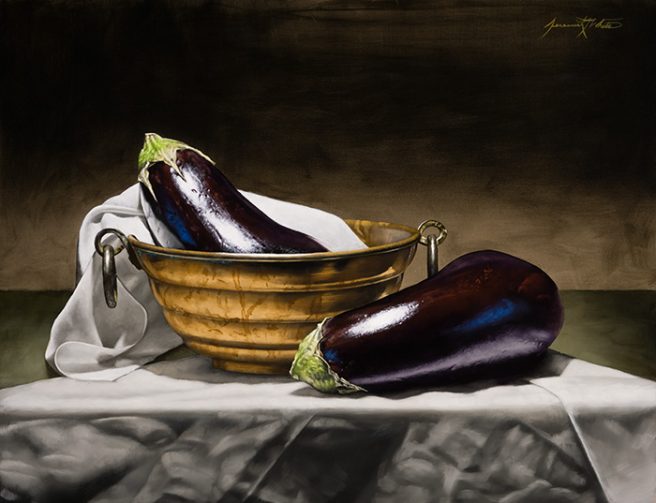
“Gleaming skin; a plump elongated shape: the eggplant is a vegetable you’d want to caress with your eyes and fingers, even if you didn’t know its luscious flavor.” ~ French Chef Roger Vergé
“Eggplants and Copper” by Jeremiah J. White.
Ahhhh . . . the eggplant has returned! *kisses bunched fingertips**
Remember when I shared Lori Levy’s wonderful poem, “Not a Hollywood Movie” for Valentine’s Day? We learned she squeezes fresh orange juice for her husband in the morning, while he patiently fries eggplant for dinner, eggplant that she loves stuffing into pita bread “with anything, everything.” That’s how I learned about sabich, a popular Israeli street food.
Recently, Lori sent along another delectable food poem in which we learn a little more about her love of eggplant and a practice suggested by her niece that I’m totally on board with. See if you agree. (This poem will appear July 9 in Certain Age Magazine.) 🙂
*
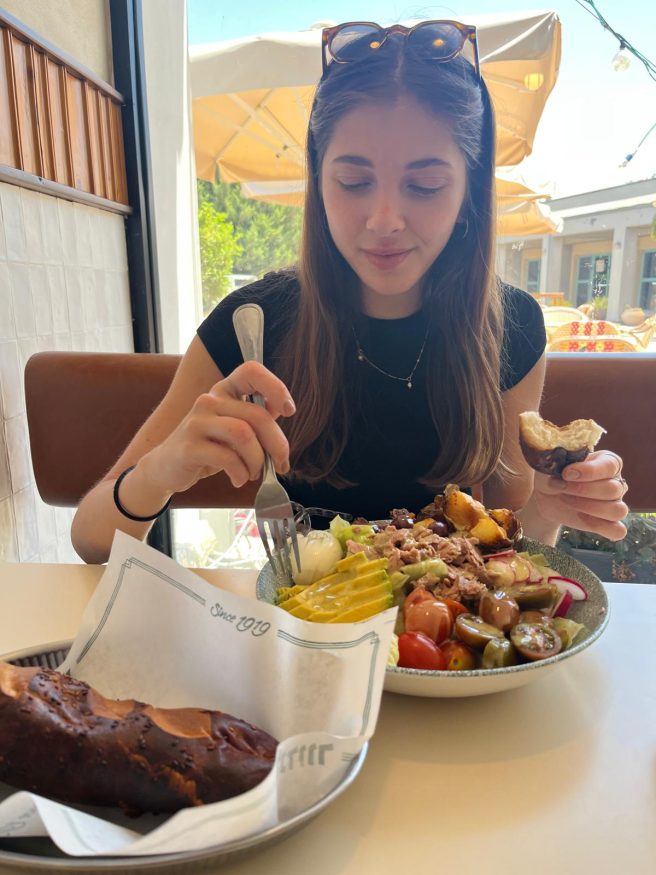
Lori’s niece Ofri pursuing a favorite hobby.
WHAT I LEARNED FROM MY NIECE by Lori Levy
When asked what her hobbies are, my 22-year-old niece says one is food— eating it, not cooking it. Good food, which, for her, means anything from shawarma to endive salad with fruit and cheese, gnocchi with pink sauce, purple soup with kubeh and beets. I love that a hobby can be as simple as savoring—not riding a bike over rough terrain or kayaking down a river, like others in my family. No action required but bringing a fork or spoon to your mouth.
Maybe my hobby is eggplant. On this visit to Israel, I scan the menu for anything with eggplant: pasta, sandwiches, salad. My brother-in-law Hiski fries eggplants for us because I crave sabich. I fill pita with chopped salad, hard-boiled eggs, tahini, amba, and my beloved eggplant, almost closing my eyes in anticipation of the first bite.
My niece, Ofri, says another hobby is sitting on the beach. I could claim that one, too. Not sailing or surfing or scuba diving. Just sitting on a beach chair, still and silent as a rock, as the sky turns red over the Mediterranean— pita with eggplant in a picnic basket beside me.
We talk about love. Sometimes I love you more, sometimes less, he says. I feel the same way. Think spectrum, range, hot warm cold as in water from a faucet, the flow increasing, decreasing, the temperature not always perfect, but good enough. Or we could say it's a matter of orange juice, eggplant . . .
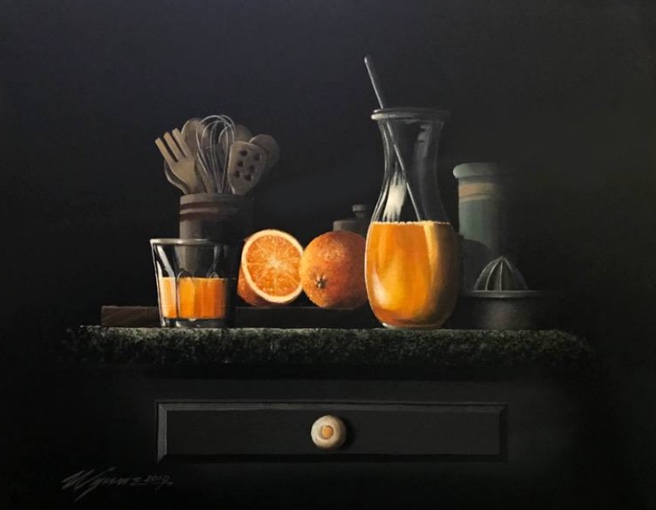
He is groggy in the morning. I wake up renewed and ready for the day. Ready, first thing, to squeeze oranges for him. He can't begin, doesn't want to begin, without a glass of fresh juice brought to him in bed. A simple act for me. For him, a big ahh, quenching, invigorating.
I don't have patience to fry eggplants for dinner. He does. He stands by the stove, tender with the slices, spicing them exactly right, turning them exactly on time. I devour the eggplant, stuff the browned slices into pita bread with cheese or eggs, tomatoes, hummus. With anything, everything.
Some moments we meld --- grateful to be living this life together. Other times we argue like kids. I tell him his way is mood-based, head in the sand, slow. He says I have no priorities: everything is important, demands attention. Sometimes you can't stand me, right? he asks. We laugh. This, too, is true.
Still, he craves my orange juice, I could die for his eggplant. Hunger, Thirst. We could call it love.


 Jama's Alphabet Soup