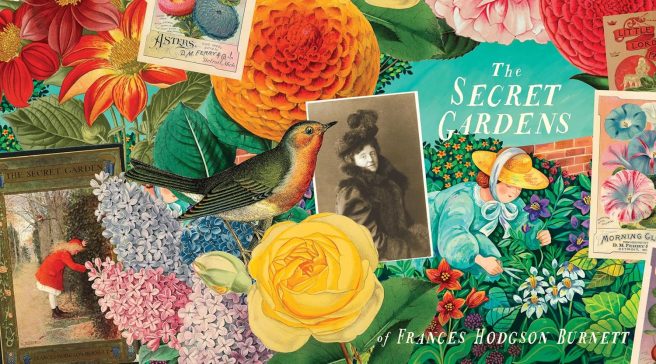
[review + recipe] The Secret Gardens of Frances Hodgson Burnett by Angelica Shirley Carpenter and Helena Pérez García

“As long as one has a garden one has a future; and as long as one has a future one is alive.” ~ Frances Hodgson Burnett

Since The Secret Garden has always been one of my favorite children’s books, I was especially excited to see Angelica Shirley Carpenter and Helena Pérez García’s recent picture book biography about Frances Hodgson Burnett.
Learning how Burnett coped with hardship and adversity in her own life shed new light on my appreciation of the novel. Now I understand why gardens were so important to her, not only as places of beauty and inspiration, but of comfort and healing. I also found it intriguing that she had a luxurious lifestyle that was shocking by Victorian standards (a twice divorced smoker who spent time away from her children). 🙂

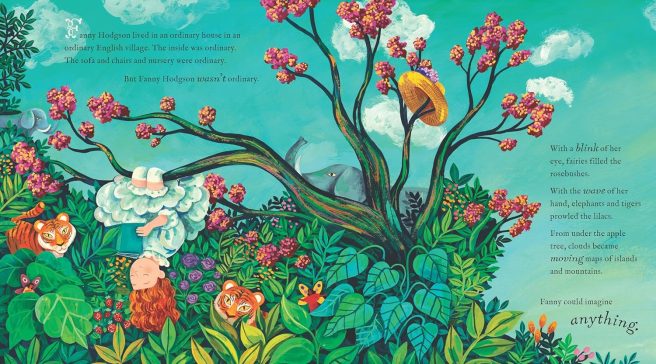
We first meet Fanny Hodgson as a girl who lived in “an ordinary house in an ordinary English village.” But Fanny herself was anything but ordinary because of her vivid imagination. In her world, “fairies filled the rosebushes” and “elephants and tigers prowled the lilacs.”
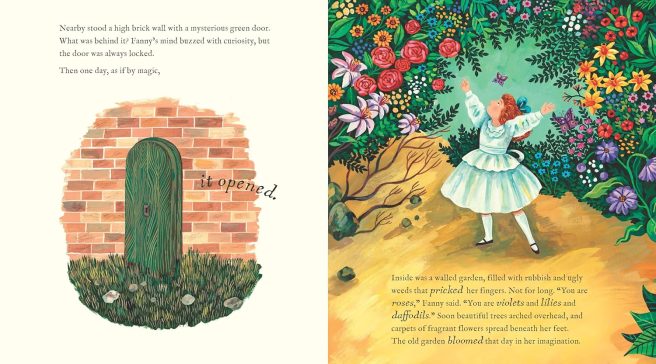
Her idyllic existence was upended when her father died (she was around six), and her family was forced to move to Manchester so her mother could run his store. The dull and grey city was a stark contrast to the beloved garden she’d left behind, but Fanny’s imagination sustained her, as she envisioned roses, violets, lilies and daffodils abloom in an old abandoned garden actually “filled with rubbish and ugly weeds.”
After a few years, her mother had to sell the store as businesses in Manchester failed. Short on money, Fanny’s family then relocated to a small village in Tennessee at the suggestion of her uncle, who thought her brothers could find work there. Unfortunately, they weren’t able to earn as much money as they’d hoped, so sometimes the family went hungry. Fifteen-year-old Fanny wanted to help, but there were no jobs for girls.

Undeterred, she put her imagination to work once again and invented her own job, opening the town’s first school. Her eight students paid with “cabbages, eggs, and potatoes,” and she read them Shakespeare. She also built a “secret room” in the woods behind her house, “weaving walls from branches and vines.”
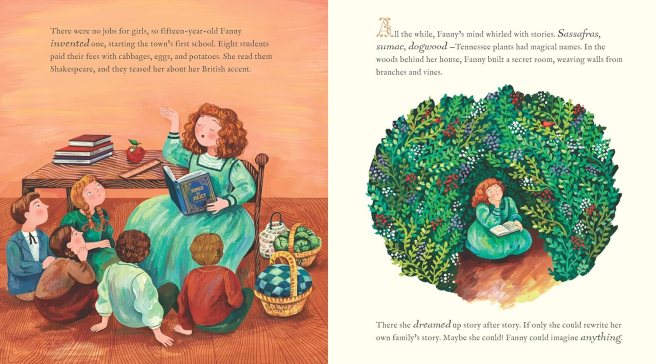
There, in her cozy sanctuary, she dreamed up stories. She knew that magazines paid for stories; could she sell one of hers? She earned money for writing supplies by picking and selling wild grapes at the market. She wrote a love story and sent it out — and to her surprise, sold it for thirty-five dollars — enough to feed her family for weeks!

Continue reading
the secret garden (part two): yorkshire culinary delights


“After a few days spent almost entirely out of doors Mary wakened one morning knowing what it was to be hungry, and when she sat down to her breakfast she did not glance disdainfully at her porridge and push it away, but took up her spoon and began to eat it and went on eating it until her bowl was empty.”

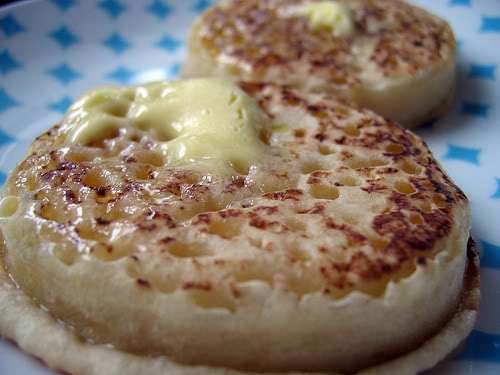
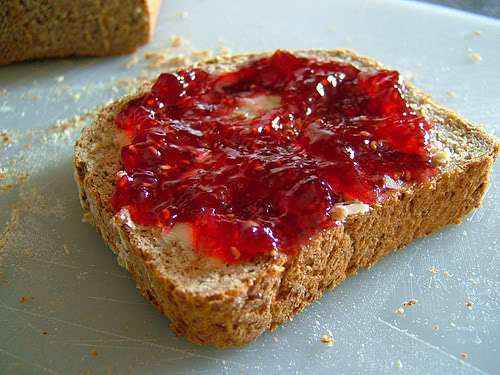
The Secret Garden is first and foremost about the wonder and magic of making things come alive — the blossoming of an abandoned garden and two lonely, neglected children. But food is also magical and plays a crucial role in the story. As the flowers and plants grow, so do Mary’s and Colin’s appetites — and who can blame them, with pails of fresh milk, homemade cottage bread slathered with raspberry jam and marmalade, buttered crumpets, currant buns, hot oatcakes, muffins, dough-cakes, and the all-important bowl of warm porridge, sweetened with treacle or brown sugar.

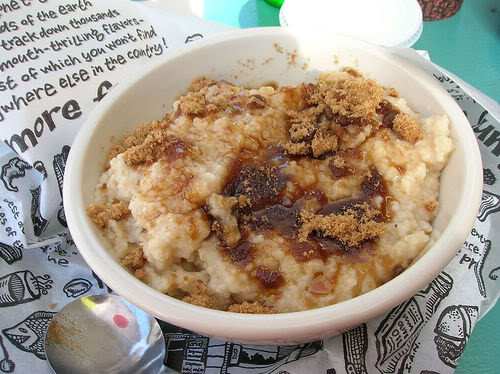
Oatmeal Porridge was eaten by both rich and poor in Yorkshire during Victorian times.

photo by Dave Knapik


My recent rereading of the novel yielded new insights about the self sufficiency of manor houses like Misselthwaite during Victorian times, and Burnett’s advocacy of homegrown and lovingly shared food as a key component in establishing physical and emotional health. We see Mary change from a sickly, sallow, ill-tempered waif, to a happy, engaged, more caring individual. Colin undergoes a dramatic transformation from a pessimistic, overprotected, bedridden tyrant to a budding evangelical Christian scientist. Purposeful activity centered around nature, lots of fresh air, exercise and companionship certainly contributed to healing, but so did unlimited access to a bounty of locally sourced nourishment.

Continue reading

the secret garden (part one): another peek inside

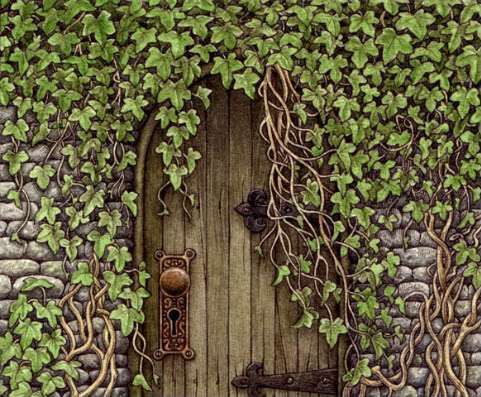
“Then she slipped through it, and shut it behind her, and stood with her back against it, looking about her and breathing quite fast with excitement, and wonder, and delight. She was standing inside the secret garden.”  ~ Frances Hodgson Burnett

Illustration by Russell Barnett

Whenever I am asked to name my all-time favorite children’s book, I always say, The Secret Garden.

It’s not like I’ve read it more than three or four times in my entire life, or that I can quote key passages from it at the drop of a hat. And as soon as I mention it, a bevy of other beloved favorites come to mind — Little Women, Little House books, Ramona Quimby, Anne of Green GablesA Little Princess. I love them all — but somehow, The Secret Garden has the tightest grip on my child’s heart.

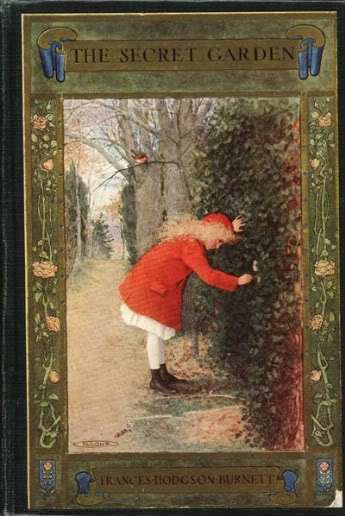
Original 1911 edition with illustrations by Troy Howell.

When I first read it, at the age of nine or ten, I knew nothing of the Yorkshire moors, gorse, heather, or the myriad flowers mentioned in the book except for roses. Instead of crocuses, snowdrops, lilacs, peonies and forget-me-nots, I had grown up with anthuriums, plumeria, bird-of-paradise. I had never seen a robin, fox, or crow. But I knew loneliness and had a big case of “it’s not fair,” and often wished I had the power to boss grown-ups around and make them listen to me. Oh, to have an Ayah or servants at my beck and call!

Continue reading