Richard Jones: of madeleines and a milk mustache (+ a summer blog break)

I’m a longtime fan of Illinois poet, editor and English Professor Richard Jones, having shared several of his poems here over the years, including “Blue Stars,” “The Nomenclature of Color,” and “The Diner.”

Prose-like, lyrical, elegant, and accessible, his poems — often about his day-to-day life, are truly a joy to read. Love how he establishes a natural intimacy with the reader, revealing profound insights in a way that seems effortless.

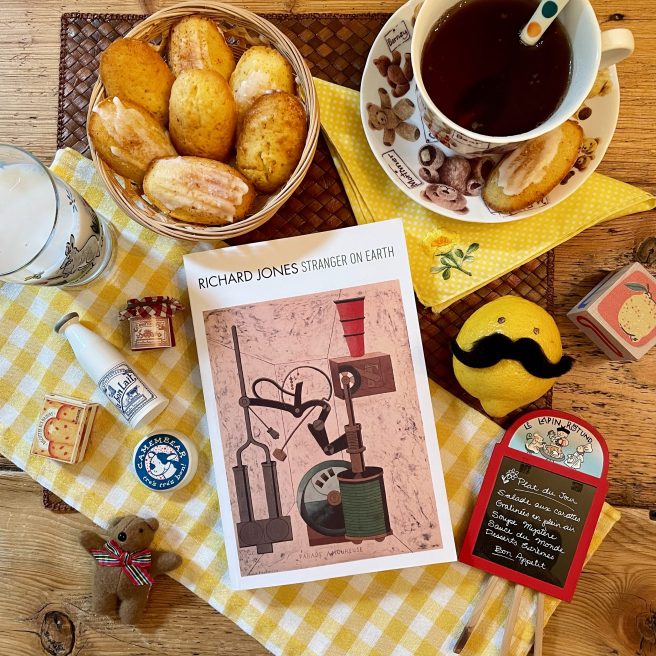
Recently I’ve been savoring his 2018 collection, Stranger on Earth (Copper Canyon Press). The poems are presented in seven sections — a nod to Marcel Proust’s 1913 seven-volume novel, Remembrance of Things Past (a.k.a. In Search of Lost Time). Jones reads Proust often, finding inspiration in the detailed stream-of-consciousness recollections transformed into a compelling art form.

Here’s a favorite poem from Stranger on Earth, a sweet moment shared by Jones and his daughter that’s perfect for Father’s Day.

*
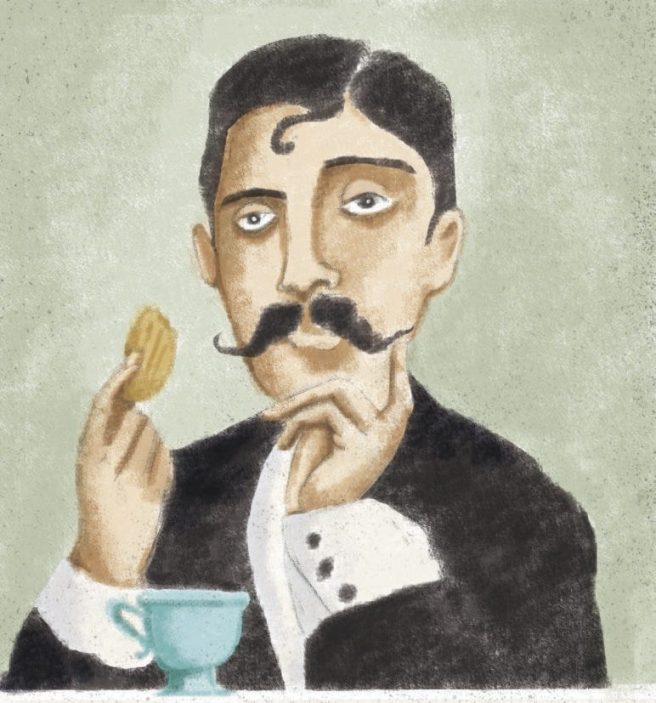
“Marcel Proust” by Nurit Spivak Kovarsky.
MADELEINES
by Richard Jones


I stay up all night reading Proust,
turning pages in the golden glow of a tall lamp,
happy in a little circle of light and dreaming of Paris.
It's like sitting up late with my closest friend
or listening to my own innermost thoughts.
There has awakened in me that anguish which,
later on in life, transfers itself to the passion of love,
and may even become its inseparable companion.


When the sun comes down the lane
with ten thousand French candles,
I climb the stairs and softly open the door
to find my seven-year-old daughter still sleeping.
I sit on the edge of her bed; she turns
and slowly wakes. After my wife's,
nothing is more beautiful than my daughter's eyes
opening in the morning, her green eyes catching the light.

"Let's have tea and madeleines," I say,
and we set out on a journey to taste in reality
what so charmed Proust's fancy.
Sarah finds the red mixing bowls.
I fill the kettle and tell her about the recluse
who spent his life in a cork-lined room
scented with camphor, happy to lie in bed
and write endless pages about his past,
revealing the essence of every moment.
Sarah breaks eggs; I measure sugar and whisk.
Together we practice French:
sucre, livre, roman, je t'aime.

Sarah pours the lemon-scented batter
into the heavy, scalloped pan.
"Would you write such a book?" she asks,
licking the spatula.
"Would my father go in search of lost time,
remembering the past so?"

I open the oven door and tell her
there is no place I'd rather be than here with her,
though I wonder, will she remember this years hence --
the lemon-scented batter, the morning light --
and, amid the ruins of everything else,
will the immense architecture of memory prove faithful?

The timer chimes.
Sarah arranges the madeleines
on a painted tole tray, sprinkles clouds
of powdered sugar, and carries the tray
to the terrace. Now we are in Paris
at her favorite café. I am
her solicitous white-aproned waiter,
attentive to mademoiselle's every need,
undone and unclosed
by how small and beautiful her hands are.
She tells me that instead of tea like Monsieur Proust,
she would prefer milk. Thin towel over my arm,
I hold the milk bottle, present the label;
she approves and I pour the milk.
"Merci avec bonté," she says,
lifting her glass to the sunlight.

"I'll always remember these madeleines,"
I say. "Will you?" I ask,
toasting her glass with my teacup.
"Certainly. And your books will remind me."
"All things find their way into a poem."
"Like madeleines do," she proclaims,
drinking down her tumbler of milk
until nothing is left but the line
of a thin mustache, like Proust's.

~ from Stranger on Earth (Copper Canyon Press, 2018).

Continue reading

starry-eyed and optimistic

“Like a bolt out of the blue, faith steps in and sees you through. When you wish upon a star your dreams come true.” ~ Cliff Edwards

“Starry Night Sky Galaxy” by Brittany Drollinger.
BLUE STARS
by Richard Jones

Yesterday I made a to-do list,
a dozen tasks I would undertake
and check off the list one by one.
But what did I do with my list?
Did I put it on the piano?
Did I set it down by the coffeepot?
I remember this morning
in my robe at the back door
contemplating frost icing the grass
and seeing a dark-eyed junco at the bird feeder.
How did I know it was a junco
and not a sparrow?
Maybe juncos and sparrows are cousins.
I thought about birds in nests
of twigs, reeds, briars, and straw.
The clear, cold sky brought to mind
the image of my late father, high up
and far away, flying
once again in his silver plane,
and I closed my eyes to admire
the many blue paintings
hanging in the gallery of my childhood heart.
Perhaps at that moment
I had the to-do list in my hand
and during my azure reverie
the paper slipped from my fingers.
I only know that when I opened my eyes
I saw it would be wise
to give my blue paintings away --
only then would my heart be free
to help those in need.
I resolved to put that on my to-do list,
and that's when I noticed
my to-do list had vanished.
Now the frost has died,
the sun is pushing noon,
and I'm still in my robe
with eternity hovering in the balance.
But no day is without its victory.
Because it is hiding,
I'll search for the lost little piece of paper,
and when I find it
I'll write down my heart's resolution.
Then I'll dress for the day and go out into the world.
With pen and to-do list in my hands,
I'll draw little blue stars
beside all the accomplished tasks --
buying milk,
picking up the laundry,
driving to the library,
and paying the fines for my overdue books.

~ from Stranger on Earth (Copper Canyon Press, 2018).
“Sky Clouds” by Alla Kizimenko.

*

Continue reading

friday feast: spoon-fed


    photo by Snugglemuffin

Put on your bibs, because today I’m going to the spoons.

This is not the same as going to the dogs, going to the mattresses, or going bananas.

Going to the spoons means finding a poem which nourishes the soul with just one tiny spoonful of sweet sustenance.

Continue reading

friday feast: the diner by richard jones

I want to eat at a diner.

Not just any diner. I want to eat at the one Richard Jones goes to. 

He doesn’t say much about the food, but the people are enough to satisfy. It’s mostly about what they’re doing while they’re there. It’s what, in an ideal world, everyone should be doing.

Let’s face it. Poetry for the masses is odd fodder. When was the last time you saw a book of poetry at the grocery store, the corner newsstand, places where everyone frequents on a daily basis? Shouldn’t it be easier to find, considering the essential nourishment it contains?

You and I know that lots of good poetry is being written these days. But who’s reading it? Mainly other poets, students, teachers, or people holed up in the ivory towers of academia — people Dana Gioia classified as a subculture. What about the rest of us?

Take my husband, Len, for example. He’s an educated professional, a responsible, upstanding citizen. He’s practical, unfailing in his loyalty to family and friends, a person who does so much, yet asks for so little. And most important, he has a good heart.

But does he read poetry? I’d sooner find him twirling around the house in a tutu and bunny slippers. Don’t misunderstand. Len appreciates the arts. He reads voraciously. But to him, most poetry isn’t entertaining, enriching or informative. It’s too abstract, too erudite.

You and I know that he’s right in some ways. We’ve all encountered poems we couldn’t understand, couldn’t relate to, simply didn’t like. I’ve plowed through many volumes of mediocre poetry, exasperated at my inability to stake common ground.

But the really good poems? So sublime you could weep for the beauty, depth and power of those words, wondering how a mere human being, using 26 letters of the alphabet, could express what you’ve harbored in the depths of your soul without you even being conscious of it. Those are the poems I want everyone to feast on.

Do you think poetry is such a precious commodity, that if it became part of mainstream culture, it would become tainted, diluted? Will it forever remain an acquired taste?

Do you ever wish it could be served up in diners, available 24 hours a day, its titles sung out in colorful diner lingo, instead of being rationed out like rarefied hors d’oeuvres to be savoured only by those with advanced degrees?

Richard Jones, Professor of English at DePaul University in Chicago, and Editor of Poetry East since 1979, is committed to poetry that is “immediate, accessible, and universal.” After reading “The Diner,” I was reminded of what William Carlos Williams said:  “It is difficult to get the news from poems, yet men die every day for lack of what is found there.” I know poetry isn’t everybody’s cup of tea, but shouldn’t it at least be on the menu?


THE DINER
by Richard Jones


The short-order cook and the dishwasher
argue the relative merits
of Rilke’s
Elegies
against Eliot’s Four Quartets,
but the delivery man who brings eggs
suggests they have forgotten Les fleurs
du mal and Baudelaire. The waitress
carrying three plates and a coffeepot
can’t decide whom she loves more —
Rimbaud or Verlaine,
William Blake or William Wordsworth.
She refills the rabbi’s cup
(he’s reading Rumi),
asks what he thinks of Arthur Waley.
In the booth behind them, a fat woman
feeds a small white poodle in her lap,
with whom she shares her spoon.

Read the rest here.

Today’s Poetry Friday Roundup is at A Wrung Sponge.