
Hungry? May I interest you in a warm bowl of Stewed Cow’s Intestines, a very smelly Fermented Bird, or even better, a crunchy Fried Tarantula?
Chances are good you’ve yet to eat any of these rare delicacies. Well, what are you waiting for?
Here’s your chance to get a little taste: in Disgustingly Delicious: The Surprising, Weird and Wonderful Food of the World (Orange Mosquito, 2023), Soledad Romero Mariño and Montse Galbany serve up a tantalizing platter of 19 international dishes that’ll make your mouth water and your stomach growl (well, maybe) . . .
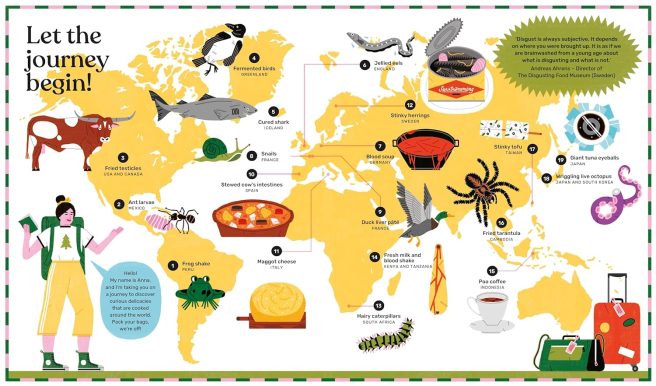
Our guide for this culinary adventure is backpack-toting Anna, who at the outset shares a quote from Andreas Ahrens, Director of the Disgusting Food Museum in Sweden:
Disgust is always subjective. It depends on where you were brought up. It is as if we are brainwashed from a young age about what is disgusting and what is not.
So true — it’s important to keep in mind that there are people out there who consider something we love to eat disgusting too!
From Frog Shakes in Peru to Giant Tuna Eyeballs in Japan, we learn how these foods are sourced and prepared, along with facts about historical origin and cultural relevance. Dishes span five continents: North America, South America, Europe, Africa, and Asia.
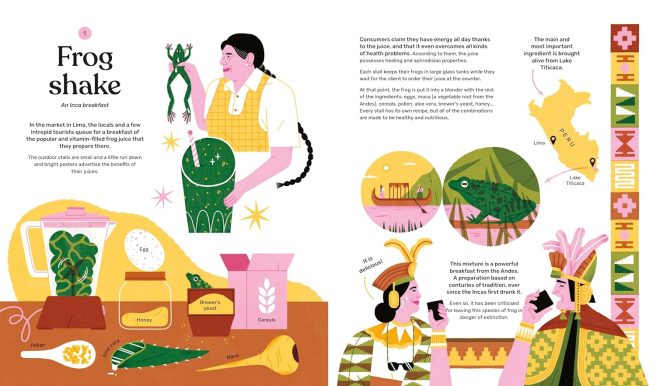
Frog Shakes, for example, date back to the ancient Incas. It’s a powerful breakfast drink that supposedly provides a day’s worth of energy in addition to possessing healing and aphrodisiac properties. In Lima, they’re sold at small outdoor market stalls that keep frogs in glass tanks until it’s time to toss one into a blender with the rest of the ingredients: eggs, maca (vegetable root), cereals, pollen, aloe vera, brewer’s yeast, and honey. These frogs are brought alive from Lake Titicaca. Any takers?
Actually, Frog Shakes sound mild compared to the Fresh Milk and Blood Shakes consumed by Maasai tribes in Kenya and Tanzania. They consider cows sacred, and obtain blood by putting a tourniquet around the neck of a cow and pushing an arrow into its jugular with great precision. They then use a gourd to collect the blood dripping from the cow’s neck to mix with fresh milk. This ancestral delicacy is reserved for special occasions or for those who are weak, as it is believed the drink reinforces the immune system.
I can proudly attest to having eaten one of the 19 foods: Snails (France). And I’ve heard of Duck Liver Pâté (France), Jellied Eels (England), Stinky Tofu (Taiwan) and Fried Testicles (USA and Canada). Reading about these didn’t gross me out as much as some others did, but it was sad learning how domestic geese are force-fed to fatten them up. Because of this controversial practice (animal cruelty), the sale of foie gras is banned in more than 15 countries.
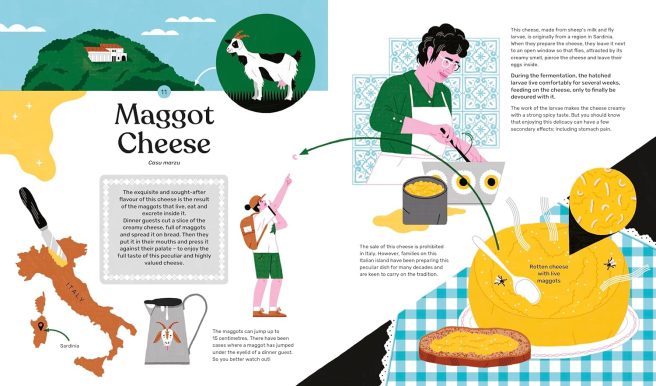
Perhaps the prize for grossest food ever goes to Maggot Cheese (Italy). Imagine cutting yourself a slice of this creamy sheep’s milk cheese full of live maggots! The cheese gets its distinctive creaminess and spicy flavor from the work of the larvae. Beware: “the maggots can jump up to 6 inches. There have been cases where a maggot has jumped under the eyelid of a dinner guest.” 😳
The sale of Maggot Cheese is banned in Italy, but people in Sardinia (where it originated) continue to make it as per decades of tradition.
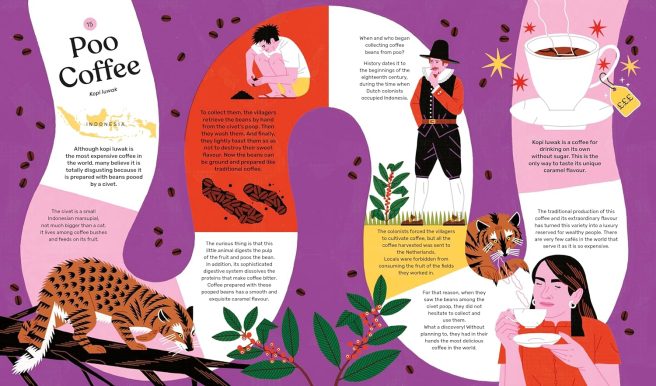
It is interesting how many of the foods are described as having a terrible smell. When you combine ‘fish’ with ‘fermentation’ it’s no surprise. I would think that a dead auk that’s fermented inside a gutted seal for seven months would smell the worst, but many think Cured Shark (a.k.a. Hákari), a “deliciously smelly Viking delicacy” from Iceland with its putrid, overwhelming stench and “rancid and gut-wrenching taste,” should take top prize as the most disgusting food on the planet.
It’s all subjective, isn’t it? 🙂
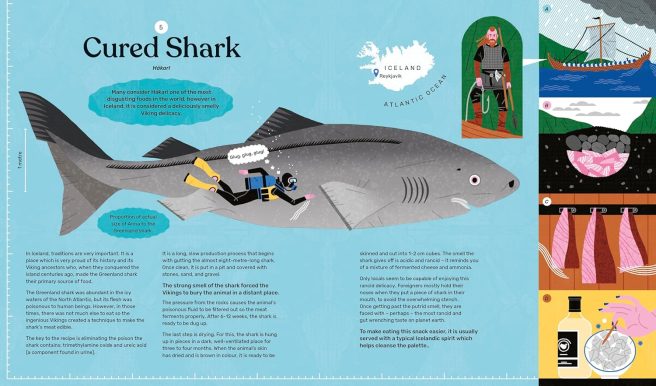
Galbany’s colorful spreads, with their attractive layouts, are a nice, balanced blend of text and digital drawings that will keep readers engaged and intrigued.
There’s no doubt kids will find this book fascinating, though it’s probably not for the squeamish. It’s an eye-opening way to learn about other cultures and attitudes when it comes to food, and may encourage some to be more open minded in their choices.
If, by some chance, you’re still hungry after reading this review, I’m sure a serving of Wriggling Live Octopus (Japan, Korea) will hit the spot. After all, who can resist the feeling of a moving, sesame oil drenched slice of octopus in one’s mouth?
Ewwwww.
*

DISGUSTINGLY DELICIOUS: The Surprising, Weird and Wonderful Food of the World
written by Soledad Romero Mariño
illustrated by Montse Galbany
published by Orange Mosquito/Welbeck Children’s Limited
Nonfiction Picture Book for ages 7-10, 48 pp.
*Interior spreads text copyright © 2022 Soledad Romero Mariño, illustrations © 2022 Montse Galbany, published by Orange Mosquito. All rights reserved.
**Copyright © 2024 Jama Rattigan of Jama’s Alphabet Soup. All rights reserved.
 Jama's Alphabet Soup
Oh, my…I’m not tempted by any of the foods described. But, I know some middle schoolers that would love to read tidbits of this outloud to their friends. Gross-out is tres-cool in middle school.
LikeLiked by 1 person
What a fun book, although I might pass on most of the ingredients…
LikeLiked by 1 person
Most of these seem gross, but to each his/her own when it comes to food. My dad loved to try different foods. He would bring home turtle soup, “rocky mountain oysters”, and snails which he would prepare with hot sauce. Italians also eat, this one excluded, a delicacy called sanguinaccio which is pigs blood mixed with chocolate! I am definitely going to put that book on hold at my library!
LikeLiked by 1 person
Wow, Jama, what a book! I’m so happy that it’s after lunch! I know a few who love snails, and grew up with people fixing frogs’ legs, but things that wiggle in the mouth, no thanks! It’s interesting to read what others believe is tasty and/or good for the body, & now I guess I’ll be wondering what else is out there we are unaware of? Thanks for the eye-opener!
LikeLiked by 1 person