

Oh, the oceans they shimmer with such wondrous lives!
Our mysterious, beautiful sea
where so long, long ago, in the far distant past,
the first glimmers of life came to be.
Imagine a leisurely stroll along the beach, waves crashing on the shore, the ebb and flow calming, hypnotic, rejuvenating. Looking out at the horizon, you marvel at the crystalline water’s sweeping expanse, in awe of its magic and mystery.

Is there a nearby tide pool to explore? Will you be lucky enough to spot a starfish, baby octopus, hermit crab or sea urchin? What about colorful sea anemones, pesky barnacles, limpets, mussels or snails? This fascinating ecosystem teeming with marine life is but a microcosm of the world’s vast, ancient oceans — oceans where life on earth began billions of years ago.
With dynamic lyrical verse and breathtakingly beautiful art, Jennifer Berne and Amanda Hall tell the greatest evolutionary tale ever told in their magnificent new picture book, How the Sea Came To Be: And All the Creatures In It (Eerdmans BFYR, 2023). Their captivating account unfolds in three parts: The Birth of the Sea, The Birth of Life, and All That the Sea Came To Be . . . From Then to Now.

They first take us back some 4.5 billion years, when our very young planet was a fiery, volatile entity with molten lava exploding from within, comets and asteroids crashing down from the sky. The sizzling and simmering, bubbling and burbling continued for millions of years until the Earth finally began to ever-so-slowly cool.
As the Earth gradually solidified — heaving, puckering, wrinkling and bulging — mountains grew and “valleys dipped deep.” Steamy hot clouds rose up and encircled the world, and for the very first time, rains began to fall. It rained and rained for thousands of years, “down the mountains,” “down the rocks, washing salt to the water below.” It rained the first oceans all over the world, and “that was the birth of the sea.”

When sunlight shone onto “the face of the Earth,” (this “planet of watery blue”), a miracle occurred:
Then something amazing, unseen, and so new
appeared in this shining blue sea . . .
The teeniest, tiniest stirrings of life
came to be, in the sea, came to be.
Though smaller than small, and adrift in the seas,
one became two became four.
For millions of years these first bits of life
became more, and then more, and then more.
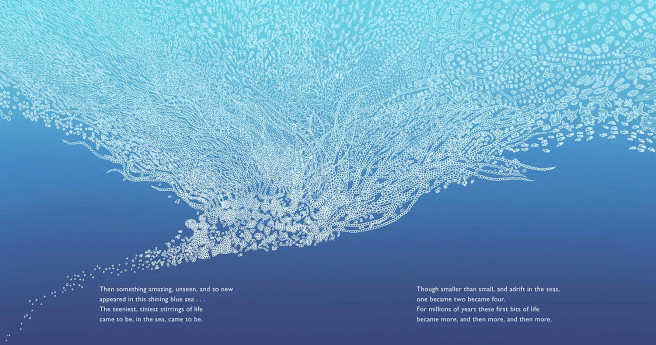
Bit by bit, with a “little twist here” and a “little change there” these teeny microorganisms gradually grew bigger, wider, and longer, rearranging themselves into exciting new forms. Some of these creatures were ribbed and frilled, wiggling and crawling on the ocean floor, while others, soft and spongy clusters clinging to rocks, sucked water to eat. There were jellyfish trailing tentacle threads “That would stick and would sting, and would capture the food floating by.”
In time there came a new shape — the worm — with a head in the front and a tail on the back, followed by more complex creatures with hard armored shells, the very first feet, claws, antennae and teeth “to fight for the foods that they eat.”

So to the ocean came all kinds of life —
fantastic, surprising, and new.
Step by step, bit by bit, they evolved in the sea,
And life grew, and life changed, and life grew.
Marine life continued to grow and spread for hundreds of millions of years across the ocean’s surface to its deepest darkest depths. In the midnight zone lived fish “in the dark with huge jaws and long, sharp, pointy teeth.” Just above that in the twilight zone, fish were able to flash lights with their mouths, heads or tails to “trap creatures in search of a meal.”
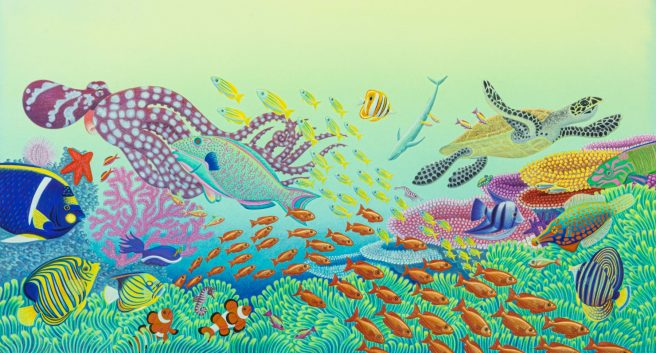
But it was in the bright sunlit zone where most sea life flourished:
Every ocean is flowing with all kinds of life,
every shape, every size, every scale —
from the small shrimp-like plankton, too tiny to see,
to the mighty, gigantic blue whale.
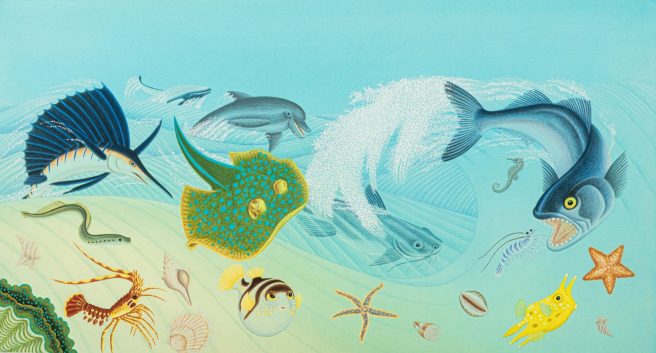
Here are the aquatic animals we are most familiar with, an awe-inspiring showcase of incredible biodiversity, from flounders, squid, sharks, barracudas, and eels; to catfish, cowfish, lampreys and clams.
How the Sea Came To Be is an excellent introduction to geology, oceanography and marine biology for budding scientists and nature lovers. Berne and Hall have done an outstanding job of describing the formation of the earth’s surface, the origin of oceans, and the evolution of life with enthusiasm and aplomb. They’ve distilled the essence of evolutionary theory — a complex, daunting subject — and made it clear and accessible for readers of all ages.
It is obvious both have gone above and beyond with their research. What I especially appreciate is the blending of scientific fact and accuracy with beauty and aesthetics. It would have been challenging enough for Berne to share this information in engaging, kid-friendly prose. But riveting rhyming quatrains that beg to be read aloud? Wow.

She succeeds at not only skillfully incorporating critical facts in each stanza, but in giving readers a good sense of how the stages of evolution hinge on time. It is hard for any of us to comprehend “billions of years,” but here, we can begin to envision its scope. Her powerful words open the mind, invite curiosity, and will leave readers with a proper sense of awe.
Amanda Hall’s work is new to me, and it would not be an exaggeration to describe her illustrations with a host of superlatives: exquisite, gorgeous, spectacular, evocative, dazzling. She created her magic with a combination of watercolor inks, gouache, pastel, pencil crayon, and opaque white paint followed by digital layering.

One can feel the explosive power of fiery molten lava, the tremendous energy of Earth birthing itself as it crumples and puckers, steam clouds rising as in a primordial fantasy. One can practically hear the torrents of rain as they thunder down to the Earth unbridled and relentless.
How fascinating to see those first alien-looking life-forms in an array of shapes, colors and textures! We get a sense of being present for monumental moments as new species emerge with each page turn, every picture brimming with fascinating details, eliciting wonder.

Kids will especially enjoy the vertical spread showing odd deep-sea creatures with their special bioluminescent colors glowing against an inky dark background. They’ll also have fun identifying some of their favorite ocean friends near the end of the book (coral, octopus, cod, scallops, rays, sailfish, lobsters, whales).
Extensive backmatter includes an Author’s Note, Illustrator’s Note, a six-panel gatefold spread (“Ocean Creatures Over Time”), a glossary of Key Terms and Concepts, a slew of recommended references (books, videos, web pages) and a bibliography.
In her note, Berne reminds us that the “Earth’s oceans are more than seventy percent of our planet’s surface, and ninety-nine percent of all the living space on our planet,” yet “less than ten percent of our ocean’s space has been explored by humans.”
To date, about 236,000 marine species have been identified, with millions more to be found. Life in the sea is a topic of endless fascination and mystery, with exploration and discovery ongoing, especially exciting in light of modern technology and innovative methods of study and research. Informative, interesting, brilliantly conceived and executed, How the Sea Came To Be is welcome inspiration for tomorrow’s oceanographic pioneers.
*

HOW THE SEA CAME TO BE: And All the Creatures In It
written by Jennifer Berne
illustrated by Amanda Hall
published by Eerdmans BFYR, April 2023
Nonfiction Picture Book for ages 6-10, 56 pp.
**Starred Reviews** from Kirkus, School Library Journal and Shelf Awareness
🐙 DIVE DEEPER: 🐳
♥️ Interview with Jennifer Berne at Eerdlings Blog
♥️ Interview with Amanda Hall at Eerdlings Blog
❤️ Visit the Chris Beetles Gallery to purchase original art from the book.
♥️ Official Book Trailer:
*
🐙 SPECIAL BOOK GIVEAWAY!! 🐳
The publisher has generously offered a brand new copy of the book for one lucky Alphabet Soup reader. For a chance to win, please leave a comment at this post naming your favorite sea creature no later than midnight (EDT) Wednesday, September 27, 2023. You may also enter by sending an email with SEA BOOK in the subject line to: readermail (at) jamakimrattigan (dot) com. Giveaway open to residents of the U.S. and Canada only, please. Good Luck!
*
The lovely and talented Rose Cappelli is hosting the Roundup at Imagine the Possibilities. Be sure to check out the full menu of poetic goodness being served up around the blogosphere this week. Have a lovely weekend!
*Interior spreads text copyright © 2023 Jennifer Berne, illustrations © 2023 Amanda Hall, published by Eerdmans BFYR. All rights reserved.
**Copyright © 2023 Jama Rattigan of Jama’s Alphabet Soup. All rights reserved.
 Jama's Alphabet Soup
What a gorgeous book. It’s still early in the school year but I’ve had two students ask me for books about marine biology already. And, they’ve asked for those books in Spanish! Yikes. I love “Rains Oceans All over the earth.” What a beautiful phrase…so true. Do I have to pick just one favorite sea creature? That’s too hard. I love otters and starfish. Great review, Jama!
LikeLiked by 1 person
Hands Or 8 arms down the octopus. A whirling swirling clever mysterious creature. Thanks for sharing this lovely book, Jama.
LikeLiked by 1 person
Thanks for this thoroughly spectacular review, Jama! I will definitely be seeking this book out. I love many sea animals, but I will pick the dolphin this morning (goes back to my Flipper days).
LikeLiked by 1 person
What a lovely book Jama!
LikeLiked by 1 person
Oh, Jama, we didn’t get to the ocean this year but now you’ve taken me on a special trip with Berne and Hall’s new book. It looks like a grand celebration of what was and now is. I am amazed at ““less than ten percent” has been explored. My favorite sea creature among lots of wonderful ones is the manatee. I had the pleasure of canoeing with them, and students, one lucky year in Florida, and observing them on Captiva Island. Thanks for the grand review!
LikeLiked by 1 person
Oh those little twists and changes and what beauty they make! The art is stunning. Thank you, Jama! xo
LikeLiked by 1 person
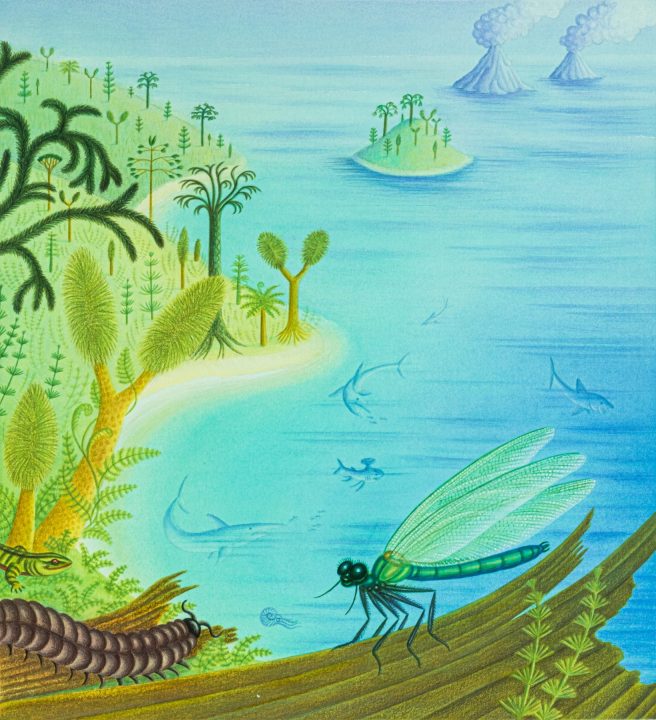
“The Jumblies” by Edward Lear came to mind while reading the quatrains, thanks Jama, for sharing this inviting, delightful, fact-filled and gorgeously illustrated book, its lovely. Loved your review too! My fav sea creature perhaps is the dragonfly at the end because they spend much time in the water in metamorphoses.
LikeLiked by 1 person
Jama, what a wonderful review. Thank you for sharing! The book (both the text and artwork) is stunning! Hard to pick a favorite sea creature, isn’t it? I think I will go with a jellyfish, they are so peaceful and fluid, but they also have another side!
LikeLiked by 1 person
Such gorgeous art! I like so many sea creatures, but for today I’ll say moon jellyfish (moon jellies) and by-the-wind sailors (velella). I saw moon jellies in a dark tank in an aquarium in Long Beach, CA, and they were very beautiful. I saw by-the-wind sailors when I took a ride on an old-fashioned sailing ship off the Southern California coast, perhaps also in the Long Beach area. A bunch of them sailed by!
LikeLiked by 1 person
Wow! This book blows me away and is right up my alley (environmental educator here)! My favorite sea creatures are sea horses! I was enamored of them at an early age and always look for them in aquariums when I travel. I was so taken by the tide pools on our recent trip to the Pacific Coast in June. They teem with life – some of the life that stayed oh, so little! Thanks again for sharing this absolutely beautiful book.
LikeLiked by 1 person
Jama, How the Sea Came to Be is an amazing, wonder-filled book that will make every child want to connect artwork to poetry and then on to research. I am in awe of the history interwoven into the content. There is so much to love about the ocean that we take for granted. Thank you for sharing your review that will encourage everyone to dig deeper. I am now off to your post from last week.
LikeLiked by 1 person
Wow – I’m simply amazed at the scope and breadth and artistry of this book – haven’t seen (yet) but will probably join the stack swimming on my nightstand soon! Thank you for sharing, and congrats to these creators. What a (beautiful) feat! (And – I was out of town last week but sure missed you & Mr. C. over the summer!) :0)
LikeLiked by 1 person
Mr C missed you too. Did you see that he was reunited with his twin brother Mr B last week? 🙂
LikeLike
This looks like an amazing book. The artwork is gorgeous. I can’t wait to have a chance to read it. Thanks so much for bringing it to my attention.
LikeLiked by 1 person
Wow, this book is simply stunning in both imagery and language! Thanks so much for the enticing sneak peek. It’s tough to pick a favorite sea creature, but mine might be the narwhal. I find them fascinating!
LikeLiked by 1 person
the book is just as magnificent as the ocean it speaks about.
LikeLiked by 1 person
What a huge subject, and just perfect for sparking the imagination of future ocean explorers and scientists!
LikeLiked by 1 person
Jama, what a beautiful book. I can see the necessity of using all those superlatives to describe the illustrations. Just gorgeous! It looks like an important science and art book. Thanks for the opportunity to participate in the giveaway of this beauty!
LikeLiked by 1 person
The art in this book looks gorgeous! Thanks for featuring it.
LikeLiked by 1 person
This looks stunning! I’ve loved Berne’s biographies (in prose). Super interested to see this rhyming book.
LikeLiked by 1 person
A gorgeous review for a gorgeous new picture book. Cannot wait to get a copy and to look for my favorite sea creature: the seahorse!
LikeLiked by 1 person