
“The woman of the future will have the memory of Josephine Garis Cochrane in grateful remembrance. It was she who invented the machine which has set woman free from the most slavish and disgusting task of housekeeping — dishwashing.” ~ The Daily Picayune, April 2, 1892.

First there’s a hum as the motor engages, the sound of water filling, then a swoosh as the pump starts up. After a couple of friendly knocks, my dishwasher settles into a comforting churn; sometimes a plate or two clinks with satisfaction. Ahhh!! Soon we’ll all be so clean and sparkly!
I like hearing the sudsy slosh and the jet spray during the rinse cycle. But as much as I’ve appreciated this efficient, time-saving appliance, I never really knew who invented it until I read Josephine and Her Dishwashing Machine by Kate Hannigan and Sarah Green (Calkins Creek, 2023).

In lively, rhythmic prose, Hannigan relates how Chicago socialite Josephine Garis Cochrane invented the first practical and successful hand-powered dishwasher despite societal hurdles, lack of professional training and financial hardship.
It all began one night after a dinner party when, much to her dismay, Josephine discovered cracks and chips in some of the china her household staff had washed. She then tried washing the dishes herself, but hated the laborious, never-ending drudgery that robbed her of precious time she’d rather spend doing pleasant things, like playing the piano, picking flowers, frosting cakes, or scratching “the furry ears of her beloved hounds.”

Convinced “there must be a better way,” she set about designing her own dishwashing machine. This wasn’t such a far fetched idea, as her great-grandfather, John Fitch, had secured a patent for the steamboat, and her father, John Garis, was an engineer who built bridges. This innovative spirit was also characteristic of the time period (Second Industrial Revolution), when many notable inventors were at work: Alexander Graham Bell (telephone), Margaret E. Knight (paper grocery bags), Thomas Edison (light bulb), Sarah E. Goode (convertible bed).
Josephine read, sketched, tinkered and pondered. She studied a dishwashing invention built in 1850: it was ineffective, only splashing water around with not much cleaning. So she “rolled up her sleeves” and built a prototype with a mechanic named George Butters, determining how big her contraption should be by measuring soup bowls and saucers, and using pliers and wires to shape metal baskets to hold plates, glasses, and spoons.

She designed a wheel to lie at the bottom, spraying hot, sudsy water from the copper boiler. And a hand crank to power it all.
She had to revise and refine her design many times until she got it to work. After her husband died, she was left with a mountain of debt. Rather than scrap the project, she slowly paid off her bills, then resumed work on her design, polishing it to perfection.

To protect her design, she had filed for a U.S. patent and finally received it in December 1886. Now she needed investors to help build her dishwasher business. But no one would take her seriously — they couldn’t imagine a woman running a company, let alone receiving a patent for a new invention.
Josephine refused to step aside and luckily found an unconventional way to garner interest. She exhibited her dishwasher at the 1893 World’s Columbian Exhibition in Chicago, where it took home the highest prize for “best mechanical construction, durability and adaptation to its line of work.”
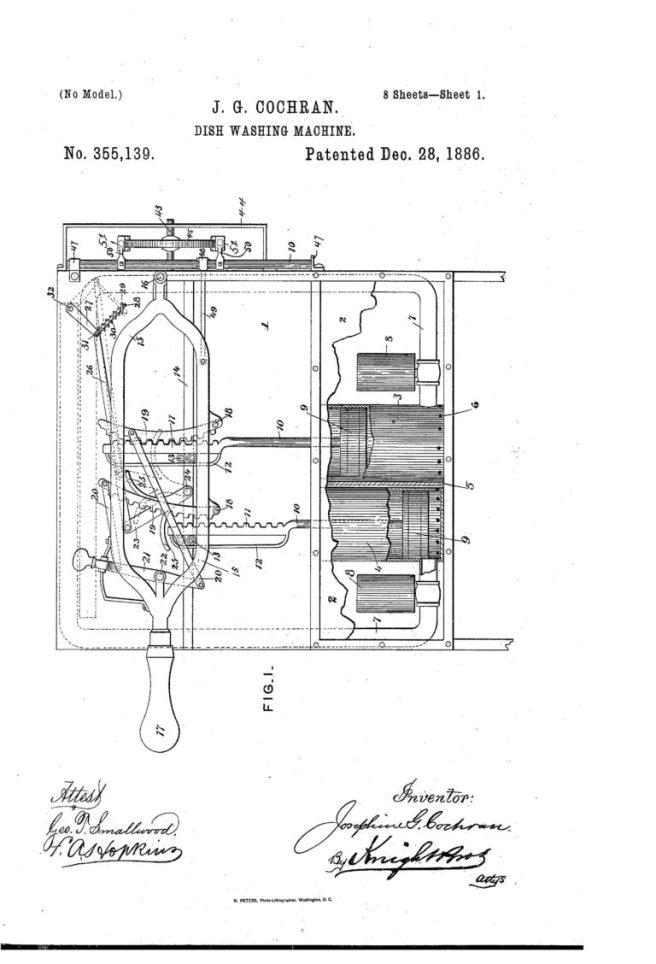
Orders poured in from hotels, restaurants, schools and hospitals. When her company outgrew the backyard shed, she opened a bigger factory near Chicago, applying for new patents to add motorized power and reduce the number of pipes.
Though Josephine’s dishwashers sold well commercially, the home market was not yet ready to adopt her invention. Her original intention had been to free the average woman from spending hours at the sink. But rather than worry about the lack of sales into homes, she continued to update her designs and improve her factory’s production. She even traveled to New York in her seventies to secure more hotel and restaurant deals.

People marveled at how her machines washed over a hundred dishes in minutes, and how the scalding-hot water killed germs better than hand washing.
In time, as more homes were wired for electricity and hot-water plumbing improved in the 30s and 40s, appliances such as stoves, refrigerators, washing machines, and dishwashers became more affordable and commonplace in households around the world. Eventually, Josephine’s dream did come true.

Hannigan’s succinct, carefully crafted text is a joy to read aloud with its inclusion of literary devices such as parallel structure, repetition, alliteration, and the use of the tag line, “There must be a better way!” to drive the narrative. The energy of the writing underscores Josephine’s work ethic and can-do spirit, and readers will be emotionally invested in her story from page one.
Sarah Green’s fetching, emotive illustrations, rendered in a pleasing palette of mostly pinks and greens, capture the highlights of Josephine’s journey with charm and verve. Love the period details and seeing how Josephine developed her design from sketchbook to prototype to patent.

And of course I love all the teacups, saucers, bowls and jugs that grace almost every spread. Handpainted pink saucers with lovely floral designs and scalloped edges! A sage green cup and saucer with pink bow and blossoms on the title page! A giant pink and tan cup with Josephine and her hounds painted on the front! Do I like a book with all manner of crockery happily floating across the pages? Is that even a question? 🙂
Kids will have fun learning about an everyday appliance that most of us tend to take for granted. Josephine Cochrane was not only a determined, innovative inventor, but also a resourceful businesswoman who defied the odds. She identified a problem and found a viable solution at a time when there were few opportunities or rights for women. Dismissed by mechanics as well as businessmen, she pressed on. After she was widowed, she made entrepreneurship her vocation.
“You cannot imagine what it was like in those days . . . for a woman to cross a hotel lobby alone. I thought I should faint at every step, but I didn’t — and I got an $800 order as my reward.”

So the next time you load your dishwasher, sorting pieces on the top and bottom racks, dropping silverware into baskets, then hearing that familiar swoosh of pressurized hot water being injected directly into the unit, remember Josephine Cochrane, who gave us all more time to pick flowers, play with our dogs, and tickle the ivories. She definitely knew how to make a splash.
*
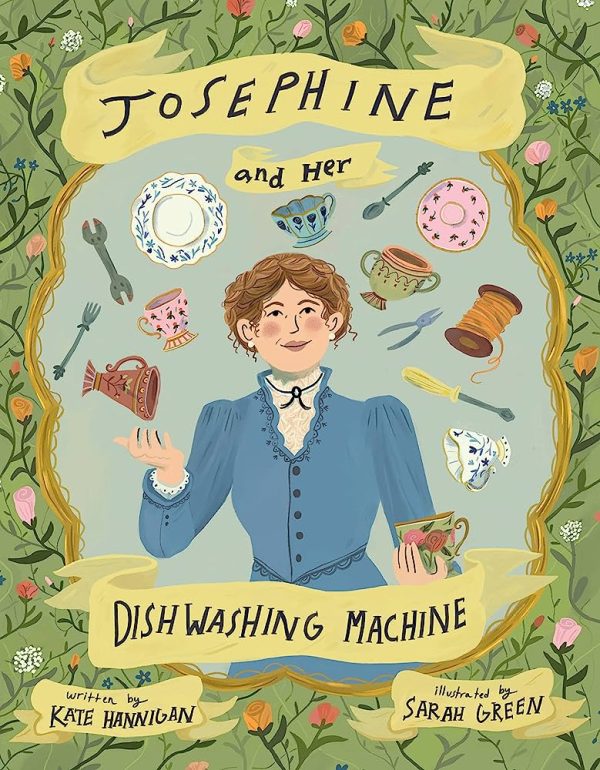
JOSEPHINE AND HER DISHWASHING MACHINE
written by Kate Hannigan
illustrated by Sarah Green
published by Calkins Creek/Astra BFYR, March 2023
Picture Book Biography for ages 7-10, 40 pp.
*Back matter includes an Author’s Note with Josephine’s patent diagram, a cool list of Notable Women Inventors, a Timeline of Fascinating Events, and a Bibliography.
*Interior spreads text copyright © 2023 Kate Hannigan, illustrations © 2023 Sarah Green, published by Calkins Creek/Astra. All rights reserved.
**Copyright © 2023 Jama Rattigan of Jama’s Alphabet Soup. All rights reserved.
 Jama's Alphabet Soup
I just sent the link of this review to my work address. I must have this book for my students! Oh, my goodness…it’s everything I look for in a MS nonfiction book. It also fits the criteria for a Reading Makes Cents program I participate in. Thanks, Jama!
LikeLiked by 1 person
That’s great, Linda!!! Glad it fits all the criteria. I know you and your students will enjoy reading about Josephine. 🙂
LikeLike
Looks delightful with colorful inviting art, thanks Jama for sharing Kate and Sarah’s new book! And here’s a congratulatory shoutout to Kate! (who I know). Yay for recognizing another unknown Woman inventor—and from Chicago too!
LikeLiked by 1 person
Yes, it was great to learn about a female inventor I hadn’t heard of before. Cool that you know Kate!
LikeLike
What an informative book. I never thought about the inventor of the dishwasher! I love that it was a woman!
LikeLiked by 1 person
Although she wasn’t the first to “invent” a dishwashing machine, she invented the first one to actually do the job of washing. Takes a woman’s practical sense :).
LikeLike
Oh what a divine book and review Jama! I love all your exclamation marks! You kindred soul!
LikeLiked by 1 person
Did I use that many exclamation marks? Guess I couldn’t hide my enthusiasm. Glad you enjoyed the review, Andrea!!!!!! 😀
LikeLike
Wonderful review! I can’t wait to read this book.
LikeLiked by 1 person
Hope you get to see it soon, Nancy. You will appreciate your own dishwasher more. 🙂
LikeLike
Heaps of gratitude for Josephine’s invention! And for the wonderful writing of Kate Hannigan, too!
LikeLiked by 1 person
Hear, hear! I need to read more of Kate’s books. 🙂
LikeLike
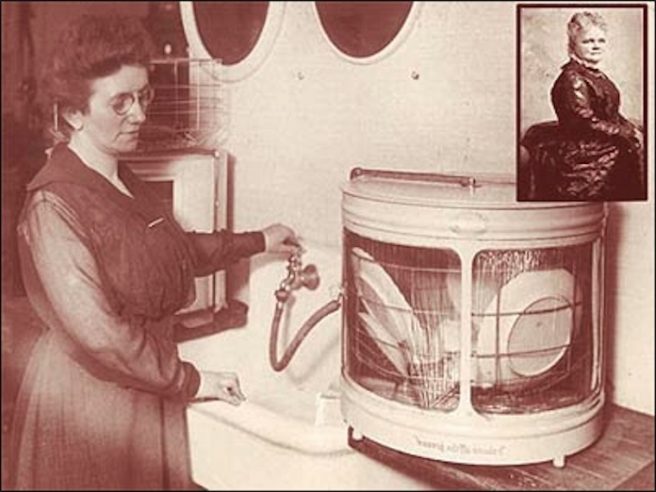
I love the real photo of her with that ‘tank’ on the counter! Hooray for Josephine, all new info to me and so wonderfully presented, Jama. Yes, I enjoyed seeing all the china, too. Thanks for sharing and thanks to Kate Hannigan and Sarah Green for the great book!
LikeLiked by 1 person
Can’t say for sure that it’s really Josephine in that photo. I tried to trace its source, etc., and find proper identification but could not. Was too interesting not to include in this post. I think it does look like her though. . .
LikeLiked by 1 person
What a fun book. I had never really thought about the invention of the dishwasher. I’ll have to check this book out. Thanks for the post.
LikeLiked by 1 person
I hadn’t either. I guess I kind of assumed it was a man. Nice surprise!
LikeLiked by 1 person