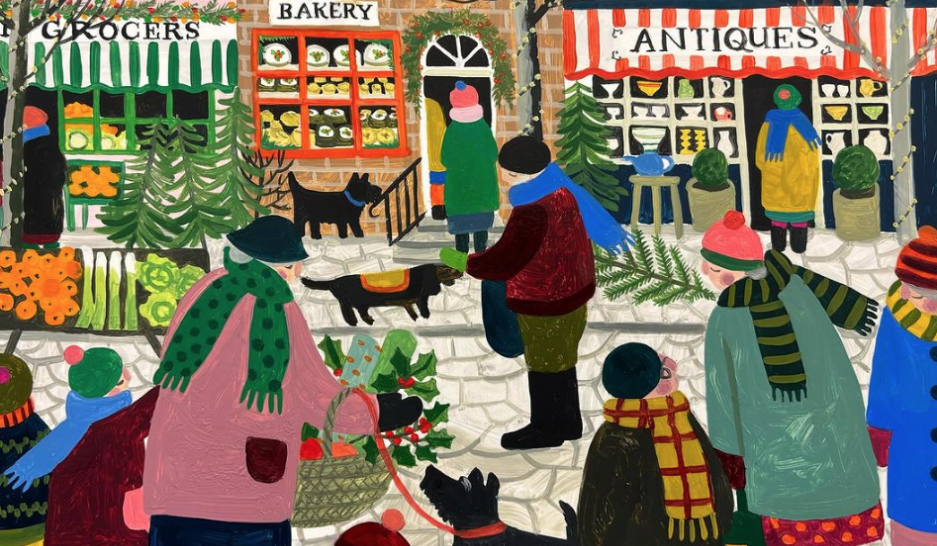

Happy to welcome back Vermont artist Ashley Wolff to talk about her latest picture book, My Towering Tree, written by Janna Matthies and published by Beach Lane Books (2024).
In Matthies’s lyrical ode to a special tree, a girl appreciates the natural wonders in her own back yard, from squirrel to garden to bee. Beneath the towering tree’s leafy canopy, she can think, breathe, rest, write, reflect, and simply be. She can also remember her dog who’s buried there beneath “a squarish stone,” and joyfully bask in the warm rays of sunshine streaming through the branches.
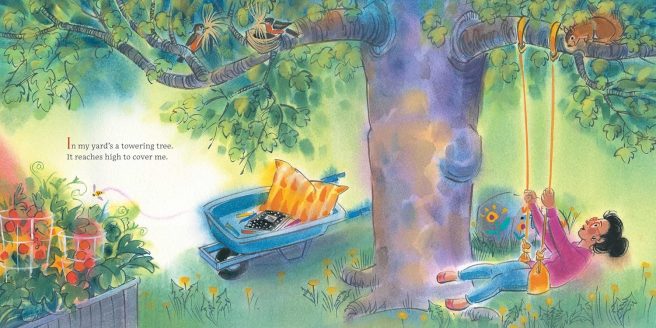
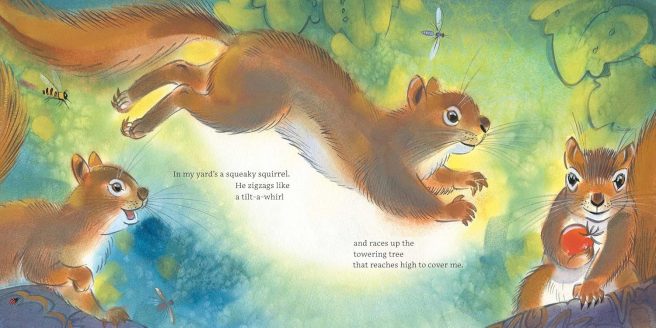
Ashley’s lush, color-saturated gouache and pastel illustrations bring Janna’s spare rhyming text to vivid, glorious life. Her dramatic use of scale in several double page spreads creates a sense of intimacy and introspection, while charming details such as the squirrel stealing a tomato, the girl blissfully reclining in a wheelbarrow, and her endearing notebook doodles keep us turning the pages. The majestic tree, with its thick sturdy trunk, generous branches teeming with wildlife, and foliage rendered in soft, fluid daubs of green is soothing and inviting.
Big thanks to Ashley for dropping by to tell us more about creating the art for this lovely study in meditation and mindfulness, and for sharing so many wonderful reference photos. 🙂
*
What was it about Janna’s manuscript that made you want to illustrate it?
In the summer I teach picture book illustration at Hollins University. Hollins offers a prestigious prize for a new book that most closely resembles Margaret Wise Brown’s “here and now” prose style. This year it was won by Lucy Ruth Cummins for her book Our Pool.
Because publishers submit so many books for the prize consideration, we have 100s of new books on campus and they are all categorized.
A couple of years ago I recognized an emerging genre among picture books labeled “Mental Wellness.”
COVID and the general stress of modern life have made many children feel more anxious and, maybe, just maybe, books that center children in nature can help.
When I read Janna’s light, rhyming, loving text I recognized just such a story.

What was the most fun part of working on this project? The most challenging?
Fun and challenging march arm in arm with this book project.
Janna’s script gave me a few clues:
There is a 1st-person narrator.
There is a setting centered around a towering tree.
There are several secondary characters, including a gravestone.
My job as an illustrator is to take what clues I am given,
and ready, set, go: create a universe!
All that room created by the author’s questions allows me, eventually, to create the illustrator’s answers.
First question: who is the narrator?
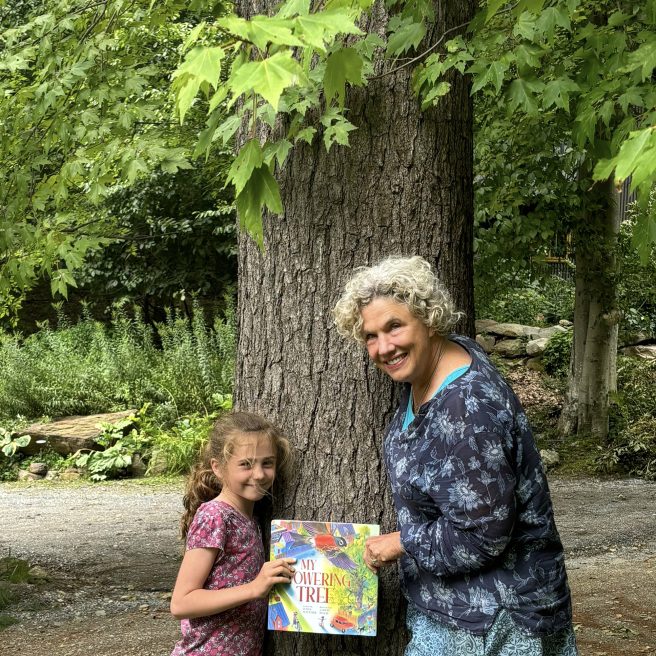
A: My model is a tall, skinny, seven year old neighbor with a lot of hair! Picture books are normally designed for 3-6 year olds, but this narrator has thoughts and questions that seem to belong to a slightly older child.

Next question: Where does she live?
A: For this story I chose an “everytown”, suburban neighborhood, somewhere in a temperate climate where great towering trees stand out but are not uncommon.
Third question: How do I make a dog’s gravestone comforting?
A: By making the child an artist with a journal and markers, I established that she may have painted Fred’s gravestone as well. I got the idea from a well known boulder on the Hollins campus that is continually repainted for different occasions.

You did a beautiful job of creating an interesting visual narrative to complement and expand on Janna’s spare text. How did you come to include the robin family, whom we follow from nest building to hungry nestlings?
The robin family helped me figure out a dimension of a book often taken for granted: how much time is passing during this story?
Our girl is alert and sensitive to the world around her and I decided that time does need to pass so she can notice changes. Robins live everywhere and are instantly recognizable. If a robin with a strand of grass appears on the cover then a nest, eggs, and eventually fledgling robins must follow.

Since the first person narrator is not identified in any way with regard to ethnicity, age, gender or physical appearance in the text, it was entirely up to you to create him/her. How did you finally decide on the girl wearing red glasses and a bun?
I had SO many choices, right?
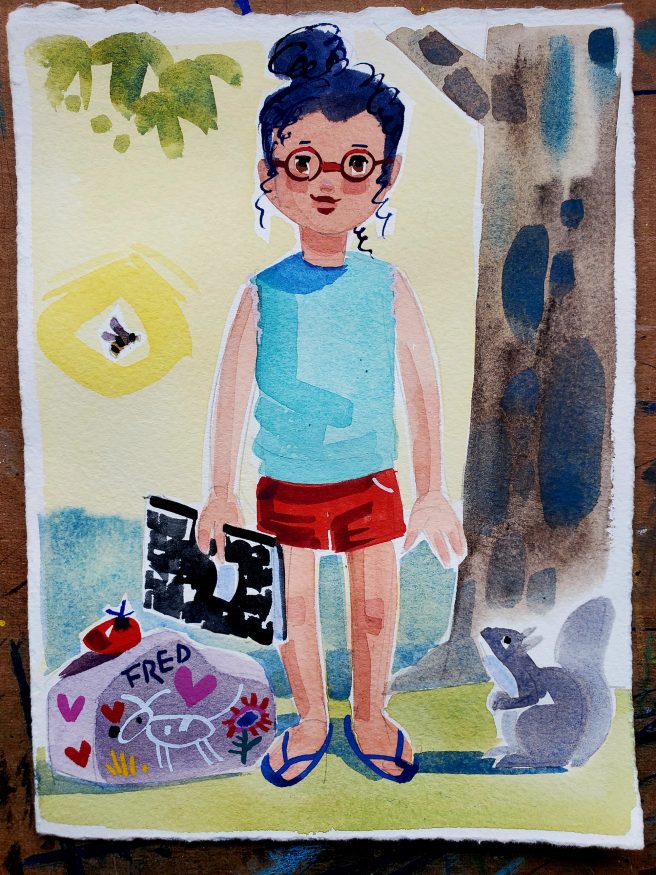
An early character sketch had the red glasses already in place.
I leaned toward creating a quiet child, one who was tuned into nature and who loved to draw.
I gave her a notebook, markers and that wheelbarrow “nest.”
Her glasses came from another young friend, but the real change came when she became much skinnier.
My model is a beautiful beanpole!

Did you have an actual tree from your own experience in mind when drawing the tree for the book? If so, why is(was) it important to you?
I have my own towering tree outside my Vermont studio. She is an American Beech (70+ feet tall).
Janna Matthies, who wrote this story, has a Tulip Tree in her head (60-100 feet tall).
I thought about what I loved about both and settled on an American Sycamore.
They are quite rare in Vermont but there is a beauty on the Hollins campus in Virginia. They normally top out at 100 feet tall, towering enough to be the star of this book. I like how the Sycamore’s branches are relatively sparse and how they spread out horizontally rather than reaching for the sky.

Why gouache and pastel for this particular book? In general, how do you determine what medium(s) to use when illustrating a book?
Jama, you know I love to mix it up!
When I wrote and illustrated Wildfire! I only used acrylic gouache. It is bold and painterly-perfect for that subject.
For My Towering Tree I wanted something softer, more fluid and transparent. I love using traditional gouache as watercolor — setting it loose to flood the page and then gathering the reins a bit by adding another wash or two, some brush line, spots of opacity and, finally, the shafts of pastel light I needed in the final spreads.
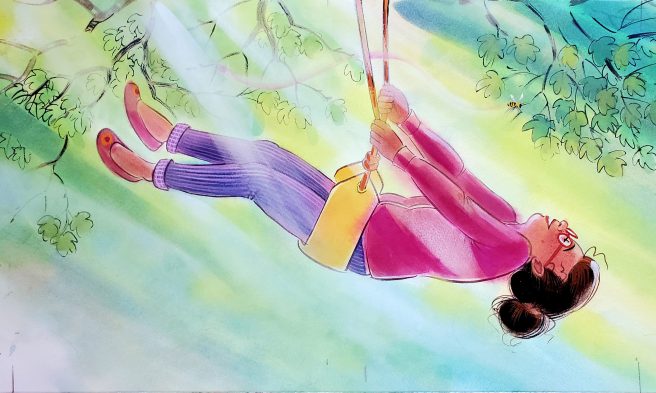
What’s your favorite spread in the book and why? Could you please describe how you made it, step by step?
I have TWO! There are consecutive spreads in the middle where our girl is musing and drawing in her notebook. They are my faves because I came of age in a trompe l’oeil mural tradition. What? Trompe what?

When I was a baby artist I had a career as a muralist, first in Vermont and then in California.

My speciality was “fool the eye” murals, aka trompe l’oeil. My simple trick then was realistic painting combined with a painted light source in the background.

For another job I created a shallow “stage” for the geese, then imagined a light source that would cause them to cast shadows –creating the illusion of space.
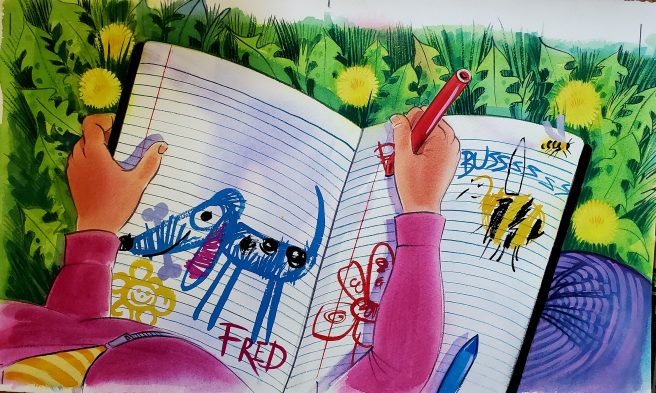
My two favorite spreads borrow a simple trompe l’oeil trick by using a cast shadow to suggest depth.
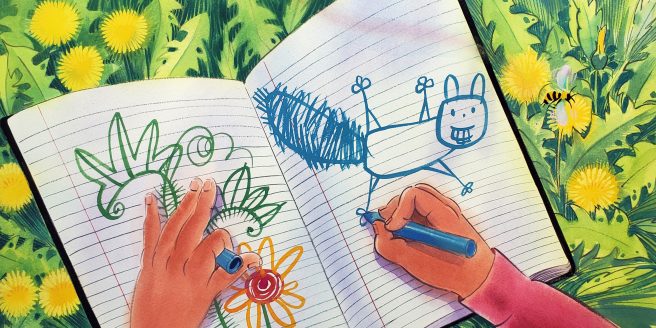
That crazy squirrel is the same one my model drew. Second graders are artistic geniuses.
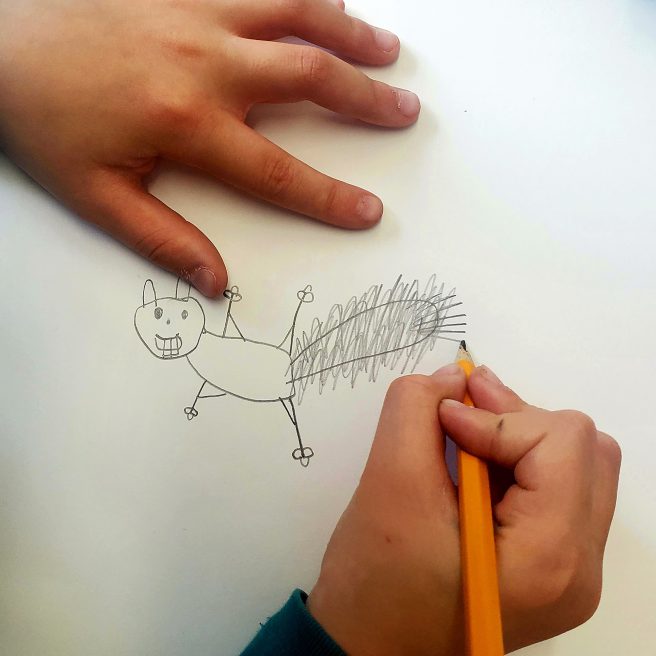
I love the way you depicted the squirrel in this story with so much personality. What are some of your favorite animals to draw and why?
Must I choose?
Forty years ago I published my first book, A Year of Birds. I have always put animals at the center of my work.

I suspect the fact that my younger sister is a huge animal lover who grew up to be an exotic animal veterinarian played a part in my fascination.
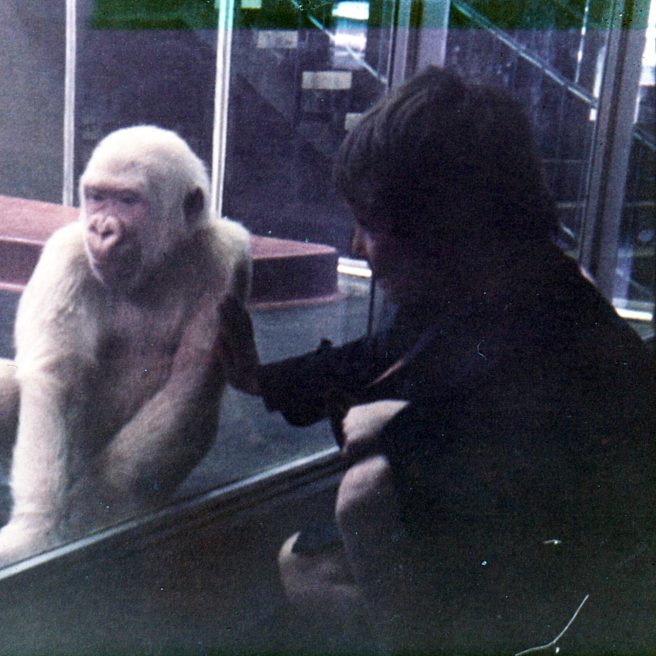
We had so many experiences with farm and zoo animals as children. Here is Peri in 1968, at the Barcelona Zoo with a young Snowflake, the only known albino gorilla.
Finally, please describe your favorite way to appreciate nature and practice mindfulness.
This fall marks my 10th year back in Vermont. I actually live in the Green Mountain National Forest and my daily habit is to walk the woods trails with my dog.
I am fully immersed in nature, sometimes to my annoyance. More than once a black bear has raided my garbage can, snagging a bag of trash and dragging it into the woods to be sorted through.
While on foot, I’m always on the lookout for various animals, wild flowers and mushrooms. Any spot of color catches my eye.


This is a red eft — the immature stage of an Eastern Newt,

These are Dutchman’s Breeches, an early spring ephemeral wildflower,
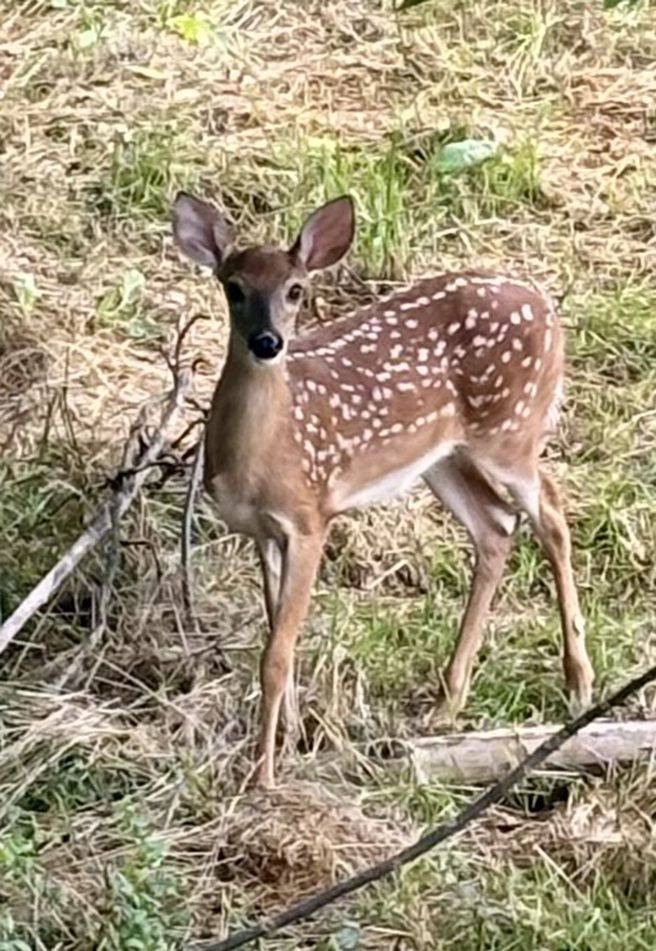
A young White-Tailed Deer,
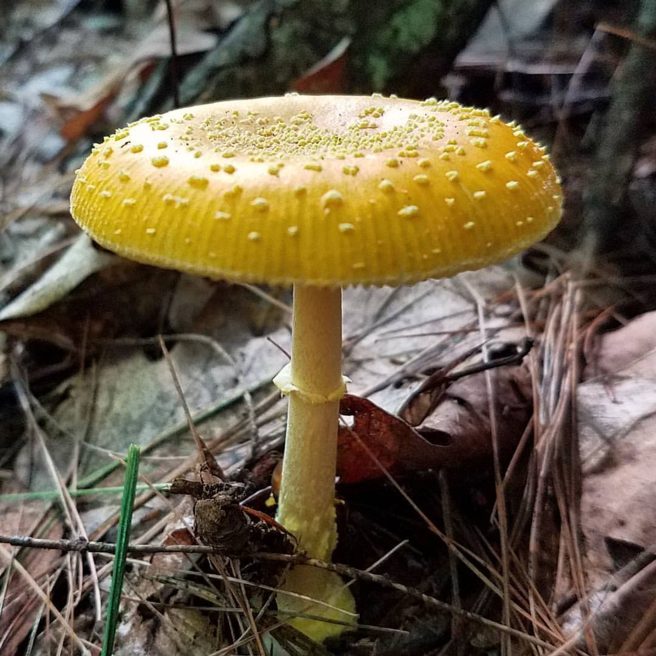
And this is Amanita Flavoconia, aka Yellow Patches.
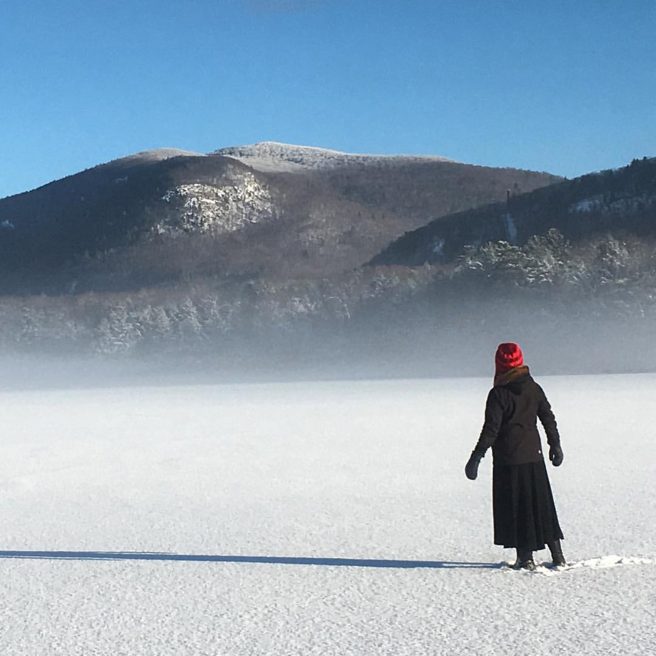
Oh, and we mustn’t forget winter. It is cold, dark and long, with plenty of time to practice mindfulness! This photo is from the middle of the lake.
*

MY TOWERING TREE
written by Janna Matthies
illustrated by Ashley Wolff
published by Beach Lane Books, August 2024
Picture Book Fiction for ages Baby-8, 32 pp.
*Interior spreads text copyright © 2024 Janna Matthies, illustrations © 2024 Ashley Wolff, published by Beach Lane Books. All rights reserved.
**Copyright © 2024 Jama Rattigan of Jama’s Alphabet Soup. All rights reserved.
 Jama's Alphabet Soup
Wow! What a fabulous interview. Thank you so much for taking the time to ask these questions. I love knowing that Ashley teaches at Hollins. Our daughter attended that incredible jewel of a college and I know that rock! I love that the Hollins rock was inspiration for something in a PB. As usual, I’ve skimmed this post before work but will be back later to savor it. Thanks for the lovely morning read.
LikeLiked by 1 person
Didn’t know your daughter attended Hollins. Very cool. That’s quite a famous rock. If I’m not mistaken, I think Ashley has painted different designs on it over the years.
LikeLike
What a great interview, Jama! I am a fan of Ashley’s art, and loved learning more about her.
LikeLiked by 1 person
Glad you enjoyed the interview, Maria. Also something new to learn from and about Ashley. 🙂
LikeLike
Thank you for sharing your world-building process, Ashley! Always fascinating to hear how artists create their illustrations. And those nature photos at the end of the blog post are gorgeous!
LikeLiked by 1 person
Thank you Patricia-those are all my photos taken within 1/2 mile of my home. It is mighty rural up here in Vermont.
LikeLiked by 1 person
Well, I finally got here, Jama, and am so glad to see all about this new wonderful book and read so much about Ashley’s work and her inspiration all through the years. It’s a special post!
LikeLiked by 1 person
Her talent is astounding, isn’t it? So multi-talented. A very prolific and generous artist-illustrator.
LikeLiked by 1 person
It’s already coming to me from my library!
LikeLiked by 1 person
You two know I’m a diehard, lifelong Ashley fan! What a glorious new book. LOVE all the background/process info – and the delightful young model.
How clever, Ashley, to go high with a bird’s eye view (a robin’s eye!) above the storied & beloved tree for the cover. (This book reminds me of a not-so-towering tree I’d climb and daydream in as a kid….)
Congrats to all of the creators, and thanks, Jama, for sharing!
LikeLiked by 1 person
The freedom of illustrators to zoom, in our imaginations, to any point of view is our superpower!
LikeLiked by 1 person
What a beautiful book steeped in nature! Thanks for sharing it with us. I wish I lived near Ashley!
LikeLiked by 1 person
Yes, judging by her photos, she has access to so many natural wonders — perfect inspiration for an artist.
LikeLike
Really good to get to know both Ashley and the book better.
I like that everything in the story has character – the child, the animals, the big tree.
Well done.
LikeLiked by 1 person
I’m always fascinated by illustrator backstories. I’m in awe of the process of creating art for picture books as well as Ashley’s versatility as an artist. Her murals are amazing too.
LikeLike
What a great book! I love the crazy squirrel. We have more than one towering tree around our house, but the big ash at the front northwest corner of our house is probably our favorite. It’s beautiful plus it shades the house in summer. Our family adores trees, and our favorite vacation for years was going to Sequoia National Park, home to some of the most amazing trees on earth.
LikeLiked by 1 person
Yes, I seem to remember seeing some pics of you and your family at Sequoia National Park. Amazing trees there!
LikeLike