“Blue skies smiling at me, nothing but blue skies do I see . . . ” ~ Irving Berlin

Blue likes me. It’s always been there, coloring my life with good things since childhood: my first Schwinn bike, Island of the Blue Dolphins, fountain pen Quink, favorite pearl bracelet, the sparkling azure of the Aegean one summer.
At age 9, I saw Elvis filming “Blue Hawaii” alongside the pineapple fields. He was driving a baby blue convertible. The first time I met Len in London he was wearing a navy blue sweater. These days, I sip Darjeeling in a Blue Calico teacup, delighted to spot the first bluebird every spring.
Blue just knows how to make an impression. From the cozy comfort of broken-in jeans to the bright optimism of a clear autumn sky, blue touches us all in ways ordinary and profound.

But now I must confess something. Until I read BLUE: A History of the Color as Deep as the Sea and as Wide as the Sky by Nana Ekua Brew-Hammond and Daniel Minter (Knopf BFYR, 2022), I knew very little about blue’s fascinating history, origins, and cultural significance. Imagine my surprise when this book magically appeared in my mailbox one day — simply out of the blue (thanks for the gift, Miss T.)! 🙂

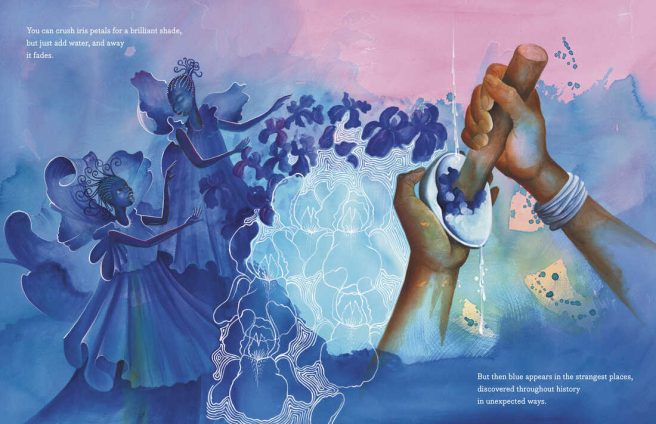
Brew-Hammond begins her captivating narrative by citing how elusive and mysterious blue actually is. It’s “all around us,” in the sky and sea. Yet we can’t touch the sky and when we try to cup the sea, its blueness disappears. We may crush iris petals for a brilliant shade of blue, but when we add water, the color fades away.
But then blue appears in the strangest places, discovered throughout history in unexpected ways.
Blue rocks called lapis lazuli were mined as early as 4500 BC in Afghanistan. The ancient Egyptians used the stones to make jewelry and charms to ward off evil, and by 44 BC they (including Queen Cleopatra VII) applied a bluish mixture around their eyes made from ground lapis lazuli grains, plants and animal fat.
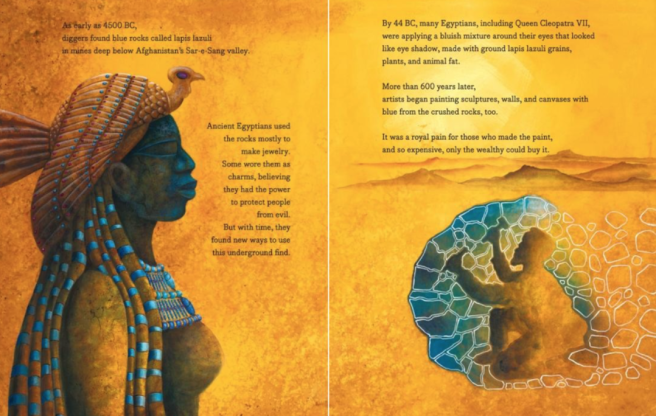
In another 600 years or so, artists began painting sculptures, walls, and canvases with blue made from the crushed rocks. Since this paint was expensive to produce, only the wealthy could afford it. This high-demand luxury prompted scientists, merchants, and dyers to search for more sources of blue.
Dyers eventually found blue in the belly of certain shellfish “on the shores of the Mediterranean, Central America, Mexico, and Japan.” (According to a Phoenician myth, a dog ate a snail which turned its tongue purplish-blue.)
Various methods were applied to release the color: pressing the snail’s foot, cracking its shell. But this snail-blue was hard to produce in viable quantities as each snail only released one or two drops.
Since blue was coveted and hard to create, it’s easy to see why people around the world considered the color holy, “a gift that connects God to humans.” In Italy, blue was reserved for painting the robes of Mary, mother of Jesus. Blue drapes hung in King Solomon’s temple, and “many Jews still wear blue-dyed threads called tekhelet.”
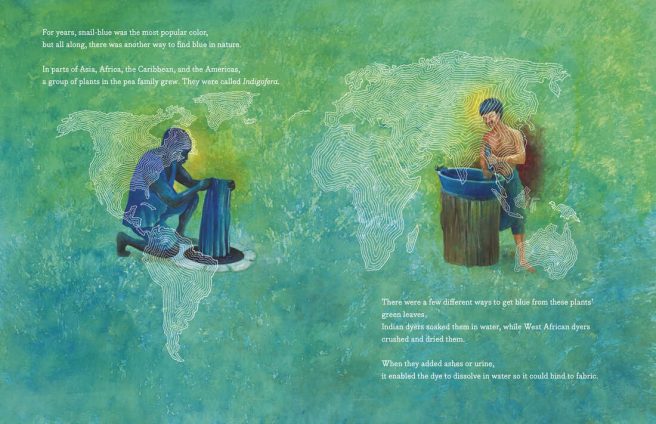
Though snail-blue was the most popular color for many years, all along in parts of Asia, Africa, the Caribbean and the Americas there was another way to “find blue in nature”: the indigo plant. Blue dyes were either made by soaking the plants’ leaves in water (India), or crushing and drying them (West Africa). When adding ashes or urine, the dye dissolved in water, enabling it to bind to fabric.
Indigo dye became the “best of the blues” — it was much cheaper to produce than using rocks or snails, and its shade was just as vibrant and long-lasting. “India and Nigeria became powerful centers for making and trading indigo.” It was used to make clothing, makeup and medicine, so precious that people spent it like money.
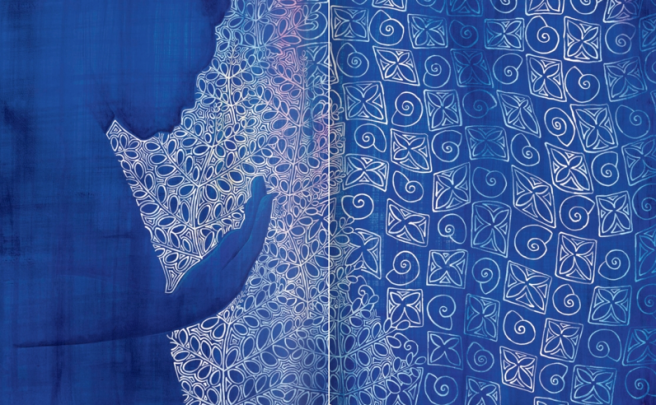
But the indigo trade had a dark side: “leaders and landowners around the world abused or enslaved countless people just so they could grow more indigo.” Enslaved Africans in the United States were forced to farm indigo since it was a very profitable cash crop.
While others were busy sourcing blue from nature, scientists worked hard to make a chemical blue that wasn’t “so difficult or cruel to produce.” In 1905 Adolf von Baeyer won the Nobel Prize for creating a chemical blue after forty years of trying.
Finally, everyone could afford something blue! As Brew-Hammond aptly reminds us, “blue was more than a color,” more than just clothing, jewelry or art. Because it was scarce, mysterious and had holy associations, “It was a feeling.”

Why do we associate “feeling blue” with sadness? Perhaps because of the painful memories associated with working the mines or of slavery on indigo plantations. Enslaved Africans in America “sang prayers that sounded like tears,” songs called spirituals, which in turn inspired the blues music genre.
We also use many “blue” expressions in everyday speech. When something happens “out of the blue,” we’re reminded blue was once so rare that its “discovery seemed to appear out of thin air.” Why do we award blue ribbons for first place? Blue is an extraordinary color, once the color of royalty, so it’s very fitting.

Daniel Minter’s gorgeous, evocative illustrations, created with layers of acrylic wash on heavy watercolor paper, beautifully extend and illuminate Brew-Hammond’s fascinating, lyrical text. Depicting various time periods across a wide geographical swath, he blends rich patterns, textures, artistic motifs and cultural flavors for a rich visual feast of magical realism.
Central to his interpretation is the inclusion of realistic hands in many of the spreads, perhaps to emphasize the human connection to the color blue with respect to its discovery, production, and global significance. We see hands using ancient tools chipping away deep in the mines, a hand holding a snail shell to extract its color, worshipping hands reaching for the sun, hands holding prayer beads to ward off evil spirits, hands distilling indigo dye and harvesting the plants, von Baeyer holding up a test tube in his right hand.

The book’s first spread shows three children floating upwards, reaching for the sky, and in the final spread, they are joined by a giant pair of blue arms, perhaps symbolizing how blue, with its “complicated history of pain, wealth, invention, and recovery” has become a symbol of possibility, “as vast and deep as the bluest sea, and as wide open and high as the bluest sky.”
BLUE is a well researched, stunningly presented exploration of a color with a fascinating backstory. Readers of all ages will be able to better appreciate blue’s lush beauty, inimitable allure and kaleidoscope of shades.
Back matter includes an Author’s Note, More Blue Facts to Explore, and an extensive Source List. Don’t miss this once-in-a-blue moon treasure!
*

BLUE: A History of the Color as Deep as the Sea and as Wide as the Sky
written by Nana Ekua Brew-Hammond
illustrated by Daniel Minter
published by Knopf BFYR, February 2022
Nonfiction Picture Book for ages 4-8, 40 pp.
**Starred Reviews** from Publishers Weekly, Kirkus, BCCB
*
*Interior spreads text copyright © 2022 Nana Ekua Brew-Hammond, illustrations © 2022 Daniel Minter, published by Alfred A. Knopf. All rights reserved.
**Copyright © 2024 Jama Rattigan of Jama’s Alphabet Soup. All rights reserved.
 Jama's Alphabet Soup
What an amazing review, Jama. You give me a lot to think about…as I’ve never considered the source of blue that I take for granted in my every day. I think I must get this book. I love learning history through a person, a place or a thing instead of a list of dates. This looks absolutely fascinating. Thank you.
LikeLiked by 1 person
It’s worth owning, Linda. I learned so much from it. I’ll never take blue for granted again!
LikeLike
I will never look at the color blue with the same eyes. What a stunningly beautiful & eye-opening book. Years ago, I was walking by a cosmetic counter in Nordstrom when the lady behind the counter said to me, “Choose blue.” When I asked why, she said, “Your colors are all wrong, wear blue hues.” She was right. Who knew browns & coppers were all wrong on me. I love blue, but for many more & important reasons now. Thanks for enlightening me, Jama Darling.
LikeLiked by 1 person
What a great story! Something similar happened to me long ago. I used to LOVE browns, wore it all the time. Then my aunt (and godmother) once complimented me, saying that I looked good in blue. This happened another time with an acquaintance. So I thought there must be something to it. 🙂 Since then, I favor blues in clothing.
Speaking of cosmetic counters, one time I rushed out of the house without lipstick. As I was walking by the Clinique counter in the old Woodies, a lady working there said, “maybe you’d like to look at our lipsticks?” 😀 Talk about observant. People don’t let you get away with anything!
LikeLiked by 1 person
Yes, they do! Especially those ladies behind the cosmetic counter! Back to blue – my novel that I just completed stars a Korean girl born with blue eyes. 🙂
LikeLiked by 1 person
Ooh!! I love blue eyes! Even more reason to look forward to your new book!!
LikeLiked by 1 person
So transporting Jama! Thank you! Remember my poem “Partial Syllabus of Blue” in MOTHERSHELL?
LikeLiked by 1 person
Yes, one of my faves! Uncanny how you included many of the key points about blue’s history in your poem that were also in this book.
LikeLike
If lucky enough to find a home, you’ll be the first set of eyes I send to!
LikeLiked by 1 person
Gorgeous Jama! thank you! Remember my poem “Partial Syllabus of Blue” in MOTHERSHELL? 🙂
LikeLiked by 1 person
Intriguing review of this fascinating book, I’ll have to look for it. Long live BLUE, thanks Jama! 💙🦋🌎🐟🧵🧢🪼🐳💧💦🫐📘🎭🩵🌀🔵🔷
LikeLiked by 1 person
Blue is powerful, prized, gorgeous, especially important this year! Hope you get to see this book in person soon. As an artist, you will find it especially fascinating.
LikeLike
Blue is a beautiful color, and I especially love navy blue! I actually wore Blue to 2 of my 3 children’s weddings. The first song I thought of with blue was an oldie by Bobby Vinton, Blue Velvet! Thanks and I think this book would be perfect for an art lesson in school.🎨🎨🎨
LikeLiked by 1 person
I like navy too! Blue Velvet is an oldie but goodie. I remember sharing the video in one of my past Cool Things Roundups. 🙂
LikeLike
Finally, I have time to savor your review, Jama, and certainly this book is for you! My library has it, so I’ll be able to see all the blues you’ve shown us! What an amazing history. Can you imagine someone working forty years and finally achieving his goal? Wow! Thanks for sharing this history from the beginning. You saw Elvis! Wow, again!
LikeLiked by 1 person
I didn’t know about Adolf von Baeyer before reading this book. Forty years is quite a testament to dedication and persistence! Certainly deserved the Noble Prize. I was about 9 or 10 when we spotted Elvis filming that car scene with the teacher and students (“Moonlight Swim”). I watched and loved all his movies. I once told this story to my dentist (whose fave song in middle school was “Rock-a-Hula” and he mentions it at almost all my visits. 🙂
LikeLiked by 1 person
That cover is truly glorious.
I’m loving this trend of taking a Thing and then taking a 360 view of its past, present, and future to make it more vivid in picture books. This is really great.
LikeLiked by 1 person
Yes, totally agree!! Thanks again for sending me the book (although it took me awhile to feature it) . . . now is the right time for all things BLUE. 🙂
LikeLike
Seeing blue skies [here in hurricane-prone Florida, too!] after reading this review. How did I miss this book in 2022? Minter’s artistry in color & Brew-Hammond’s words leave me reaching for my bluebook notebook to write. Many Appreciations for sharing.
And I’m guessing you made the wise gal with the blue button which make me smile.
LikeLike