My grandmother and I had a unique way of communicating. Our made-up language was a hodgepodge of Korean, Hawaiian Creole English (Pidgin), broken English and American slang. We stuck to simple subjects as we watched our favorite soaps or gossiped about other family members.
While in middle school, I sometimes greeted her with a simple “Ohayō” or “Kon’nichiwa,” and she would shush me, her face like thunder. Since many of my classmates were Japanese, I naturally echoed some of what they said. My mom finally explained why Grandma got upset: from 1910 to 1945 the Japanese had occupied her homeland; Koreans were assigned Japanese names and the Korean language had been banned.
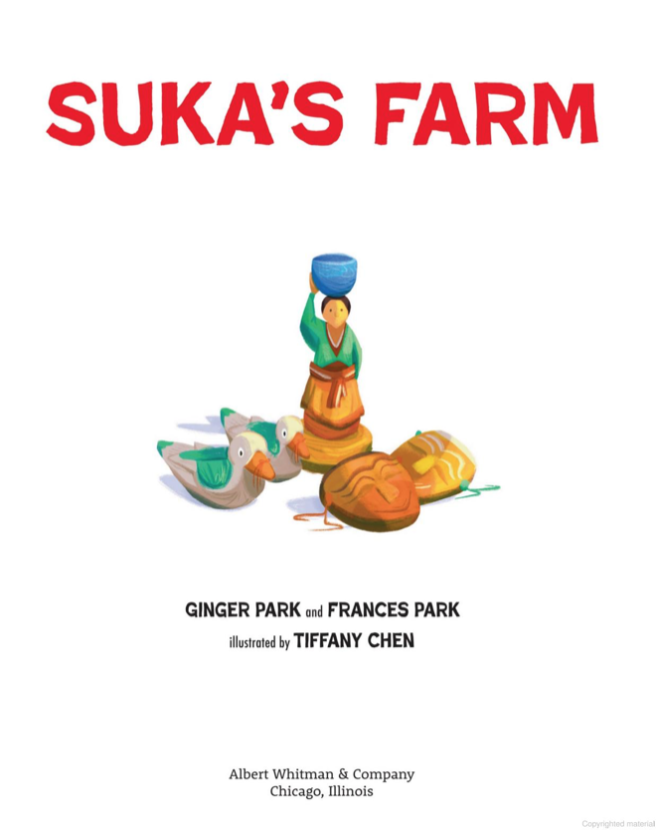
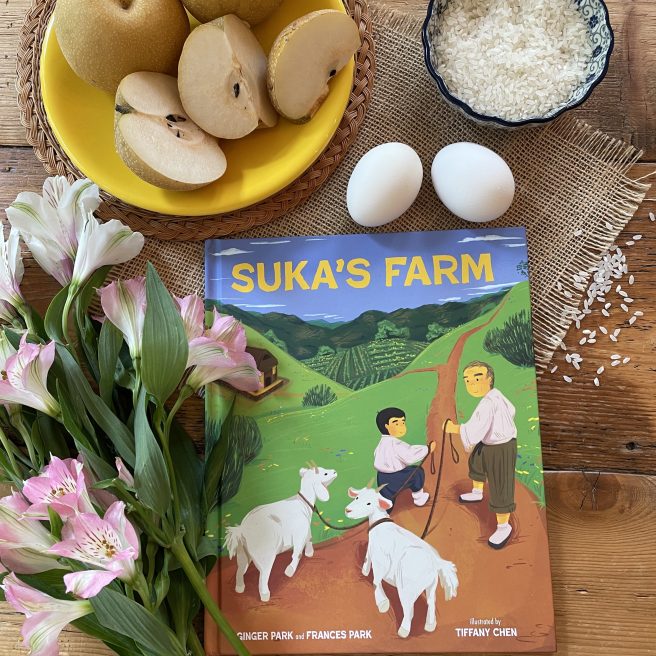
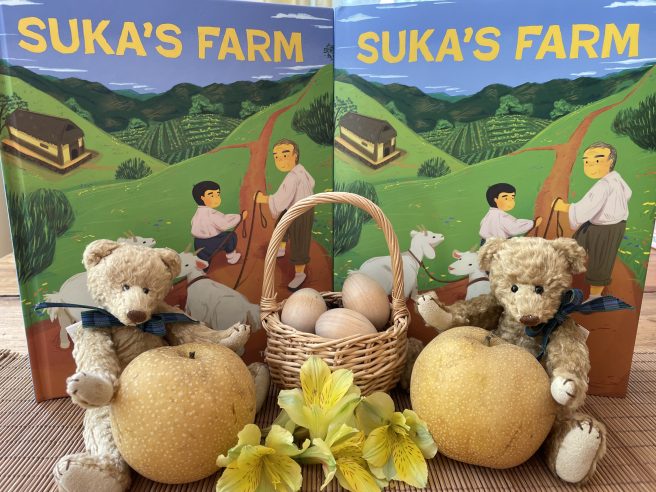
I thought of her while reading Suka’s Farm (Albert Whitman, 2025), a new picture book by Ginger Park and Frances Park, set in 1941 Korea. Illustrated by Tiffany Chen, this touching story of an unlikely friendship between an elderly Japanese farmer and a hungry Korean boy warms the heart and offers a much-needed glimmer of hope for humanity.
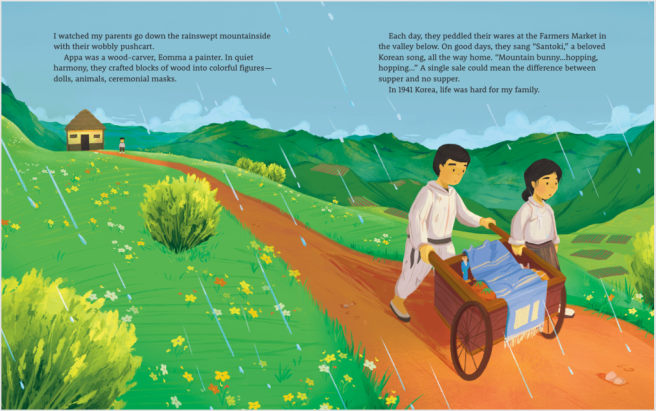
As the story opens, we learn Kwan lives on a quiet mountainside with his artisan parents, who eke out a living by selling their woodcarvings at the Farmers Market. Times are hard as they struggle to get by with meager bowls of rice porridge for supper. One night, Kwan overhears his worried parents say they only have a handful of rice left.
When Kwan passes Suka’s Farm on his way to school the next morning, he’s reminded of his family’s struggles. He sees pear trees growing from fertile soil, and acres of cabbages, melons and wheat — yet none of these foods ever appear on Kwan’s table. That’s because the land belongs to Japan, and Suka’s Farm is off-limits to Korean boys like him.
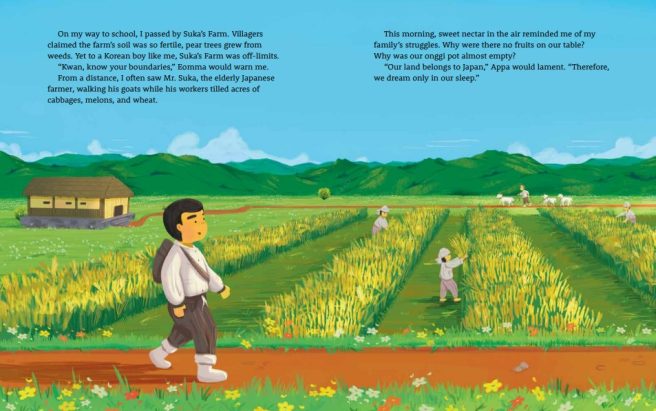
Still, Kwan is determined to help his family and, “as if in a dream without boundaries,” he steps onto the farm and musters up the courage to ask gruff Mr. Suka for a job. Kwan respectfully introduces himself as Aoki, the Japanese name he’d been assigned by law.
Mr. Suka is dismissive and rejects Kwan’s offer of work. How could a child help him? Kwan explains he could help with the goats, begging Mr. Suka because his family is hungry. Mr. Suka tells Kwan to go to school, but just as the boy is leaving the barn, he calls him back. He agrees to let Kwan work on a trial basis.

So, the next day, Kwan arrives before dawn, bearing a gift for Mr. Suka from his parents — a carved wooden goat. Though puzzled by the gift, he thanks Kwan, then introduces him to his little herd of goats, each of which has a name. Kwan and the goats, whom Mr. Suka loves like family, become fast friends.
At dawn they walk the goats up a hill for their breakfast and afterwards, Mr. Suka gives Kwan his breakfast — a plump pear — before sending him off to school. After school, Kwan returns to the farm to bathe the goats. He cheerfully whistles the mountain rabbit song, “Santoki” to them as he scrubs their coats, but Mr. Suka hushes him, reminding him to “just work.”

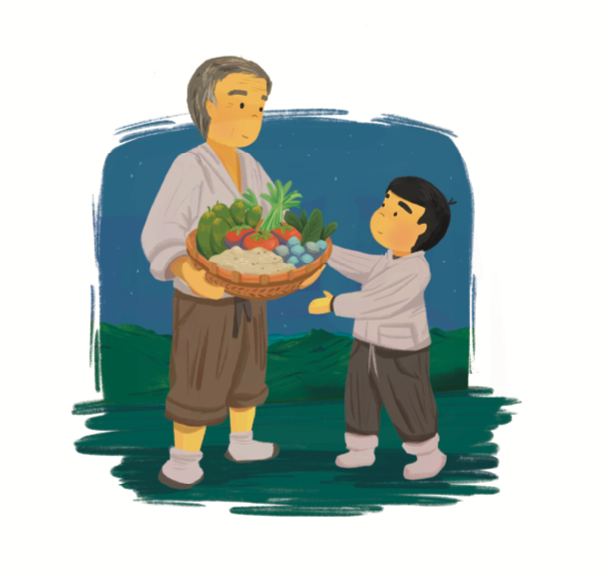
At dusk, Kwan takes the goats for a last walk and before he leaves, Mr. Suka hands him a basket of eggs, fruit, and rice for his family. Before dawn the next morning, Kwan heads for the farm again, only to find the barn dark when he arrives. Mr. Suka is out in the fields desperately searching for the goats by lantern light. He’d forgotten to close up the barn the night before and they’d wandered away.
Together, they comb through acres of farmland with no luck. The goats are lost! Then Kwan has an idea. He whistles “Santoki” as the sun rises, louder and louder, until they finally hear “the goats singing from beyond the forest edge.”
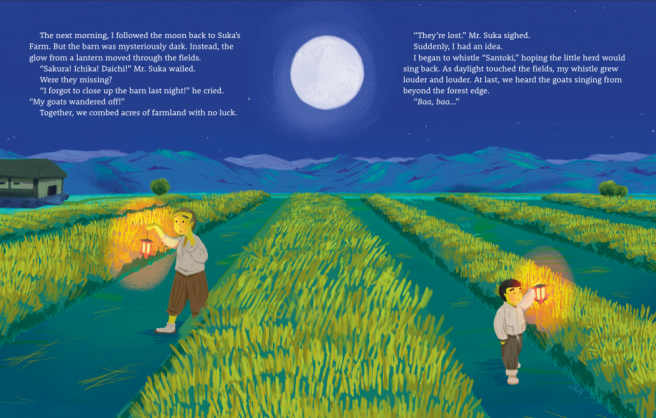
A relieved and elated Mr. Suka asks Kwan what tune he was whistling. After Kwan explains it’s a Korean song, Mr. Suka wants to know his Korean name. Kwan happily tells him, and Mr. Suka says how lucky he is to have such a good worker.
This beautifully written story of kindness, compassion and friendship was inspired by the Park sisters’ father, who worked on a Japanese goat farm as a boy. Engaging and earnest, Kwan’s voice rings true as he shares the details of his unique relationship with Mr. Suka, how it grew from a timid boy begging for a job from an intimidating elder, to two people bonding over their affinity for animals, to happy friends working together in harmony.

It is reassuring to read about individuals of different generations and cultural backgrounds finding common ground, especially in this day and age of divisiveness and demonizing of “the other.” Though set in a tumultuous period of Korean history, marked by subjugation, oppression, hardship and poverty, this story focuses on the characters’ shared humanity, the rewards of honest work, and the power of small gestures to change lives.
Tiffany Chen’s luscious color-saturated illustrations, rendered in a jewel-toned palette of mostly greens, blues, and browns, showcase the beauty of the landscape, whether field, mountain or hillside. She also amplified the emotional arc of the story via simple facial expressions and posturing, everything from worry, humility, and trepidation, to gratitude, relief, and contentment.

Overall, the scenes are calm and peaceful, suggesting that despite any turmoil in the outside world, it’s still possible for two strangers to forge a genuine bond when interacting one on one. Mr. Suka opened his heart to an impoverished boy and it made all the difference.
Though young readers will likely be unfamiliar with the historical context of Suka’s Farm, this engaging, sensitively written narrative is a good way to introduce age appropriate discussions about the importance of political autonomy and retaining one’s identity.
Whether read as a satisfying story of friendship or considered for its wider implications, Suka’s Farm will inspire empathy. Kids will admire Kwan’s courage, work ethic, and positive spirit, and may even become interested in exploring their own family histories. I think my grandmother would have liked this story about a kind Japanese farmer who came to call an enterprising Korean boy by his real name. 🙂
*
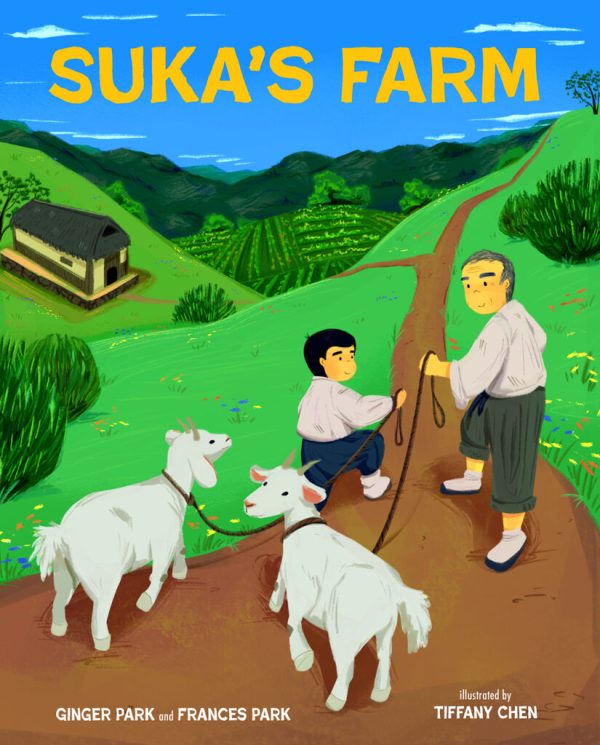
SUKA’S FARM
by Ginger Park and Frances Park
illustrated by Tiffany Chen
published by Albert Whitman & Co., April 2025
Historical Fiction Picture Book for ages 4-8, 32pp.
*Includes Authors’ Note and Glossary
♥️ Enjoy the Official Book Trailer:
*
*Interior spreads text copyright © 2025 Ginger Park and Frances Park, illustrations © 2025 Tiffany Chen, published by Albert Whitman & Co. All rights reserved.
**Copyright © 2025 Jama Rattigan of Jama’s Alphabet Soup. All rights reserved.
 Jama's Alphabet Soup
What a wonderful book! Look forward to reading!
LikeLiked by 2 people
It offers that all-important element of hope. I like that it was inspired by the authors’ father. 🙂
LikeLiked by 1 person
Jama- thank you for your words and for sharing this gem of a book… the authors did a beautiful job conveying a peaceful simple story in such a turbulent time… kindness will always be the victor in the end👏
LikeLiked by 2 people
We certainly need more kindness in this world, one story at a time. I’m reminded that in any turbulent situation there are those doing the right thing, making a difference, finding their own peace.
LikeLiked by 1 person
Fascinating post! I always enjoy your Hawaii stories, Jama, and the Park sisters picture book looks charming (and important). It’s especially interesting that it was inspired by their dad’s experience.
LikeLiked by 2 people
Their dad did herd goats for a Japanese farmer when he was a boy. He had an impoverished childhood but grew up to attend Harvard — what could be more inspiring than that?
LikeLiked by 1 person
This book’s theme is so timely in many levels. People if different cultures bonding of their shared humanity. Also, as a senior citizen, I feel that many times age and the wisdom that comes along with living a long life are not valued, but this book clearly highlights that no matter our age differences, we can be friends. The movie Finding Forrester with Sean Connery and Rob Brown has a similar theme. I highly recommend this movie. Thanks Jama for this book review. I plan to check it out!
LikeLiked by 2 people
Yes, I agree that age and wisdom are not valued in some cultures. From someone with an Asian background, I can say that we value our elders and try to honor and learn from their experiences. Mr. Suka in this story was able to see a boy in need and his compassion and empathy prompted the right action. Thanks for the movie rec. I’ll have to watch Finding Forrester!!
LikeLiked by 1 person
This looks like a lovely book with some wonderful lessons for youngsters. Thanks for telling me about it.
LikeLiked by 2 people
This story is like a feel-good light in the darkness in our turbulent world — where it seems everyone is at war with each other.
LikeLike