

What kind of food do you most like to eat when dining out? For me, it’s Japanese. Maybe it’s because I like fish and dishes that aren’t smothered in rich, heavy sauces. Perhaps it’s the artful plating of fresh, healthy ingredients that showcase their colors and textures (we eat first with our eyes). Or what about those lacquered bento boxes — just-right portions nestled in cute little compartments — so neat and organized! Moreover, after a Japanese meal I feel satisfied but not stuffed, and more often than not, the overall experience is calm and relaxing.

A bowl of warm, restorative miso soup is the perfect prelude to a delicious Japanese meal, priming the palate for the goodness to come. I enjoy nibbling on the little cubes of tofu and wakame strips while stirring the broth with my chopsticks, then savoring each sip (no matter the restaurant, it’s usually just the right temperature too!). Ahhhh . . . so good!
Much as I love Japanese food, I actually didn’t know how miso was made until I read Miso Magic by Moni Ritchie Hadley and Mizuho Fujisawa (Albert Whitman, 2024), a tender father-daughter story about family traditions and cultural heritage flavored with a gentle lesson in patience.

As the story opens, young Chiyoko is anxious to build a snowman with Papa to celebrate the first snowfall of the year, but Papa says it’s time for her to learn the family business of miso making. They head for the misogura (work barn), where she learns how to clean the tubs for making kōji, an edible mold that’s the secret to miso’s umami flavor.
Despite Papa’s enthusiasm, Chiyoko remains unimpressed with the prospect of tasting miso made with her own hands, and watches passively while Papa pours rice into a big tub of water. While the rice cooks, they shell soybeans, and once it’s done, Papa spreads the rice on a large tray to release the steam.
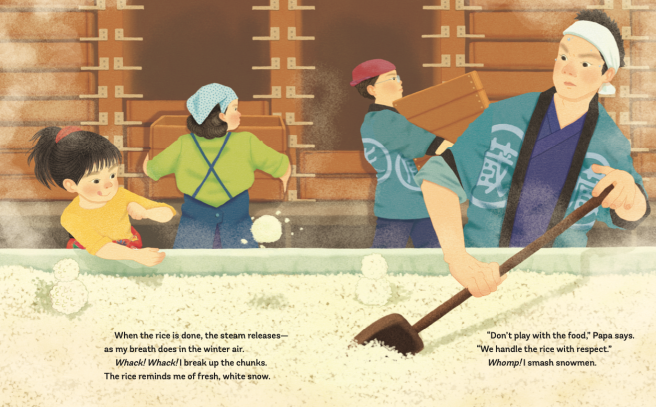
Since it reminds Chiyoko of fresh, white snow, she whacks at the rice to break up the chunks and to smash “snowmen.” Papa tells her not to play with the food: “We handle the rice with respect.” He sends her outside for a time out.
Chiyoko expects Papa to scold her, but after awhile, his “gentle voice” invites her back inside. He explains that “Magic takes time,” while handing her a bamboo shaker filled with powder — kōji mold that will live and feed on the rice, changing its flavor and texture. Chiyoko sprinkles powder on the rice, but doesn’t see anything magical happening. Papa explains the magic will be in the transformation.

With their spades, Chiyoko and Papa scoop and turn the rice, allowing it to breathe. Papa then covers the rice with a blanket to keep it warm before tucking Chiyoko into bed.
She wakens when she hears Papa walking to the misogura and follows him there to see if the rice is ready. “Not yet,” Papa says, reminding her that “magic takes time.” Papa needs to periodically turn the rice so it won’t overheat and kill the kōji.
Papa continues to check the rice temperature throughout the night, with Chiyoko following him each time. He shares his memories of the family miso business which began three generations ago. Now Chiyoko is part of that tradition too. What a gift she’s been given!

Since the kōji still needs more time the next morning, Papa and Chiyoko prepare the rice for the next batch. Finally it’s time to lift the cover; they inhale the sweet aroma before nibbling on a chunk of kōji rice. Then they add the kōji and some salt to the boiled soybeans. Chiyoko works hard smashing and smushing before they cover the vat. The miso will next need a long rest — an entire year.
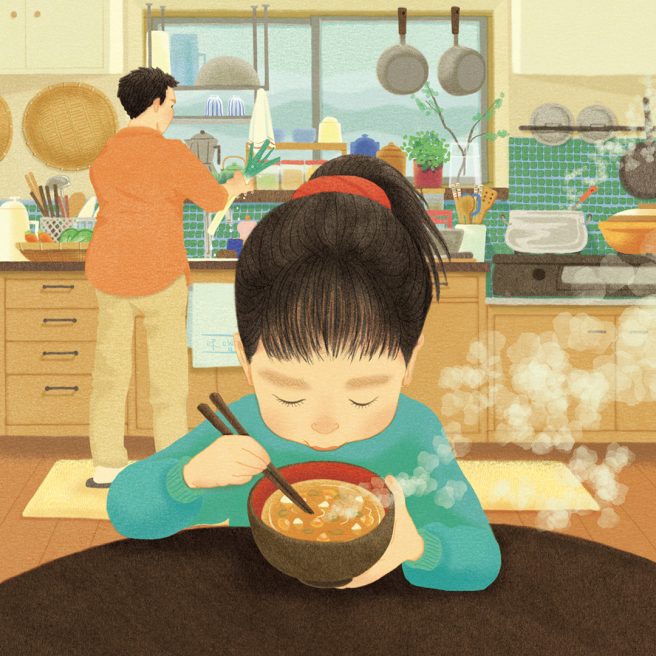
Papa and Chiyoko make and enjoy soup made from last year’s stock. The warmth in her belly “is a hug from a long line of papas,” and she looks forward to the day when it’s her turn to share “all that brews inside the barn.” Papa reassures her that snow will come again soon, but now Chiyoko is only too content to wait for the magic.
In this day and age of ‘instant everything,’ with mass produced foods coming straight off supermarket shelves into the home, it’s good for kids to read about how a special seasoning has been made by hand with loving care and attention through multiple generations.
It’s been said “patience is a virtue,” and that’s something Chiyoko learns in the best possible way, as she comes to appreciate her role in the family business and gains a new sense of pride that comes with accomplishment. Just as plain rice is transformed into miso, Chiyoko changes from a disappointed and reluctant observer into an engaged helper. As she participates in each step of the miso making process, she comes to understand that good things are truly worth waiting for.
The father-daughter relationship in the story is touching; their bond is strengthened as they work together through the night. Hadley’s succinct lyrical narrative invites readers to learn about miso making right along with Chiyoko. No doubt they will be fascinated by the science of fermentation and will crave a bowl of miso soup. 🙂
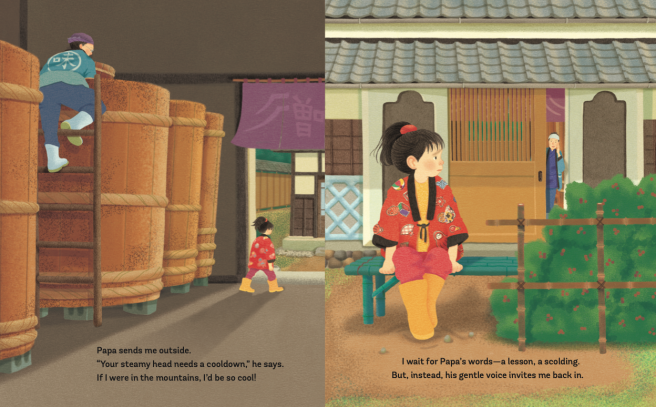
Mizuho Fujisawa’s charming, vibrant illustrations fetchingly extend the text, engaging readers and pulling them right into the action. We’re given a close-up view of miso making equipment and the hard but satisfying work taking place in the misogura. The ‘flavor’ of Japan is nicely conveyed via scenic views, architecture, clothing and other interesting details.

Fujisawa’s depictions of Chiyoko and Papa together are especially well drawn, showing a variety of relatable emotions through convincing facial expressions and gestures. Since their relationship is at the heart of the story, it’s wonderful to follow them from spread to spread, get a sense of their personalities, and see their reactions. I especially like the spread of them shelling soybeans, when Chiyoko squeezes a pod and the bean accidentally hits Papa’s face. Nice bit of playfulness!
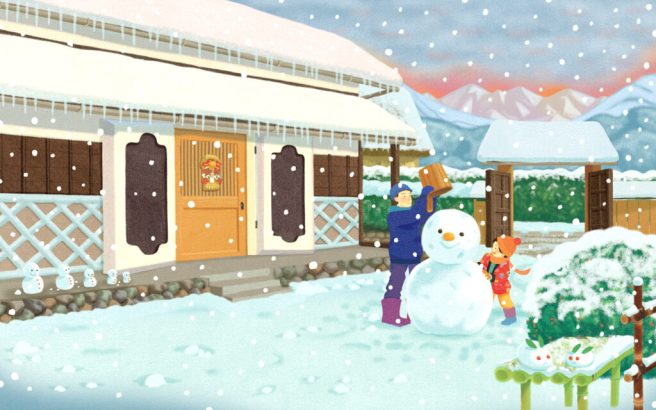
The final double page spread showing Papa and Chiyoko building a snowman together brings the magic of this heartwarming story full circle in a peaceful, satisfying way.
Back matter includes a short list defining key terms, an explanation of the magic mold process, and an easy miso soup recipe. Don’t miss this delicious blend of science, Japanese culture, and familial love!
*

MISO MAGIC
written by Moni Ritchie Hadley
illustrated by Mizuho Fujisawa
published by Albert Whitman & Co., September 2024
Picture Book for ages 4-8, 32 pp.
*Includes Vocabulary List, Mold Process Note, and Miso Soup Recipe
♥️ Enjoy this lovely book trailer:
*Interior spreads text copyright © 2024 Moni Ritchie Hadley, illustrations © 2024 Mizuho Fujisawa, published by Albert Whitman & Co. All rights reserved.
**Copyright © 2025 Jama Rattigan of Jama’s Alphabet Soup. All rights reserved.
 Jama's Alphabet Soup
Jama, I love this, and I too like Miso soup. I haven’t had Japanese food in quite some time. My mouth is watering especially for tempura! It is an adorable book for a little girl to give to her dad on Father’s Day! Then he can read it to her. Papa bonding! Thanks for sharing.
LikeLike
Yes, it’s a lovely read for Father’s Day! Sounds like you need to eat some tempura very soon. 🙂
LikeLike
I love Mona – such a beautiful writer and person. Miso Magic. What a memorable title! Mizuho’s illustrations are as magical as a bowl of miso! I will never look at a bowl of miso the same way – I will feel the love, magic, and time that is stirred into my bowl. Thank you for sharing, Jama Darling!
LikeLiked by 1 person
Didn’t realize you know Moni! Such a charming story, and I do love Mizuho’s illustrations too. Perfect pairing.
LikeLike
The artwork is adorable. The pea-shucking scene is so funny and cute. Looks like a lovely book. Thanks for telling me about it.
LikeLiked by 1 person
I really like the illustrations too. Mizuho Fujisawa is new to me, so I was glad to see her work in this book.
LikeLiked by 1 person