“In El Salvador the full moon is a celestial pupusa.” ~ Francisco X. Alarcón
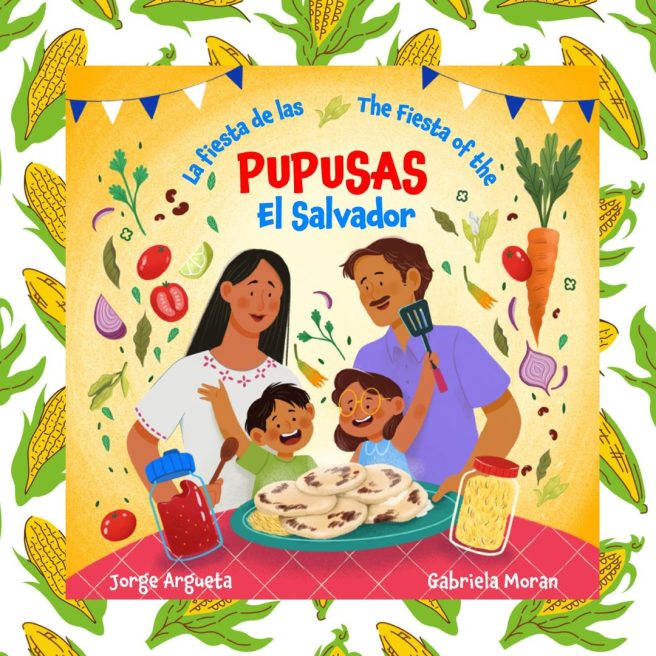
Right about now, I’m hungry for a warm, savory pupusa. Filling of choice? Pork, beans and melty cheese. Don’t skimp on the salsa roja or curtido! Officially declared the national dish of El Salvador in 2005, pupusas are the ultimate happy-making comfort food and the delectable subject of Jorge Argueta’s new picture book.
As a big fan of his bilingual cooking poem series published by Groundwood Books (Sopa de frijoles/Bean Soup (2009), Arroz con leche/Rice Pudding (2010), Guacamole (2012), Tamalitos (2013), and Salsa (2015)), I was excited to see La fiesta de las pupusas/The Fiesta of the Pupusas: El Salvador (Luna’s Press Books, 2024), charmingly illustrated by Salvadoran artist and graphic designer Gabriela Morán.

This joyful celebration of El Salvador’s favorite food is also a love letter to Argueta’s home country, where his family once owned a restaurant and he grew up with the colors, smells, and sounds of traditional foods being lovingly prepared by his mother and aunts in his own kitchen.
As the story opens, our friendly narrator explains that pupusas are a very popular, magical food in El Salvador, where it’s eaten morning, noon, and night. Pupusas are made from corn or rice flour, were once cooked in clay griddles, but are now made on big metal grills. And they’re round!

Las pupusas son redonditas,
son como llantitas,
son como la letra O,
son como la luna,
son como el sol.

Pupusas are round,
like little tires,
like the letter O,
like the moon,
like the sun.
Though most pupusas are filled with beans and cheese, some are made with cheese and loroco, a tiny white fragrant flower:

 ¡Qué rico huele el loroco!
Es una flor blanquita como las nubes.
Picadita, la flor se revuelve con el queso
y se pone en la masa haciéndola una bolita.
La bolita se aplasta aplaudiendo.
Así se hacen pupusas de loroco.
¡Ayyy, qué loroco, más loco y qué delicioso!

Loroco smells so wonderful!
It’s a little flower, white as clouds.
Chopped-up loroco gets stirred in with the cheese
and kneaded in the corn dough to make a little ball.
You flatten the ball by clapping.
That’s how you make loroco pupusas.
Ahhh, loroco, it’s loco, and yummy in the tummy!
Other favored fillings include chicharrón (fried pork), the leaves of wild plants such as papelillo and mora, and even squash blossoms. Our young narrator’s uncle Gabriel, a chef in San Francisco, makes vegan pupusas using beans, mint leaves, mushrooms, spinach and cashew cheese. Indeed, there are pupusas for every taste — there’s no limit to the creative combinations of plants, fruits, and vegetables that can be used. Requiring precision and skill to make, pupusas are truly an art form.

Hay pupusas para todos los gustos:
unas de plantas, frutas y verduras,
otras de zanahorias y jocotes.
Hasta pupusas de anonas hicieron para
las fiestas patronales
de San Pedro Puxtla.
¡Que ricooo!

There are pupusas for every taste:
some with plants, fruits and vegetables,
others with carrots and hog plums.
They even made pupusas with soursop
for San Pedro Puxtla’s
saints-day festival.
So goood!
Speaking of the patron saint’s day fiesta, our friend also mentions a pupusa-eating contest held in her village of Witzapan, where a man ate 45 pupusas with salsa and curtido! Curtido, a pickled cabbage slaw and tomato salsa are commonly eaten with pupusas. She describes how curtido is made:
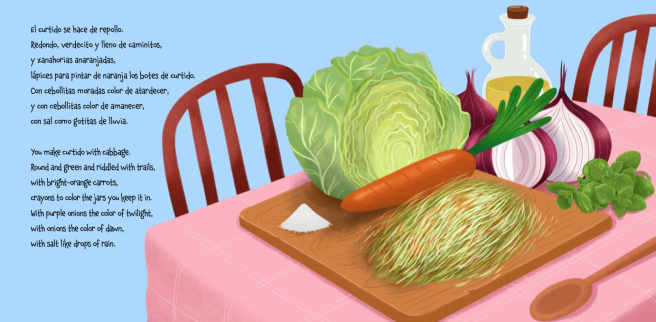
El curtido se hace de repollo.
Redondo, verdecito y lleno de caminitos,
y zanahorias anaranjadas,
lápices para pintar de naranja los botes de curtido.
Con cebollitas moradas color de atardecer,
y con cebollitas color de amanecer,
con sal como gotitas de lluvia.

You make curtido with cabbage.
Round and green and riddled with trails,
with bright-orange carrots,
crayons to color the jars you keep it in.
With purple onions the color of twilight,
with onions the color of dawn,
with salt like drops of rain.
For Argueta, food is poetry and poetry is food. I love his use of sensory details, metaphors and fun imagery to describe ingredients. I especially like hearing that pupusas are happy and magical things, and that, “They’re born singing, they’re born to applause,” referring to hands clapping together to flatten and form the griddle cakes. Pupusas are so divine, they are shaped like celestial spheres. 🙂

Gabriela Morán’s colorful and cheery digital illustrations dance across the pages, capturing the energy and enthusiasm of hungry pupusa makers and eaters. Pictures of fresh cabbage, tomatoes, carrots, onions and stacks of pupusas being cooked and shared with others will certainly make readers curious to try them if they haven’t already done so.

Who can resist images of gooey melted cheese being stretched as the cakes are broken apart with bare hands? Can you imagine the aroma of onion and oregano as the salsa simmers? What about tangy curtido, zesty salsa, rich refried beans, Quesillo cheese, and fried masa all in one bite?
Morán’s ebullient festival of colors and textures is truly a feast for the eyes. Whether eaten at home, at a busy pupusería, or outdoors at a fiesta, the best pupusas are made with love, and not surprisingly, taste even better when shared with family and friends. There is even a special place in the highlands of San Salvador called Los Planes de Renderos, where every weekend for decades people have gone to eat pupusas.

In his Author’s Note, Jorge says, “My house in the San Jacinto neighborhood of San Salvador was full of applause: it was my mama and my aunties making pupusas. From early in the morning until late afternoon, every day the house felt like a pupusa, filled with flavors, colors, and family joy.”
Kids will enjoy learning about the origin of pupusas, how they date back to pre-Columbian times with the indigenous Nahua people, and how rice flour came to be used in the town of Olocuilta. Now the rice flour pupusa capital, Olocuilta hosts the National Pupusa Festival every November. In 2022, they broke their own Guinness World Record by creating a pupusa 18 feet in diameter!

Back matter also includes a Glossary and Did You Know? tidbits. In addition to Central and South America, there are now pupuserías all over the world in places like Japan, France, Australia, Mexico, Italy and the United States. In 2005, pupusas were declared an Intangible Cultural Heritage by the United Nations Educational, Scientific, and Cultural Organization (UNESCO) in recognition of their cultural importance and contribution to the culinary world.
La fiesta de las pupusas is a wonderful introduction to Salvadoran cuisine and makes a great addition to school and home libraries. Colorful, fun and engaging, this tasty book begs for repeated readings and is a perfect choice for Hispanic Heritage Month.
Hooray for pupusas and El Salvador, a small country with a big appetite!
*

LA FIESTA DE LAS PUPUSAS/THE FIESTA OF THE PUPUSAS: El Salvador
written by Jorge Argueta
illustrated by Gabriela Morán
translated by Elizabeth Bell
art direction and production by Holly Ayala
published by Luna’s Press Books, August 2024
Bilingual Nonfiction Picture Book for ages 4+, 32 pp.
*

Lovely and talented Irene Latham is hosting the Roundup at Live Your Poem. She is sharing about her new anthology with Charles Waters, The Mistakes That Made Us: Confessions From Twenty Poets. Be sure to check out the full menu of poetic goodness being served up around the blogosphere this week. Can you believe September is just about over?
*Interior spreads Spanish and English text copyright © 2024 Jorge Argueta, illustrations © 2024 Gabriela Morán, published by Luna’s Press Books. All rights reserved.
**Copyright © 2024 Jama Rattigan of Jama’s Alphabet Soup. All rights reserved.
 Jama's Alphabet Soup
Another book to put on my “must buy” list for school and the public library. I live in an area full of Central American families. We have pupusaterias here. I’m always looking for bilingual books and books that support pride in one’s heritage. I can’t wait to share this with Mr. A. who is teaching a Meso-american unit right now.
Thank you, Jama! I’m also going to link this blog to my library announcements for kids to read and to the librarian newsletter so that other school librarians can see it. You are always one of my favorite book review sources.
LikeLiked by 1 person
So happy to hear this book hit the mark for you, Linda. Thanks for sharing about it with other librarians and Mr. A! You’re lucky to have pupusaterias nearby. Yum!
LikeLike
Thank you for this wonderful recommendation, Jama. I’m always hungry when I leave your site!
LikeLiked by 1 person
Hungry is good, right? I’m always on the lookout for delicious food-related books. 🙂
LikeLike
What a yummy way to greet the morning. A beautiful, savory, meaningful book. Love learning about other cultures, food, memories. “Food is poetry and poetry is food.” It’s been on my literary bucket list to write my “love letter” to Korea. Pupusas has inspired me. But first… Rosita’s Restaurant is in my hood – will be ordering pupusas! Mmm…Thank you for sharing, Jama Darling!
LikeLiked by 1 person
Enjoy Rosita’s! And I’m anxious to read your love letter to Korea. You’ve already written a cookbook, so writing about Korean food (and other memories) should be a thoroughly delectable experience! 🙂
LikeLiked by 1 person
Food and poetry are such a delicious combination! I’ve not had pupusas, but I will remedy that soon! And I love Jorge and Elizabeth’s work together. Beautiful! Thank you, Jama! xo
LikeLiked by 1 person
Yes, food and poetry!! Must feed body, mind and spirit. Hope you get to try pupusas soon, Irene. I’ve been inspired to try many new-to-me foods by reviewing books such as this one.
LikeLike
I love pupusas & we have so many places to buy them here, Jama, & I’ve loved Argueta’s books before, too. Thanks for sharing this one, poetry in food and in words, too! “With purple onions the color of twilight.” That is a beautiful thought!
LikeLiked by 1 person
Yes, that’s a beautiful line, isn’t it? Good to hear you like pupusas and have easy access to them.
LikeLike
A delectable review! I must try a pupusa (or several, but probably not 45 in one sitting) very soon. Thank you for sharing!
LikeLiked by 1 person
LOL. Yes, 45 in one sitting is quite something, isn’t it?
LikeLike
Jama, reading your review reminds me that I am hungry. Thank you for filling my taste buds with poetic goodness. “For Argueta, food is poetry and poetry is food.” Your review makes for an interesting book. You brought so much to the table with your yummy thoughts.
LikeLiked by 1 person
It’s always a treat to read and review Jorge’s books. I like that he often writes about food, but I also enjoy his books about immigration and Mother Earth.
LikeLike
What a great line: “They’re born singing, they’re born to applause!” — Chef’s kiss!
LikeLiked by 1 person
Yes, I love that part too. It’s child-like and whimsical and definitely got my attention.
LikeLike
Jama, I’m intrigued by these delicious-sounding pupusas. I hadn’t heard of them before today, so I will have to pay attention for a chance to try them. You shared so many sweet details from the book. It is fascinating, especially the world record size pupusa.
LikeLiked by 1 person
I hadn’t known about or eaten pupusas until I read and reviewed Holly Ayala’s book, ABC El Salvador (she’s Jorge’s wife and publisher of Luna’s Press Books). I love learning about different cultures through children’s books. Hope you get to try pupusas sometime soon.
LikeLiked by 1 person
My mouth is literally watering, Jama! What a bright and beautiful new book–and post! Thank you always for your enthusiasm!
LikeLiked by 1 person
Thanks for stopping by to read, Laura. Good foodie books always hit the spot. 🙂
LikeLike
My stomach is rumbling reading your post! What a beautiful introduction to a food and culture I do not know about–looks like a perfect window and mirror book.
LikeLiked by 1 person
Yes, it really is a good window and mirror book. There aren’t that many titles about El Salvador, so it’s good to see more being published.
LikeLike
It’s beans and melty cheese for me in my pupusas! I like to get them at a Nats game because the stand is right near the seats we usually get, and because well…they are delicious. Your posts are always so stuffed with goodness, Jama. I know I’m not online as much as I used to be, but always glad to count you in my circle of friends.
LikeLiked by 1 person
Happy to hear you like pupusas!! Didn’t realize you could get them at a Nats game. I do miss you online, but am glad you still share poems with the Poetry Sisters every month. Your “7 ways” poem took the top of my head off, much like what happened when I first read “Bones of January.” Can you believe it’s been 17 years since you posted that? I still think about it after the holidays.
LikeLike
Culinary and poetic gorgeousness, and now I’m so hungry… 😀
LikeLiked by 1 person
I’ve learned to eat quite a few new foods while reviewing picture books. Now you know my “real” incentive for continuing to do that. 😀
LikeLike