“Chefs like me feed the few, but our destiny is to feed the many. To be an army of goodness where a plate of food becomes a plate of hope…a light in dark times. Together, we can change the world through the power of food.” ~ Chef José Andrés
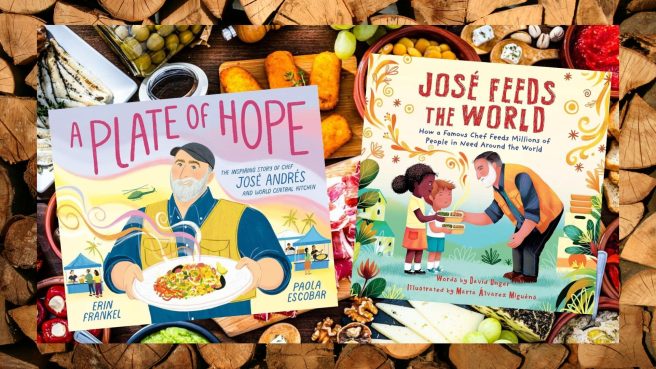
Since I’m a big fan of chef, restaurateur, and humanitarian José Andrés, I was happy to see both of these recently published picture books about his interesting life and amazing accomplishments.
Chef Andrés’s World Central Kitchen is truly a beacon of hope during tumultuous times of untold trauma, displacement and uncertainty due to natural and man-made disasters. Whether earthquake, hurricane, war, wildfire or pandemic, WCK is right there on the frontlines offering food, comfort, and a helping hand to local communities.
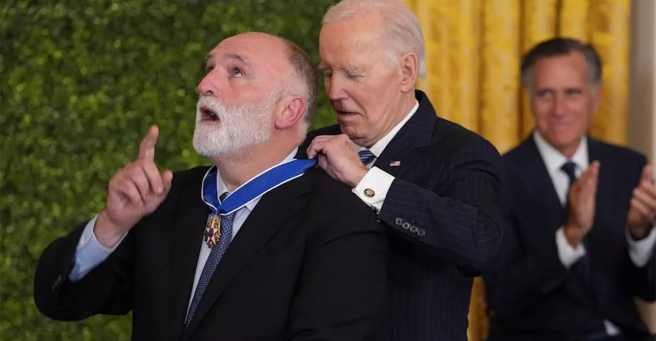
You may know that in early January, Andrés received the Presidential Medal of Freedom, and that 2025 marks WCK’s 15th anniversary. Just recently, WCK provided free meals to firefighters, first responders and evacuees of the catastrophic wildfires in Los Angeles via food distribution centers as well as local restaurant and food truck partners.
So how did this incredible food aid/disaster relief nonprofit get started? What first inspired Andrés to become a chef, what continues to motivate him, and what are some of his core beliefs when it comes to food?
Both books, A Plate of Hope and José Feeds the World trace José’s life from his childhood interest in cooking, to attending cooking school in Barcelona, to becoming an assistant chef at El Bulli, opening a tapas restaurant called Jaleo in Washington, D.C. (where he also volunteered at the DC Central Kitchen), to the 2010 Haiti earthquake, which motivated him to create World Central Kitchen.
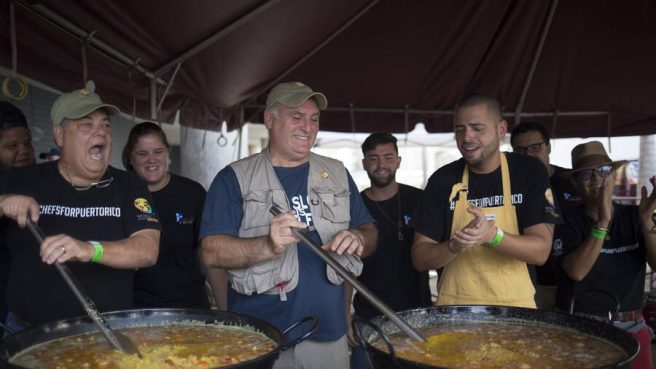
When Hurricane Maria hit Puerto Rico in 2017, José and his WCK team got local people to volunteer after realizing they couldn’t do the work alone and there weren’t any other nonprofit organizations planning to feed the millions of people affected by the catastrophe.

As time passed, each new disaster presented different challenges requiring different solutions, and José found himself wanting to do more and more — establishing food distribution systems, flying in equipment to set up field kitchens, offering Meals Ready to Eat, etc. He also empowered local communities to use their skills and resources to help others as they had helped themselves.
While both books offer engaging introductions to Andrés’s life and work from childhood to present day, each has unique features to recommend it. Here are some of the things that stood out for me about each book:
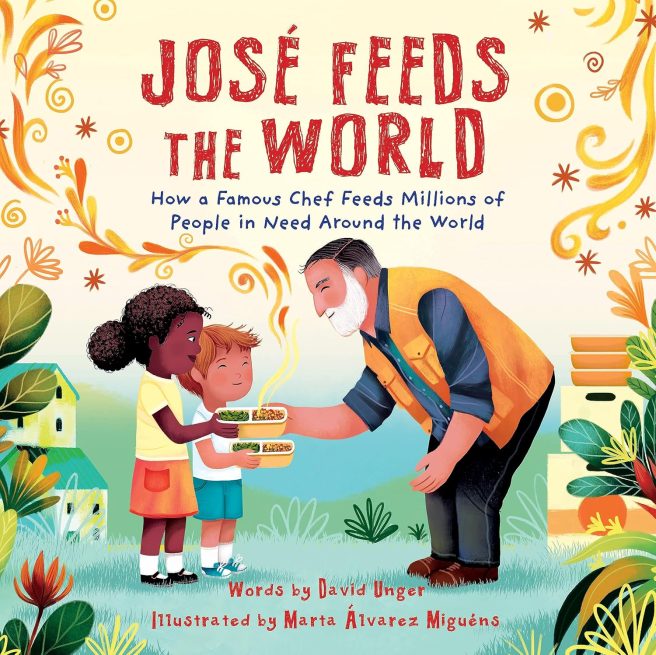
José Feeds the World: How a Famous Chef Feeds Millions of People in Need Around the World by David Unger and Marta Álvarez Miguéns (Duopress, 2024).
1. David Unger imparts a lot of facts in an accessible, engaging narrative with a clear timeline, showing not only why Andrés created WCK after the Haiti Earthquake, but how with each subsequent disaster response, he implemented innovative solutions according to need and location. In Haiti he had learned the importance of cooking food in the local style to make people feel better and to help build a community. In addition to Haiti and Puerto Rico, Unger included Hurricane Dorian in the Bahamas, the Fire Volcano in Guatemala, the COVID-19 pandemic (Navajo Nation, California, NYC), and the Russian invasion of Ukraine.

2. He begins the book by mentioning how both José’s parents were nurses and that during his childhood he spent a lot of time in hospitals seeing medical personnel helping people. This instilled in him a sense of empathy, compassion, and a desire to care for others. Early on, he also saw how “food could make sad people feel better.”

3. After opening Jaleo in Washington, D.C. and other restaurants thereafter, José was able to realize his dream of inventing his own recipes. He started to experiment with new ways of cooking and combining ingredients in creative ways, and subsequently received many awards for his work.

4. Marta Álvarez Miguéns’s vibrant illustrations are packed with affecting details showing José’s interactions with family, friends, fellow culinary workers, customers, traveling companions, and local residents. The sense of joy and community shines through despite tragic circumstances, and readers will get a better sense of what disaster relief workers do. “Whenever José Andrés goes to a new place where people are hungry, he gets motivated because he remembers his father wearing a white apron and cooking paella. José can see his neighbors, young and old, eating, laughing, and even dancing.”
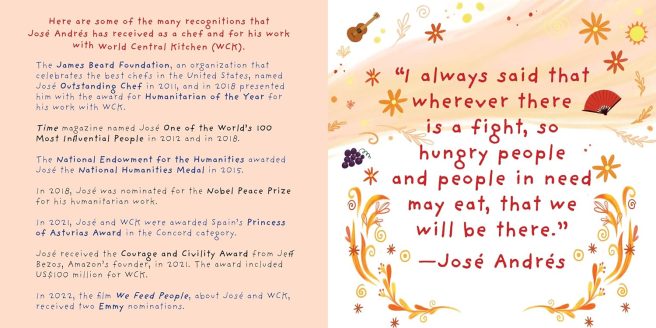
5. The book ends with a “Career Day” spread showing a diverse group of kids reminding the reader that, “One day you, too, will find your calling and make the world a better place.”
*

A Plate of Hope: The Inspiring Story of Chef José Andrés and World Central Kitchen by Erin Frankel and Paola Escobar (Random House, 2024).
1. Erin Frankel’s lyrical, poetic text brims with mouthwatering sensory details. Important milestones in Andrés’s life are highlighted with recurring taglines in Spanish, underscoring his expansive approach to everything. There is always more — more possibilities, more places, more ways to help. The book begins with No es solo arroz (“A paella is so much more than just rice”), continuing with ‘more’ than just a boat, a restaurant, a trip, more than just a dream. Andrés views life as full of opportunities to learn, reach out, and impact ever-widening, diverse groups around the world.

2. Frankel includes Andrés’s year after culinary school cooking for sailors on a famous Spanish navy ship. This expanded his geographical and culinary horizons, piquing his interest in the United States. When he returned to Spain and worked at El Bulli, he was able to put into practice his wish “to tell stories with food.” As the most famous restaurant in Spain, El Bulli was a place “where the food spoke to José.” When he craved change, something new, he left Spain for the United States, cooking his way from NYC to Washington, D.C.


3. I like the emphasis on the “we” rather than “me” recurring theme, showing how teamwork is essential for a food program such as WCK to succeed. Andrés’s boundless energy, organizational skills and ability to mobilize thousands of volunteers cannot be underestimated. The “we” also refers to the “All are Welcome” mindset. As an immigrant himself, Andrés is sensitive to the importance of promoting diversity and inclusion (cooking without borders): “Build longer tables, not higher walls.” “Everyone deserves a hot plate of food.” Beyond feeding the body, it is just as important to feed the soul by extending kindness, lifting spirits, and most important, offering HOPE. In this way, food can truly be transformative.
4. Paola Escobar’s emotive, captivating illustrations capture Andrés’s indefatigable personality as he jubilantly moves from one phase of his life to the next. Her use of hand-drawn text in some of the spreads — “Change Me, Don’t Be Afraid, Surprise Me, Anything is Possible!” — encapsulate some of José’s guiding principles, in addition to reminders that, “We Haven’t Forgotten You” and “We Care About You.” Love the sandwich-making assembly line in Puerto Rico and the flurry of kitchen activity at El Bulli!

5. Backmatter includes an interesting Author’s Note as well as a Selected Bibliography for further study. Frankel mentions Andrés is also a bestselling author, TV personality, and proud father, and that he and his wife Patricia hatched the idea of WCK together.
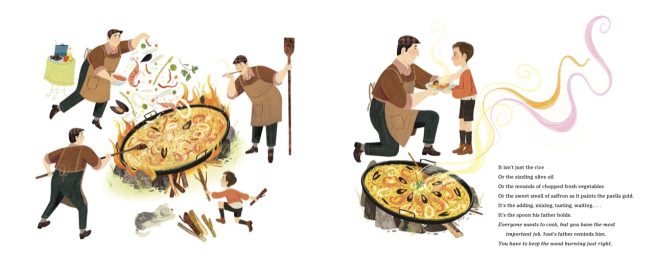
Finally, both José Feeds the World and A Plate of Hope describe how Andrés grew up with family gatherings every weekend, and that these loving memories of food, togetherness, and happy times made a lasting impression on him. He’ll never forget gathering the wood for the paella fire as a young boy, wishing he could be the one “adding, mixing, tasting, waiting.” But his father had taught him a valuable lesson back then, that in fact, tending the fire was actually the most important job: “You have to keep the wood burning just right,” and “. . . if you control the fire, then you can do any cooking you want.”
It’s hard to imagine José growing up becoming anything other than an award-winning chef and food activist. The kitchen had always been his favorite room in the house, and even as a boy of three, he was already helping his mother peel onions and scrub carrots. With the World Central Kitchen, he’s been able to prove that food tells the most powerful story of all: “You have not been forgotten. You are not alone,” embodying the very essence of humanitarianism. With his big heart, outsized personality and generous spirit, José is truly someone for whom cooking is an expression of love.
Both these books should be considered essential additions to home, school, and public libraries. No finer role model or inspiration for kids than this modern-day hero, someone who’s continuing to make a huge difference in the world. Every day, it seems, there is a new disaster or crisis. It is reassuring to know that the worst of times often brings out the best in people.
*

JOSÉ FEEDS THE WORLD: How a Famous Chef Feeds Millions of People in Need Around the World
written by David Unger
illustrated by Marta Álvarez Miguéns
published by Duopress, January 2024
Picture Book Biography for ages 4-8, 40 pp.
*Includes List of Awards Andrés received as a chef and for WCK + a Glossary
*Starred Review* from Youth Services Book Review
*

A PLATE OF HOPE: The Inspiring Story of Chef José Andrés and World Central Kitchen
written by Erin Frankel
illustrated by Paola Escobar
published by Random House Studio, February 2024
Picture Book Biography for ages 4-8, 48 pp.
*Includes Author’s Note and Selected Bibliography
**Starred Review from Kirkus**
New York Public Library Best Books 2024
Recommended for 2025 NCTE Orbis Pictus Award for Outstanding Nonfiction
***Spanish Edition Available
*
♥️ For a good serving of positivity, enjoy this video of Chef Andrés sampling his favorite Spanish snacks. Funny, passionate, lovable. Guaranteed to make you laugh. 😀
*
*Interior spreads from José Feeds the World, text copyright © 2024 David Unger, illustrations © 2024 Marta Álvarez Miguéns, published by Duopress. All rights reserved.
*Interior spreads from A Plate of Hope, text copyright © 2024 Erin Frankel, illustrations © 2024 Paola Escobar, published by Random House Studio. All rights reserved.
**Copyright © 2025 Jama Rattigan of Jama’s Alphabet Soup. All rights reserved.
 Jama's Alphabet Soup
F
LikeLike
I
LikeLike
So great Jama! Can’t wait to share with my 4th graders who are currently learning about Caring👍
LikeLiked by 1 person
Sounds perfect for them!
LikeLike
He does such AMAZING work! Thank you for spotlighting these books!!
LikeLiked by 1 person
He certainly does — I don’t know how one person could juggle so many things all at once either. WCK, restaurants, podcasts, books, etc., etc.
LikeLike
His good works make such a difference! Wonderful books, thanks for featuring them!
LikeLiked by 1 person
Yes, he’s truly an inspirational person. The essence of humanitarianism.
LikeLiked by 1 person
Oh, Jama, this is the first time I’ve seen these books shared anywhere! How wonderful for there to be two about this special man! I hope that I can get them! I agree about his figuring out the “importance of cooking food in the local style”. What a gift he is to the world! Thanks so much for sharing! Hope you’re keeping warm at home. I know you have snow as we do today & tomorrow!
LikeLiked by 1 person
These two PBs came out about a month apart last year. They’re both good, each has its own merits. Ingenious not only to cook in the local style, but to recruit people in those communities to actively become involved. I like the idea of using restaurant kitchens on location.
Yes, we’re bracing for snow starting this afternoon, supposedly 6-8 inches. Hope you stay safe and warm, and enjoy your snow!
LikeLiked by 1 person
Thanks, Jama, winter won’t go away yet! When I see photos of Andres’ team cooking, I am constantly amazed at the size of those pots! He’s awesome!
LikeLiked by 1 person
So inspirational, Jama–thank you for sharing with aloha!
Margo 🙂
LikeLiked by 1 person