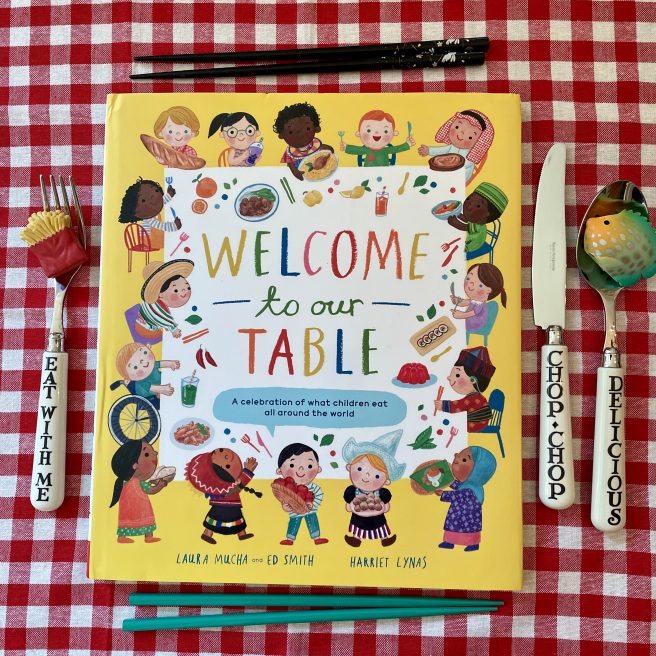
I couldn’t help but smile upon first seeing the sunny yellow cover with 16 happy kids at the table sharing dishes from their native countries. What an irresistible invitation to join them for a mouthwatering feast!
Even before you open the book, the message is clear: international, diverse, community, inclusive, fun and delicious. When you start reading, it’s so easy to relate: We are different, but we all love food!

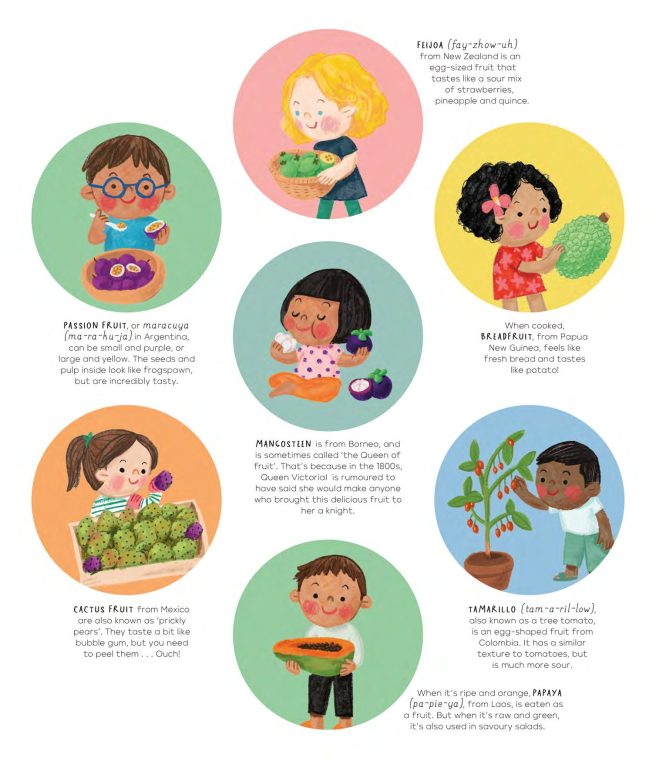
Welcome to Our Table: A Celebration of What Children Eat All Around the World (Nosy Crow, 2023) is an epic smorgasbord featuring hundreds of dishes and ingredients, both familiar and exotic, temptingly flavored with fascinating tidbits about how certain foods are grown and prepared.
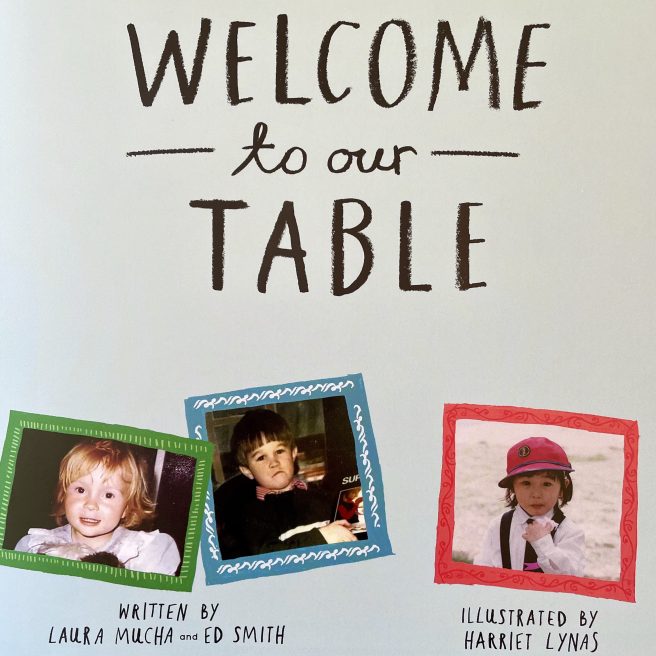
Written by poet-author Laura Mucha and her chef-food writer husband Ed Smith, the 64-page compendium is served up with Harriet Lynas’s cheery, drool-worthy digital illustrations, sure to whet the appetite and arouse curiosity.
The mouthwatering menu contains 33 “courses” or topics, most featured on inventively designed, reader friendly double page spreads along with several single page spreads + sidebars. Friendly kids of multiple ethnicities are shown eating, serving, or interacting with various types of foods (interesting asides are conveyed via occasional speech bubbles).

After a brief introduction, Mucha and Smith set the table with descriptions of common eating utensils. Besides forks, knives, spoons and chopsticks, more than 1/4 of the world eats mainly with their hands. In India, Pakistan, Bhutan and Bangladesh, fingers are the way to go! And in places like South Korea, Italy or Nigeria, hands are preferred only for certain dishes (lettuce wraps, pizza, pounded yams).
Next, how do we experience food? Flavor is a combination of taste, smell and physical sensations like temperature. Our tongues can sense five different tastes: sweet, salty, sour, umami, and bitter. But did you know flavor mostly comes through our noses? Hooray for those olfactories! Some of the smelliest foods ever (hold your nose!) include Japanese natto, French Vieux Boulogne cheese, and Stinking Toe Fruit — the seed pods from a West Indian locust tree that not only resemble toes, but smell like them too (I think I’ll pass on that one).
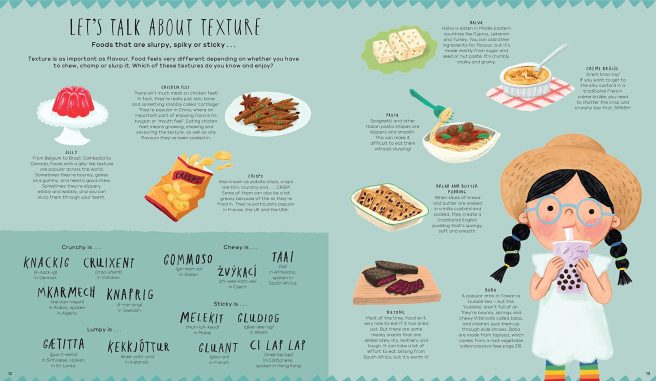
Texture is also important. We love the crunchiness of chips, can slurp slippery jello through our teeth, enjoy the sponginess of bread pudding or the bounciness of boba balls, can even give our jaws a good workout with a slice of Biltong from South Africa. Why not bask in the “mouth feel” of Chinese chicken feet?
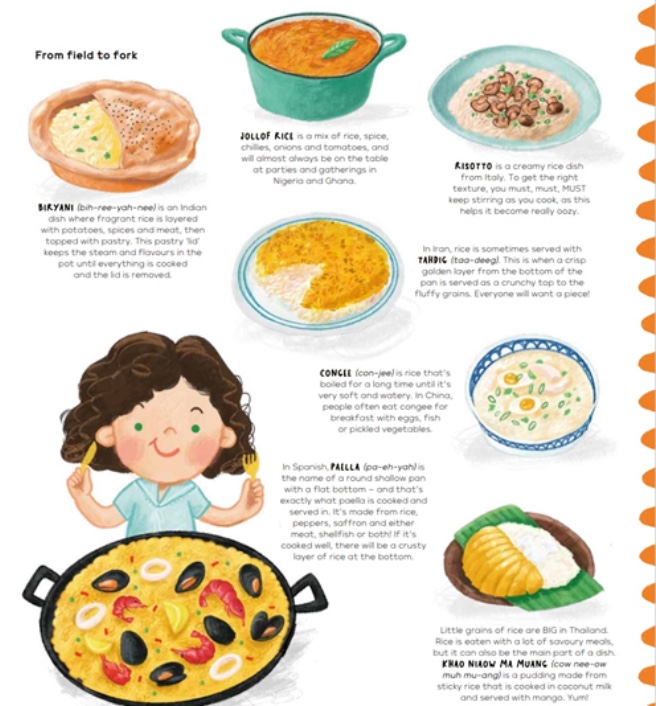
We are then treated to spreads featuring ancient global staples: rice, maize, bread and noodles. We see that growing rice takes a lot of work, and that of all the plants grown for human consumption, it is one of the most important (more than 40,000 varieties!). From biryani to risotto to paella and congee, rice takes center stage (did you know there’s on average 5,000 grains in a single bowl?).

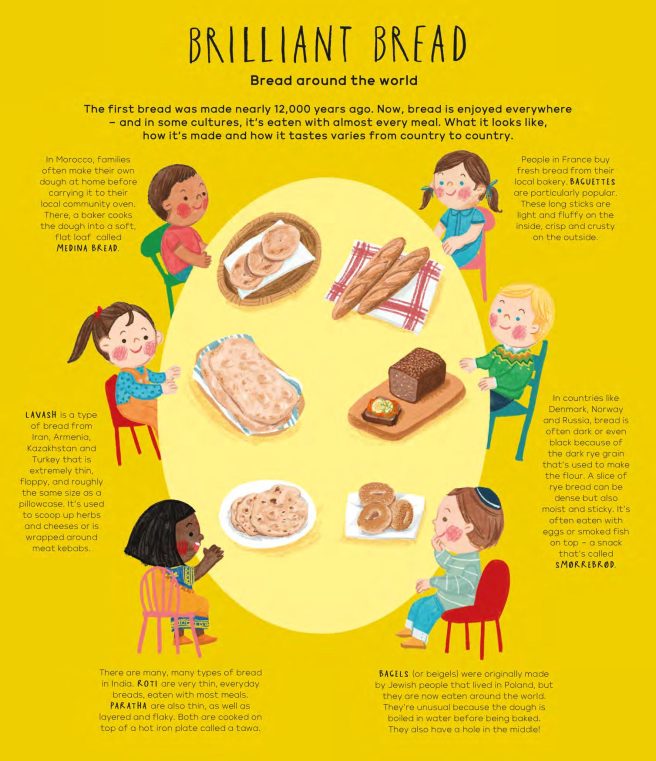
Kids will like reading about sweet corn on the cob and popcorn, as well as corn flour (masa harina) for making tortillas. What about favorite breads? Choose from lavash, roti, bagels, or baguettes. When it comes to oodles of noodles, learn the different ways noodles are made (pressed through wires, cut with a knife or machine, etc.).
Fun Fact: “Hundreds of years ago in Japan, women started stomping on dough with their feet to make udon noodles. They even carried backpacks with books to make themselves heavier!”
Noodle dishes? Vermicelli (Vietnam), spätzle (Austria), lokshyna (Ukraine), num banh cook (Cambodia). Don’t forget the different types of pasta (farfalle, cavatappi, lumache, linguine). Yes, please!!

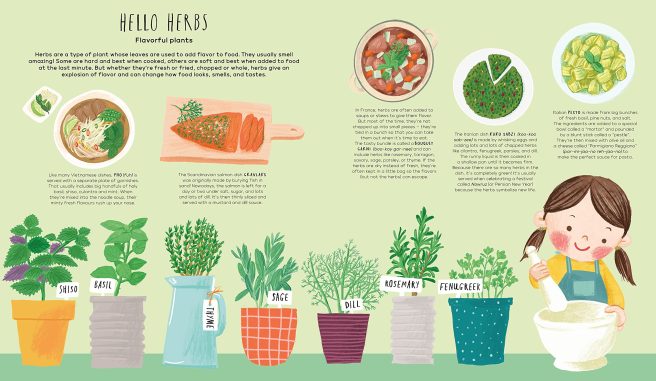
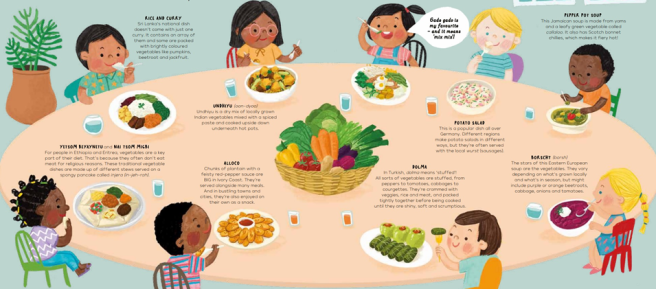
This foodie festival is just getting started with spices, herbs, pickles, fruits, veggies, tubers, leafy greens, chili peppers, tomatoes, pulses, soybeans, and nuts each taking their turns in the spotlight. If you’re a carnivore, feast on “Beautiful Beef,” “Billions of Birds,” “Pork, Glorious Pork,” “Hungry for Hangi” (lamb), shellfish and fish like salmon, cod, pollock, anchovies and tuna. Read a little about the impact of overfishing on the planet too.


As you near the ending of this meal to end all meals, hopefully you’ve left room for universal kid favorites like milk, ice cream, apples, and bananas.
Grand finale? “Pastries and Desserts” of course! Nibble on delectable sweets you’ll definitely want to try if you haven’t already: Lamingtons from Australia (little sponge cakes covered in chocolate and rolled in coconut flakes), Makroudh from Tunisia (diamond-shaped cookies filled with date paste), Picarones from Peru (deep fried sweet potato and squash dough rings drizzled with syrup). Was happy to see two personal favorites, Chinese Moon Cakes and Japanese Daifuku Mochi on the menu too. YUM!

To top it all off (yes, there’s more!), an intriguing discussion of “Future Foods.” In view of climate change and the ever growing human population depleting natural food sources we can farm, fish, or forage, we might come to depend on “fake food,” that is, food made in laboratories and factories, since it would require less energy, water and space to make. These products will taste and feel similar to meat, fish, vegetables or fruit.
If all else fails, we can always subsist on incredible insects (caterpillars, beetles, termites, bees). There are actually around 2,000 edible insects, including worms, flies and their larvae. I can just hear a collective “ewwww” coming from young readers. 🙂
Celebratory, entertaining, engaging and jam packed with interesting cultural and culinary facts, Welcome to Our Table is one literary feast kids will want to return to again and again — there’s just so much to see, study, and digest on every single page. They will have a blast identifying all the foods/dishes they already know, and learning about those that are new to them. Kudos to the illustrator for meticulously drawing all the dishes in an accurate, kid-friendly way (I can’t imagine how many hours of research that required!).
As the authors mentioned in their introduction, food is an amazing way to travel the globe and to learn about different countries. We see how kids around the world “eat the same things, the same things cooked differently, and different things altogether.” Food feeds our bodies, but also brings people together, forms cultures and traditions.
Budding linguists will appreciate the spreads showing how to say ‘delicious,’ ‘goodbye,’ ‘crunchy,’ ‘chewy,’ ‘happy eating,’ etc., in a variety of languages. Pronunciation guides for foreign dishes are also included, and food trivia buffs will have a field day with the tasty little nuggets sprinkled throughout.
Back matter includes a map of the world and a list of all the countries and places featured in the book.
Did you know:
There are 5,000 types of potatoes and 10,000 types of tomatoes.
The spiciest chili pepper is the Carolina Reaper (it ranks 1,500,000 – 2,200,000 on the Scoville scale). HOT stuff!
People in Indonesia eat deep-fried cow hide coated in a funky sweet and spicy paste (Rambak Petis).
If you’re in the mood for something different, you can enjoy Tarta de Seso (creamy pie filled with spinach, cheese, and cow brains) in Colombia.
Ukrainians eat Salo (cold white fat from a pig’s back), and Jamaicans, Salted Pig Tails.
It truly is incredible what people eat and why. So pull up a chair to this global table soon, put on your best bib, and graze to your heart’s content.
Bon Appétit! (French) Sahtain! (Lebanese) Kia Mākona! (Maori) Ha Kuu Macaanaato! (Somali).
*

WELCOME TO OUR TABLE: A Celebration of What Children Eat All Around the World
written by Laura Mucha and Ed Smith
illustrated by Harriet Lynas
published by Nosy Crow (August 2023)
Picture Book Nonfiction for ages 6-10, 64 pp.
♥️ Enjoy these two short videos where the authors discuss the book and suggest activities to do at home.
*Interior spreads text copyright © 2023 Laura Mucha and Ed Smith, illustrations © 2023 Harriet Lynas, published by Nosy Crow, 2023. All rights reserved.
**Copyright © 2025 Jama Rattigan of Jama’s Alphabet Soup. All rights reserved.
 Jama's Alphabet Soup
What a delicious and artfully delightful book Jama! I particularly liked the fruit and herb pages, and learning about the mangosteen fruit! Thanks for your tasty review!
LikeLiked by 1 person
Lots of info packed into this one. Fun to read. 🙂
LikeLike
I’m teaching a food unit to my 4th graders right now about Jose Andres’ World Food Kitchen!! ( I bought the book after your wonderful review last month😉) This book will enhance the fun discussions we are having (my kids are mostly immigrants from around the world… so in reality I’m the one doing the learning😆😆)
LikeLiked by 1 person
Wow! Great to hear about the Jose Andres food unit!! Uncanny how two PB biographies about him came out at about the same time early last year. 🙂
P.S. Been trying to contact you via email about your Awesome Earth book. Need your snail mail addy to send it. Please email me: readermail (at) jamakimrattigan(dot)com if you haven’t received my messages. Thanks!
LikeLike
It’s amazing all of the different foods we consume all over the world! It has always been my idea that food is the chain that links us all together. If only we could all sit down at a huge table and eat and talk the world would be a better place!🍔🌭🌮🌯🥙🥗🥪🍕🍟🍖🍗🥓🍱🥘🧆🍲🍛🍜🍝🍣🍤🍿🥟🍳🥞🧇🍪
LikeLiked by 1 person
Yes, if only . . . one big table. That’s the one thing all humans have in common. Everyone needs food to survive. Food not only connects us, but learning about different foods is IMHO the best way to learn about other cultures, taking away the strangeness and “other-ness” that seems to be dividing us now.
LikeLike