What’s on the menu today?
Hmmm . . . let’s see. I’ll start with a plate of refreshing ceviche, followed by spicy jerk chicken — and then for dessert, rice pudding. Sound good?
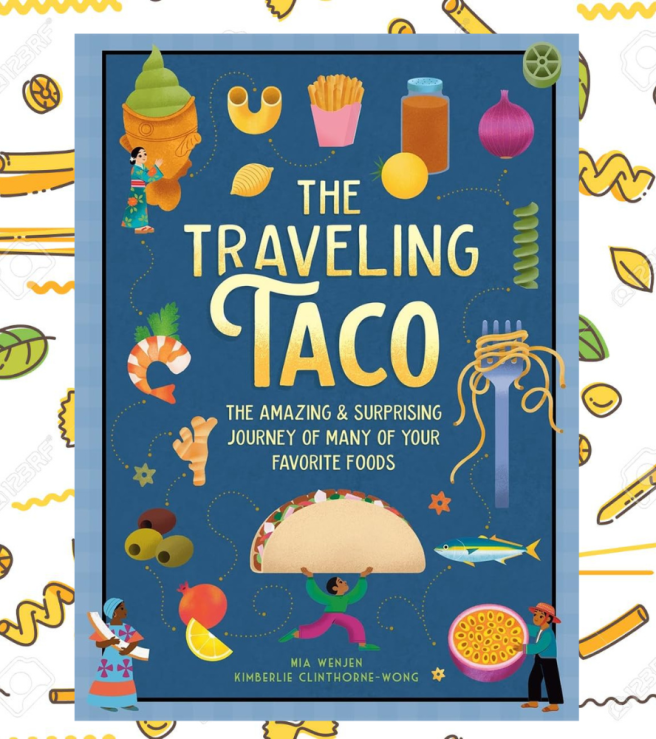
In Mia Wenjen’s delectable picture book The Traveling Taco: The Amazing & Surprising Journey of Many of Your Favorite Foods (Red Comet Press, 2025), hungry readers are invited to nibble from a scrumptious smorgasbord of twelve different dishes, everything from pizza and pasta to cheesecake and churros.
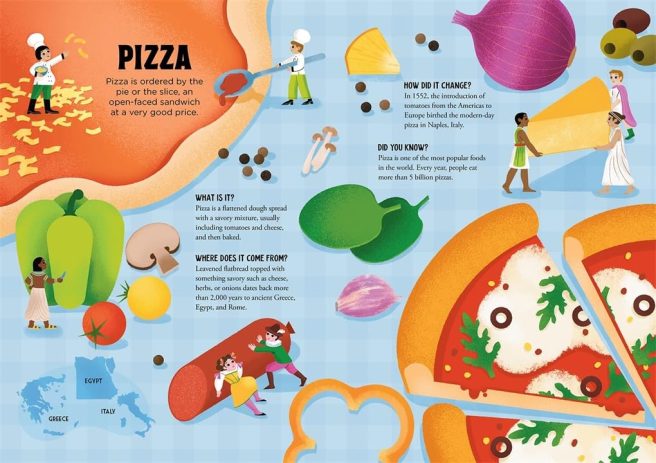
Whimsically illustrated by Kimberlie Clinthorne-Wong, the history of each of these popular foods is served up in a double page spread with an introductory rhyme + appetizing info bites answering four basic questions:
- What is it?
- Where does it come from?
- How did it change?
- Did you know?
Learning about food origin and evolution is fascinating as we travel across the globe and back through time. Do French Fries come from France or Belgium? Did you know people all over the world eat more than 5 billion pizzas every year, or that cheesecake can be traced back to Ancient Greece and the first Olympic Games?
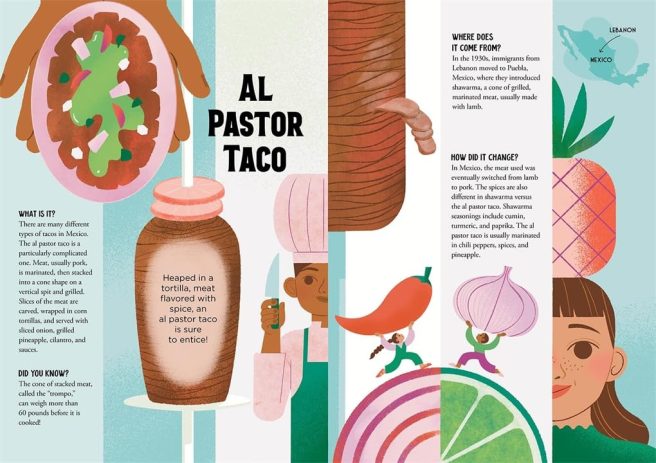
The feast begins with the tastebud tempting Al Pastor Taco; we learn that it actually traveled to Puebla, Mexico in the 1930s via Lebanese immigrants who “introduced shawarma, a cone of grilled meat, usually made with lamb.”
Heaped in a tortilla, meat flavored with spice, an al pastor taco is sure to entice!
Once in Mexico, pork was eventually substituted for the lamb and marinade seasonings changed to chili peppers, spices, and pineapple. The Al Pastor is just one of many different types of tacos in Mexico.

As they page through the book, kids will enjoy picking up juicy tidbits about foods familiar to them. The next time they chow down on a comforting dish of mac ‘n’ cheese or spaghetti and meatballs, they might remember that Italians use semolina flour for their pasta, which is higher in protein than the flour typically used in other countries, or that Arab traders introduced Sicilians to pasta in 1154 CE, despite the popular misconception that Marco Polo first introduced it to Italians in the 13th century.
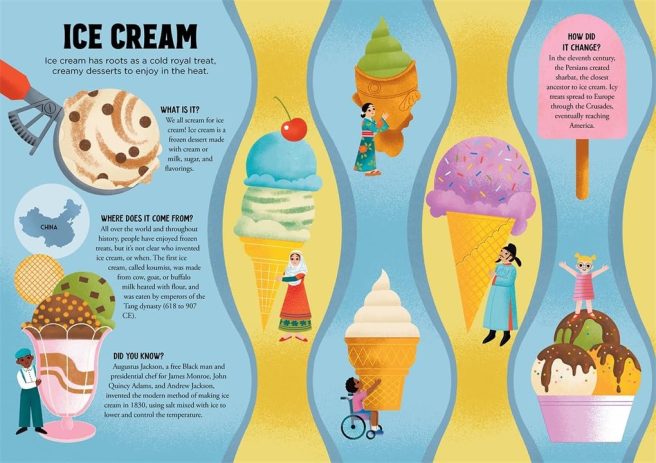
Who brought French fries to America? Who opened the first Fish and Chips shop in London? What is koumiss (the first ice cream)? What’s the difference between the Chinese youtiao doughnut and a churro? Inquiring foodies want to know! 🙂
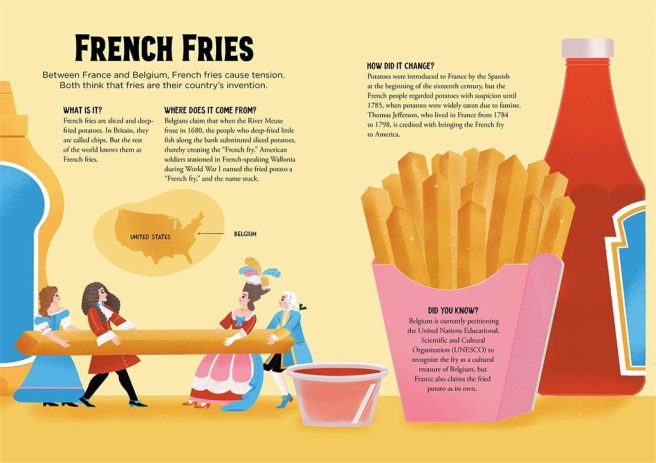
Clinthorne-Wong’s delightful illustrations are populated with ethnically diverse characters interacting with different foods in fun ways. Love how she’s played with scale: in most of the pictures, the people are small and the foods are BIG. Giant forks, ice cream cones, slabs of cheese and bell peppers! The French and the Belgians play tug of war with a jumbo French fry, while an Indian woman stirs an enormous bowl of rice pudding. And who wouldn’t love a churro taller than they are, or a doughnut the size of an inner tube?
Along with foods they’ve already eaten, readers will learn about a handful of unfamiliar ones — most likely ceviche, pavlova, and jerk chicken. The tempting morsels in this book are a good incentive to try something new and even explore each food in more detail.

I like how food is presented as a dynamic entity: it continues to evolve according to where it goes, how people interact with it, how tastes and fads change, and what needs it fills. The book’s title, “The Traveling Taco,” caught my attention right away and aroused my curiosity. It shines a tasty spotlight on the world’s diversity and the interconnectedness of us all.
This book will spark lively conversations about favorite foods, places visited, and which featured foods readers have already tried. Back matter includes a map showing food travel routes and a bibliography. Another dish of ice cream, please! 🙂
*

THE TRAVELING TACO: The Amazing & Surprising Journey of Many of Your Favorite Foods
written by Mia Wenjen
illustrated by Kimberlie Clinthorne-Wong
published by Red Comet Press, May 2025
Nonfiction Picture Book for ages 5-8, 36pp.
♥️ Enjoy this yummy book trailer:
*
*Interior spreads text copyright © 2025 Mia Wenjen, illustrations © 2025 Kimberlie Clinthorne-Wong, published by Red Comet Press. All rights reserved.
**Copyright © 2025 Jama Rattigan of Jama’s Alphabet Soup. All rights reserved.
 Jama's Alphabet Soup
I love the style of the illustrations! So inviting. A+ Would devour.
LikeLiked by 2 people
I love the idea of moving around the globe to eat different foods. On my most recent travel stateside I had a Muffuletta sandwich in New Orleans which is a tasty cold cut sandwich on an Italian roll topped with an olive salad. When I got home I ordered jars of that salad from Central Grocery! The sandwich originated from the Sicilian population who settled in New Orleans. Yummy!
LikeLiked by 2 people
Wow, that does sound yummy!
LikeLiked by 1 person
Deliciously fascinating, 💙 the art too, thanks Jama!
LikeLiked by 2 people
I still haven’t shared it, Jama, but I do have it, and yes, as you wrote, it is ‘delectable’, so full of MORE for Taco Tuesday! Thanks!
LikeLiked by 2 people
Unfortunately it sounds like a very poorly researched book. Example: Everyone has heard the claim that Marco Polo brought pasta from China to Italy, and thus to the West. The source of this patently false idea is a single “fable” which appeared in 1929 in Macaroni Journal, a publication dedicated to the advancement of the American macaroni (that is, pasta) industry. The language of this silly little article is the language of fairy tales, and the anonymous author was clearly making a joke. The boat on which Marco Polo was traveling, says the fable, stopped for provisions and a sailor named Spaghetti (ha ha) went ashore where he found people cooking — yes — spaghetti. Note: The word spaghetti means little strings, in case you were wondering. The transformation of this fable into a widespread belief about culinary history appears to be a mystery.
Really sad example of no respect for serious research.
LikeLiked by 2 people
Thanks for your reply, Mae. I’ll do some further research, too!
LikeLiked by 1 person
Thanks for your comment and correction, Mae!! I’m afraid the fault is mine — I misstated that notion about MP. In the book, the author wrote that it’s a popular belief that Marco Polo introduced pasta to Italians, she didn’t state it as absolute fact. The poor wording on my part shouldn’t reflect on the author’s research. Rereading that part of the book, I now think the author tried to dispel and clarify the MP thing. Going into more detail was beyond the scope of this book, which was introductory in nature. In any case, I corrected my wording and appreciate your input!
LikeLiked by 1 person
So nice to see you back in the comments, Linda!! Looking forward to your review. 🙂
LikeLiked by 2 people