“Should you wish to be in heaven forever? Be a friend to everyone.” ~ Rumi
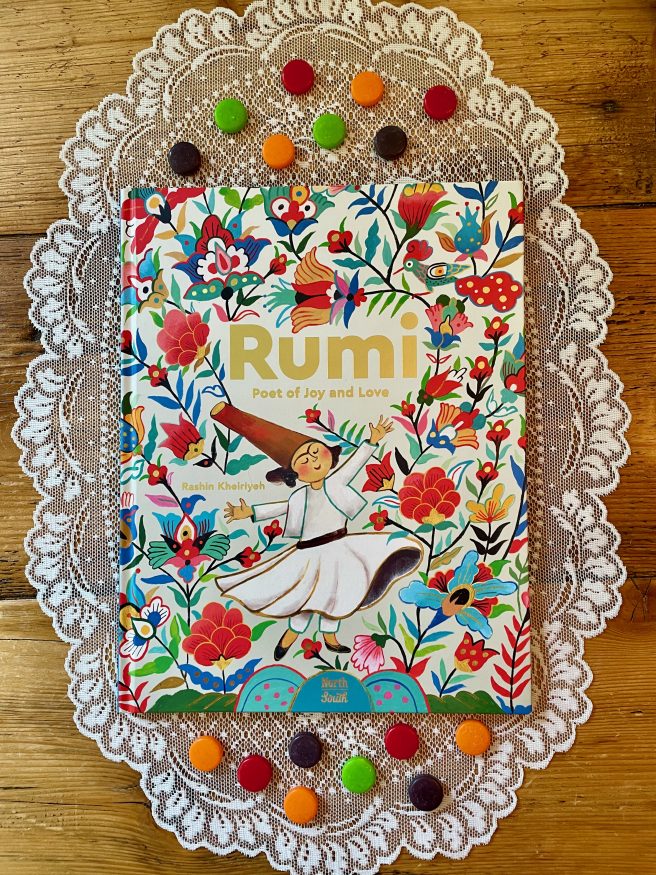
Can meeting the right friend change your life? Why is it important to share your story with others, and how is embracing everyone in love and friendship its own spiritual practice?
Whether through his relatable aphorisms or divine poetry, Rumi has touched us all. As one of the world’s most popular poets, this 13th century Persian scholar and Sufi mystic continues to teach, inspire, and open our hearts to humanity.
In her stunning picture book biography, Rumi: Poet of Joy and Love (NorthSouth Books, 2024), Iranian-American author-illustrator Rashin Kheiriyeh shows how a chance meeting with a stranger transformed an already revered scholar and theologian into a poet for the ages.

We first learn Rumi was born on “a crisp and colorful autumn day in Iran” (present day Afghanistan) on September 30, 1207. From the beginning he was a child of nature and reveled in the beautiful world around him. He chased butterflies and “delighted in the scent of roses and the songs of the birds.” Rumi especially loved to feed the birds; his favorite was the hoopoe, the symbol of wisdom.
Rumi’s father patiently answered his many questions, teaching his son all he knew. One day he shared these prescient words: “Learn generosity from the sun. It lights the world every day and asks for nothing in return.”
An avid reader, Rumi was excited one day to meet the great Persian poet Attar, who gifted him with a copy of his epic poem, “The Conference of the Birds.” Attar advised Rumi to “read it and search for the deeper meaning. One day you will shine and illuminate the world like the sun.”
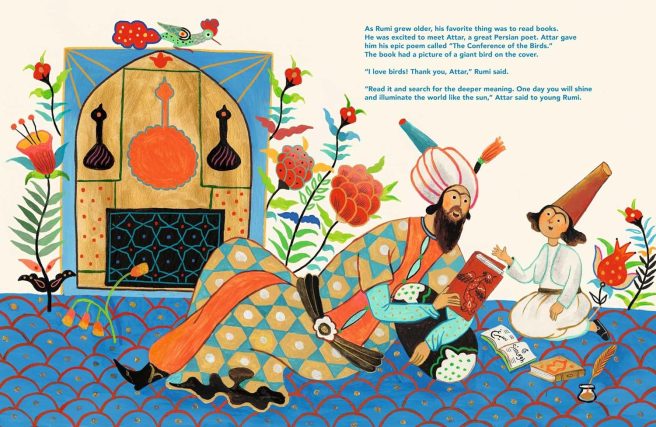
In Attar’s poem, hundreds of birds (including the hoopoe) travel many miles in search of the mythical bird Sīmurgh to serve as their king. Only thirty birds survived this arduous journey, realizing when they reached their destination that they were actually the Sīmurgh. When together, they flew as one giant bird.
Years later, after Rumi had moved to Turkey with his family, he followed in the footsteps of his father and grandfather, with followers from near and far eager to study with him.
By chance one day at a bazaar, Rumi encountered a stranger named Shams, a Persian spiritual teacher who traveled the world to find God and collect stories from all the people he met along the way. Now he was anxious to hear Rumi’s story.

The two soon became inseparable friends, talking incessantly for days and hours on end. “Rumi was inspired by Shams. Shams was the sun, shining in Rumi’s heart and mind.”
Though Rumi’s students were jealous of this new friendship, Rumi was thrilled, and danced Sama to thank God. “He raised his hands to the sky, spinning, spinning, spinning in a circle to celebrate unity and friendship.”
Eventually Rumi’s students drove Shams away. They wanted Rumi all to themselves. This left Rumi sad, silent and depressed. His students later regretted what they had done, but weren’t able to find Shams, who had seemingly disappeared.

Remembering Attar’s poem about the birds searching together, Rumi soon realized he was the Sīmurgh. “We are what we seek!” His mother then spoke to him in a dream, encouraging him to write and share his stories of friendship with everyone he loved. In this way, he would find what he was looking for.
So Rumi wrote for days and nights. His words merged letters “like drops of rain merge in the ocean.” He wrote his masterpiece “The Masnavi,” inspired by his friendship with Shams and everyday tales. People of all ages loved his book, which was translated into many languages. Rumi became one of the greatest writers of all time.

Rumi most loved sharing his stories with children. When he danced Sama to thank God, the children danced with him. Opening their arms and raising their hands to the sky, they spun around and around, flying like birds.
Kheiriyeh’s gorgeous acrylic paintings are resplendent with beauty, joy and whimsy. Referencing ornamental Persian motifs, designs, and symbols with a lush palette of blues, greens, oranges and golds, her artfully composed spreads immerse the reader in a world of magic, wonder and enchantment.

Just as Attar advised Rumi to “search for the deeper meaning,” I enjoyed considering the symbolism of Kheiriyeh’s chosen colors. Blue/turquoise is linked to holiness, transcendence, and the celestial realm. Yellow, the face of the sun, signifies wisdom and connection; while reds and oranges suggest love, power, and vitality. Green represents nature, paradise and life-giving water.
All these vivid colors adorn birds, flowers, clothing and architecture. Intricate patterns and textures on carpets, mosaic tiles, and painted walls add another layer of richness. In both text and images, Kheiriyeh illuminates the themes of sun, birds, love, and unity.
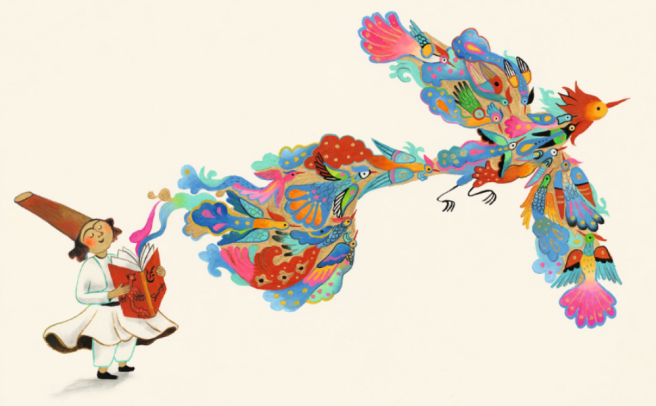
The theme of birds, in particular, is especially beautiful — from Rumi’s childhood love of the hoopoe, to Attar’s giant Sīmurgh, to the children with their circular dancing. Kids will enjoy finding the hoopoe in various spreads as it perches on musical instruments, atop young Rumi’s conical hat, even on decorative vessels and books.
The significance of the sun is also well drawn, from Rumi’s father first advising him to “learn generosity from the sun,” to Attar’s mention of it lighting the world, to Shams becoming Rumi’s sun, to Rumi soaring above the sun on hoopoe’s back, on his way to fulfilling Attar’s prophecy to one day “illuminate the world like the sun.”
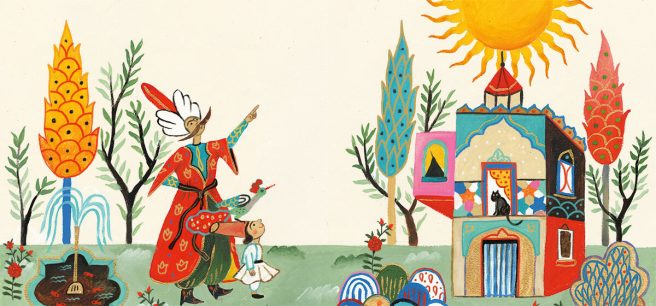
This book is a basic, appealing introduction to Rumi’s life and work. Readers will enjoy the fanciful, colorful illustrations and gain insight into the connection between love, communion and faith. They will also likely be curious to read some of Rumi’s poems and stories.
In her Author’s Note, Kheiriyeh explains how in Shams, Rumi found God in love. And though the concept of mysticism may be somewhat difficult to grasp, young readers will still be able to understand that the “best religion is to make friends with all the people of the world.” Rumi believed in embracing humanity with love, as all loves were a bridge to divine love.

Back matter also includes more biographical information, including an explanation of Sama (“listening”), the circular dance that’s part of the Sufi ceremony of meditation and prayer. Whirling dervishes are a fascinating aspect of the Sufi mystical journey, demonstrating the desire to achieve a personal union with the deity (a state of perfection/ecstasy).

So, can meeting the right friend change your life? Your despair at losing one may just spark a divine revelation: what you were seeking all along can be found in yourself. Rumi had internalized Shams. As Shams told Rumi, “Friendship is the bridge between you and everything.”
*

RUMI: Poet of Joy and Love
written and illustrated by Rashin Kheiriyeh
published by NorthSouth Books (March 2024)
Picture Book Biography for ages 4-8, 40 pp.
*Includes Author’s Note + Notes on Rumi’s Life
**Starred Reviews** from Kirkus and School Library Journal
*

♥️ Rashin’s book does not include any of Rumi’s poems, but here’s a favorite from The Essential Rumi, translated by Coleman Barks (HarperCollins, 1995). I like to imagine Rumi chanting, singing, dancing, and flying free.
WHERE EVERYTHING IS MUSIC

Don’t worry about saving these songs!
And if one of our instruments breaks,
it doesn’t matter.
We have fallen into the place
where everything is music.
The strumming and the flute notes
rise into the atmosphere,
and even if the whole world’s harp
should burn up, there will still be
hidden instruments playing.
So the candle flickers and goes out.
We have a piece of flint, and a spark.
This singing art is sea foam.
The graceful movements come from a pearl
somewhere on the ocean floor.
Poems reach up like spindrift and the edge
of driftwood along the beach, wanting!
They derive
from a slow and powerful root
that we can’t see.
Stop the words now.
Open the window in the center of your chest,
and let the spirit fly in and out.
*

The lovely, talented and entertaining Tracey Kiff-Judson is hosting the Roundup at Tangles & Tails. Sashay on over to check out the full menu of poetic goodness being served up around the blogosphere this week. Enjoy your weekend!
*Interior spreads text and illustrations copyright © 2024 Rashin Kheiriyeh, published by NorthSouth Books. All rights reserved.
**Copyright © 2024 Jama Rattigan of Jama’s Alphabet Soup. All rights reserved.
 Jama's Alphabet Soup
Ack! I just submitted orders yesterday–maybe there is room for one more! Beautiful book. I must have this one.
LikeLiked by 1 person
This looks amazing Jama! Definitely on my list!
LikeLiked by 2 people
Gorgeous artwork and such an interesting story line! I loved your review, Jama, and the additional information you added, including the underlying meanings of the color palate. I can’t wait to get a copy of this beauty!
LikeLiked by 2 people
This book 📖 looks delightful and charming, and I love her whimsical art, so magical, light, and uplifting! 💙the ending lines of “Where Everything is a music” Open the window in the center of your chest,
and let the spirit fly in and out.“ Yes!
Thanks for sharing this treasure Jama!
LikeLiked by 2 people
Thank you for this beautiful blogpost! Have a wonderful weekend!
LikeLiked by 1 person
This book looks gorgeous, I can’t wait to get my hands on it.
Thank you, Jama! xo
LikeLiked by 1 person
“best religion is to make friends with all the people of the world.” — I love this so much. That pb looks gorgeous. Thanks for the Rumi poem. That’s new to me, and I like it lots more than the ones I’ve read–which are fine, but just don’t light me on fire. (I know I’m the outlier in that one.)
LikeLiked by 1 person
I have mixed reactions to some of Rumi’s poems too — much depends on the translation.
LikeLike
Love the art! So colorful and joyful. Thanks, Jama!
LikeLiked by 1 person
Jama, since I am a Rumi lover, I was excited to read your post. As always, you never disappoint your readers. You not only showcased this beautiful book but provided interesting informqtion. Thank you for sharing this beautiful picture book.
LikeLiked by 1 person
Thanks for the kind words, Carol. It truly is a beautiful book. 🙂
LikeLike
Jama, what a beautiful book! Thank you for sharing about Rumi. “Rashin Kheiriyeh’s gorgeous acrylic paintings are resplendent with beauty, joy and whimsy.” You nailed that description. They are so wonderful.
The ending of the poem you share is so powerful, starting with: “Poems reach up like spindrift and the edge / of driftwood along the beach, wanting!” Poems reach up…wanting. So thought-provoking.
LikeLiked by 1 person
I was not familiar with Rashin’s books before I saw this one — lots of catching up to do as she has published so many. The illustrations in this Rumi book must be seen in person to be fully appreciated.
LikeLike
Stunning indeed! Wow. What a labor of (aptly) love.
“Open the window in the center of your chest,
and let the spirit fly in and out.”
Ah, so lovely.
LikeLiked by 1 person
I didn’t know much about Rumi’s life before reading this one. Fascinating stuff.
LikeLike
I love the idea that the best religion is to make friends with people all over the world. I also loved the last poem with the idea that even without instruments there is music all around us. This looks like a lovely book. Thanks Jama!
LikeLiked by 1 person
So so interesting, Jama! One of my neighbors was telling me about Sīmurgh recently. Thank you for this explanation. It was helpful/complementary to what she said.
LikeLiked by 1 person
Beautiful illustrations! Ill be bookmarking this post.
LikeLiked by 2 people