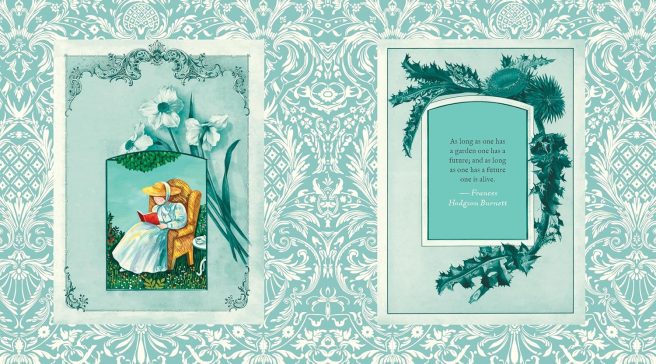
“As long as one has a garden one has a future; and as long as one has a future one is alive.” ~ Frances Hodgson Burnett

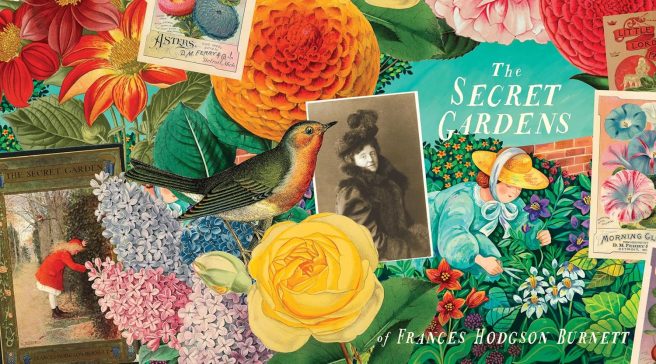
Since The Secret Garden has always been one of my favorite children’s books, I was especially excited to see Angelica Shirley Carpenter and Helena Pérez García’s recent picture book biography about Frances Hodgson Burnett.
Learning how Burnett coped with hardship and adversity in her own life shed new light on my appreciation of the novel. Now I understand why gardens were so important to her, not only as places of beauty and inspiration, but of comfort and healing. I also found it intriguing that she had a luxurious lifestyle that was shocking by Victorian standards (a twice divorced smoker who spent time away from her children). 🙂
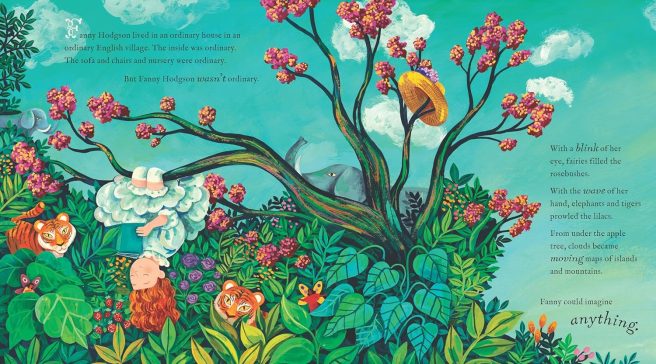
We first meet Fanny Hodgson as a girl who lived in “an ordinary house in an ordinary English village.” But Fanny herself was anything but ordinary because of her vivid imagination. In her world, “fairies filled the rosebushes” and “elephants and tigers prowled the lilacs.”
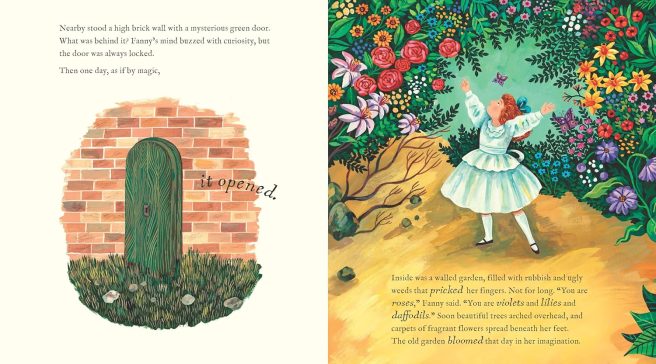
Her idyllic existence was upended when her father died (she was around six), and her family was forced to move to Manchester so her mother could run his store. The dull and grey city was a stark contrast to the beloved garden she’d left behind, but Fanny’s imagination sustained her, as she envisioned roses, violets, lilies and daffodils abloom in an old abandoned garden actually “filled with rubbish and ugly weeds.”
After a few years, her mother had to sell the store as businesses in Manchester failed. Short on money, Fanny’s family then relocated to a small village in Tennessee at the suggestion of her uncle, who thought her brothers could find work there. Unfortunately, they weren’t able to earn as much money as they’d hoped, so sometimes the family went hungry. Fifteen-year-old Fanny wanted to help, but there were no jobs for girls.
Undeterred, she put her imagination to work once again and invented her own job, opening the town’s first school. Her eight students paid with “cabbages, eggs, and potatoes,” and she read them Shakespeare. She also built a “secret room” in the woods behind her house, “weaving walls from branches and vines.”
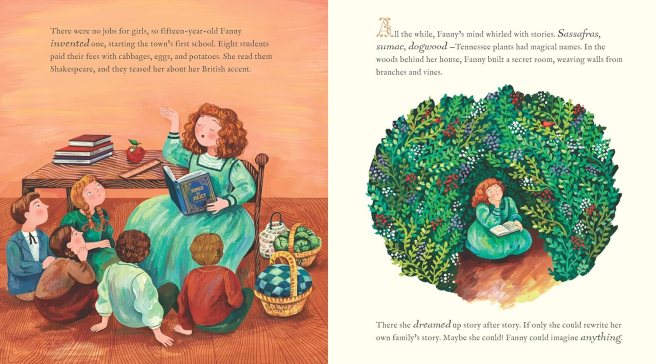
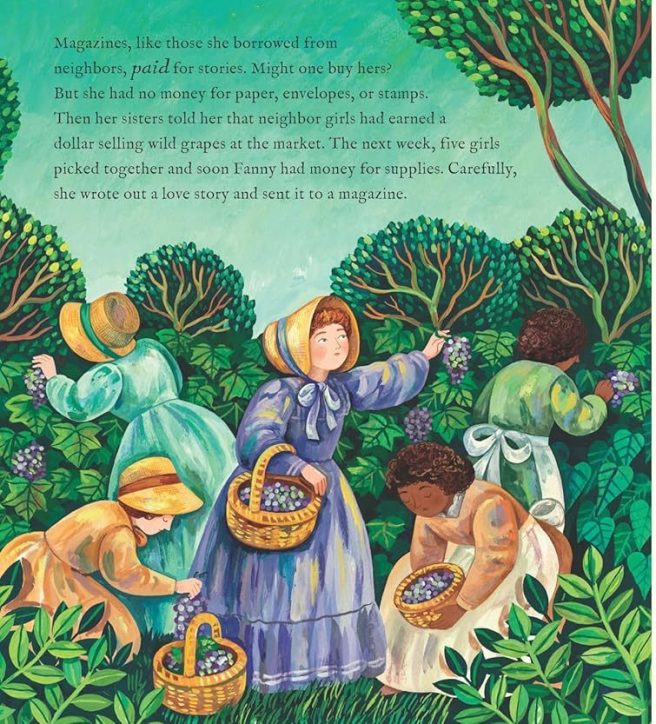
There, in her cozy sanctuary, she dreamed up stories. She knew that magazines paid for stories; could she sell one of hers? She earned money for writing supplies by picking and selling wild grapes at the market. She wrote a love story and sent it out — and to her surprise, sold it for thirty-five dollars — enough to feed her family for weeks!
“By the time she was nineteen, Fanny had sold enough stories to move her family to a large house in Knoxville.” Five years later, she married eye doctor Swan Burnett. They would eventually settle in Washington, D.C., with their two sons, Lionel and Vivian. Fanny supplemented Swan’s income by writing adult novels, reinventing herself as the author, “Frances Hodgson Burnett.”
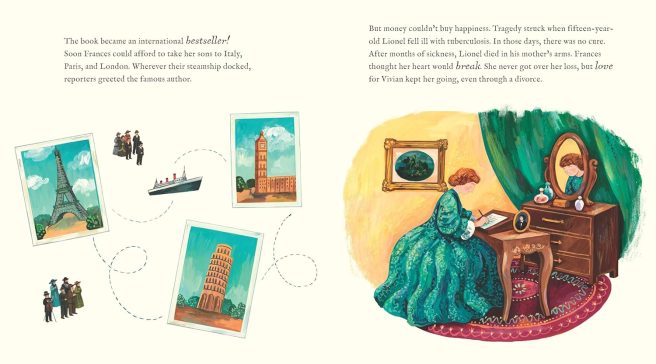
At Vivian’s suggestion, Burnett wrote her first children’s book, Little Lord Fauntleroy (1886), which became an international bestseller. Now Frances was able to take her sons to Europe, where the famous author was greeted by reporters everywhere.
“But money couldn’t buy happiness.” Frances was heartbroken when fifteen-year-old Lionel died of tuberculosis. Though she never got over this loss, her love for Vivian kept her going, even through her divorce.
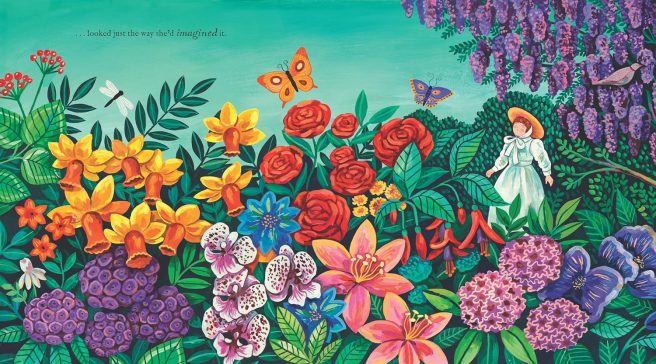
Eight years later, she rented a country estate called Maytham Hall in the South of England. Frances worked hard to transform a walled garden behind the house (that was a tangle of weeds) into the garden of her dreams. She pruned, weeded and dug, then planted bulbs, borders and three hundred rosebushes. By August her first garden looked just the way she had envisioned it.
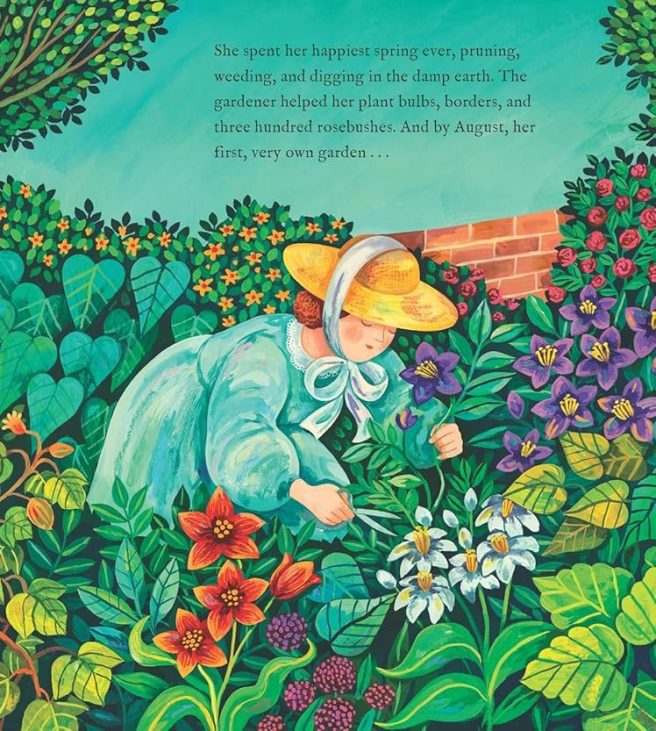
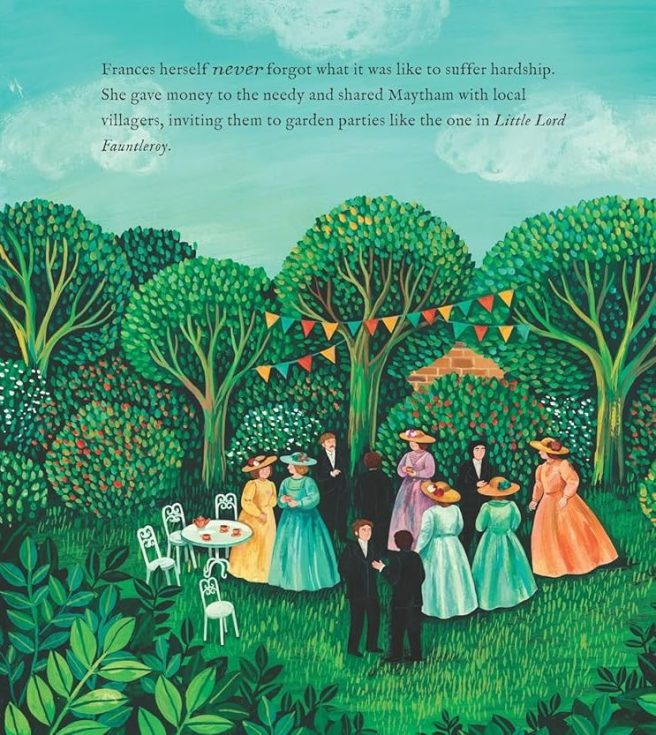
The garden became her outdoor study (a robin kept her company). There she wrote A Little Princess (1905), a story about a girl who used her imagination to forget her troubles. Frances never forgot what it was like to suffer hardship; she gave money to the needy and shared Maytham with local villagers, inviting them to garden parties.
Sadly, about ten years later Frances was forced to leave Maytham Hall because the owner had decided to sell it. She couldn’t afford to buy it, so she moved to a smaller home on Long Island, where she designed a smaller garden.
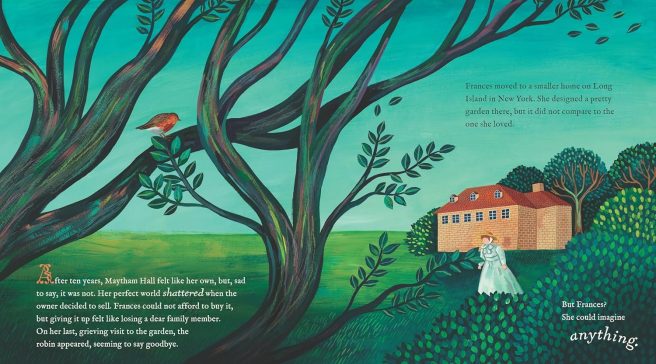
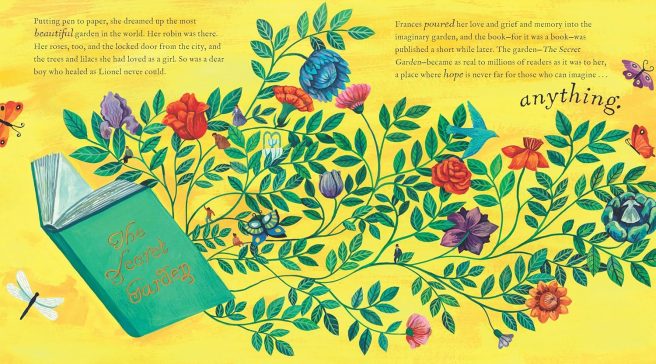
Though this garden couldn’t compare to Maytham’s, she was able to conjure up the most beautiful garden in the world while writing a new book. She included her robin friend, the lilacs and trees she’d loved as a girl, and a sick boy who was able to heal as Lionel never could.
“Frances poured her love and grief and memory into the imaginary garden, and the book . . . was published a short time later.” The Secret Garden (1911) became as real to millions of readers as it was to her, “a place where hope is never far for those who can imagine . . . anything.”
Young readers will enjoy Carpenter’s engaging narrative with its overriding themes of resilience, resourcefulness, renewal, and positive thinking. From her humble beginnings in England to the highest-earning woman in the United States, Hodgson proved time and again that her ability to adapt, meet challenges head on, and never lose hope enabled her to carve out a life on her own terms. How often do we read about a female author who was able to financially support her family (or even become rich) through her writing?
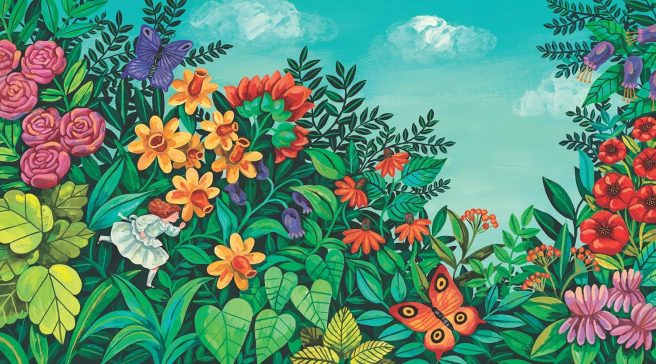
García’s lavish color-saturated illustrations are a joy to behold as she captures Hodgson’s adventurous transatlantic life in all its glory. We are invited into the story via a keyhole cutout on the front cover that sets the tone for stepping into pure enchantment — a life story about a daring girl who used her imagination to create her own reality.
The gorgeous endpapers are resplendent with colorful blooms and greenery, while the title page, epigraph and back matter feature frames and borders resembling vintage ephemera for an old-fashioned feel.
Kids will smile when meeting Fanny in the opening spread, for she’s hanging upside down from a branch, reading a book. With her curly red hair tumbling down, her facial expression is one of pure bliss, as she’s totally immersed in her own secret world.
It’s interesting to see the family store in Manchester and Fanny at various stages of her life: a young teacher reading to her class, a mother with two children, the famous author at her desk, the avid gardener cultivating her own Eden, the book lover peacefully reading under a leafy tree.
All the garden scenes are beautiful, and readers will enjoy identifying different flower species. The final double page spread showing a leafy, flowering branch springing from an open book brings the story full circle, only instead of fairies hiding in the bushes, there are tiny people perched on stems. Fun and fanciful!
Extensive back matter includes more info about Burnett, a detailed timeline, selected FHB titles for children and adults, a bibliography, and a special letter from Hodgson’s great-great-granddaughter, Keri Wilt, who shares nine keys to cultivating one’s imagination at any age.
A charming keepsake for Secret Garden fans of all ages, this book is an appealing introduction to the author of what is considered by some scholars to be “the most significant children’s book of the twentieth century.” I envy readers encountering this classic for the first time (in any of its many wonderful editions), because there is nothing more irresistible or empowering to a child than having a secret place of one’s own where magic lives and absolutely anything is possible.
*
🍒 FRUIT TEA LOAF ☕️
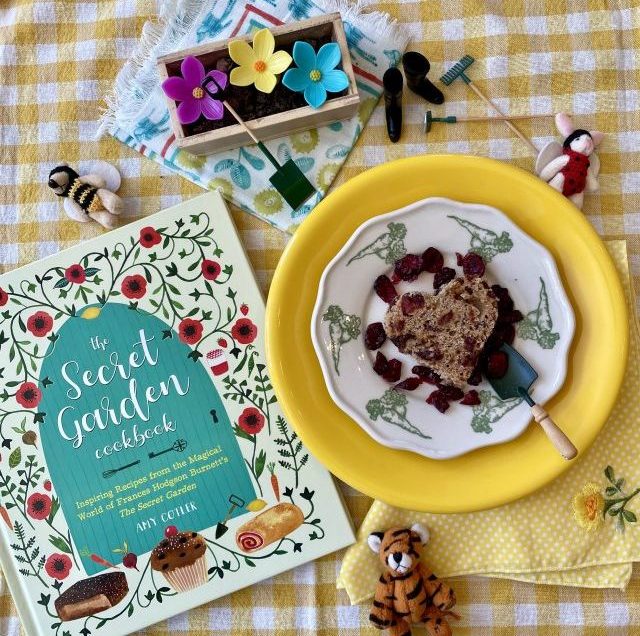
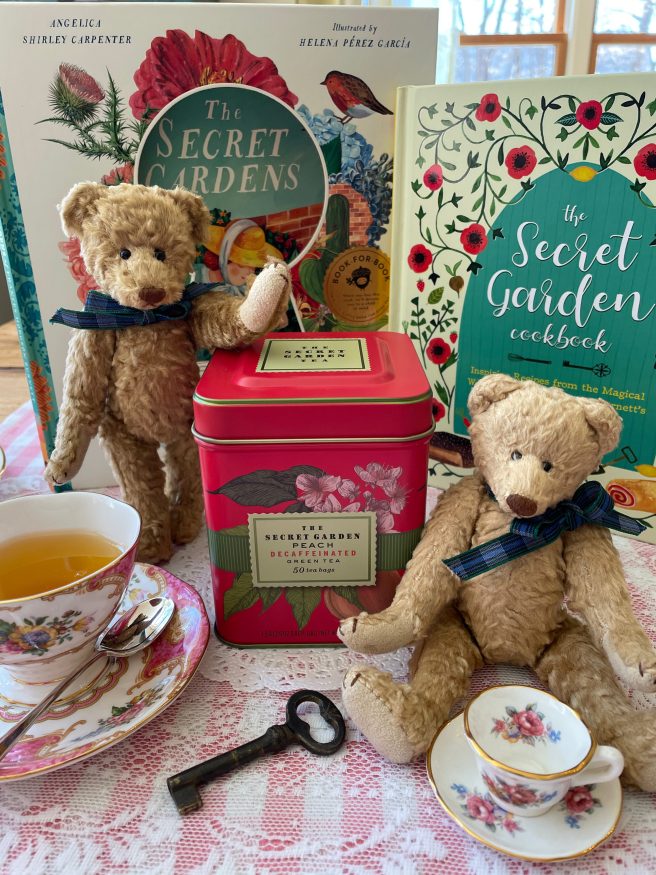
After learning that Frances Hodgson Burnett hosted garden tea parties at Maytham Hall, Basil and Cornelius declared they were hungry (what else is new?) and wanted to nibble on a traditional Yorkshire recipe.
We found just the thing in The Secret Garden Cookbook by Amy Cotler (Harvard Common Press, 2020). We had previously made Yorkshire Oatcakes and Cranberry Scones from this same book with good results, so this time we tried the Fruit Tea Loaf.
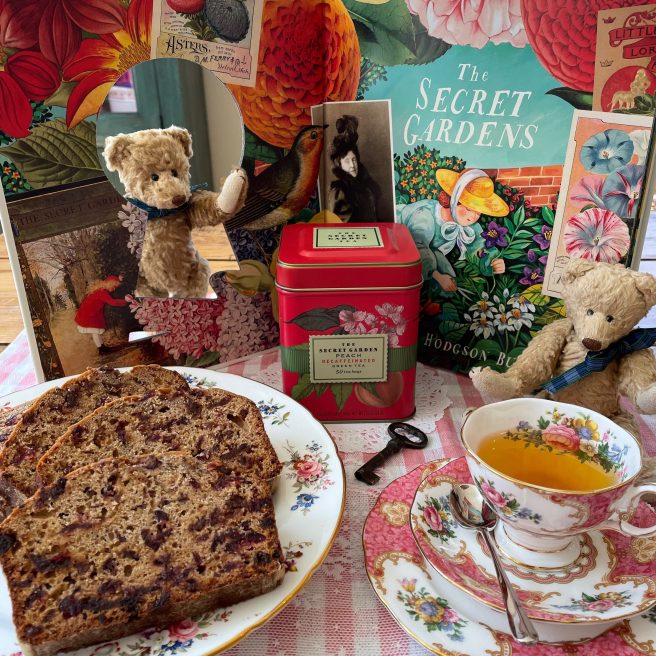
Not only was this bread good with tea, it also has tea in it! Yes, the recipe calls for two tea bags (we used Earl Grey) steeped in a cup of hot water, along with one’s choice of mixed dried fruit. We opted for cherries and reduced sugar cranberries, which made for a nice combination of textures.
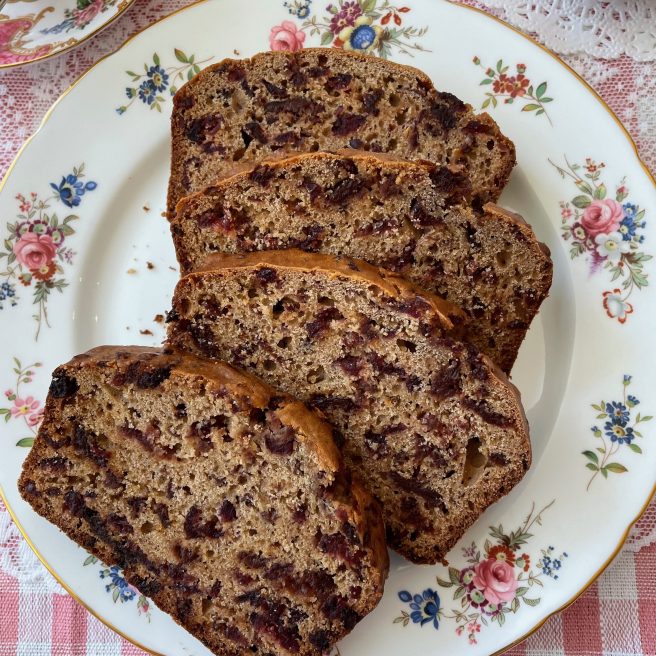
Tea breads such as this one are standard fare, something Mary Lennox would have known by its Yorkshire name, “Slow Walking Bread.” Perhaps it was given this name because it kept well on long trips and over a long period of time (it was also called “cut and come again cake.”).
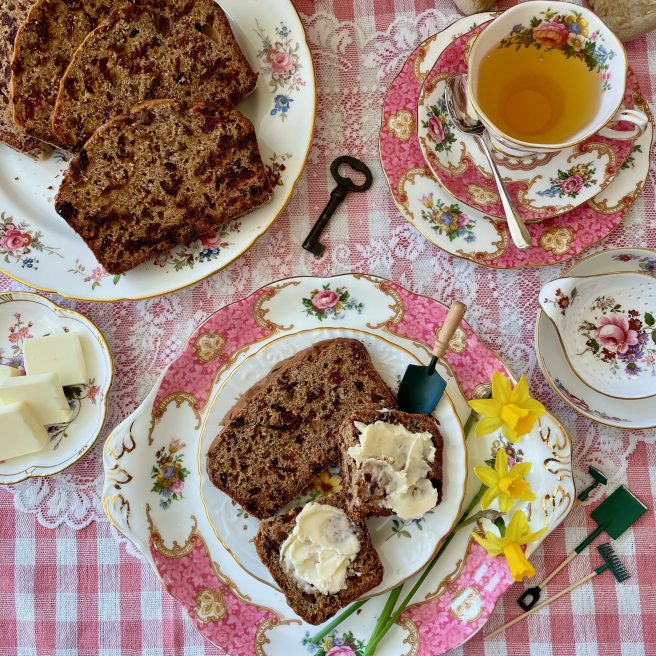
In any case, this dense, fruity bread is something that will hit the spot after spending a few chilly hours outdoors tending one’s garden or playing with Dickon’s animal friends.
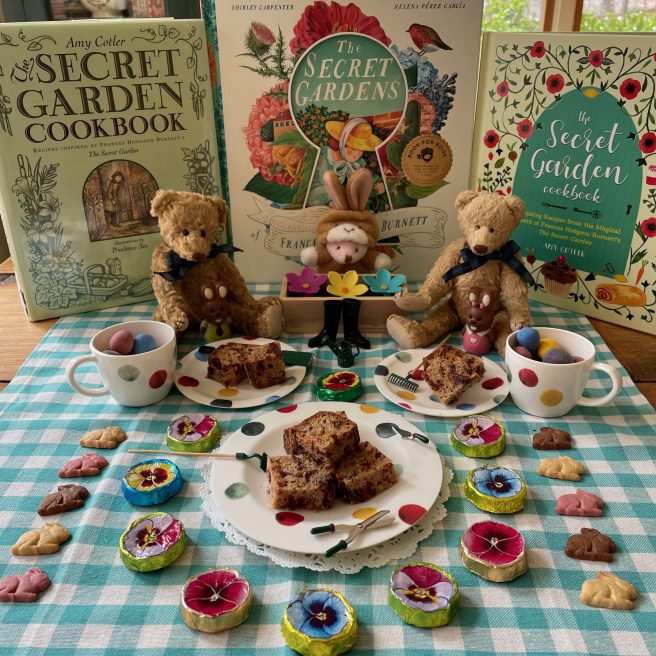
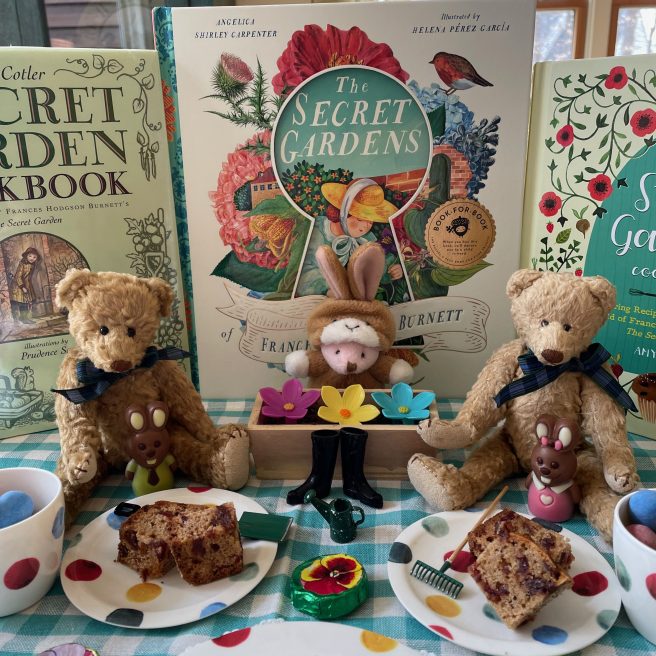
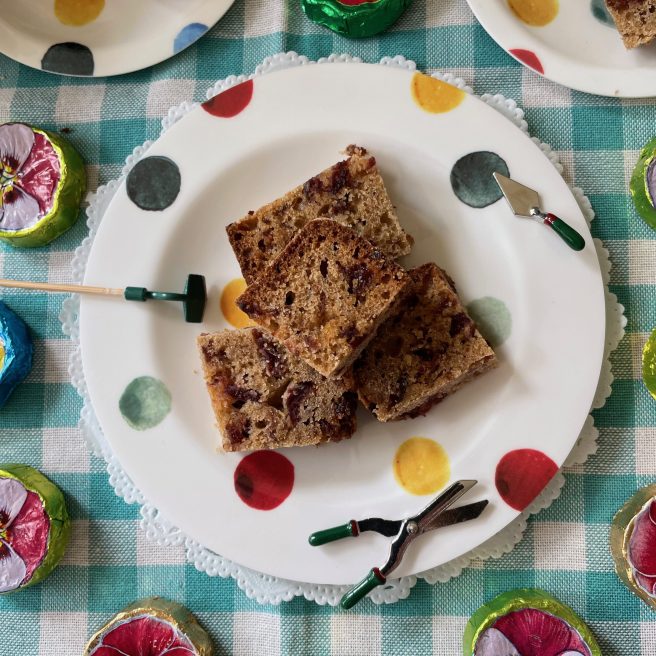
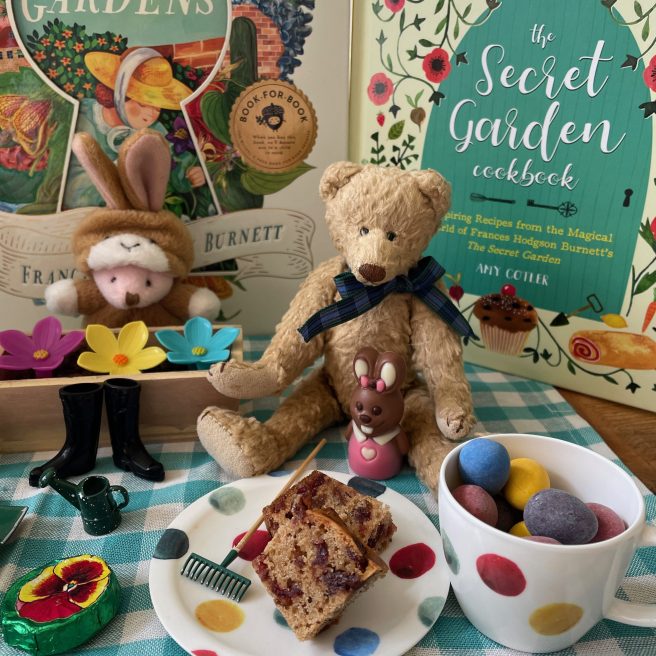
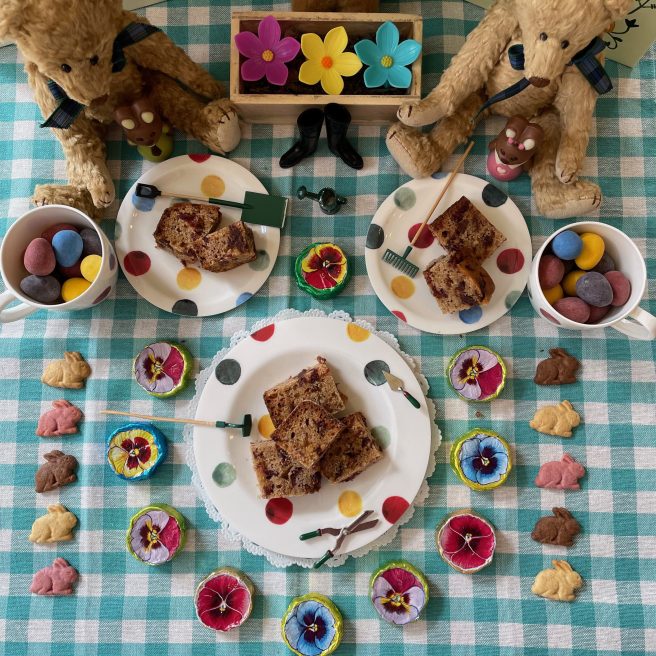
Basil and Cornelius happily scarfed down a couple of slices while sipping Secret Garden Decaf Peach Green Tea, only wishing they could become friends with Mary, Colin, Dickon, and the friendly robin. This tea bread is good as is or toasted with butter, and would make a nice addition to your Easter brunch table. 🙂
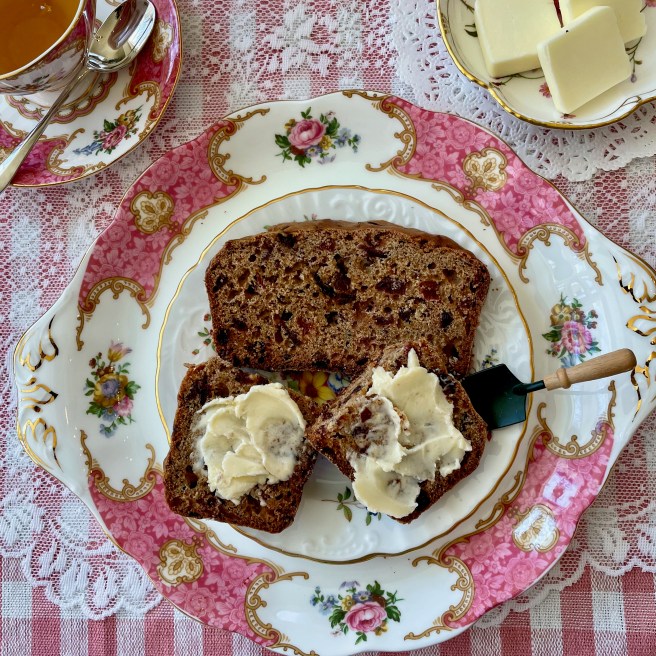
Fruit Tea Loaf
Ingredients
- 1 cup water
- 2 black tea bags, preferably Earl Grey or chai
- 2 cups mixed dried fruit such as cranberries, cherries, or black or golden raisins
- 2 cups plus 2 tablespoons all-purpose flour, divided
- 2/3 cup dark brown sugar
- 1/4 cup unsalted butter, at room temperature
- 2 eggs
- 1 teaspoon baking powder
- 1/2 teaspoon baking soda
- 1/2 teaspoon salt
Directions
- Preheat the oven to 350 degrees F. Butter a loaf pan, line with parchment paper, then butter again.
- Bring the water to a simmer in a small pan, add the tea bags, then turn off the heat and let the tea steep until very strong, about 10 minutes. Remove the tea bags and set aside.
- Put the dried fruit and 1/2 cup flour into a food processor and pulse several times, just until chopped. Set aside.
- Combine the brown sugar and butter in a large bowl with a mixer or wooden spoon until creamy. Blend in the eggs, then sift the remaining 1-1/2 cups plus 2 tablespoons flour with the baking powder, baking soda, and salt into the bowl. Mix to combine. Blend in the fruit mixture and the tea.
- Pour the batter into the prepared loaf pan. Bake for about 1 hour, or until a toothpick inserted into the loaf comes out with just a few crumbs sticking to it. When cool enough to handle, invert the loaf pan onto a cooling rack and remove the parchment paper. Turn right side up. Slice when cool.
*
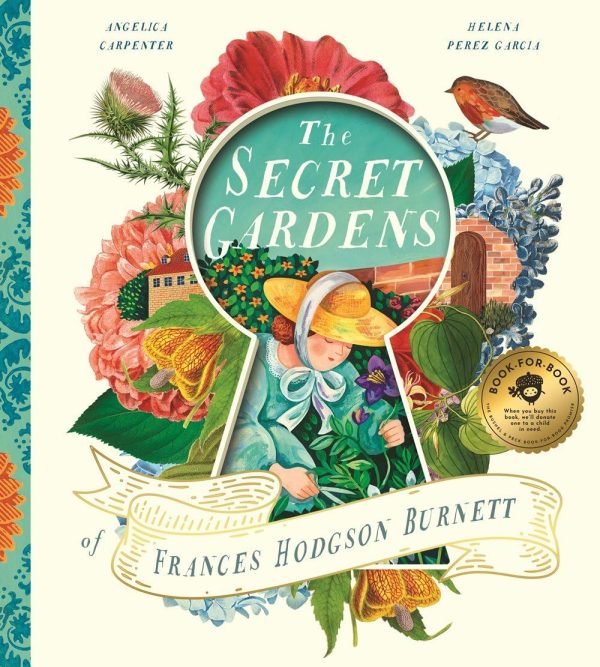
THE SECRET GARDENS OF FRANCES HODGSON BURNETT
written by Angelica Shirley Carpenter
illustrated by Helena Pérez García
published by Bushel & Peck Books, July 2024
Picture Book Biography for ages 4-8, 40pp.
*includes Biographical End Note, Timeline, Selected FHB Titles for Children and Adults, Bibliography, and How to Cultivate Your Imagination Letter from Keri Wilt
**Starred Review** from Foreword Reviews
***Publisher will donate a copy to a child in need for every book sold.
*
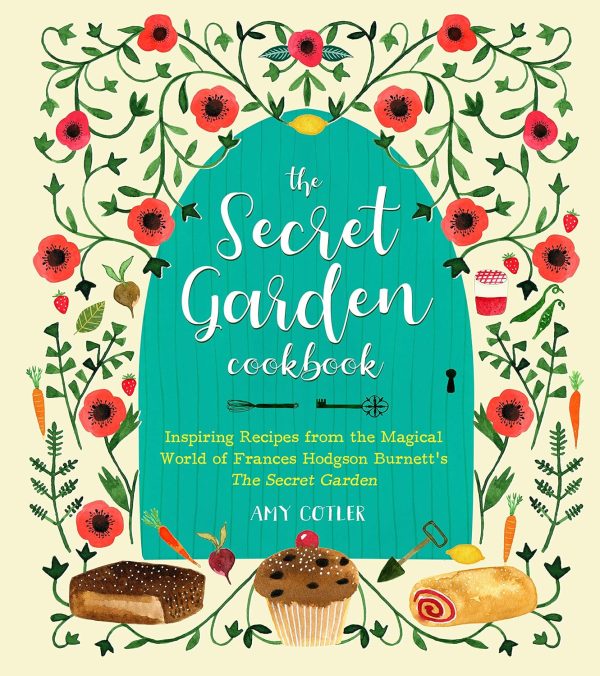
THE SECRET GARDEN COOKBOOK: Inspiring Recipes from the Magical World of Frances Hodgson Burnett’s The Secret Garden
written by Amy Cotler
published by Harvard Common Press (revised edition), 2020
Literary Cookbook, 112 pp.
*
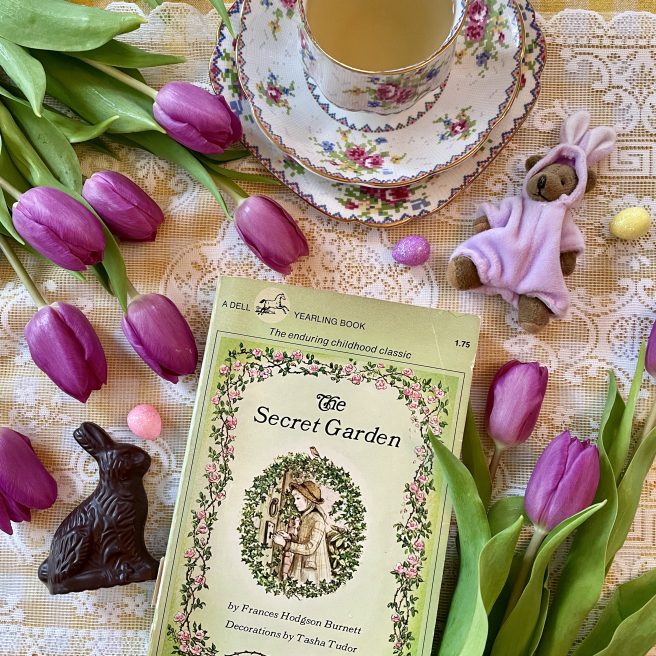
♥️ More Secret Garden posts at Alphabet Soup:
The Secret Garden (Part Two) Yorkshire Culinary Delights
Celebrating Colin Firth’s Birthday with Two Treats from The Secret Garden Cookbook
*

🐇 Happy Easter Week! 🐣
🌿 May you find joy and peace in this season of growth, renewal, and rebirth.🌷
*Interior spreads text copyright © 2024 Angelica Shirley Carpenter, illustrations © 2024 Helena Pérez García, published by Bushel & Peck Books. All rights reserved.
**Copyright © 2025 Jama Rattigan of Jama’s Alphabet Soup. All rights reserved.
 Jama's Alphabet Soup
Such vibrant colors in this beautiful book!
LikeLiked by 1 person
Such a good read. I grew up reading these kinds of books. They had such a realism about them, never shying away from human suffering or life’s sometimes harsh reality. But it’s good for the human experience, to give one hope, courage and strength because adversity will always come. Thank you! 😃🎉👍
LikeLiked by 1 person
Thanks for stopping by to read!! Glad you enjoyed the post. 🙂
LikeLiked by 1 person
I’m in love with this post. The Secret Garden was a breakthrough book for me and has a permanent corner in my heart. I have never used tea as an ingredient before. Sounds interesting. I can’t wait to get my hands on this book! Thanks for the recommendation.
LikeLiked by 1 person
Feel the same about The Secret Garden. I couldn’t detect a noticeable tea flavor in the bread — maybe it’s just there to balance out the sweetness.
LikeLike
This post made my day. I was privileged to see The Secret Gardens of Frances Hodgson Burnett become real from first draft to glorious picture book and I’m so glad you are sharing it with your followers. It certainly shows the power of imagination.
LikeLiked by 1 person
That’s cool to be able to see the progress from first draft to finished ms! Didn’t Angelica write another biography of FHB? I think I saw it listed in the bibliography.
LikeLike
Yes, she wrote a middle grade biography and edited a collection of essays on Frances Hodgson Burnett but I haven’t read them. I think I’ll put them on my “to read” list.
LikeLiked by 1 person
Beautiful book. I’m going to have to pick it up! Thank you.
LikeLiked by 1 person
Delightful👏👏👏
LikeLiked by 1 person
What a beautiful book and story. Happy Easter week and Passover week to all!🐣🐇🐰❤️
LikeLiked by 1 person
What a lovely book and what a lovely post. Thanks!
LikeLiked by 1 person